
TL;DR:
- Israeli wealth management law provides a comprehensive legal framework governing inheritance, trust creation, taxation, and corporate asset structuring for international clients. Understanding these statutes is crucial for effective estate planning, asset protection, and cross-border wealth transfer in Israel, which imposes no inheritance tax but applies capital gains tax on asset sales. Proper legal strategies involve compliant wills, trusts, and corporate structures, with early consultation and coordination with foreign counsel crucial for success.
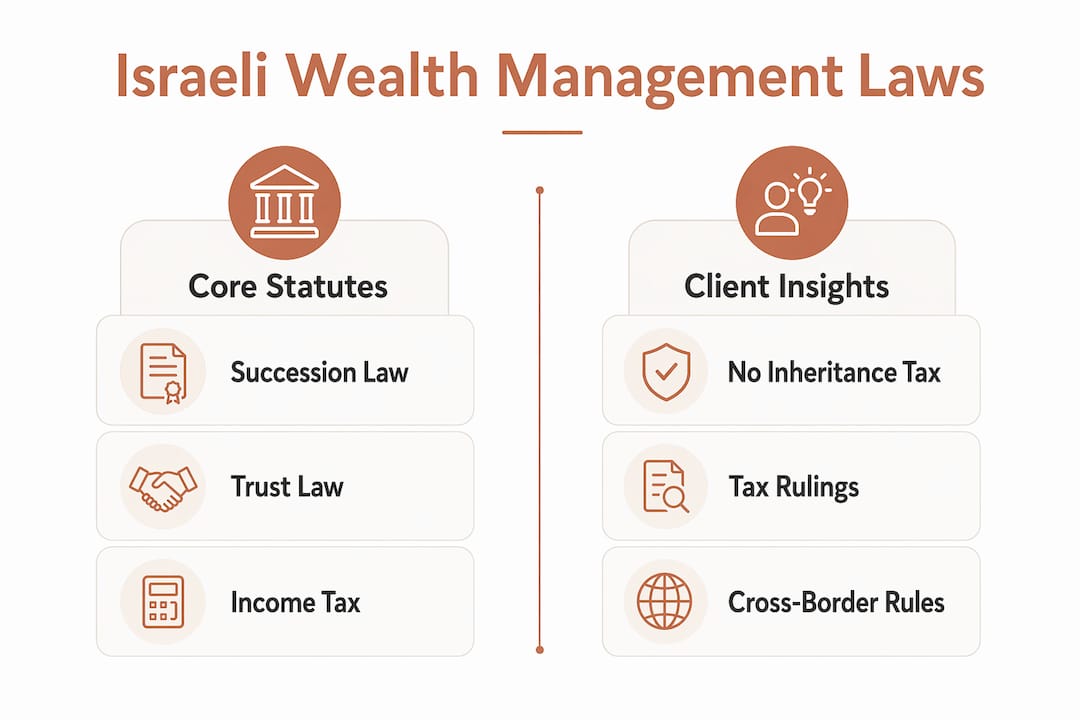
Israeli wealth management law is the comprehensive legal framework governing inheritance, asset protection, taxation, and fiduciary arrangements for anyone holding assets in Israel. If you are an international investor, a foreign heir, or a new immigrant managing wealth across borders, understanding this framework is not optional. It directly determines how much tax you pay, how your assets transfer to the next generation, and whether your estate plan holds up under Israeli scrutiny. The role of Israeli wealth management law centers on four core statutes: the Succession Law 5725-1965, the Trust Law 5739-1979, the Income Tax Ordinance 5721-1961, and the Companies Law 5759-1999. Menora Law works with international clients every day to translate these laws into practical, protective strategies.
What are the key legal statutes governing wealth management in Israel?
Israeli wealth management is built on four statutes that collectively regulate estates, trusts, taxation, and corporate vehicles. Each one plays a distinct role, and they interact in ways that can either protect your wealth or create unexpected liability if you ignore them.
The Succession Law 5725-1965 governs how assets pass at death. It sets out rules for valid wills, intestate succession, and the probate process through the Registrar of Inheritance or the Family Court. Without a valid Israeli will, your assets distribute according to statutory default rules that may not reflect your wishes.
The Trust Law 5739-1979 establishes the legal basis for creating and administering trusts in Israel. It defines fiduciary duties, the rights of beneficiaries, and the conditions under which trust assets are managed. Trusts formed under this law can be inter vivos (created during your lifetime) or testamentary (created through a will), and they can be revocable or irrevocable depending on your planning goals.
The Income Tax Ordinance 5721-1961 is where most international clients encounter complexity. It governs how trust income, capital gains, and asset transfers are taxed. The Ordinance classifies trusts by the residency of the settlor and beneficiaries, which determines the applicable tax regime.
The Companies Law 5759-1999 becomes relevant when corporate vehicles are used to hold trust assets or structure family wealth. An underlying company declared as a trust asset holder can combine the flexibility of a trust with the legal certainty of a corporate structure.
Here is a quick reference to the four pillars:
- Succession Law 5725-1965: Governs wills, intestate succession, and estate administration
- Trust Law 5739-1979: Establishes fiduciary duties, trust creation, and beneficiary rights
- Income Tax Ordinance 5721-1961: Regulates taxation of trusts, capital gains, and transfers
- Companies Law 5759-1999: Enables corporate vehicles for wealth structuring and asset holding
One fact that surprises many international clients: Israel imposes no inheritance or estate tax. This is a significant advantage compared to many Western jurisdictions. However, capital gains tax applies when inherited assets are sold, so the absence of an estate tax does not mean the transfer is entirely tax-free. Proper legal planning, including obtaining a tax ruling, can limit exposure to capital gains rather than the full inheritance value.
Pro Tip: If you hold Israeli real estate or securities, request a tax ruling from the Israeli Tax Authority before completing any transfer. This ruling locks in the tax treatment and prevents disputes later.
How does Israeli law facilitate inheritance and intergenerational transfers?
Intergenerational wealth transfer under Israeli law follows a structured process that rewards early planning. The primary mechanisms are wills, gifts, trusts, and estate distribution agreements, each with distinct tax and control implications.
Drafting a valid Israeli will. A will is the foundation of any estate plan. Under the Succession Law, a will must meet formal requirements: it can be handwritten, witnessed, or notarized. A poorly drafted will can be contested or declared invalid, sending the estate through intestate succession rules instead. For foreign residents, a will that complies with both Israeli law and the law of the country where assets are located provides the strongest protection.
Using gifts during your lifetime. Transferring assets as gifts while you are alive avoids probate entirely. The trade-off is immediate loss of control. Gifts of Israeli real estate trigger acquisition tax for the recipient and may trigger capital gains tax for the donor, so the timing and structure of the gift matters considerably.
Establishing a trust for generational control. Trusts in Israel can include restrictive conditions, such as prohibiting the sale of a family property for a set number of years or limiting distributions until beneficiaries reach a certain age. This makes trusts the preferred tool when you want to transfer assets but retain some governance over how they are used.
Applying the step-up basis for foreign assets. When a foreign heir inherits assets held abroad and brings them into the Israeli tax system, the step-up cost basis mechanism creates a new acquisition cost equal to the asset’s value at the time of inheritance. This can dramatically reduce capital gains tax when those assets are eventually sold, because the taxable gain is measured from the stepped-up value rather than the original purchase price.
Executing an estate distribution agreement. When multiple heirs are involved, a formal distribution agreement signed by all parties and approved by the court provides legal certainty. It prevents one heir from later challenging the allocation and protects the executor from personal liability.
Preparing an enduring power of attorney. This document appoints a trusted person to manage your financial and personal affairs if you become incapacitated. Without one, a court-appointed guardian takes over, which is slower, more expensive, and less predictable.
Tax professionals consistently stress the decisive impact of where an inheritance is realized, urging integration of international tax and family law to optimize asset transfer value. This is not abstract advice. A family that inherits Israeli real estate while residing in Germany faces a completely different tax calculation than one residing in Canada, and the planning strategy must account for both jurisdictions.
Pro Tip: Prenuptial agreements and family mediation protocols, drafted before disputes arise, are among the most cost-effective tools in Israeli estate planning. They define asset ownership clearly and reduce the risk of litigation that can consume a significant portion of an estate.
What are the cross-border considerations under Israeli wealth management law?
Cross-border wealth planning under Israeli law presents specific challenges that domestic planning does not. Israel’s legal system relies on its own private international law rules rather than multilateral conventions for most cross-border matters.

The table below summarizes the key cross-border frameworks and their practical implications:
| Framework | Status in Israel | Practical Impact |
|---|---|---|
| Hague Apostille Convention (1961) | Israel is a signatory | Foreign documents with an apostille are recognized for legal proceedings |
| Hague Trust Convention (1985) | Israel is not a signatory | Foreign trusts are not automatically recognized; local enforcement applies |
| Common Reporting Standard (CRS) | Israel participates | Financial accounts of foreign residents are reported to their home tax authority |
| FATCA | Israel has an intergovernmental agreement | Israeli financial institutions report accounts held by relevant foreign nationals |
| Double Taxation Treaties | Israel has treaties with over 50 countries | Reduces risk of paying tax twice on the same income or gain |
Israel’s position on the Hague Trust Convention is the most consequential gap for international clients. A trust validly created under English or Jersey law does not carry automatic legal recognition in Israel. Israeli courts apply domestic law to determine whether the arrangement is enforceable, which can produce unexpected results if the trust was not structured with Israeli law in mind from the start.
Tax residency classification is equally critical. The Income Tax Ordinance classifies trusts into four categories: Israeli resident trusts, foreign beneficiary trusts, relatives’ trusts, and testamentary trusts. Each category carries different tax treatments, including different rules for taxable income, reporting obligations, and withholding requirements. Getting the classification wrong at the outset can result in years of incorrect tax filings and significant penalties.
For non-residents and new immigrants, the use of an underlying company declared as a trust asset holder offers a practical solution. This structure is tax transparent under Israeli law, meaning the company itself is not taxed as a separate commercial entity. It simplifies administration and provides legal certainty without triggering the complexities of full commercial company governance.
Coordinating with foreign counsel is not optional in these situations. An Israeli attorney who understands the interaction between Israeli law and the client’s home jurisdiction can identify conflicts before they become disputes. Menora Law regularly works alongside foreign legal teams to deliver coordinated cross-border estate plans that hold up in multiple jurisdictions simultaneously.
What asset protection strategies does Israeli wealth management law enable?
Asset protection under Israeli law is built primarily around trusts, underlying companies, and careful fiduciary governance. Each tool serves a different purpose, and the most effective plans combine more than one.
Fixed-interest trusts give named beneficiaries a defined entitlement to income or capital. They provide certainty but limited flexibility. Discretionary trusts give the trustee authority to decide how and when to distribute assets among a class of beneficiaries. This flexibility makes discretionary trusts harder for creditors to attach, because no single beneficiary has a fixed claim on the assets at any given time. Spendthrift trusts go further, explicitly restricting a beneficiary’s ability to assign their interest or have it seized by creditors.
The trustee’s legal duty under the Trust Law 5739-1979 is central to all of these structures. A trustee must act in the best interests of the beneficiaries, keep trust assets segregated from personal assets, maintain proper records, and avoid conflicts of interest. Breach of these duties exposes the trustee to personal liability. This is why selecting a qualified, independent trustee, rather than a family member with no legal training, is one of the most important decisions in trust planning.
The comparison below shows how trusts and underlying companies differ as asset protection vehicles:
| Feature | Trust | Underlying company |
|---|---|---|
| Legal recognition in Israel | Governed by Trust Law 5739-1979 | Governed by Companies Law 5759-1999 |
| Tax transparency | Depends on classification | Tax transparent when declared as trust asset holder |
| Creditor protection | Strong for discretionary trusts | Strong when properly structured |
| Administrative complexity | Moderate | Lower for non-residents |
| Flexibility for non-residents | Good | Excellent |
Israel allows the use of an underlying company declared as a trust asset holder to combine trust flexibility with company legal certainty. This is particularly beneficial for non-resident estate planning because it avoids the need for a trustee to hold assets directly in their own name, which can create complications when the trustee is also a foreign national.
Ongoing compliance is not a one-time task. Trusts and underlying companies must file annual reports with the Israeli Tax Authority, disclose changes in beneficiaries or trustees, and maintain documentation that supports the tax classification. Failure to comply can result in the trust being reclassified, which changes the tax treatment retroactively.
Pro Tip: Review your trust’s beneficiary and trustee details every three to five years. Changes in residency, marriage, or the birth of new family members can shift the trust’s tax classification under Israeli law without any formal action on your part.
For a deeper look at how these strategies apply to family wealth, Menora Law’s guide on Israeli asset protection covers practical scenarios in plain language.
Key takeaways
Israeli wealth management law provides a structured, statute-based framework that international clients must understand before making any decisions about inheritance, asset protection, or cross-border transfers involving Israeli assets.
| Point | Details |
|---|---|
| No inheritance tax, but capital gains applies | Israel imposes no estate tax, but selling inherited assets triggers capital gains tax without proper planning. |
| Four core statutes govern everything | The Succession Law, Trust Law, Income Tax Ordinance, and Companies Law work together to regulate all wealth management activity. |
| Trust classification determines tax treatment | Residency of the settlor and beneficiaries defines which tax regime applies, affecting reporting and withholding obligations. |
| Cross-border plans require dual-jurisdiction coordination | Israel does not recognize foreign trusts automatically, making coordination with foreign counsel a practical necessity. |
| Underlying companies simplify non-resident planning | A company declared as a trust asset holder is tax transparent and reduces administrative complexity for foreign clients. |
Menora Law’s perspective on Israeli wealth management for international clients
From our experience working with international clients on Israeli estates and wealth structures, the single most common mistake is treating Israeli law as an afterthought. Clients often arrive with a trust or estate plan drafted entirely under foreign law, assuming it will function the same way in Israel. It usually does not.
The interaction between Israeli tax classifications and foreign residency rules is where plans break down most often. A trust that is tax-efficient under one jurisdiction’s rules can trigger full Israeli income tax liability if the settlor or a beneficiary becomes an Israeli resident, even temporarily. We have seen this happen with new immigrants who did not update their trust documentation before their aliyah date.
What actually works is integrated planning that combines Israeli inheritance law, tax law, and family law from the start. This means drafting wills that comply with Israeli formal requirements, selecting trustees who understand their fiduciary duties under Israeli law, and obtaining tax rulings before transfers rather than after. It also means building in review cycles, because Israeli tax law changes, and a structure that was optimal five years ago may carry unnecessary risk today.
The clients who manage their Israeli wealth most effectively are the ones who engage qualified Israeli legal counsel early, maintain open communication with their advisors in other jurisdictions, and treat compliance as an ongoing commitment rather than a one-time filing. Menora Law provides remote representation for clients based anywhere in the world, which means geography is never a reason to delay getting proper advice.
For foreign residents dealing with Israeli inheritance and succession, the legal framework is manageable with the right guidance. The law rewards preparation and penalizes delay.
— Menora Law
How Menora Law helps international clients with Israeli wealth planning
Menora Law specializes in Israeli inheritance, estate administration, trust structuring, and cross-border wealth planning for international clients. Whether you are managing an inherited Israeli property from abroad, structuring a trust for the next generation, or working through a probate process in Israel, the firm provides personalized legal strategies backed by deep knowledge of Israeli financial regulations and estate law.
Menora Law offers remote representation and fast international communication, so distance is never a barrier to getting the right legal support. The firm’s attorneys work directly with clients across multiple time zones and coordinate with foreign counsel when cross-border matters require it. If you are ready to protect your assets and plan your estate under Israeli law, explore Menora Law’s Israeli inheritance law guide or review the firm’s 2024 estate law resource to get started.
Kontak Menora Law today for a tailored consultation.
Gereelde vrae
Does Israel have an inheritance or estate tax?
Israel does not impose an inheritance or estate tax. However, capital gains tax applies when inherited assets are sold, and obtaining a tax ruling in advance can limit exposure to the gain rather than the full asset value.
How are trusts taxed in Israel?
Israeli trusts are classified by the residency of the settlor and beneficiaries into four categories, each with different tax treatments covering taxable income, reporting obligations, and withholding requirements. Getting the classification right at the outset is critical to avoiding retroactive tax liability.
Are foreign trusts recognized under Israeli law?
Israel is not a signatory to the 1985 Hague Trust Convention, so foreign trusts are not automatically recognized. Israeli courts apply domestic private international law to determine enforceability, which means foreign trusts must be structured with Israeli law in mind to function reliably.
What is an underlying company in Israeli trust planning?
An underlying company is a corporate entity declared to the Israeli Tax Authority as the holder of trust assets. It is tax transparent under Israeli law, meaning it is not taxed as a separate commercial entity, and it simplifies administration for non-resident clients by combining trust flexibility with corporate legal certainty.
What documents are needed for cross-border estate planning in Israel?
A valid Israeli will, an enduring power of attorney, and any foreign documents bearing a Hague Apostille are the core requirements. Coordination with Israeli legal counsel to align these documents with the Succession Law 5725-1965 and the applicable tax classification is the most reliable way to protect your estate across jurisdictions.


 English
 Afrikaans
 العربية
 বাংলা
বাংলা Čeština
 简体中文
简体中文 Nederlands
 Suomi
Suomi Français
 Deutsch
 עִבְרִית
 हिन्दी
 Magyar
 Italiano
 日本語
日本語 한국어
한국어 Polski
 فارسی
فارسی Português do Brasil
 Русский
 Español de México
 Українська