
If you are licensing software into or out of Israel, three things determine whether your agreement will hold up: your license terms need to track Israeli statutory language, your data-transfer clauses need to satisfy Israeli privacy rules, and your signature process needs to match the value and risk of the deal. Software is legally treated as a literary work under Israeli Copyright Law, and certain legal specialists help foreign companies and investors get these three pieces right from the start.
TL;DR:
- Software licenses must align with Israeli statutory language, especially regarding rights to reproduce, distribute, and modify, to withstand legal challenges.
- Registering trademarks and patents related to software before disputes arise strengthens enforceability under Israeli law.
- License agreements should specify data transfer obligations, security standards, breach notifications, and consent requirements to comply with Israeli privacy rules.
- Certified electronic signatures are recommended for high-value contracts, while simple signatures suffice for routine or short-term deals, with explicit mention in the agreement.
- Clarifying jurisdiction, governing law, and dispute resolution clauses is essential to avoid costly conflicts, especially when enforcement involves Israeli courts or arbitration.
How Israeli law treats software: copyright, authorized copies, and why registration still matters
Under the Israel Copyright Law, 2007, software is classified as a literary work. That single classification carries real weight: it means the owner automatically holds exclusive rights to reproduce the code, distribute it, and make it available to the public, without any registration step required. For a foreign licensor, this is good news and a trap at the same time. Good news, because you do not need to file anything in Israel to hold copyright. A trap, because many foreign companies assume that since copyright is automatic, no further legal work is needed. It is not that simple.
The law also defines what counts as an “authorized copy,” and it carves out statutory exceptions that a license agreement cannot override. Licensees are generally permitted to:
- Make a backup copy for archival purposes.
- Fix errors when doing so is necessary for the software to function as intended.
- Make adaptations needed for the software to work with their own systems.
A license that tries to strip these rights away entirely may run into enforceability problems, since contract terms need to work alongside statutory exceptions rather than against them.
Israeli law grants automatic copyright protection to software the moment it is created, but that protection alone does not guarantee an easy win in a dispute. The Israel Patent Office recommends that companies treat trademark and patent registration as a strategic move, not an afterthought. Registration gives documented evidence of ownership and priority, which matters if enforcement is needed in an Israeli court. If software will be sold, licensed, or defended commercially in Israel, marks and any patentable elements should be registered before disputes arise, not after.
Essential clauses checklist for an Israeli-law software license
A license agreement that reads well in another jurisdiction often falls apart in Israel because it skips terms that Israeli courts expect to see clearly defined. Build your agreement around these clauses, in roughly this order:
- Definitions of licensed rights. Spell out reproduction, distribution, making available to the public, and derivative works, tied to the language the Copyright Law actually uses.
- Scope and territory. State exactly where and how the software may be used, for how long, and how many copies are permitted.
- Modification and backup rights. Confirm what the licensee may do without violating the license, consistent with the statutory exceptions covered above.
- Sublicensing rules. Either prohibit it outright or set clear conditions, since silence invites disputes later.
- IP ownership reservation. State plainly that the licensor retains all rights not expressly granted.
- Operational terms. Cover maintenance, updates, escrow arrangements, acceptance testing, audit rights, and export-control compliance.
- Dispute resolution and governing law. Choose Israeli law and an Israeli forum or arbitration seat if enforcement in Israel is likely.
- Commercial terms. Fees, payment schedules, liability caps, warranties, and indemnities, calibrated to what Israeli courts will actually enforce.
Pro Tip: Draft your definitions section first and tie every other clause back to it. Vague definitions are the single most common reason license disputes drag on in Israeli courts.
Data protection and cross-border transfers: what Israeli rules require and what clauses work
Software licenses rarely stop at code. They usually involve some flow of data, whether that is user information, telemetry, or business records, and Israeli privacy rules govern how that data can leave the country. Article 3 of the Privacy Protection Regulations addresses the transfer of data to a database abroad, and the Privacy Protection Authority has clarified that an Israeli data controller can transfer data abroad when it secures adequate written guarantees from the recipient. Safeguards at the level of GDPR or similar contractual assurances are commonly accepted as sufficient.
For a foreign licensee receiving data from an Israeli counterparty, or a foreign licensor whose software processes Israeli user data, your license agreement should include:
- Processor obligations that spell out how data may be used, stored, and deleted.
- Subprocessor rules requiring written consent before data moves further down a supply chain.
- Breach-notification timelines so the Israeli party knows exactly when and how it will be told of an incident.
- Security-standard references consistent with Article 15 obligations for outsourced processing.
- Audit and cooperation language giving the Israeli controller the ability to verify compliance.
Where multiple subprocessors are involved, a chain-of-transfer clause that requires written consent before each onward transfer keeps the whole arrangement inside the PPA’s expectations rather than testing their limits.
Remote execution and electronic signatures: which signature type to use and when
Israel’s Electronic Signature Law, 2001 recognizes three tiers of electronic signature: general, secure, and certified. Certified signatures, issued by an approved certification authority registered with the Registrar of Certifying Authorities, carry the strongest evidentiary weight and are the safest choice for high-value agreements or any document where Israeli law expects a stronger form of execution. A general electronic signature, such as a typed name or a basic click-to-accept, is usually adequate for lower-stakes agreements or fast-moving commercial arrangements.
- Use a certified signature for licenses involving significant revenue, exclusive rights, or long-term commitments.
- Use a general or secure signature for routine amendments, non-disclosure agreements, or short-term pilot arrangements.
- Specify the signature type directly in the signature block so there is no ambiguity later.
- Preserve the audit trail: timestamps, IP data, and the signing platform’s records.
Pro Tip: Naming the certification authority in the signature block is a small step that removes a common argument in Israeli litigation over whether a signature was properly executed.
Negotiation tips and red flags: clauses that commonly cause disputes in Israel
Several recurring clauses cause friction once a license is in force. Watch for:
- Vague scope of license that does not specify permitted copies, users, or environments.
- Overly broad assignment of moral rights, which Israeli law treats differently from economic rights.
- Missing or unclear backup and modification provisions that conflict with statutory exceptions.
- Weak or absent data-transfer guarantees.
- Undefined sublicensing chains with no consent requirement.
- Unlimited or poorly capped indemnities that expose either party to open-ended liability.
When negotiating, take these steps:
- Localize the choice-of-law clause to Israel if you expect to enforce the agreement here.
- Use definitions tied directly to Israeli statutory language rather than importing terms from another jurisdiction’s template.
- Insist on precise remedies rather than broad, open-ended damages language.
- Use escrow or staged acceptance testing to reduce the risk of a technical dispute derailing the whole deal.
- Define liability caps clearly and require insurance where the exposure justifies it.
A license that leaves these points loosely worded rarely causes trouble on day one. It causes trouble eighteen months later, when the parties disagree about what “authorized use” actually meant.
Step-by-step guidance on drafting and registering software licenses
Getting a software license right in Israel is a sequence, not a single drafting session. Start by identifying which Israeli statutory rights actually apply to your software, since a generic license template built for another market will miss the copyright, exception, and data-transfer terms Israeli law expects. Next, draft the core clauses covered above, definitions, scope, modification rights, sublicensing, and IP reservation, using language that mirrors the Copyright Law rather than translating a foreign template word for word.
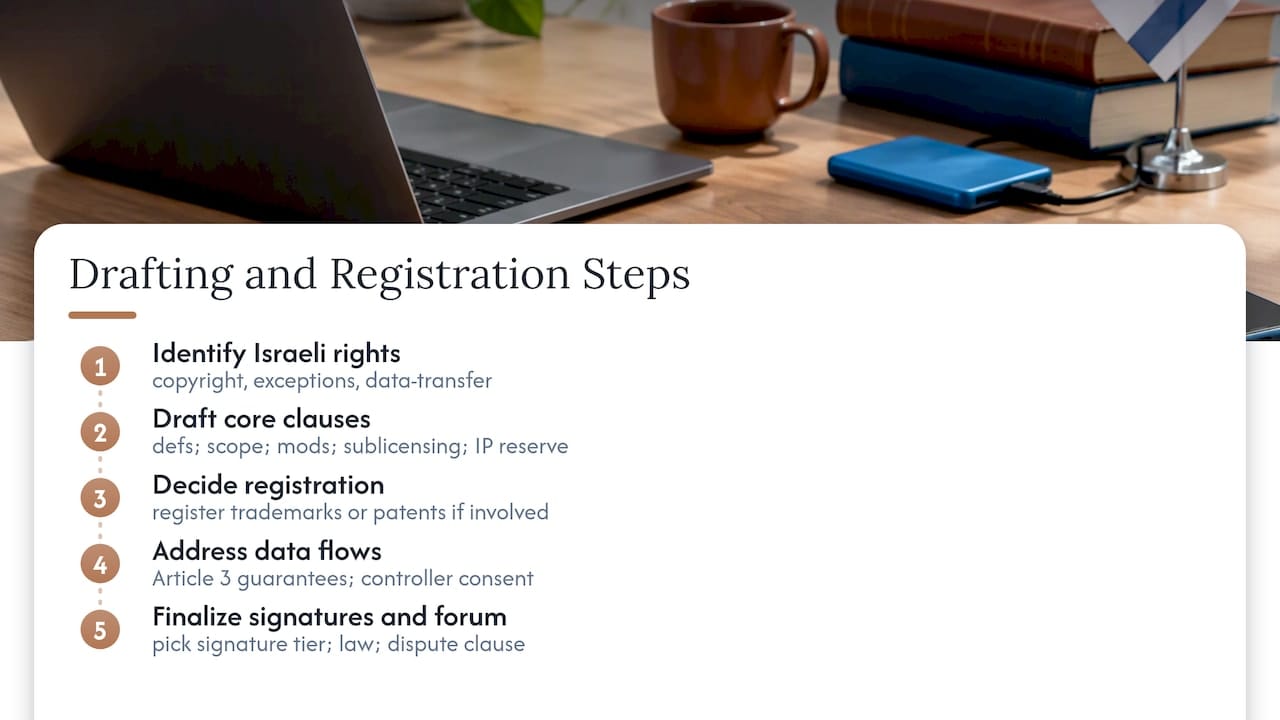
Once the draft is stable, decide whether registration strengthens your position. Copyright protection is automatic, so there is no registration step for the software code itself. But if your license involves a trademark, a distinctive product name, or a patentable technical process, register those with the Israel Patent Office before the license is signed, since registered rights are easier to enforce and easier to prove in a dispute than unregistered ones.
Address data flows before execution, not after. If the software will process data belonging to an Israeli party, build in the Article 3 guarantees and processor obligations described earlier, and confirm the Israeli controller’s written consent where the regulations require it.
Finally, choose your signature tier deliberately and finalize the governing law and dispute resolution clauses. A license that is well drafted but silent on jurisdiction, or signed with the wrong signature tier for its value, creates avoidable risk. Foreign companies that work through these steps with counsel familiar with Israeli statutory language typically avoid the most common enforcement disputes.
Recent Israeli case law on software licensing disputes
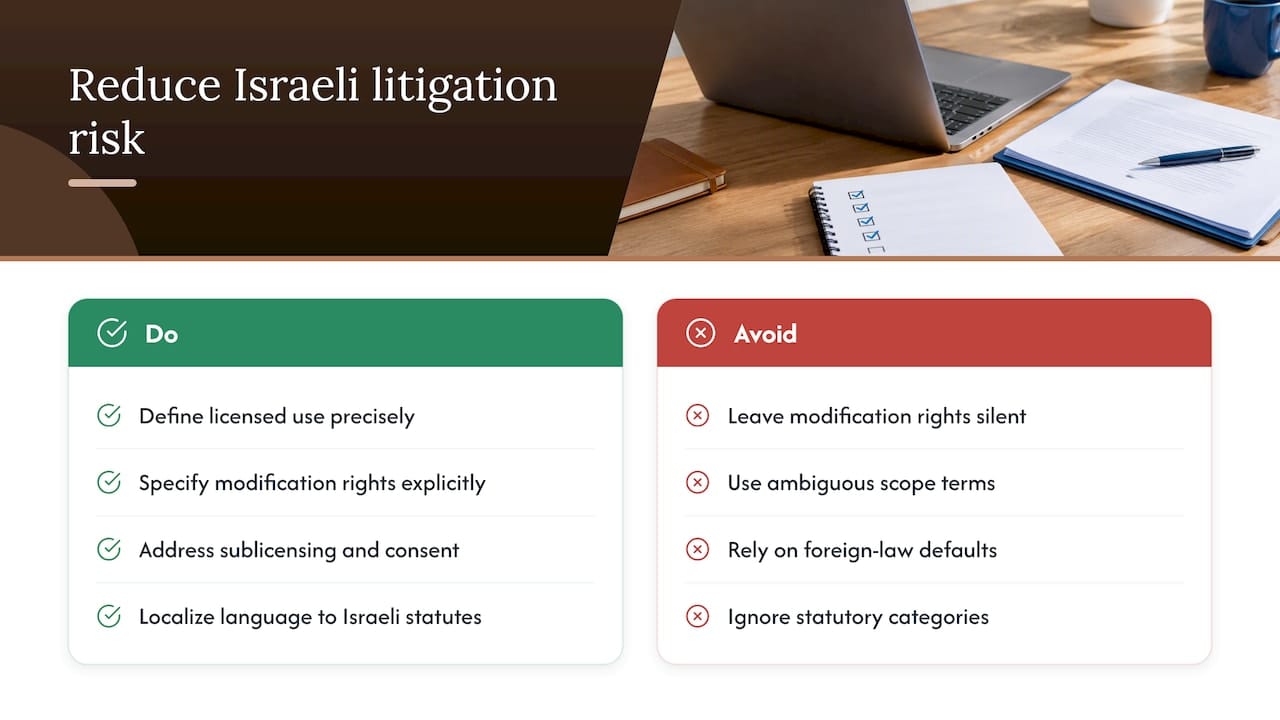
Israeli courts have repeatedly treated the boundary between licensed use and unauthorized copying as a factual question that turns on the specific wording of the license agreement, which is exactly why precise definitions matter so much. Disputes involving foreign licensors commonly center on whether a licensee’s use exceeded the scope defined in the contract, whether modifications fell inside the statutory exceptions for necessary adaptation, and whether sublicensing occurred without proper consent.
Because software is treated as a literary work, courts apply general copyright doctrine alongside the specific statutory exceptions discussed earlier. This means a license silent on modification rights leaves room for a licensee to argue that its changes were “necessary adaptations” permitted by law, even where the licensor intended a stricter reading. Foreign parties who litigate in Israel without having localized their contract language often find the statutory default fills in gaps in ways they did not anticipate.
The practical lesson for foreign licensors is straightforward: the more precisely your agreement tracks the statutory categories, the less room a court has to import its own interpretation of what the parties “must have meant.” Ambiguity favors whichever party can construct the more sympathetic factual narrative at trial, not necessarily the party with the stronger commercial position.
Dispute resolution and jurisdiction for enforcing a software license in Israel
When a software license involves an Israeli party, or is intended to be enforced against assets or conduct in Israel, the agreement should say plainly which forum handles disputes. Israeli courts will generally respect a properly drafted choice-of-law and choice-of-forum clause, provided it is clear and was agreed to by both sides. Arbitration is a common alternative, particularly for cross-border technology deals where both parties prefer a private, faster process over public litigation.
Jurisdictional questions become more complicated when the licensor is based abroad and the licensee operates only in Israel, or vice versa. Courts look at where the harm occurred, where the software was used, and where the relevant data or servers are located. A license that fails to address this directly leaves the question open to argument, which is costly and slow.
For foreign companies, the safer path is to name Israel as the governing law and forum whenever enforcement in Israel is a realistic possibility, and to pair that with an arbitration clause specifying rules and a seat if either party prefers to avoid Israeli court litigation. Either approach works, but the agreement has to choose one deliberately rather than leaving it to be litigated later.
Menora Law: how we help foreign clients license software under Israeli law
Some law firms focus on Israeli law for international clients, and software licensing is one of the areas where that focus matters most. They draft license terms that track Israeli statutory language, negotiate with Israeli counterparties on clients’ behalf, register trademarks and patents where enforcement is likely, and build data-transfer guarantees into agreements to satisfy Article 3 expectations. Typical engagements start with a review of an existing license or a term sheet, move through drafting or negotiation, and end with a signed agreement built to hold up in an Israeli court if tested. For international companies and developers not based in Israel, that local grounding is often the missing piece.
Contact Menora Law for Israeli-law licensing, IP registration and cross-border compliance
If you are drafting or negotiating a software license that touches Israel, getting the statutory language right from the outset saves far more time and money than fixing it after a dispute starts. Menora Law works remotely with clients around the world, so you do not need to travel to Israel to get this done properly.
We can help you with:
- Drafting and reviewing Israeli-law software license agreements.
- Registering trademarks and patents to strengthen your enforcement position.
- Building data-transfer and privacy clauses that satisfy Israeli requirements.
- Advising on the right electronic-signature tier for your agreement.
For readers who also need guidance on AI-specific licensing patterns and cross-border data processing, Chief Legal Office’s AI industry guidance is a useful complementary resource. To move forward on your own agreement, reach out to Menora wet for a consultation, remote or on-site, and we will walk you through exactly what your license needs.
This article is general information, not a substitute for advice from a qualified lawyer. Consult a qualified legal professional about your own circumstances before acting on anything here.
Sources
Gereelde vrae
Is software automatically protected by copyright in Israel?
Yes. Under the Israel Copyright Law, 2007, software is classified as a literary work and receives automatic copyright protection without any registration requirement. Registering related trademarks or patents still strengthens your position if you expect to enforce your rights in Israel.
Which type of electronic signature should I use for a software license?
It depends on the value and risk of the agreement. A certified electronic signature, recognized under Israel’s Electronic Signature Law, offers the strongest evidentiary weight for high-value deals, while a general electronic signature is usually sufficient for routine agreements.
Can I transfer data from Israel to my company abroad under a software license?
Generally yes, provided you secure adequate written guarantees, as described in the PPA’s Article 3 guidance. GDPR-level safeguards or comparable contractual assurances are commonly accepted, but the specific clauses need to be drafted carefully.
Do I need to register my software copyright in Israel before licensing it?
No, copyright protection is automatic under Israeli law and does not require registration. Registering a trademark or patent tied to the software is still worthwhile if enforcement or commercial launch in Israel is likely.
How does Menora Law help foreign companies with software licensing in Israel?
Some legal practices draft and negotiate software license agreements under Israeli law, register related IP rights, and build data-transfer and signature provisions into contracts for international clients. These firms can work remotely with clients abroad, so an in-person visit to Israel may not be required.
— Menora Law


 English
 Afrikaans
 العربية
 বাংলা
বাংলা Čeština
 简体中文
简体中文 Nederlands
 Suomi
Suomi Français
 Deutsch
 עִבְרִית
 हिन्दी
 Magyar
 Italiano
 日本語
日本語 한국어
한국어 Polski
 فارسی
فارسی Português do Brasil
 Русский
 Español de México
 Українська