
TL;DR:
- An Israeli limited company, or Chevra Prutit, is a legal entity that protects shareholders’ personal assets from company debts.
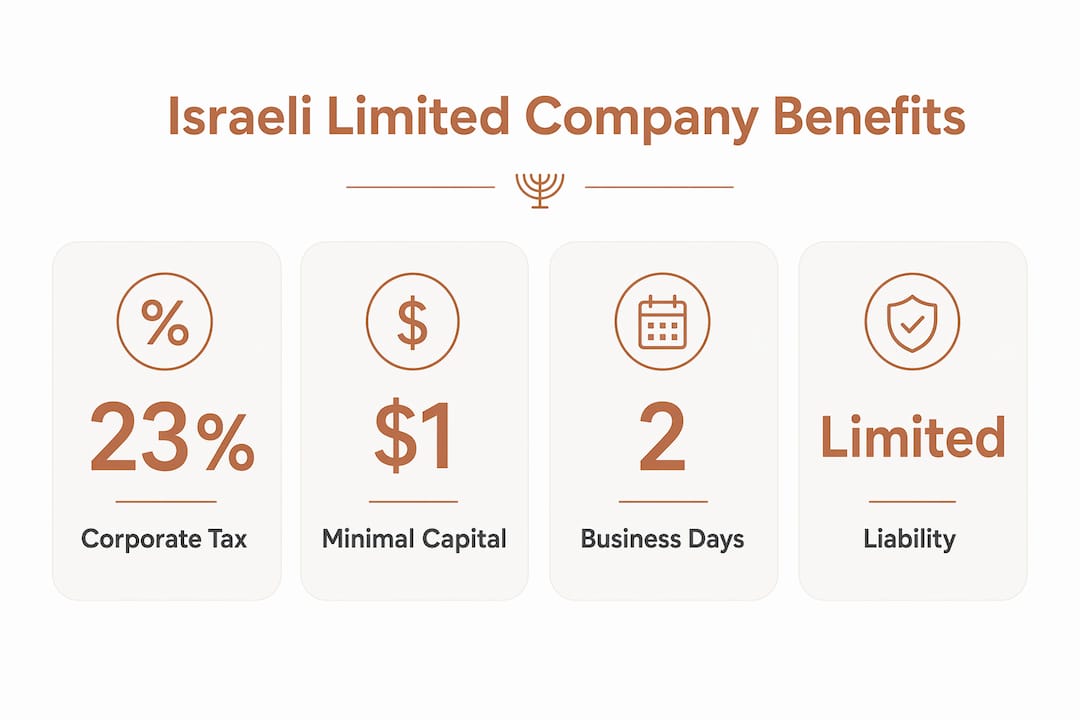
- It offers flexible ownership, no minimum share capital, and a fixed 23% corporate tax rate in 2026.
- Registering typically takes one to two business days, but opening a bank account may require local support and patience.
An Israeli limited company, formally known as a Chevra Prutit, is a distinct legal entity under Companies Law, 5759-1999, where shareholders’ personal assets are fully protected from company debts. This structure is the most common choice for foreign investors and entrepreneurs entering the Israeli market. It combines flexible ownership, no minimum share capital requirement, and a fixed corporate tax rate of 23% as of 2026. If you are weighing your options for setting up a business in Israel, understanding this entity type is the right place to start.
What is an Israeli limited company and how is it defined?
An Israeli limited company is a private limited liability corporation that exists as a legal person separate from its owners. That separation is the foundation of everything. It means the company can own property, sign contracts, sue, and be sued in its own name, completely independent of the people who own shares in it.

The formal term in Hebrew is Chevra Prutit, and it is governed by the Companies Law, 5759-1999. This law defines the rights of shareholders, the duties of directors, and the rules for how the company operates day to day. Foreign entrepreneurs and investors consistently choose this structure because it offers liability protection and flexible ownership without the heavy regulatory burden that comes with a public company.
One detail that surprises many first-time founders: there is no minimum share capital required by law. A nominal capital of $1 is legally sufficient to incorporate. That makes entry accessible, though the practical costs of setup, including legal and administrative fees, average around $8,000.
What are the legal requirements and registration steps?
Registering an Israeli limited company is a straightforward process when you prepare correctly. The Registrar of Companies, operating under the Ministry of Justice, handles all incorporation filings.
ال registration process breaks down into these steps:
- Choose a company name. Submit two or three name options to the Registrar. The name must be unique and not misleading.
- Draft the Articles of Association. This document defines the company’s purpose, share structure, and internal governance rules.
- Gather identification documents. All shareholders and directors must provide valid government-issued ID or passport copies.
- Submit to the Registrar of Companies. Filing can be done online through a licensed professional or in person. The Registrar issues a certified incorporation certificate upon approval.
- Register for taxes. After incorporation, register with the Israel Tax Authority for VAT and income tax files, and with the National Insurance Institute. These registrations typically complete within hours or a few days.
- Open a corporate bank account. This step requires patience. More on that below.
The incorporation timeline is typically 1 to 2 business days when all documents are properly prepared. That speed is one of Israel’s genuine advantages for entrepreneurs.
Pro Tip: Work with a licensed Israeli attorney or accountant to submit your incorporation documents. Errors in the Articles of Association or missing ID certifications are the most common causes of delays.
What benefits and protections does an Israeli limited company offer?
The Israeli limited liability company structure delivers several concrete advantages that make it the preferred vehicle for startups, small and medium enterprises, and foreign investors.
Personal asset protection
The most important benefit is asset partitioning under Companies Law. Creditors can only pursue company assets to satisfy debts. Your personal bank accounts, property, and savings are off limits. This protection holds as long as you operate the company properly and do not personally guarantee company obligations.
Tax efficiency
Corporate income tax in Israel is fixed at 23% for companies recognized as local tax residents. That rate applies to net profits after allowable deductions. Israel also has an extensive network of tax treaties with other countries, which can reduce withholding taxes on dividends paid to foreign shareholders.
No minimum share capital
There is no statutory minimum share capital for a private limited company. A nominal $1 share capital is legally valid. This removes a common barrier that entrepreneurs face in other jurisdictions.
Ownership flexibility
Key structural features of an Israeli private limited company include:
- Shareholder range: Between 1 and 50 shareholders are permitted.
- Director requirement: At least one director is required. No statutory obligation exists for a local Israeli director, though it is strongly recommended.
- Share transfer restrictions: The Articles of Association can restrict share transfers, protecting founders from unwanted ownership changes.
- Registered office: The company must maintain a registered office address in Israel.
- Operational scope: The company can conduct comprehensive commercial operations across virtually any industry.
Pro Tip: Even though a local director is not legally required, appointing one significantly improves your chances of opening a corporate bank account and builds credibility with Israeli counterparties.
How it compares to other Israeli business entities
| Entity type | Legal personality | Shareholder liability | Corporate tax | Best suited for |
|---|---|---|---|---|
| Private limited company | Separate legal entity | Limited to investment | 23% | Startups, SMEs, foreign investors |
| Public company | Separate legal entity | Limited to investment | 23% | Capital market fundraising |
| Limited partnership | Not a separate entity | General partner: unlimited | Pass-through | Joint ventures, real estate funds |
| Branch office | Not a separate entity | Parent company: unlimited | 23% on local income | Testing the market, no local entity |
| Representative office | Not a separate entity | Parent company: unlimited | Generally exempt | Market research, liaison only |
How does an Israeli limited company differ from other Israeli business entities?
The private limited company is not the only option available, and choosing the wrong structure creates real legal and tax problems. Understanding the differences matters before you commit.
Private vs. public company
A public company in Israel must comply with the Israel Securities Authority and carries significantly heavier regulatory obligations. Public companies can raise capital from the general public through stock exchanges, but they face mandatory disclosure requirements, independent auditor obligations, and ongoing reporting to regulators. For most entrepreneurs and foreign investors, a private limited company is the right choice. Choosing between them early avoids costly regulatory missteps later, especially if you have capital market ambitions down the road.
Private limited company vs. limited partnership
A limited partnership requires at least one general partner who carries unlimited personal liability for the partnership’s debts. Limited partners are protected, but they are excluded from day-to-day management. Partnerships are not separate legal entities, which affects how contracts are signed and how liability flows. The private limited company eliminates that unlimited liability exposure entirely.
Private limited company vs. branch office
A branch office is not a separate legal entity. The parent company remains fully liable for all branch activities. Branches are taxed on locally generated income at the standard 23% rate, but they offer no liability shield. They work well for companies testing the Israeli market before committing to a full incorporation. Once operations grow, most businesses convert to a private limited company.
For foreign entrepreneurs who want to understand Israeli legal jurisdiction before choosing a structure, getting clarity on how Israeli courts treat each entity type is a practical first step.
What should entrepreneurs know when operating an Israeli limited company?
Running an Israeli limited company involves more than just incorporation. Ongoing compliance and operational realities shape how smoothly your business functions.
Banking challenges for foreign founders
Opening a corporate bank account is the single biggest practical challenge for foreign founders. Israeli banks apply strict Know Your Customer (KYC) requirements. The process can take weeks to months, and some banks decline foreign-owned companies without a local operational presence. Having a resident director or a local accountant on record significantly improves the outcome.
Key ongoing compliance obligations
Once incorporated, your company must meet these requirements:
- Annual financial statements: Companies must prepare financial statements each year. Larger companies require an independent audit.
- Shareholder meetings: Annual general meetings are required under the Companies Law.
- Company records: The company must maintain a register of shareholders, directors, and meeting minutes at its registered office.
- Tax filings: Annual corporate tax returns, VAT returns (typically monthly or bimonthly), and National Insurance filings are mandatory.
- Reporting changes: Any change in directors, shareholders, or registered address must be reported to the Registrar of Companies promptly.
The value of local professional support
Foreign entrepreneurs who try to manage Israeli compliance remotely without local support consistently run into problems. Israeli tax law, labor law, and corporate governance rules have specific local nuances. Engaging an Israeli attorney and a local accountant from day one is not optional if you want to stay compliant. For a broader picture of what foreigners and investors must know about operating in Israel, the legal framework extends well beyond company formation.
Pro Tip: If you plan to hire employees in Israel, register with the National Insurance Institute before your first payroll. Late registration creates penalties that are entirely avoidable.
Key Takeaways
An Israeli private limited company under Companies Law, 5759-1999 is the most practical and protective structure for foreign entrepreneurs entering the Israeli market.
| Point | Details |
|---|---|
| Legal entity status | A Chevra Prutit is a separate legal person, fully distinct from its shareholders. |
| Liability protection | Creditors can only claim company assets, not shareholders’ personal property. |
| Tax rate | Corporate income tax is fixed at 23% as of 2026 for Israeli tax residents. |
| Registration speed | Incorporation takes 1 to 2 business days with properly prepared documents. |
| Banking reality | Opening a corporate bank account can take weeks; a local director improves success. |
Menora Law’s view on forming an Israeli limited company
We have worked with foreign entrepreneurs and investors at every stage of Israeli company formation, and the pattern is consistent. The legal incorporation itself is rarely the hard part. What trips people up is everything that comes after: the bank account delays, the tax registrations, the compliance calendar, and the realization that Israeli corporate governance has its own specific rules that do not always map neatly onto what founders know from their home countries.
The most common mistake we see is founders who incorporate quickly and then assume the hard work is done. They skip the Articles of Association review, use a generic template, and then discover two years later that their share transfer restrictions are unenforceable or that their governance structure does not match how they actually run the company. Fixing that retroactively costs far more than getting it right at the start.
Banking is the other area where we consistently see frustration. Israeli banks are cautious with foreign-owned entities. They want to see real operational substance, not just a certificate of incorporation. A local director, a physical office address, and a clear business plan all help. Founders who treat the bank account as an afterthought often wait three to four months before they can actually transact.
The good news is that Israel genuinely welcomes foreign investment. The regulatory environment for private limited companies is well-structured and predictable once you understand it. The corporate tax rate is competitive. The legal framework under the Companies Law is modern and clear. With the right local legal and accounting team, the process is manageable from anywhere in the world.
If you are considering an Israeli family holding company structure or a startup vehicle, the private limited company is almost always the right foundation. The key is building it correctly from day one.
— Menora Law
Menora Law’s legal services for Israeli company formation
Setting up an Israeli limited company from abroad requires more than filing paperwork. It requires a legal team that understands both Israeli corporate law and the specific challenges foreign entrepreneurs face.
Menora Law works with international clients to handle the full scope of Israeli company formation, from drafting Articles of Association to managing tax registrations and advising on corporate governance. The firm provides remote consultations and fast communication tailored for overseas founders who cannot be in Israel in person. Whether you are forming a new entity, restructuring an existing one, or need ongoing legal guidance, Menora Law offers the local expertise and international focus your business needs. Visit Menora Law’s legal services to get started with a consultation.
التعليمات
What is a Chevra Prutit in Israel?
A Chevra Prutit is the Hebrew term for an Israeli private limited company. It is a separate legal entity under Companies Law, 5759-1999, where shareholders’ liability is limited to their capital contributions.
How long does it take to register an Israeli limited company?
Registration typically takes 1 to 2 business days when all documents are correctly prepared and submitted to the Registrar of Companies.
Is there a minimum share capital requirement for an Israeli limited company?
No minimum share capital is required by law. A nominal capital of $1 is legally sufficient to incorporate a private limited company in Israel.
What is the corporate tax rate for an Israeli limited company?
The corporate income tax rate in Israel is 23% as of 2026, applied to net profits of companies recognized as Israeli tax residents.
Do I need a local director to form an Israeli limited company?
No statutory requirement exists for a local Israeli director. However, appointing one is strongly recommended, as it significantly improves the chances of opening a corporate bank account and satisfying KYC requirements.


 English
 Afrikaans
 العربية
 বাংলা
বাংলা Čeština
 简体中文
简体中文 Nederlands
 Suomi
Suomi Français
 Deutsch
 עִבְרִית
 हिन्दी
 Magyar
 Italiano
 日本語
日本語 한국어
한국어 Polski
 فارسی
فارسی Português do Brasil
 Русский
 Español de México
 Українська