
If an estate spans Israel and another country, your first two moves are to secure the original death certificate with an apostille و اتصل an Israeli inheritance lawyer. Expect more than one legal system to be involved: real estate in Israel is governed by Israeli law regardless of where the owner lived, while other assets may follow the deceased’s domicile or habitual residence. Getting this architecture right early prevents months of wasted paperwork later.
TL;DR:
- Securing an apostille and translating foreign documents into Hebrew are critical early steps, often delaying the process if not started immediately after reporting the death.
- Assets in Israel, like real estate, follow Israeli law regardless of the deceased’s residence, while movable assets typically comply with their location-based laws, requiring careful asset mapping.
- Cross-border estates often need parallel legal proceedings, so appointing a single coordinator and prioritizing slow-moving paperwork can save months.
- Israeli inheritance orders are usually necessary even with foreign probate, and both must be supplemented with certified translations and apostille/legalization to be accepted.
- Failure to coordinate foreign and Israeli estate procedures can cause delays, conflicts, and missed deadlines, making early legal and logistical planning essential.
What to do in the early days after a death
The early steps matter more than people realize, because Israeli authorities and banks will not move without specific documents in hand. If the death happened outside Israel, the Ministry of Foreign Affairs requires formal notification through the nearest consulate before an Israeli inheritance file can even open.
- Report the death to the Israeli consulate or the Ministry of Foreign Affairs if it occurred abroad.
- Collect the original death certificate and the deceased’s identity documents, including an Israeli ID or passport if one existed.
- Arrange an apostille or consular legalization for the death certificate, then have it translated into Hebrew by a certified translator.
- Notify banks, insurers and pension providers in Israel and abroad, and start a file with account statements, property deeds and mortgage records.
Heirs who wait on any of these steps often find that accounts get frozen longer than necessary or that a bank in Israel refuses to even discuss the file. Acting on all four fronts at once, rather than sequentially, saves real time.
Which country’s law actually governs the estate
Cross-border estates rarely run on a single law. Courts and institutions look at four connecting factors: domicile (where someone intended to permanently live), habitual residence (where they actually lived day to day), nationality, and lex situs (the law of the place where an asset sits). Conflict-of-law rules generally treat immovable property, like an apartment in Tel Aviv, under the law of its location, while bank accounts and other movable assets often follow the deceased’s domicile or habitual residence instead.
That split matters in practice. An Israeli apartment owned by someone who lived in London for thirty years will still pass under Israeli succession law. A New York brokerage account owned by the same person may follow New York’s rules on wills and intestacy. When heirs or any estate assets connect to Israel, Israeli courts will often need to be involved for the Israeli-situated property even if a foreign court has already issued a probate order.
To help a lawyer map this out quickly, gather:
- The deceased’s last known addresses and how long they lived there.
- A list of assets by country, including real estate, bank accounts and investments.
- Any existing will, and where it was signed and under which country’s law it was drafted.
What documents Israeli authorities will actually ask for
Foreign documents do not simply get accepted in Israel on their face. If the country that issued the death certificate or probate order is a signatory to the Hague Apostille Convention, an apostille is typically required before Israeli authorities will recognize the document. When the issuing country is not part of that convention, consular legalization takes its place, which is a slower process involving both the foreign ministry of the issuing country and the Israeli consulate there.
- Get a certified apostille on the death certificate and any foreign probate order.
- Arrange a notarized Hebrew translation for every document submitted to the Registrar of Inheritance or an Israeli family court.
- Keep certified copies, not just originals, since authorities often request both.
- Confirm translator credentials, since an unsigned or uncertified translation is routinely rejected.
The most common delays are not legal complications at all. They are an unsigned translation, a missing apostille page, or a late notification to the Ministry of Foreign Affairs that pushes the entire timeline back by weeks.
Pro Tip: Start the apostille and translation process the same week you report the death, since both steps often take longer than the legal filings that depend on them.
Running an Israeli inheritance order alongside foreign probate
Most cross-border estates need more than one legal proceeding running at the same time, and getting the order of operations right saves months. When the deceased left no will, Israeli law determines who inherits under the Succession Law of 1965, and heirs typically need an Israeli inheritance order to access Israeli assets. A foreign probate order can support that filing, but it usually needs to come with a certified foreign certificate and a Hebrew translation rather than standing on its own.
- Determine whether any assets or heirs are connected to Israel: if so, begin the Israeli inheritance order process in parallel with any foreign proceeding, not after it.
- Expect banks or land registries abroad to require their own local probate or ancillary probate before releasing funds or transferring title, even once an Israeli order exists.
- Appoint one coordinator, often a lawyer familiar with both the Israeli and foreign process, to track every proceeding and avoid duplicate filings.
- Prioritize the documents with the longest lead times first, meaning apostilles and certified translations, since they gate nearly everything else.
Centralized coordination between a single point of contact and foreign counsel reduces delays, duplicate paperwork and the risk of conflicting timelines. Heirs who split responsibility across multiple family members in different countries, each dealing with their own local lawyer without a shared plan, tend to see the process drag on far longer than necessary.
Tax exposure and getting banks to release funds
Israel does not impose an estate or inheritance tax, but that does not mean the estate is free of tax questions. Capital gains tax can apply later when inherited Israeli property is sold, and the country where other assets sit may levy its own estate or inheritance tax on the same assets, creating a real risk of double taxation if nothing is coordinated. A comparison of how estate tax and inheritance tax work is a useful starting point for understanding why the same estate can be taxed differently depending on which country is asking.
- Confirm with a tax advisor whether the foreign jurisdiction taxes the estate, the heirs, or both.
- Expect Israeli banks to ask for the inheritance order, apostilled foreign documents and certified translations before releasing funds to a beneficiary living abroad.
- Keep records of the asset’s original purchase price and improvements, since this becomes the basis for any future capital gains calculation.
- Check whether a tax treaty between Israel and the heir’s country of residence affects reporting obligations.
Banks move slowly here on purpose. Without the full document set, a release of funds to an overseas beneficiary can sit pending for weeks even after the legal matter is otherwise resolved.
Reducing the chance of a dispute before it starts
Most of the disputes that end up in an Israeli family court trace back to a will that never accounted for assets abroad, or to a family that never discussed what the estate actually contained. Legal commentary on cross-border inheritance planning consistently points to clear, jurisdiction-aware wills and transparent family communication as the most effective way to avoid conflict.
- Decide early whether a single international will or separate wills for each jurisdiction fits the estate better, and register any will covering Israeli real estate with Israeli authorities to speed up a future transfer.
- Consider a family agreement, an escrow arrangement, or an independent executor when heirs are spread across countries and friction is likely.
- Keep a written, updated list of where every asset sits and share realistic expectations with heirs well before any dispute can form.
Pro Tip: A will drafted only under foreign law often creates confusion over Israeli real estate. A separate, Israel-specific will covering local property tends to move through the Registrar of Inheritance faster.
Legal professionals experienced in Israeli inheritance law can assist heirs and executors in advancing an Israeli inheritance file while living abroad, managing the practical mechanics that typically stall these cases:
- Filing for an Israeli inheritance order and managing the Registrar of Inheritance process.
- Coordinating apostille and Hebrew translation requirements so documents are accepted the first time.
- Liaising with foreign counsel handling ancillary probate in the heir’s home country.
- Managing Israeli tax questions and real estate transfer steps tied to the inherited property.
Because consultations can be conducted remotely, heirs do not need to travel to Israel to get the file moving, and Menora Law coordinates directly with the Israeli authorities and any foreign attorneys already involved in the matter.
Choosing between mediation, arbitration and negotiation
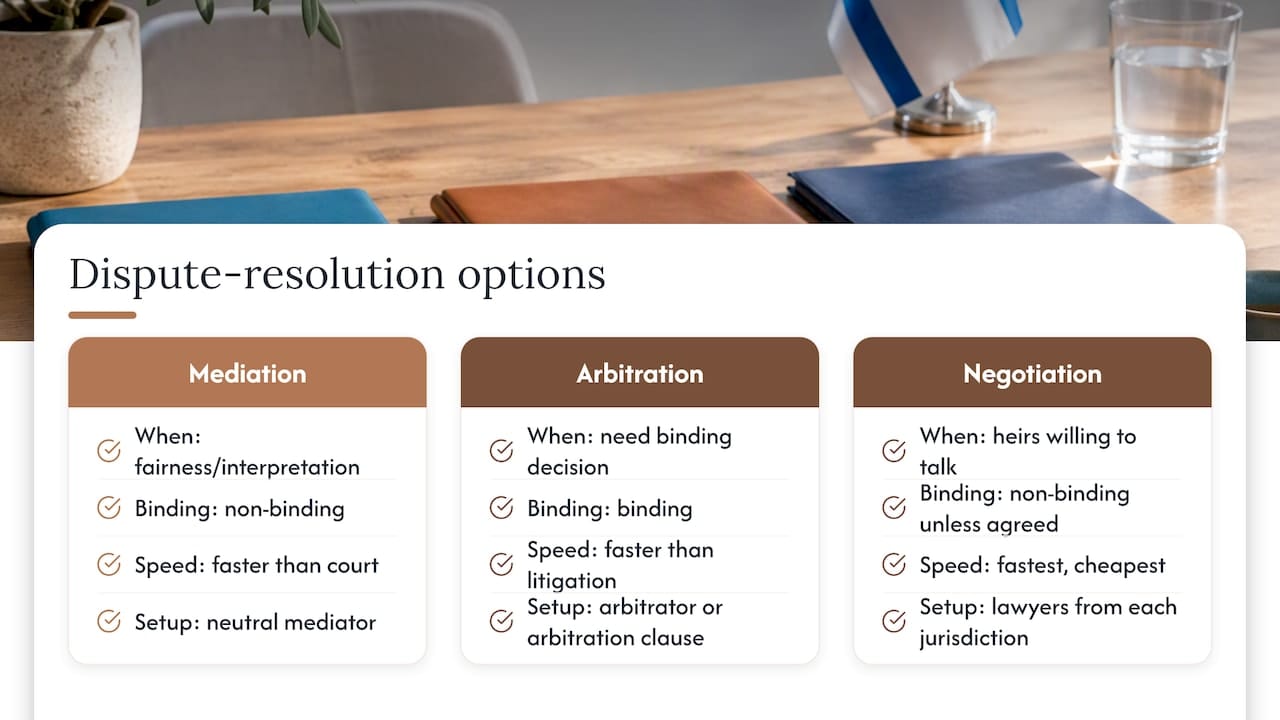
When heirs disagree, not every disagreement needs to go to court, and in a cross-border estate, litigation in multiple countries at once is often the most expensive and slowest path available. Mediation tends to work best when the disagreement is about interpretation or fairness rather than a hard legal question, such as how to divide a property that cannot easily be split or how to value a business interest held jointly. A neutral mediator familiar with both the Israeli succession framework and the other country’s inheritance rules can often bridge gaps that would otherwise require separate rulings in two legal systems.
Arbitration suits disputes where the parties want a binding decision without the delay of formal court proceedings, particularly when the estate includes a will with an arbitration clause or when all heirs agree in writing to arbitrate. It tends to move faster than litigation and can be structured so a single arbitrator addresses the whole estate rather than separate courts ruling on separate pieces of it.
Direct negotiation, ideally with lawyers from each jurisdiction present or consulted, remains the fastest and cheapest route when heirs are willing to talk. It works particularly well early, before positions harden and before each side has spent heavily on separate legal proceedings in different countries. Whichever method is used, the estate benefits from keeping the Israeli and foreign legal questions in the same conversation rather than negotiating them in isolation, since a concession on one asset can affect tax or distribution outcomes on another.
When there is no will: intestacy across borders
Dying without a will creates very different outcomes depending on which country’s intestacy rules apply to which asset, and this is where cross-border estates most often surprise heirs. Under Israeli law, intestate succession follows a fixed order set out in the Succession Law of 1965, typically giving a surviving spouse a share alongside children, with specific rules for how property and movable assets are divided among them.
A foreign jurisdiction may use a completely different formula. Some countries favor the surviving spouse over children; others split the estate more evenly among all children regardless of spouse. Heirs who assume the foreign country’s intestacy formula applies to the Israeli property often lose time correcting that assumption once an Israeli court or the Registrar of Inheritance gets involved.
This is one of the clearest reasons to identify early which assets sit in which country, since the intestacy outcome can differ asset by asset rather than applying uniformly to the whole estate.
Getting a foreign ruling recognized in Israel or an Israeli ruling recognized abroad
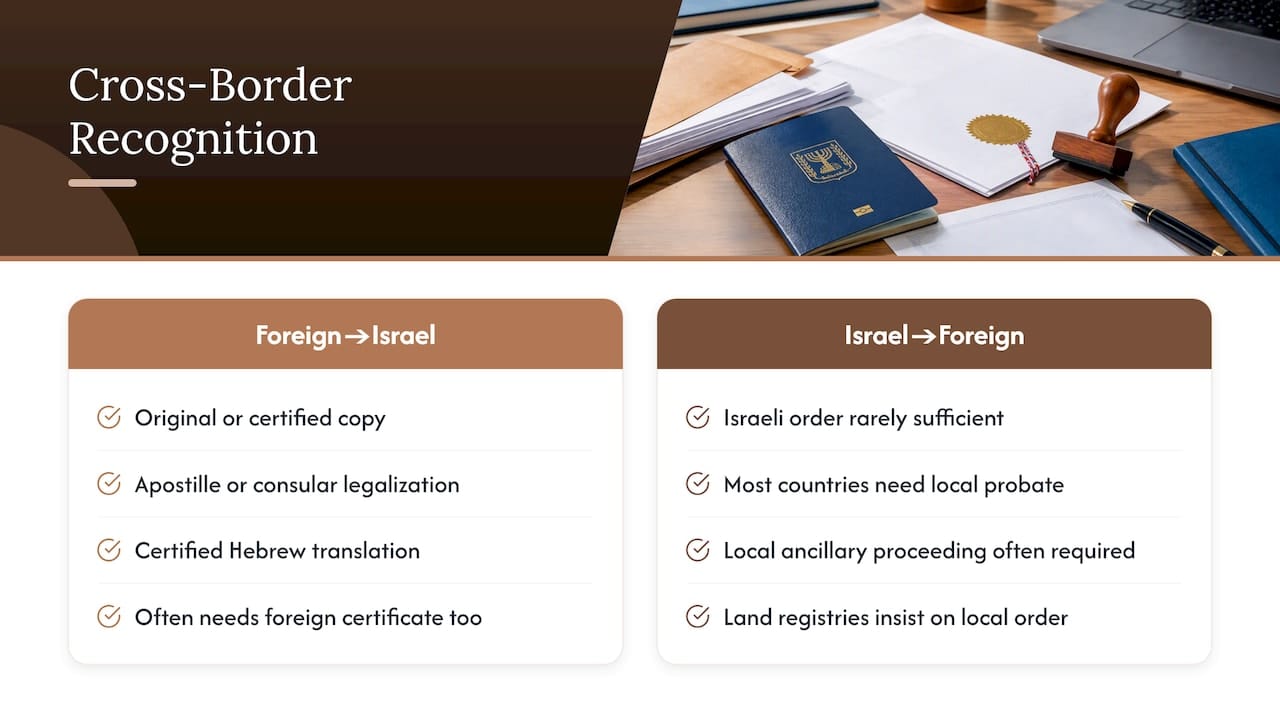
A probate order or inheritance ruling issued in one country does not automatically carry legal force in another. To use a foreign order in Israel, heirs generally need the original or a certified copy, an apostille or consular legalization, and a certified Hebrew translation before the Registrar of Inheritance or a family court will accept it as proof of inheritance. Even then, a foreign certificate often needs to accompany the foreign order for it to be usable in an Israeli filing.
The reverse is just as common: an Israeli inheritance order rarely transfers foreign real estate or unlocks a foreign bank account on its own. Most countries require their own local probate or ancillary proceeding before recognizing an Israeli ruling, which means heirs should expect to run a parallel process abroad rather than assuming the Israeli order will be enough. Land registries in particular tend to insist on a local court order before updating title, regardless of what an Israeli court has already decided.
Building in time for this dual-recognition step from the start avoids the common mistake of treating the Israeli order as the finish line when it is often only half the process.
Where these cases usually go wrong
A few patterns show up again and again in estates that span Israel and another country. The first is treating the matter as routine when it is not: forum selection and early choice-of-law decisions shape the entire case, and skipping that analysis tends to produce expensive corrections later. The second is underestimating the apostille and translation timeline, which can take weeks and routinely becomes the actual bottleneck rather than any legal dispute between heirs.
A third pitfall is assuming one country’s inheritance order settles the whole estate, when in practice each country with estate assets usually runs its own parallel process. A fourth is poor communication among heirs scattered across different time zones and legal systems, which turns a manageable administrative process into a dispute simply because no one is coordinating. The fix for most of these issues is the same: appoint one coordinator early, start the slowest-moving paperwork first, and keep every heir informed of the same timeline rather than letting each branch of the family work from a different understanding of where things stand.
A practical note from Menora Law
Most cross-border inheritance problems get worse through delay, not through bad luck. Heirs who اتصل an محامي إسرائيلي early, document everything, and talk openly with co-heirs tend to resolve their file in a fraction of the time. A single coordinator who understands both sides of the process is usually the difference between a smooth filing and a stalled one.
— Menora Law
Let Menora Law move your Israeli inheritance file forward
Legal services are available to heirs and executors abroad to help move an Israeli inheritance file forward without requiring a trip to Israel. Such cross-border inheritance assistance may include:
- Filing for an Israeli inheritance order and handling the Registrar of Inheritance process.
- Preparing, filing or amending wills that cover Israeli property.
- Managing apostille and certified Hebrew translation requirements for foreign documents.
- Coordinating with foreign counsel already handling probate outside Israel.
For a first consultation, bring the death certificate, any existing will, a list of assets by country and any foreign probate documents already in hand. Consultations can be held remotely by phone or video, which means international clients can get started the same week they reach out. Visit Menora Law to begin.
This article is general information, not a substitute for advice from a qualified lawyer. Consult a qualified legal professional about your own circumstances before acting on anything here.
Sources
- Ministry of Foreign Affairs — Notification on the death of an Israeli citizen or resident abroad
- Gov
- Hugh James — Domicile, forced heirship and conflict-of-laws issues
- Succession with heirs in 4 different countries: coordination Italy-USA-UK-Switzerland — Boschetti
التعليمات
What is the first legal step after a death involving Israeli assets?
Report the death to the Israeli consulate or Ministry of Foreign Affairs if it occurred abroad, then secure the original death certificate with an apostille. Contacting an Israeli inheritance lawyer at the same time helps identify which Israeli procedures apply to the estate.
Do I need an Israeli inheritance order if there is already a foreign probate?
Often yes, since a foreign probate order usually needs to be accompanied by a certified foreign certificate and Hebrew translation to be used in Israel. Israeli real estate and other Israeli-situated assets generally still require an Israeli inheritance order regardless of a foreign ruling.
How long does the apostille and translation process usually take?
There is no fixed universal timeline, and it depends on the issuing country and translator availability, but apostille and translation steps are commonly the biggest source of delay in cross-border inheritance matters. Starting this process immediately after the death, rather than waiting for other filings, helps avoid it becoming the bottleneck.
Will I owe tax in Israel on inherited property?
Israel does not impose an inheritance tax, but capital gains tax can apply later if inherited property is sold, and the other country involved may separately tax the estate or the heir. A comparison of estate and inheritance tax rules is a useful starting point, and coordinating with a tax advisor familiar with both jurisdictions helps avoid double taxation.
Can Menora Law represent me if I live outside Israel?
Yes, Menora Law regularly represents heirs and executors living abroad and offers remote consultations so clients do not need to travel to Israel. The firm coordinates directly with Israeli authorities and any foreign counsel already involved in the estate.


 English
 Afrikaans
 العربية
 বাংলা
বাংলা Čeština
 简体中文
简体中文 Nederlands
 Suomi
Suomi Français
 Deutsch
 עִבְרִית
 हिन्दी
 Magyar
 Italiano
 日本語
日本語 한국어
한국어 Polski
 فارسی
فارسی Português do Brasil
 Русский
 Español de México
 Українська