
Yes, foreign investors can buy Israeli companies, and the process is well-established. The immediate must-dos are choosing a transaction structure, running Israel-focused due diligence, checking whether foreign-investment screening or an Israel Competition Authority (ICA) filing applies, and preparing a tax-withholding plan with the Israel Tax Authority (ITA) before money changes hands. Review windows typically run 45 to 60 days, and we regularly guide overseas buyers through each stage remotely.
TL;DR:
- Foreign investors can acquire Israeli companies through structures like share purchases, asset deals, or mergers, each with different tax and liability implications.
- Due diligence must focus on local details such as corporate records, intellectual property, tax history, employment, and Innovation Authority grants to avoid deal-breaking surprises.
- Regulatory approvals, including foreign-investment screening and merger notifications, operate on different timelines, requiring early planning to prevent delays.
- Tax withholding and potential grant restrictions demand proactive ruling requests and escrow arrangements to mitigate post-closing liabilities.
- Handling legal, tax, and regulatory processes remotely with Israeli counsel enables fast, efficient acquisitions without frequent travel for overseas buyers.
Acquisition Structures in Israel: Share Purchase, Asset Purchase, and Mergers
The structure you choose shapes your tax exposure, your liability for the target’s past conduct, and how fast you can close. Israeli law offers three common paths, and each fits a different kind of deal.
أ share purchase transfers ownership of the company itself, including its history, contracts, and liabilities. It is the fastest route when the target is privately held and the shareholder base is small and cooperative, but you inherit everything, known and unknown, unless your purchase agreement carves out specific indemnities.
أ asset purchase lets you cherry-pick what you acquire: specific contracts, equipment, intellectual property, and employees, while leaving legacy liabilities with the seller’s existing entity. This route tends to appeal to buyers wary of undisclosed tax assessments, pending litigation, or messy historical cap tables. It can also trigger separate approval requirements for each transferred contract, particularly where change-of-control clauses exist.
أ reverse triangular merger is the preferred vehicle for acquiring Israeli public companies and many well-organized private ones. The buyer forms a merger subsidiary that merges into the target, with the target surviving as a wholly owned subsidiary of the buyer. This structure avoids the need for unanimous shareholder consent that a pure share purchase might require, and it is commonly used by cross-border acquirers for exactly that reason, according to Chambers’ Israel M&A practice guide.
Statutory merger and tender offer rules matter once you move beyond a small, consensual deal:
- أ full tender offer that reaches 95% acceptance from remaining shareholders generally allows the buyer to compel a squeeze-out of holdouts, completing a full takeover.
- Crossing certain ownership thresholds, commonly the quarter and near half of a company’s voting rights, can trigger special tender offer procedures under Israeli securities rules, even outside the context of a public takeover.
- أ statutory merger requires board and shareholder approval on both sides, a waiting period for creditor objections, and filings with the Registrar of Companies.
Practical red flags push many buyers toward an asset deal instead of a share deal: material unresolved litigation, a history of underfunded pension obligations, or contracts riddled with change-of-control triggers that would otherwise need to be renegotiated one by one. If the target holds Israel Innovation Authority grants, that alone can reshape your structural choice, a point we return to later.
Due Diligence: Israeli-Focused Checklist and Common Closing Blockers
Generic due diligence templates miss the issues that actually stall Israeli deals. A sequence built around local law and local regulators saves weeks.
- Corporate records first. Request the articles of association, full cap table, shareholder agreements, board and shareholder meeting minutes, and any voting or drag-along provisions.
- Material contracts and IP. Pull every agreement with a change-of-control clause, all IP assignment agreements from founders and employees, and any license agreements tied to third-party technology.
- Tax history. Obtain historic tax assessments, VAT filings, payroll tax compliance records, and any open disputes with the ITA.
- Innovation Authority grant records. Confirm whether the target has received Israel Innovation Authority funding, and if so, pull every grant agreement and royalty report.
- Employment files. Review severance exposure, pension and provident fund contributions, and any collective bargaining arrangements that could survive a change of control.
- Litigation and regulatory correspondence. Check for open claims, labor tribunal matters, and any prior interactions with the ICA or sectoral regulators.
Tax diligence deserves special attention. Historic assessments can reveal unresolved VAT exposure, and a seller’s prior withholding failures can become the buyer’s problem if the purchase price isn’t adjusted to reflect them. Where the numbers are large or the structure is unusual, requesting an advance ruling from the ITA before closing is often worth the delay.
The intellectual property and grant audit is where many foreign buyers get caught off guard. A missing Israel Innovation Authority clearance is one of the most common deal-breakers in Israeli tech acquisitions, because grants can restrict the transfer of government-funded know-how and often require approval or repayment before a transfer can proceed, according to the Ministry of Finance’s 2025 foreign direct investment report. Running this check in week one, not week six, avoids renegotiating price after the parties have already built emotional momentum toward signing.

Employment diligence often surfaces the second-biggest surprise: severance liabilities that were never properly funded, or essential engineers who have informal retention arrangements that won’t survive a change of ownership unless you address them directly in the deal terms.
Cap table problems are the quiet killer of otherwise good deals. Missing shareholders from early funding rounds, crowdfunding investors scattered across small holdings, and minority shareholders with contractual blocking rights can all delay or derail a share purchase. An asset purchase sometimes sidesteps this entirely, which is one more reason structure and diligence decisions need to happen together, not in sequence.
Pro Tip: Request the Israel Innovation Authority grant file and the full cap table on day one of diligence, not after the letter of intent is signed. Both routinely take the longest to resolve.
Regulatory Approvals: Screening Timelines and ICA Merger Thresholds
Two separate Israeli regulatory processes can apply to a foreign acquisition, and they run on different clocks.
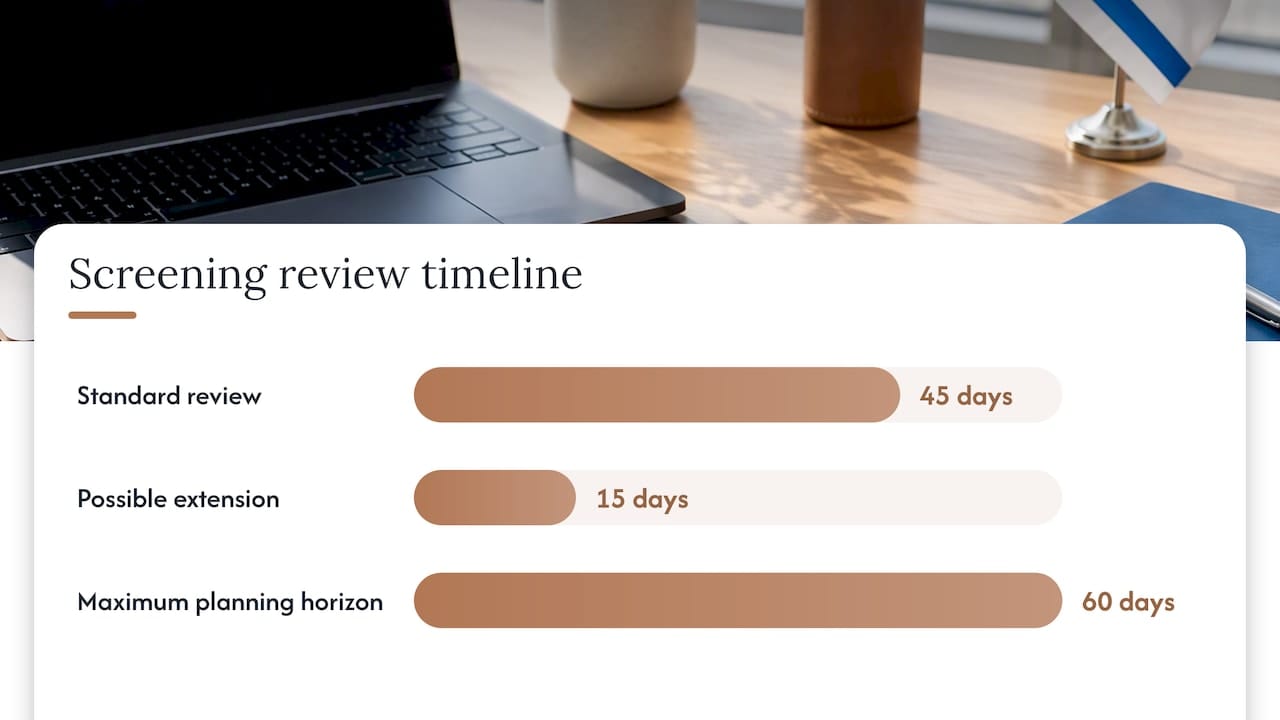
Foreign-investment screening applies when a deal touches sensitive sectors or raises national security considerations. A government committee evaluates qualifying investments case by case and must forward a recommendation to the relevant regulator within 45 days of a complete submission, with a possible 15-day extension, according to the methodology published for Israel’s foreign investment screening mechanism
A 45-day review window, extendable to 60 days, is the standard timeline foreign buyers should plan around when a deal falls within screening scope. (Israel foreign investment screening methodology) That window should be built into your closing timeline from the first draft of the letter of intent, not discovered midway through negotiations.
Separately, the Israel Competition Authority requires merger notification when the combined annual turnover of the merging companies exceeds 360 million NIS, and at least two of the companies involved each have annual turnover exceeding 20 million NIS, according to the ICA’s merger notification guidance. Both tests must be checked together: a large acquirer buying a small target can still trigger notification if the combined turnover clears the threshold, even if the target alone looks modest.
A few practical points worth flagging before you file:
- Screening review and ICA review can run in parallel, but neither substitutes for the other, and closing conditions should reference both explicitly.
- Sectoral regulators, including those overseeing defense, telecommunications, and financial services, may require additional consents layered on top of the general screening and competition processes.
- Submissions that are incomplete on first filing are the single biggest cause of delay; gathering corporate, ownership, and funding-source documentation before filing shortens the clock meaningfully.
- Being transparent early about the ultimate investors behind a deal and the source of funds tends to smooth the screening outcome, since identity and control profile are central to the committee’s review.
Tax at Closing: Withholding, Capital Gains, and the Steps That Protect You
Buyers in Israeli M&A carry a tax withholding duty that catches many first-time foreign acquirers off guard. Absent a withholding certificate or exemption from the ITA, the buyer is generally required to withhold tax from the purchase consideration paid to the seller and remit it, with practical guidance pointing to a short statutory window, often around 30 days, for completing payment after closing, according to practical M&A commentary published by the Jerusalem Post
How the deal is structured changes who bear this risk. A share purchase typically concentrates the withholding question on the shareholders receiving consideration, while an asset purchase can shift the tax character of the transaction entirely. In many deals of meaningful size, the seller applies for an advance ruling from the ITA specifying the correct withholding rate or an exemption, and escrow arrangements are used to hold back a portion of the purchase price until that ruling or certificate is in hand.
Practical steps that limit your exposure as the buyer:
- Appoint a paying agent or escrow agent authorized to hold funds until tax clearance is confirmed.
- Negotiate a tax indemnity from the seller covering any shortfall if the ITA later assesses additional tax.
- Request an advance tax ruling before closing when the consideration is substantial or the seller’s tax position is unclear.
- Confirm whether a double tax treaty between Israel and your home jurisdiction affects the applicable withholding rate.
Pro Tip: Build the tax ruling request into your deal timeline the same day you sign the letter of intent. ITA rulings are rarely fast, and waiting until after signing the purchase agreement to start the process is the most common cause of delayed closings.
Cross-border buyers should also check whether their home country’s tax treaty with Israel changes the calculus, since treaty relief can lower withholding rates but usually requires documentation filed in advance, not after the fact. This is an area where specialized Israeli tax counsel earns its fee quickly.
Deal Mechanics: From Letter of Intent to Post-Closing Integration
A realistic timeline keeps everyone’s expectations grounded and prevents the frustration that derails otherwise sound deals.
- Letter of intent and exclusivity. The parties agree on headline price, structure, and an exclusivity period, typically 30 to 60 days, during which the buyer completes diligence without competing bidders.
- Due diligence. Legal, tax, financial, and IP review runs in parallel, often taking four to eight weeks depending on the target’s record-keeping.
- Definitive agreements. The share purchase agreement or asset purchase agreement is negotiated, covering representations and warranties, indemnities, escrow terms, and any earn-out mechanics.
- Regulatory filings. ICA notification and, where applicable, foreign-investment screening submissions go in once the deal terms are firm enough to describe accurately.
- Closing. Funds move, tax withholding or escrow mechanics are triggered, and shares or assets formally transfer.
- Post-closing integration. Employee transition, system integration, and ongoing compliance filings begin.
Good letter of intent practice locks in exclusivity and price expectations early, which protects both sides from wasted diligence costs if the deal falls apart later over terms that should have been settled upfront.
Representations and warranties under Israeli law function similarly to other common law systems, but indemnity caps, survival periods, and escrow percentages are heavily negotiated and vary by deal size and sector. Earn-outs are common in tech acquisitions where founder retention matters, though they require careful drafting to avoid disputes over post-closing performance metrics.
Closing deliverables commonly include tax withholding certificates or exemptions, any required regulatory waivers, and, for grant-funded companies, written Israel Innovation Authority approval of the transfer. Where documents originate in multiple languages, pre-closing translation and notarization review prevents last-minute delays over improperly certified paperwork.
On the buyer side, assembling the right team early matters: local Israeli counsel, a tax adviser familiar with ITA ruling practice, a financial diligence lead, and someone responsible for post-closing integration from day one.
Israeli Tech Targets: Innovation Authority Grants and IP Transfer Rules
Acquiring a grant-funded Israeli tech or biotech company carries risks that generic M&A playbooks don’t cover. Israel Innovation Authority grants can restrict transferring the know-how they funded, and in many cases a transfer requires either regulatory approval or repayment of the grant before the deal can close cleanly, according to the Ministry of Finance’s 2025 FDI report.
An early Innovation Authority audit is one of the most valuable steps a foreign buyer can take in a tech acquisition, because it surfaces restrictions and repayment obligations before they become last-minute surprises that threaten the agreed price.
IP diligence specific to grant-funded Israeli firms should cover:
- Full assignment documentation from every inventor and employee who contributed to the funded technology.
- A complete license history, including any outbound licenses granted to third parties.
- Written confirmation of the grant’s terms regarding foreign ownership, manufacturing location requirements, and royalty obligations.
Several mitigation strategies can preserve deal value when a grant restriction surfaces late. Retaining the R&D activity within Israel, rather than relocating it abroad, can satisfy some grant conditions while still delivering the buyer’s commercial goals, and in some cases qualifies for separate tax relief tied to keeping research centers local, according to the Jerusalem Post’s M&A guidance. Structuring the deal as a license rather than a full assignment is another option worth exploring where full transfer approval looks unlikely. In either case, a pre-closing ruling from the Innovation Authority or the ITA is usually the cleanest way to remove the uncertainty before signing.
Pro Tip: Treat the Innovation Authority grant file as a closing condition, not a disclosure item. A grant restriction discovered after signing is far more expensive to fix than one addressed in the purchase price before anyone signs anything.
How We Help Foreign Buyers Acquire Israeli Companies
We built our practice around exactly this gap: foreign investors who need Israeli legal expertise but can’t spend months traveling back and forth to get it. We handle structuring decisions, regulatory filings with the Israel Competition Authority and foreign-investment screening committee, tax ruling requests with the Israel Tax Authority, Innovation Authority liaison, and full due diligence and closing support for buyers acquiring Israeli companies.
When a foreign buyer engages us, the first 30 to 60 days typically involve an initial legal health check on the proposed target, a screening and competition risk map specific to the deal, and a proposed timeline with the documents we need from both sides to move efficiently. We flag Innovation Authority and tax exposure early rather than waiting for them to surface mid-negotiation, because that is where most foreign-buyer deals lose time and money.
Because clients are based overseas, remote representation is built into how we work. We conduct calls across time zones, handle document review and signing logistics without requiring your presence in Israel, and communicate in plain English throughout, not just legal shorthand translated after the fact. Whether you’re a strategic acquirer, a private equity fund, or an individual investor buying into an Israeli company for the first time, our structure is designed so you never have to fly to Tel Aviv just to keep a deal moving.
What Happens After Closing: Compliance, Reporting, and Employee Rights
Closing the deal is not the finish line. Israeli companies carry ongoing obligations that a new foreign owner needs to plan for immediately.
Annual filings with the Registrar of Companies continue regardless of ownership change, and any shift in directors or controlling shareholders typically needs to be reported promptly. Employee rights survive a change of control in most structures, meaning existing severance entitlements, pension contributions, and any collective arrangements remain binding on the new owner unless specifically renegotiated.
Tax reporting obligations shift to the new ownership structure, and if the acquisition triggered any ITA ruling conditions, those conditions often come with their own follow-up reporting requirements for a period after closing. Where an Innovation Authority grant was part of the deal, post-closing royalty reporting or repayment schedules typically continue under the terms negotiated during diligence.
Buyers who treat post-closing compliance as an afterthought tend to discover gaps within the first annual reporting cycle, usually around payroll tax reconciliation or pension fund contributions that weren’t fully transferred. Assigning a local compliance اتصل, whether internal or through Israeli counsel, during the integration phase avoids this.
Financing the Acquisition: Debt and Equity Structures Under Israeli Rules
How you fund the purchase affects both your tax position and your regulatory exposure. Foreign buyers financing an Israeli acquisition typically choose between equity contribution from the parent company, debt financing raised locally or abroad, or a blend of both.
Debt financing secured against the Israeli target’s assets can trigger additional lender due diligence and may interact with existing security interests already registered against the company. Where the target holds Innovation Authority funding, lenders often require confirmation that the grant terms don’t restrict using company assets as collateral.
Equity financing from abroad is generally more straightforward from a regulatory standpoint but should still be checked against foreign-investment screening rules if the deal otherwise qualifies for review. The source and identity of equity investors matters here just as much as in the underlying acquisition itself.
Currency considerations also matter in practice. Purchase consideration and financing structured in shekels versus foreign currency can affect tax withholding mechanics and escrow arrangements, so this should be settled early in drafting the definitive agreements rather than left as a closing-week detail.
Purchase Price Adjustments and Escrow in Israeli Deals
Most Israeli acquisitions include a mechanism to true up the purchase price after signing, because the price agreed at the letter of intent stage rarely matches the company’s exact financial position at closing.
Working capital adjustments are common: the buyer and seller agree on a target working capital figure, and the final price shifts up or down based on the actual figure at closing, calculated against audited or reviewed financial statements. Net debt adjustments work similarly, reducing the price by any debt the target carries at closing that wasn’t accounted for in the original valuation.
Escrow arrangements typically hold back a percentage of the purchase price for a fixed period, often tied to the survival period of the seller’s representations and warranties, to cover any indemnity claims that surface after closing. A separate, smaller escrow is frequently used specifically to cover tax withholding risk until the ITA issues a final certificate or ruling. Release conditions should be spelled out precisely in the purchase agreement, including what evidence triggers release and what happens if a dispute arises before the escrow period ends.
Negotiation Style and Deal Culture in Israeli M&A
Israeli business negotiations tend to move faster and more directly than many foreign buyers expect. Founders and executives are often comfortable raising difficult questions early rather than saving them for late-stage negotiation, and directness is generally read as efficiency rather than aggression.
Relationship-building still matters, but it tends to run in parallel with substantive negotiation rather than as a prerequisite to it. Expect counterparts to push back on terms they see as unfavorable without much diplomatic cushioning, and expect the same directness to be welcomed in return.
Decision-making in Israeli companies, particularly founder-led tech companies, is often more centralized than in larger corporate structures, which can speed up negotiations once the right people are in the room. Foreign buyers who bring too many layers of approval into early conversations sometimes find that mismatch frustrating for Israeli counterparts used to faster turnaround. Building a lean, empowered negotiating team on your side tends to match the pace better.
Our Take: The Real Risk Isn’t the Deal, It’s the Timeline
The biggest mistake we see foreign buyers make isn’t choosing the wrong structure or missing a contract clause. It’s underestimating how much the screening and tax clocks, not the commercial negotiation, actually control the closing date. Buyers who treat Innovation Authority grant restrictions and foreign-investment screening as late-stage paperwork consistently lose weeks they didn’t budget for.
Conventional M&A advice focuses heavily on valuation and deal terms, and those matter, but in Israeli cross-border transactions the regulatory and tax mechanics are where deals actually stall. A buyer who starts the tax ruling request and the grant audit in the same week as the letter of intent closes faster than one who waits for diligence to “confirm” the need.
Our advice: front-load the boring parts. Request the grant file, the cap table, and the tax history before you fall in love with the valuation. The commercial terms are negotiable until the day you sign. The regulatory clock is not.
**
Ready to Acquire an Israeli Company? Here’s How to Start
Before your first call with us, gather a few basics: the target company’s name, any signed letter of intent, the current cap table, and a short list of sectors the deal might touch, since that helps us flag which regulators are likely to require notification.
From there, we run an initial legal health check on the target, map out the foreign-investment screening and ICA risk specific to your deal, and give you a realistic timeline before you commit further resources. Everything happens remotely: document review, calls, and signing logistics, so you never need to fly to Israel just to keep the deal moving.
We handle acquisitions at every stage, from first-time foreign buyers exploring a single Israeli target to funds running multiple cross-border deals at once, with full confidentiality throughout. Reach out to Menora Law to start your intake and get a clear picture of what your specific acquisition will require.
This article is general information, not a substitute for advice from a qualified lawyer. Consult a qualified legal professional about your own circumstances before acting on anything here.
التعليمات
Can a foreign investor own 100% of an Israeli company?
Yes, Israeli law generally permits full foreign ownership of Israeli companies, though deals touching sensitive sectors may require foreign-investment screening before closing. The screening methodology sets a 45-day review window with a possible 15-day extension for qualifying cases.
Do I need to notify the Israel Competition Authority before buying an Israeli company?
Notification is required when the combined annual turnover of the merging companies exceeds 360 million NIS and at least two of them each have turnover above 20 million NIS, according to the ICA’s merger guidance. Deals below both thresholds generally don’t require this filing.
What happens to Israel Innovation Authority grants when a company is acquired?
Innovation Authority grants can restrict transferring the know-how they funded, and a transfer often requires written approval or repayment of the grant before closing, according to the 2025 Ministry of Finance report. Running an early grant audit is the most reliable way to catch this before it affects price or timing.
Who pays the tax withholding at closing in an Israeli acquisition?
The buyer generally bears the withholding duty on the purchase consideration unless the seller secures a withholding certificate or exemption from the Israel Tax Authority, with payment typically due within a short statutory window after closing, according to practical guidance from the Jerusalem Post. Many deals use escrow to manage this risk until the ruling or certificate is confirmed.
Can a foreign law practice represent a foreign buyer remotely during an Israeli acquisition?
Yes, structuring, regulatory filings, tax rulings, and closing support can be handled remotely for clients based overseas. The process can be designed so foreign buyers never need to travel to Israel to complete a transaction.


 English
 Afrikaans
 العربية
 বাংলা
বাংলা Čeština
 简体中文
简体中文 Nederlands
 Suomi
Suomi Français
 Deutsch
 עִבְרִית
 हिन्दी
 Magyar
 Italiano
 日本語
日本語 한국어
한국어 Polski
 فارسی
فارسی Português do Brasil
 Русский
 Español de México
 Українська