
If a foreign company does business in Israel, it generally has to open a VAT file with the Israel Tax Authority and appoint a representative who lives or operates in Israel. The application goes in on Form 22 together with Form 821, and the clock is short: the representative’s details are due within 30 days of the day the business activity starts. This guide walks you through who must register, what to file, what the representative takes on, and where foreign companies tend to trip.
TL;DR
- A foreign company doing business in Israel must appoint a local representative and open a VAT file using Form 22 and Form 821.
- The representative’s name is due within 30 days of starting business activity in Israel, so register before the first invoice, not after.
- The representative carries real responsibility for reports and payments, so choose someone you trust and agree on the terms in writing.
- The standard VAT rate is 18% as of 2025, and an Israeli VAT number is what lets you recover input VAT.
- A “representative office” does not get you out of registration once any revenue-generating activity begins.
Who has to register
The short answer: a foreign company that carries out business or taxable activity in Israel. That can mean selling goods or services to Israeli customers, running a branch, employing people, holding inventory, or providing services connected to Israeli property. The Tax Authority’s service page for Form 22 describes the process for a foreign resident or a foreign company that wants to do business in Israel and is not an Israeli company.
The tricky part is that “doing business” is not always obvious. A few situations we see often:
- A foreign company with Israeli customers and no office. A company that sells services to Israeli customers may still have VAT obligations. The Tax Authority has published guidance on whether international corporations providing services over the internet to Israeli customers must register as an authorized dealer (Osek Murshe). Note that this document is a 2016 draft for discussion, so treat it as an indication of the Authority’s thinking and check the current position before you rely on it.
- A foreign company that opens an Israeli branch. The branch is part of the foreign company and is registered with the Registrar of Companies. VAT registration follows. We cover that route in our guide on registering a foreign branch in Israel.
- A foreign company that forms an Israeli subsidiary. This is a separate Israeli company with its own VAT file. It is not the same as the process described in this article, which is for the foreign entity itself.
- A foreign company that owns or sells Israeli real estate or supplies services tied to it. These deals have their own VAT treatment and should be reviewed before signing.
Whether you are actually obliged to register depends on the facts: what you sell, to whom, where the service is performed, and who the customer is. Two companies with similar websites can end up with different answers. If you are on the edge, get a written opinion before you decide to skip registration.
Foreign company, Israeli tax residency and VAT are different questions
People often merge three separate issues: VAT registration, corporate tax residency and the form of the entity. A foreign company can be registered for VAT without being an Israeli tax resident for income tax purposes. At the same time, a company incorporated abroad may be treated as an Israeli tax resident if it is managed and controlled from Israel. Our checklist for foreign companies entering the Israeli market goes through both traps together, because a VAT filing can draw attention to the tax residency question.
The local representative: the part people underestimate
Israeli VAT law requires a foreign dealer to name a local representative. The representative can be an individual or a company in Israel. The Tax Authority’s page says that a foreign company is required to appoint a representative in Israel, and that the representative handles the Form 22 application.
According to the research we reviewed, the representative must be named within 30 days of the start of the company’s business activity in Israel (Section 60 of the VAT Law, as reflected in the Tax Authority’s Form 22 page).
What the representative takes on
This is not a mailbox arrangement. The Tax Authority’s own guidance describes how the representative acts on behalf of the foreign entity before the tax authorities, and that creates a direct link between the foreign company and the Israeli tax system. In practice that means:
- Filing the periodic VAT reports on time.
- Paying the VAT due.
- Answering the Authority’s questions and audits.
- Facing exposure if the foreign company does not provide the funds or the information.
Because of that exposure, many representatives ask for protection before they accept the role. Expect them to ask for a written agreement, a clear flow of documents from you, and often a financial guarantee or deposit. That is a normal commercial request, not a red flag, and it is better to negotiate it before registration than after a missed deadline.
Choosing the representative
When you compare candidates, ask:
- Will they handle the monthly or bi-monthly reporting, or only sign the form?
- Who is responsible for bookkeeping and invoices?
- What happens if the foreign company stops paying or goes silent?
- How is the role ended when you close the Israeli activity?
- Can they communicate with you in English and respond within a working day?
The last point matters more than it looks. VAT deadlines in Israel do not move because of a time difference.
What you file: Form 22 and Form 821
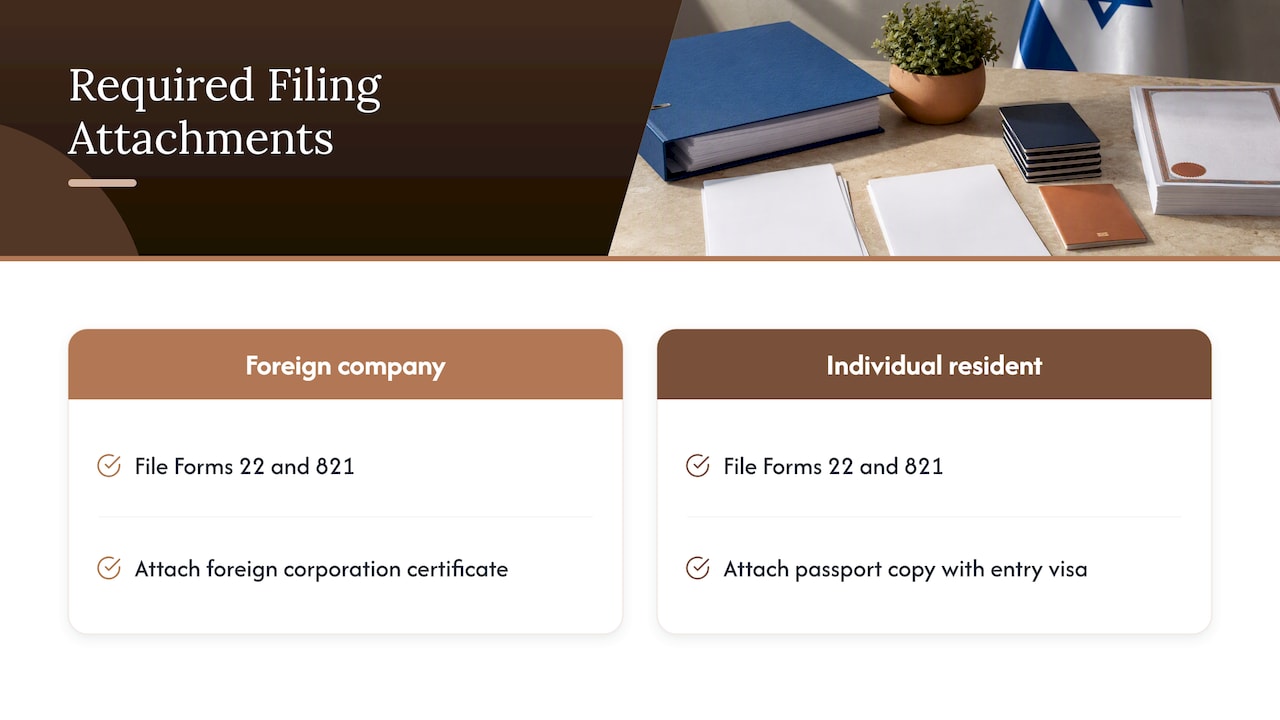
The application consists of two main forms plus supporting documents. According to the Tax Authority, the representative submits VAT Form 22 together with registration Form 821 and the attachments.
For a foreign company, the attachments include a foreign corporation certificate. For an individual foreign resident, a photocopy of the passport including the entry visa is required.
Signing from abroad
This is where overseas clients lose time. The Tax Authority explains two paths:
- If the signatures on Form 22 are made abroad, a notarized power of attorney certifying the signatures is required.
- If the form was signed in Israel, a statement from an attorney or the representative that it was signed in their presence is enough. The same page notes the representative may also sign Form 22 at the VAT offices.
If your directors are overseas, plan for a notary appointment before the paperwork leaves your hands. Notarial requirements for documents executed abroad can add days. Check our guide to Israeli filing steps and apostille rules if your company is also registering a branch, since the same document set is often reused.
A practical checklist
| Item | Who prepares it | Notes |
|---|---|---|
| Form 22 (appointment of representative) | Foreign company and representative | Signature rules depend on where it is signed |
| Form 821 (registration) | Representative with company data | Describes the activity and expected turnover |
| Foreign corporation certificate | Foreign company | Obtain from the registry in the home country |
| Notarized power of attorney | Foreign company | Needed if signed abroad |
| Representative’s ID or company details | Representative | Individual or Israeli entity |
| Description of Israeli activity | Foreign company | Keep it consistent with contracts and invoices |
We always check one thing before filing: the description of activity on the form must match what your contracts, website and invoices say. Inconsistent descriptions are an easy way to invite questions.
The timeline and what happens after approval
The statutory deadline for naming the representative is 30 days from the start of business activity. Beyond that, the approval time depends on the Authority’s workload and on whether your file is complete, so we do not promise a specific processing time. What we can say is that a complete file with correct signatures moves faster than one sent back for notarization.
Once your VAT file is open, you become a registered dealer with reporting duties. The routine looks like this:
- Issue tax invoices for taxable transactions.
- Report each period’s output VAT (on sales) and input VAT (on purchases).
- Pay the net amount, or claim a refund if input exceeds output and the rules allow it.
The Tax Authority explains that online filing and payment is due by the 19th of the month, compared with the 15th for manual filing. Transactions that require an invoice are reported for the period even if the money has not arrived yet. That surprises companies used to cash-based thinking.
The same page also notes that the old identification system of the Tax Authority was closed from 1 December 2024, so your representative needs to be set up with the current login method.
The rate and why registration pays for itself
The standard rate rose from 17% to 18% on 1 January 2025, as the Grant Thornton Israel tax update explains in its preparation note. Every taxable invoice you issue in Israel from that date carries the new rate, unless a specific exemption or zero rate applies.
So why register at all, if it adds work? Because an Israeli VAT number is what makes the system work in your favor:
- You can recover input VAT on Israeli costs such as rent, local services and supplier invoices, when the expense relates to taxable activity.
- Your customers can treat you as a proper supplier. Large platforms collect tax registration numbers from clients to separate business and consumer sales. AWS explains this in its Israel tax help page, and the Israeli number on an invoice is what supports input VAT recovery.
- You avoid the cost of non-compliance. Late registration can mean back-assessments, interest and penalties.
On that last point, our own article on Israeli VAT for cross-border sales explains how invoice problems lead to denied deductions for your Israeli customers. When a customer cannot deduct VAT on your invoice, they notice, and they usually tell you.
Zero-rated and exempt transactions
Some services supplied to non-residents are taxed at 0%, and the conditions are strict. Do not assume your sale qualifies because the customer is abroad. The conditions concern who the customer is, whether an Israeli party benefits from the service, and how the transaction is documented. Because the answer changes between services, we review the actual contract rather than the label on the invoice.
“Representative office” is not a shortcut
A common plan is to open a representative office so that the foreign company “has a presence” without being taxed. The City of Tel Aviv-Yafo’s page on forming a legal entity in Israel lists the three options for a foreign company: a subsidiary, a branch office or a representative office. The choice depends on what the company wants to do.

The key point is the limit on what a representative office may do. It is meant for market research and feasibility work. Once it signs contracts, issues invoices or earns revenue, it has crossed into a business activity, and the company should be registered as an authorized dealer. We have seen foreign companies discover this only after an Israeli customer asks for a tax invoice.
Common mistakes we see
- Waiting for the first sale. The 30 days run from the start of activity, which can be earlier than the first invoice.
- Signing abroad without a notarized power of attorney. The Authority sends the file back and the clock keeps running.
- Picking a representative on price alone. A cheap signature can mean no one is watching deadlines.
- Mixing up VAT and income tax. Registering for VAT does not decide your corporate tax position, and the reverse is also true.
- Inconsistent descriptions. The form says consulting, the invoices say software licensing, the contract says distribution.
- Forgetting the bank. Israeli banks often want to see your registration documents before they open or maintain an account. Our guide on building a bank-ready file for foreign companies shows how the VAT file fits in.
Our perspective
We work with foreign companies that have to deal with Israeli rules from a distance, and the pattern is consistent. Companies rarely get VAT wrong because the rule is hard to understand. They get it wrong because nobody owns it. The finance team abroad assumes the Israeli side is handling it, the Israeli اتصل assumes head office has it covered, and the 30 days pass.
Our approach is to treat VAT registration as part of the entry plan, not a form to file later. We look at the contract structure, the invoice flow, the representative arrangement and the tax residency question together, because a decision on one changes the others. We also work with overseas clients remotely, so a director who is abroad can sign the right documents, in the right way, without flying in. Fast, clear communication is the part clients tell us they value most, because VAT problems are almost always deadline problems.
If you take one thing from this article: decide who is the representative, what they will do each month, and how they will be protected, before the first Israeli invoice goes out.
— Menora Law
How we can help
Menora Law is an Israeli law practice built for international clients. For VAT registration we can coordinate the representative arrangement, prepare and review Form 22 and Form 821, arrange the signature and notarization steps for directors abroad, and align the registration with your contracts and corporate structure. If you are still deciding between a branch, a subsidiary and a lighter presence, we cover those options under representing international companies in Israel. Tell us what you sell and who your Israeli customers are, and we will tell you what we think you need to file and when.
التعليمات
Can a foreign company register for VAT in Israel without a local representative?
No. The Tax Authority’s process for foreign dealers requires appointing a representative in Israel. The representative can be an individual or an entity operating in Israel, and the appointment is made through Form 22.
How long do we have to register?
The representative’s details must be reported within 30 days of the start of business activity in Israel, according to the Tax Authority’s Form 22 service page. Because it is hard to say exactly when activity “starts” for a given business, we recommend registering before you sign your first Israeli customer contract.
Do directors have to travel to Israel to sign?
Not necessarily. If the signatures on Form 22 are made abroad, the Authority asks for a notarized power of attorney certifying them. If the form is signed in Israel, an attorney’s or representative’s statement that it was signed in their presence is enough.
When is the monthly VAT report due?
For online filing and payment, the deadline is the 19th of the month, and the 15th for manual filing. Your representative should have these dates in a calendar, and you should receive the draft report before it goes in.
Does VAT registration make my foreign company an Israeli tax resident?
Not by itself. VAT registration and corporate tax residency are separate questions. Residency turns on where the company is managed and controlled, so review the structure with an Israeli tax adviser at the same time as the registration.
Sources
- Tax Authority: application to open a VAT file for a foreign trader (Form 22), English
- Tax Authority: application to open a VAT file for a foreign trader (Form 22), Hebrew
- Tax Authority: reporting and paying VAT reports
- Tax Authority: 2016 draft guidance on international corporations providing internet services
- Grant Thornton Israel: preparing for the VAT increase from 17% to 18%
- Tel Aviv-Yafo Municipality: forming a legal entity in Israel
- AWS: tax help for Israel


 English
 Afrikaans
 العربية
 বাংলা
 Čeština
 简体中文
 Nederlands
 Suomi
 Français
 Deutsch
 עִבְרִית
 हिन्दी
 Magyar
 Italiano
 日本語
 한국어
 Polski
 فارسی
 Português do Brasil
 Русский
 Español de México
 Українська