
TL;DR:
- Israeli Bar Association membership is a mandatory license that grants lawyers the legal right to practice and represent clients in Israel. It requires completing an accredited law degree, a supervised internship, passing a Hebrew-language Bar exam, and taking an oath, typically over 18 to 24 months. Continued obligations include paying dues, adhering to ethical standards, and engaging in ongoing legal education to maintain active membership and professional credibility.
Israeli Bar Association membership is the compulsory professional credential that grants lawyers the legal right to practice law in Israel, and without it, no person may represent clients, appear in court, or provide legal advice for compensation under Israeli law. This credential is not simply a formality. It defines your professional identity, subjects you to ethical oversight, and ties you to a regulatory framework that has been in place since the Bar Association Law of 1961. Whether you are a law graduate preparing for your first steps in the profession, a foreign-qualified attorney considering a move to Israel, or a client trying to understand who is legally authorized to represent you, knowing what this membership means and how it works is the foundation of everything else.
What is Israeli Bar Association membership?
Israeli Bar Association membership is the licensed status conferred by the Israel Bar Association (IBA) upon advocates who have met all statutory requirements under the Bar Association Law 1961, the foundational legislation governing admission, ethics, and discipline across the legal profession in Israel. The IBA is not a voluntary professional society you can opt into or out of. It is the exclusive licensing body for lawyers in Israel, and its authority covers everything from approving law school programs and administering the Bar exam to disciplining members and setting ethical standards.
The distinction between membership and a simple license matters here. When you become a member of the IBA, you are simultaneously granted the protected title of “advocate” (עורך דין), the right to appear before Israeli courts, and the obligation to comply with the IBA’s code of professional conduct. These three elements are inseparable. The Bar Association Law makes clear that practicing law without IBA membership is a criminal offense, not just a regulatory violation.
As of 2025, IBA membership is treated as effectively mandatory for anyone practicing law in Israel, though the Knesset has been actively debating whether to make membership voluntary. That debate has not yet changed the legal requirement. Until legislation passes to alter the status quo, every practicing lawyer in Israel must hold active IBA membership.
What are the eligibility requirements and admission process?
The path to IBA membership follows a structured sequence governed by Israeli law. Each step builds on the last, and skipping any one of them disqualifies a candidate from admission. Here is how the process works from start to finish.

1. Earn an accredited LLB degree
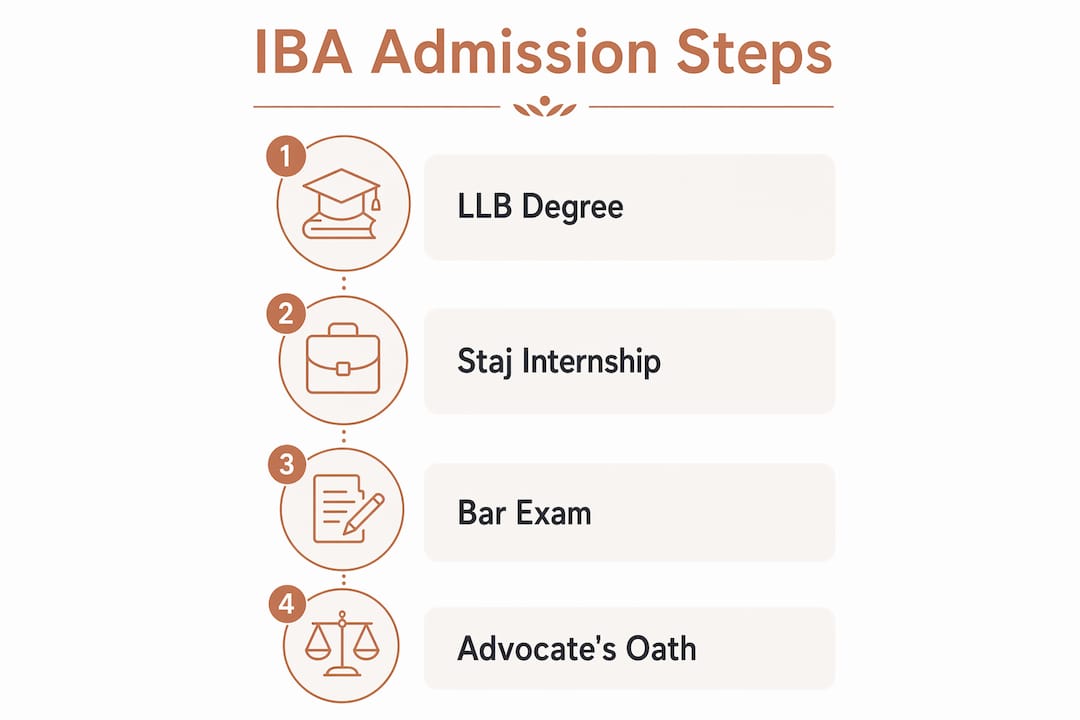
The starting point is a Bachelor of Laws (LLB) degree from a university or college accredited by the Israeli Council for Higher Education. Institutions like Tel Aviv University, Hebrew University of Jerusalem, Bar-Ilan University, and the Interdisciplinary Center Herzliya (IDC) are among the recognized providers. The degree program typically takes three years for students entering directly from high school or two years for those with a prior bachelor’s degree.
2. Complete the staj (supervised internship)
After graduating, candidates must complete a 12-month supervised internship known in Hebrew as the staj. This internship must be registered with the Bar Association and conducted under the supervision of a licensed advocate with at least five years of practice experience. The staj is not a passive observational period. Interns are expected to handle real casework, draft legal documents, appear in lower courts, and develop practical skills under direct supervision. The IBA monitors compliance with internship requirements and can reject or invalidate an internship that does not meet its standards.
3. Pass the Bar examination
The IBA administers the Bar exam twice per year, typically in spring and fall. The exam covers core areas of Israeli law including civil procedure, criminal law, contract law, property law, and professional ethics. All examination materials are in Hebrew, which means Hebrew proficiency is not optional. It is a prerequisite. Pass rates historically fall between 50 and 70%, which reflects the exam’s genuine difficulty. Candidates who do not pass may retake the exam in a subsequent sitting without limit, though each attempt requires a new registration fee.
4. Take the advocate’s oath
Once a candidate passes the Bar exam, the final step is taking a formal oath before a judge of the Supreme Court or a District Court. The oath affirms the candidate’s commitment to uphold the law, serve clients faithfully, and maintain the integrity of the legal profession. Admission to the IBA is formalized upon completion of this oath, and the candidate’s name is entered into the official register of advocates.
Pro Tip: Start preparing for the Bar exam during the final months of your staj, not after it ends. The exam’s Hebrew-language requirement catches many candidates off guard, particularly those who completed part of their legal education abroad. Dedicated exam preparation courses are widely available in Israel and are worth the investment.
The entire process from LLB graduation to IBA admission typically takes 18 to 24 months when the staj and exam preparation are completed without interruption.
How are membership dues structured and what recent changes affect fees?
Membership dues are an annual financial obligation for every IBA member, and the fee structure has been the subject of significant legislative activity in recent years. Understanding the current fee environment matters both for budgeting and for following the broader political debate about the IBA’s financial independence.
As of 2025, annual membership dues stand at approximately NIS 1,000 per year, which is roughly $280 at current exchange rates. That figure reflects a 20% reduction enacted by the Knesset in January 2025, making it one of the more concrete outcomes of the ongoing legislative debate about the IBA’s financial governance.
| Fee category | Approximate amount (2025) |
|---|---|
| Annual membership dues (established lawyers) | NIS 1,000 (~$280) |
| Reduction enacted by Knesset (2025) | 20% decrease from prior rate |
| Fee-setting authority (post-2025 law) | Justice Minister, not IBA leadership |
| Bar exam registration fee | Varies; check IBA directly |
The 2025 legislation did more than reduce dues. It also transferred fee-setting authority from IBA leadership to the Justice Minister and restricted how collected funds can be spent. The Knesset’s stated concern was that the IBA had been using membership fees to fund political activities, including public campaigns opposing judicial reform legislation. The new law limits fee usage to core Bar functions such as exam administration, internship accreditation, and professional regulation.
“The Knesset debate on restricting fee spending reflects a broader effort to limit the IBA’s role as a political actor and refocus it on its core licensing and regulatory functions.” — Knesset legislative discussion, January 2025
A separate bill proposing to make IBA membership voluntary has also been under active discussion. If passed, this would fundamentally alter the IBA’s funding model and potentially its regulatory authority. As of early 2026, that bill has not yet become law, but it remains a live legislative proposal. Any lawyer tracking their compliance obligations should verify current fee amounts directly with the IBA, since dues and regulations are subject to change by statute.
Pro Tip: Always check the IBA’s official website or اتصل them directly before paying annual dues. Fee amounts and payment deadlines can shift following legislative changes, and paying an outdated amount could leave your membership in arrears.
What ongoing obligations and benefits come with membership after admission?
Admission to the IBA is not a one-time achievement. It carries continuing obligations that every licensed advocate must meet to keep their membership active and in good standing. These obligations are matched by a set of professional rights and resources that make membership genuinely valuable beyond the basic license to practice.
Ongoing obligations every member must meet:
- Annual dues payment. Members must pay their annual membership fees on time. Failure to pay can result in suspension of membership and loss of the right to practice.
- Ethical compliance. The IBA’s code of professional conduct governs everything from client confidentiality and conflict of interest rules to advertising restrictions and fee arrangements. Violations are investigated by the IBA’s disciplinary tribunals, which have authority to impose sanctions ranging from reprimands to disbarment.
- Continuing legal education (CLE). Licensed advocates are required to complete continuing education requirements to stay current with developments in Israeli law. The IBA organizes seminars, workshops, and online courses that count toward these requirements.
- Reporting obligations. Members must keep their اتصل and practice details updated with the IBA and report certain changes in their professional circumstances.
Benefits that come with active membership:
- The exclusive right to use the title “advocate” and to represent clients before all Israeli courts, including the Supreme Court.
- Access to IBA-organized professional development programs, legal databases, and member resources.
- Participation in IBA committees and working groups that shape legal policy and professional standards.
- Professional credibility with clients, courts, and counterparties who recognize IBA membership as the definitive mark of a licensed محامي إسرائيلي.
- Access to the IBA’s legal aid and pro bono frameworks, which connect members with public interest work.
The right to practice and ongoing compliance obligations are distinct but interconnected. You cannot separate the benefits from the responsibilities. That is precisely what makes IBA membership a professional identity, not just a credential.
How do foreign-qualified lawyers navigate IBA membership?
Foreign-qualified lawyers face a more complex path to IBA membership than Israeli law graduates, but the path exists and is well-defined. The core rule is straightforward: foreign lawyers cannot practice Israeli law unless they are admitted to the IBA. Advising clients on Israeli legal matters, drafting Israeli law documents, or appearing in Israeli courts without IBA membership exposes a foreign lawyer to criminal liability.
The table below compares the standard admission route for Israeli graduates with the route typically available to foreign-qualified lawyers.
| Admission element | Israeli law graduate | Foreign-qualified lawyer |
|---|---|---|
| Degree requirement | Israeli LLB from accredited institution | Foreign law degree subject to IBA review |
| Internship (staj) | 12 months, mandatory | May be reduced or waived by exemption committee |
| Bar exam | Full exam in Hebrew, mandatory | May receive partial exemptions based on foreign qualifications |
| Hebrew proficiency | Required (exam is in Hebrew) | Required; no exemption available |
| Oath | Mandatory | Mandatory |
| Practice without admission | Prohibited | Prohibited |
The IBA’s Exemption Committee reviews foreign qualifications on a case-by-case basis. Lawyers who hold degrees from recognized foreign institutions and have substantial practice experience may receive exemptions from parts of the internship or exam requirements. However, Hebrew proficiency is never waived. The Bar exam is administered exclusively in Hebrew, and no translation or alternative language option is available.
Foreign lawyers who want to understand the full scope of their options should review the detailed guidance on becoming a licensed lawyer in Israel before approaching the IBA. The process requires careful planning, particularly around Hebrew language preparation and the timing of the staj registration. For those who are also navigating broader questions about the Israeli legal system, understanding how the IBA fits into the overall regulatory structure is a useful starting point.
One practical reality that surprises many foreign lawyers: even if your home jurisdiction has a reciprocity agreement with Israel, that agreement does not automatically grant IBA membership. Reciprocity may reduce the steps required, but the IBA retains final authority over every admission decision.
Key takeaways
Israeli Bar Association membership is the mandatory licensing credential required to practice law in Israel, governed by the Bar Association Law of 1961, and it combines admission requirements, ongoing obligations, and professional rights into a single, inseparable framework.
| Point | Details |
|---|---|
| Membership is mandatory | No person may practice law in Israel without active IBA membership under the Bar Association Law 1961. |
| Admission follows four steps | Candidates must complete an LLB, a 12-month staj, the Hebrew-language Bar exam, and a formal oath. |
| Dues reduced in 2025 | Annual fees stand at approximately NIS 1,000 after a 20% Knesset-mandated reduction in January 2025. |
| Foreign lawyers must also join | Foreign-qualified lawyers cannot practice Israeli law without IBA admission; exemptions exist but Hebrew is always required. |
| Ongoing obligations are binding | Active members must pay annual dues, comply with ethics rules, and complete continuing legal education every year. |
The IBA’s evolving role: a perspective from Menora Law
Working with Israeli law on behalf of international clients gives us a front-row seat to how IBA membership shapes the legal profession in practice, not just on paper. What strikes us most is how often foreign lawyers and their clients underestimate the IBA’s reach. It is not a background institution. It is the gatekeeper of every legal interaction in Israel, and its decisions about who can practice, under what conditions, and subject to what ethical rules define the quality of legal service that clients receive.
The recent legislative changes around fees and financial governance are worth watching carefully. The 2025 law transferring fee-setting authority to the Justice Minister represents a meaningful shift in the balance of power between the government and the legal profession. We think the intent to prevent political spending from member dues is legitimate. At the same time, reducing the IBA’s financial independence carries risks for the profession’s ability to advocate for rule-of-law principles without political interference. That tension is not resolved yet.
For anyone considering admission to the IBA, our honest advice is this: treat Hebrew preparation as your first priority, not an afterthought. We have seen talented foreign lawyers delay their admission by a year or more simply because they underestimated the language requirement. The Bar exam is genuinely difficult in Hebrew, and there is no workaround. Start early, use structured preparation courses, and register for the staj as soon as your degree is in hand.
The IBA’s role in maintaining public trust in the legal system is real and worth preserving, even as its governance evolves. Membership is not just a license. It is a commitment to the standards that make legal representation meaningful.
— Menora Law
How Menora Law can help with Israeli legal matters
Menora Law brings deep expertise in Israeli law to clients across the globe, including those navigating the complexities of the Israeli legal system from abroad.
Whether you are a foreign lawyer researching the IBA admission process, an international client who needs qualified Israeli legal representation, or someone managing cross-border Israeli legal matters from overseas, Menora Law provides clear, direct guidance backed by years of practice. The firm handles a broad range of Israeli legal matters, from inheritance and estate administration to business and property law, and is experienced in working with clients who cannot be physically present in Israel. If you need a trusted Israeli legal partner, اتصل Menora Law today for a consultation.
التعليمات
What is Israeli Bar Association membership?
Israeli Bar Association membership is the mandatory licensed status granted by the Israel Bar Association that authorizes a person to practice law in Israel. It is governed by the Bar Association Law of 1961 and requires completion of a law degree, internship, Bar exam, and formal oath.
How do you join the Israeli Bar Association?
Joining the Israeli Bar requires completing an accredited LLB degree, a 12-month supervised internship registered with the IBA, passing the Hebrew-language Bar exam, and taking an advocate’s oath before a judge. The full process typically takes 18 to 24 months after graduation.
How much are Israeli Bar Association membership fees?
Annual membership dues stand at approximately NIS 1,000 (around $280) as of 2025, following a 20% reduction enacted by the Knesset in January 2025. Fee amounts are now set by the Justice Minister rather than IBA leadership, so members should verify current rates directly with the IBA.
Can a foreign lawyer practice law in Israel without IBA membership?
No. Foreign-qualified lawyers cannot practice Israeli law without IBA admission, and doing so is a criminal offense under Israeli law. Foreign lawyers may apply for exemptions from certain admission requirements through the IBA’s Exemption Committee, but Hebrew proficiency and the formal oath are always required.
What are the benefits of Israeli Bar Association membership?
IBA membership grants the exclusive right to use the title “advocate,” represent clients before all Israeli courts, and access IBA professional development resources. It also confers professional credibility and connects members to the IBA’s ethical and regulatory framework, which underpins client trust across the legal profession.


 English
 Afrikaans
 العربية
 বাংলা
বাংলা Čeština
 简体中文
简体中文 Nederlands
 Suomi
Suomi Français
 Deutsch
 עִבְרִית
 हिन्दी
 Magyar
 Italiano
 日本語
日本語 한국어
한국어 Polski
 فارسی
فارسی Português do Brasil
 Русский
 Español de México
 Українська