
If your brand is rooted in Israel, or you want to protect it there, you have two basic routes for going abroad. You can file one international application through the Madrid System, or you can file a separate national application in every country you care about. The Madrid route is usually cheaper and simpler when you need many countries. Separate filings give you more control in the markets where the stakes are highest. Most growing brands end up using a mix of both.
This guide walks through how each route works, where the money goes, what can go wrong, and how to choose. We write it from the Israeli side, because that is the law Menora Law practices.
TL;DR
- The Madrid System lets you file one application, in one language, for up to 130 countries. It is usually the cheaper route for wide coverage.
- Madrid does not guarantee anything. Each country you designate still examines the mark under its own national law, and a refusal only affects that country.
- For the first five years, your international registration depends on your home (basic) mark. If that mark fails, the whole bundle can fall with it.
- Direct national filings cost more in total but let you tailor the goods and services wording and work with local counsel from day one.
- A common strategy: Madrid for the broad list of secondary markets, direct filings for the two or three markets that matter most.
The two routes in plain terms
Madrid System. This is run by the World Intellectual Property Organization (WIPO). You start with a national application or registration, called the basic mark. You then file one international application that names the countries where you want protection. WIPO explains that you file in one language, English, French or Spanish, and manage everything in one place afterward.
Direct national filings. You file a separate application with each country’s trademark office, under that country’s rules, in its language, usually through a local attorney. Each registration lives its own life. There is no link between them.

There is one more thing to understand early. Trademark rights are territorial. A registration in one country protects you in that country only. That is why the question of how to expand matters at all.
How Madrid actually works
Madrid is a procedural treaty, not a substantive one. It standardizes the paperwork. It does not change the trademark law of any country. USPTO’s overview of the protocol describes the same thing from the filing-office side: once your application is received, each designated country examines your mark under its own rules.
In practice the steps look like this:
- File and secure a basic mark. For an Israeli applicant, that means an application or registration with the Israeli Patent Office. New applications there go through the official trademark e-services portal.
- File the international application. Israeli holders can file directly through the Madrid e-Filing platform, which became available in Israel in July 2023.
- Pay the fees. You pay a basic fee to the international bureau plus an individual or standard fee for each country you designate.
- Wait for each country’s examination. Some countries accept quickly. Others issue a refusal that you have to answer locally.
- Manage everything centrally. Renewals and changes of ownership or address can be done in one filing instead of dozens.
Israel is an active player here. According to the Israeli Patent Office’s annual technical report to WIPO, 9,735 trademark applications were filed in 2025, and 5,195 of them were international applications. That tells you foreign brands treat Israel as a real market worth protecting, and that the Israeli office handles a large flow of Madrid designations.
How direct national filing works
With direct filings, you pick each country, hire or instruct a local representative, and file under local rules. The upside is control. You can word the list of goods and services to fit the local classification practice, answer local objections your way, and keep each registration independent.
The downside is cost and admin. You pay a filing fee in every country, plus local attorney fees, plus translation where needed. You also track a separate renewal date for each registration, so a portfolio of ten countries means ten calendars.
Side-by-side comparison
| Factor | Madrid System | Direct national filings |
|---|---|---|
| Number of applications | One | One per country |
| لغة | English, French or Spanish | Each country’s required language |
| Upfront cost | Lower for many countries | Higher in total |
| Dependence on home mark | Yes, for five years | None |
| Control over wording of goods and services | Limited by basic mark | Full, within local rules |
| Handling a refusal | Local counsel needed in that country | Local counsel already in place |
| Renewals | One renewal for the bundle | Separate for each country |
| Best for | Broad coverage, many markets | Key markets, complex jurisdictions |
This matches the general picture WIPO gives: Madrid is typically more cost-effective for large multi-country filings, while national filings let you tailor an application to each country’s legal requirements.
What each route costs
We cannot give you one number, because the total depends on how many countries and classes you pick. We can show you how the pieces add up.
Under Madrid, you pay:
- a basic fee to the international bureau,
- a fee for each designated country, which is either a standard fee or an individual fee set by that country,
- and any local attorney fees if a country refuses your mark.
As one data point, WIPO reported that as of March 22, 2026, the individual fees for designating Israel were 471 Swiss francs for the first class and 354 for each additional class. Israel has since notified WIPO of a change in those amounts, as shown in Information Notice 4/2026. Fee schedules move, so check the current table before you budget. We would rather you hear that from us than rely on an old figure.
Under direct filing, you pay each office’s own fee, in its own currency, plus a local attorney in each country. The sum is usually higher for five or more countries. For one or two countries it can be close, or even lower, because you skip the international bureau’s fees and avoid refusals caused by a mismatch with the basic mark.
Here is a simple way to think about it. Each additional country under Madrid adds a fee. Each additional country under direct filing adds a fee plus a lawyer plus translation. The gap grows with every country you add.
The five-year dependency, and why it matters
This is the part many founders miss. For five years after the international registration date, it depends on your basic mark. If your home mark is cancelled or narrowed during that time, your international registration is affected in the same way in every designated country. WIPO’s filing guide lays this out, and lawyers call it a central attack.
A scholarly review of the mechanism, published in the Berkeley Technology Law Journal, looks at how it works and what it means strategically. Actual central attacks are statistically rare. Still, they create a domino effect that is awkward for startups and foreign brands with a thin home portfolio.
The practical lesson is not to avoid Madrid. It is to make sure the foundation is solid. Before you file internationally, ask:
- Did we run a proper clearance search in Israel, covering both word and design elements?
- Is our list of goods and services in the basic filing broad enough for what we plan to sell abroad?
- Is anyone likely to oppose or challenge the Israeli mark?
If the answer to any of these is uncertain, fix it first. A flaw in the basic mark flows straight into your international portfolio.
The safety net: transformation
If the international registration is cancelled because the basic mark fails, you are not left with nothing. You have a strict three-month window to convert it into separate national applications. WIPO’s guide explains that these keep the original international filing date. They do become separate national proceedings, so you will need local counsel and local fees in each country. Put the deadline in your calendar the moment a problem appears, because it does not extend.
Where Madrid can leave you short
There are two weak spots worth knowing about.
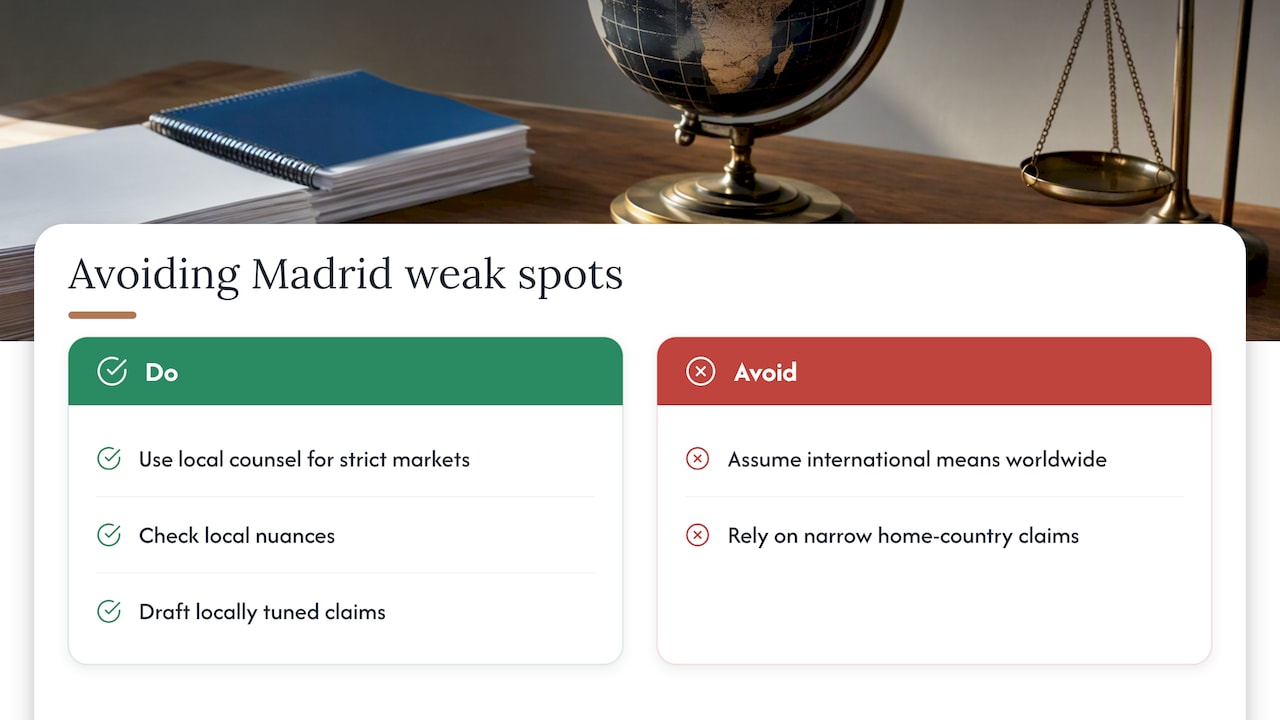
Narrow scope. Your international application has to match your basic mark’s goods and services. So you can end up with protection that is only as broad as your home-country filing, which may not be optimal under another country’s practice. Foreign counsel filing directly can often draft broader, locally tuned claims. This is described in the outbound process guidance of a national trademark office.
A false sense of security. An international registration is not a global one. You still have to pass examination in each country you designate. Experts say the biggest mistake is assuming a granted international registration equals worldwide protection without checking local nuances. When a country refuses, you answer through local counsel in that country, and the refusal affects that country alone.
When a market has strict examination or a very particular way of describing goods, a direct filing built with local counsel can be the cleaner path. If you are choosing between routes for a single high-value market, this is usually the deciding factor. Some brands that set up a physical presence abroad, for example through company formation services in a target country, also bring in local counsel at that stage, which makes a direct filing easy to add.
Which route fits which brand
There is no universal winner. Here is how we usually frame it for clients.
Madrid tends to fit when:
- You want coverage in many countries, especially secondary markets where you expect little conflict.
- Your Israeli trademark is already registered or well advanced and has been cleared with care.
- Your goods and services description is simple and maps cleanly across countries.
- You want one renewal date and one place to record changes.
Direct filing tends to fit when:
- You are entering one or two key markets where revenue, manufacturing or distribution is concentrated.
- You expect objections and want local counsel involved from the start.
- You need a bespoke description of goods or services that differs from your home registration.
- You do not want the fate of your foreign rights tied to your home mark for five years.
A hybrid is often smartest
Practitioners often note that businesses entering new markets should file directly where they expect local challenges or need specific wording, and use Madrid for the broad-brush coverage elsewhere. That is also how we would build a plan for most startups. Direct filings protect your core, and Madrid stretches your budget across the rest.
A worked example
Take an Israeli software company that sells in eight countries but earns most of its revenue in two. It has one Israeli trademark registered in the software classes.
- Step one: confirm the Israeli registration is clean and its goods and services description reflects the products being sold abroad.
- Step two: file directly in the two core markets, with local counsel drafting descriptions to fit local practice.
- Step three: file one Madrid application for the six remaining countries, naming only the classes the company really needs.
- Step four: diarize the five-year dependency date and the three-month transformation window.
The company pays local counsel where precision matters, and it pays only standard fees where it does not. It also avoids having its two most valuable registrations depend on a single basic mark. This is an illustration of method, not a quote or a prediction of outcome.
Choosing your first Israeli step
Whatever route you pick, the Israeli application comes first if you plan to use Madrid from Israel. That means a clearance search, a careful class selection and a clean filing. The classification matters because each additional class adds cost, and a gap in coverage is hard to repair later.
If you are a foreign brand that wants protection in Israel itself, the path is different. You can file directly with the Israeli Patent Office, or you can designate Israel in your own international application. Both are valid. Direct filing in Israel gives you a local registration that does not rely on a foreign basic mark. Designating Israel through Madrid is usually cheaper if you are already filing in many countries. Our team can help with either, working remotely, so you do not have to travel.
After registration: protecting what you filed
A registration is only useful if you can use it. If someone copies your mark in Israel, you need to act quickly and through the right channels. We cover the practical steps in our guide on enforcing a trademark in Israel from abroad.
Trademarks are also only one layer. Founders often need to sort out ownership of code, confidential know-how and licensing at the same time. These related guides can help:
- Software copyright for founders in Israel
- Trade secret protection in Israel
- Israeli IP licensing for overseas parties
Our perspective
We see the same pattern again and again. A founder hears that one application covers the world, files fast, and finds out two years later that the key market refused the mark and nobody was watching. The tool was fine. The plan was missing.
Our view is simple. Start with the Israeli foundation, because everything in a Madrid portfolio leans on it. Decide which two or three markets truly matter and treat them with local, tailored filings. Use Madrid to cover the rest efficiently. Then keep a calendar, because the dependency period and the transformation window are deadlines that do not bend.
Because we work with international clients, we handle the Israeli side remotely and communicate quickly, so you can make decisions without flying in. We also prefer to tell a client when the cheaper route is the right one. A good strategy saves more than it costs.
— Menora Law
Work with Menora Law on your Israeli trademark
If you need to register a trademark in Israel, whether as your base for a Madrid filing or as a market in its own right, our team can handle it end to end. We prepare and file trademark applications, advise on strategy, and support foreign brands protecting their intellectual property in Israel. See our full range of services on the Menora Law home page and get in touch to talk through your plan.
التعليمات
Is Madrid always cheaper than filing in each country?
Not always. Madrid usually wins when you need many countries, because you avoid repeated local filings and translations. For one or two countries, direct filing can cost about the same or less, since you skip the international bureau’s fees and the risk of a refusal caused by a narrow basic mark. The exact numbers depend on the countries and classes, so compare current fee tables before deciding.
What happens if my Israeli trademark is cancelled after I file through Madrid?
If this happens within the first five years, your international registration is affected in every designated country. You then have a three-month window to transform it into separate national applications that keep the original filing date. You would need local counsel and pay local fees in each country.
Does a Madrid registration protect my brand everywhere?
No. It protects you only in the countries you designate, and only if each one accepts the mark after its own examination. A refusal in one country does not cancel the rest, but you usually need a local lawyer to respond to it.
Can I file in Israel directly if I am a foreign company?
Yes. You can file with the Israeli Patent Office directly, or designate Israel in an international application. We can prepare and file for you remotely, so you do not need to travel to Israel.
Should I register in Israel before going international?
If you plan to use Madrid from Israel, yes. The Israeli application or registration is your basic mark, and its strength carries into your international portfolio. A clearance search before filing helps avoid problems later.
Sources
- WIPO: Madrid System, filing international trademark applications
- WIPO: Madrid e-Filing now available in Israel
- WIPO: Information Notice 4/2026, change in individual fees for Israel
- WIPO: Israel trademark annual technical report 2025
- WIPO: general information
- Berkeley Technology Law Journal: Madrid’s central attack
- USPTO: Madrid Protocol overview
- USPTO: outbound Madrid application process
- Israeli trademark e-services portal


 English
 Afrikaans
 العربية
 বাংলা
 Čeština
 简体中文
 Nederlands
 Suomi
 Français
 Deutsch
 עִבְרִית
 हिन्दी
 Magyar
 Italiano
 日本語
 한국어
 Polski
 فارسی
 Português do Brasil
 Русский
 Español de México
 Українська