
TL;DR:
- A Tzav Yerusha is the official Israeli decree that names heirs and their shares when someone dies without a will. It is required for transferring assets like real estate, bank accounts, and insurance policies to heirs. The process involves legal filings, document verification, and typically takes around 40 days for uncontested cases.
أ Tzav Yerusha (Succession Order) is the official decree issued by Israel’s Registrar of Inheritance Affairs that names the legal heirs and their shares when someone dies in Israel without a valid will. Without this order, banks, the Land Registry (Tabu), and insurance companies are legally prohibited from releasing or transferring any assets. If you are based abroad and a family member has died in Israel leaving no will, this document is your starting point for everything.
Here is what you need to do right now:
- Locate the decedent’s Israeli identity documents (teudat zehut or Israeli ID number) and any existing will
- Obtain a certified copy of the death certificate
- Gather proof of your relationship to the decedent (birth or marriage certificates)
- اتصال an محامي إسرائيلي with international experience before approaching any bank or registry
Pro Tip: Do not اتصل Israeli banks or insurance companies on your own before you have legal representation. Premature اتصل can complicate the process and, in some cases, trigger administrative holds on accounts.
What is a Tzav Yerusha under Israeli law?
A Tzav Yerusha is grounded in the قانون الخلافة لعام 1965, Israel’s primary statutory framework governing intestacy, inheritance rights, and the formal process for identifying heirs. This law defines who inherits, in what order, and in what proportions when no valid will exists.
The order itself is issued by the مسجل شئون المواريث, a government body operating under the Guardianship General. The Registrar handles the majority of uncontested cases. When complications arise, such as heir disputes, conflicting foreign wills, or incomplete documentation, the file is forwarded to the Family Court under the Succession Law, where a judge takes over.
The legal effect of the order is concrete and far-reaching:
- Banks release funds and close accounts in favor of named heirs
- Tabu (the Israel Land Registry) transfers registered real estate to heirs
- Insurance companies pay out policies to the identified beneficiaries
- The Israel Securities Authority and brokerage firms transfer securities holdings
ال Registrar issues the Succession Order digitally, sending it by email to the applicant and directly to cooperating government ministries. Printed copies are not issued.
Pro Tip: Save the original digital file the Registrar sends you. This is the operative document. A screenshot or printout carries no legal weight with banks or Tabu.
When do you actually need a Succession Order?
The trigger is intestacy: the decedent died without a valid will, or the will does not cover the entire estate. In either situation, a Tzav Yerusha is the only instrument that authorizes asset transfers under Israeli inheritance laws.
The asset types that cannot be accessed without the order include:
- Real estate — registered in Tabu or held through the Israel Lands Authority
- Company shares — in Israeli-registered entities
| Situation | Instrument Required | Issued By |
|---|---|---|
| No valid will (intestacy) | Tzav Yerusha (Succession Order) | Registrar / Family Court |
| Valid will exists | Tzav Kiyum Tzava’a (Probate Order) | Registrar / Family Court |
One practical note: certain categories, such as estates of fallen soldiers or recognized martyrs, may qualify for reduced fees or modified procedures. An محامي إسرائيلي can confirm whether any exemption applies to your case.
Who inherits and how are shares divided?
Under the Succession Law of 1965, heirs are ranked in a fixed hierarchy. The law distributes shares in this order:
- Spouse and children (first priority, inherit together)
- آباء (inherit if no spouse or children survive)
- إخوة (inherit if no parents survive)
- Grandparents, then their descendants (more distant heirs)
The spouse’s share depends on who else survives. With children present, the spouse receives half the estate and the children divide the remaining half equally. With no children but surviving parents, the spouse receives two-thirds and the parents share one-third.
Example calculation: A decedent leaves a spouse and two children. The estate is valued at 1,200,000 NIS.
- Spouse receives 600,000 NIS (one-half)
- Child A receives 300,000 NIS (one-quarter)
- Child B receives 300,000 NIS (one-quarter)
Two edge cases that frequently arise:
- Surviving spouse with no children or parents: The spouse inherits the entire estate.
- A child predeceases the decedent: That child’s share passes to their own children (the decedent’s grandchildren) by representation, not to the surviving siblings.
For a deeper look at how these rules interact with complex family structures, Menora Law’s Israeli inheritance law guide for families covers the full range of scenarios.
How to apply for a Succession Order from abroad
The process has clear stages, and each one requires specific documentation. Here is the full sequence for a U.S.-based heir.
Step 1: Assemble your documents
- Certified death certificate (legalized for use in Israel)
- Passport copies for all potential heirs
- Birth certificates and/or marriage certificates proving family relationships
- The decedent’s Israeli ID number (teudat zehut) if available
- Notarized Power of Attorney authorizing your محامي إسرائيلي to file on your behalf
Step 2: Authenticate and translate
Documents issued outside Israel must be authenticated. For most countries, this means an apostille under the Hague Convention. Documents from countries not party to the Hague Convention require consular legalization. All documents must be accompanied by certified Hebrew translations prepared by a translator recognized in Israel.

One specific requirement: if the decedent held Israeli citizenship but died abroad, the death must be registered in Israel’s Population Registry before the Succession Order application can proceed. Your محامي إسرائيلي handles this coordination.
Step 3: File with the Registrar
The application is submitted electronically through the Registrar Online portal for the district where the decedent last resided in Israel. Only a licensed محامي إسرائيلي can file electronically on behalf of a foreign heir.
Step 4: Publication and objection period
After submission, the Registrar publishes a notice. Any party with a claim has a window to object. If no objections are filed and the documentation is complete, the Registrar issues the digital order.
Step 5: Receive the digital order
The order is sent by email. As a rule, a complete submission results in issuance within about 40 days. If the file is referred to the Attorney General, the issuance time is generally longer. Contested matters referred to Family Court take considerably longer.
Pro Tip: Menora Law prepares a pre-filing validation package for remote clients: apostille-ready documents, certified Hebrew translations, and a notarized affidavit of heirship. This reduces Registrar requests for additional information and shortens the path to issuance.
What does the process cost and how long does it take?
Setting realistic expectations on both fronts helps you plan and avoid surprises.
Typical timeline
| Stage | Estimated Duration |
|---|---|
| Document collection and authentication | 2–4 weeks (varies by country) |
| Registrar review and publication | About 40 days after complete submission |
| Digital order issuance (uncontested) | 40–50 days from complete submission |
| Family Court litigation (contested) | Several months to over a year |
Cost components
| Cost Item | Typical Range |
|---|---|
| Registrar filing fee | Approx. 550 NIS (starting point; varies by case) |
| Certified Hebrew translations | Variable by document volume |
| Apostille or consular legalization | Variable by country and document count |
| Israeli attorney fees | Range varies by scope and complexity |
| Tabu registration (post-order) | Separate fee per property transaction |
Israel abolished inheritance tax in 1981, so heirs do not pay tax on receiving the estate itself. However, if you later sell inherited real estate, capital gains tax may apply under Israeli tax law. Confirming your specific tax exposure with an محامي إسرائيلي before any sale is advisable.
For cross-border estate planning that coordinates Israeli succession with broader wealth structures, NXD Family Office’s legal services offer a complementary perspective for high-net-worth families.
What complications should you watch for?
Most delays and cost overruns trace back to a predictable set of problems. Knowing them in advance gives you a real advantage.
- Heir disputes: — Any heir can file an objection during the publication period. Disputes over shares, the validity of relationship evidence, or competing claims from a second family move the case to Family Court automatically.
Pro Tip: Pre-filing outreach to all potential heirs, coordinated by your محامي إسرائيلي, often prevents objections from being filed in the first place. A certified family tree prepared before submission is one of the most effective tools for keeping a file with the Registrar.
Professional representation keeps an uncontested file administrative. Unresolved disputes or incomplete documentation typically move the case into litigation, with the cost and time implications that follow.
What you should do in the next 72 hours
If you have just learned of a death in Israel and believe you may be an heir, these are your immediate priorities.
Locate and secure:
- The decedent’s death certificate (or initiate the request for a certified copy)
- Any Israeli identity documents (passport, teudat zehut, Israeli ID number)
- Any document that might be a will, even if you believe it is invalid
- A list of all potential heirs with their contact details
Start the documentation process:
- Request certified copies of birth and marriage certificates that establish your relationship
- Identify which documents will need apostilles and begin that process
- Prepare a notarized Power of Attorney if you plan to file through an محامي إسرائيلي (which, for heirs abroad, is the practical path)
Contact actions:
- Open communication with Menora Law for a remote intake consultation before taking any other steps
- Do not notify Israeli banks or insurance companies independently; coordinate all contact through your محامي إسرائيلي to avoid complications
Menora Law’s guide for international heirs provides a detailed intake checklist and explains what to prepare before your first call.
How Menora Law helps U.S. heirs obtain a Succession Order
Menora Law handles the full scope of what a foreign heir cannot easily do from abroad. The firm’s services for international Succession Order cases include:
- Remote document checklist and intake consultation
- Power of Attorney preparation and notarization coordination
- Apostille and certified Hebrew translation coordination
- Electronic filing with the Registrar through the Registrar Online portal
- Liaison with Tabu, Israeli banks, and insurance companies post-order
- Family Court representation when a case becomes contested
The process for remote clients follows a clear sequence: remote intake, document legalization, electronic submission, publication monitoring, and digital order delivery followed by post-order asset transfers. Menora Law’s pre-filing validation approach, which includes apostille-ready documents, certified translations, and a notarized affidavit of heirship, reduces Registrar requests for additional information and shortens the overall timeline.
There are specific tasks that only a licensed محامي إسرائيلي can perform:
- File electronically through the Registrar Online portal on behalf of a foreign heir
- Appear before the Family Court if the case is referred
- Certify Hebrew documents for submission
- Liaise directly with Tabu and Israeli financial institutions using the digital Succession Order
Menora Law has guided international heirs through the Succession Order process across dozens of jurisdictions. The firm’s remote intake model means clients in the U.S. receive the same level of document preparation, filing precision, and post-order coordination as clients who walk into an Israeli law office. Speed of communication and pre-filing validation are the two factors that most consistently keep a file with the Registrar rather than in court.
For a broader view of Menora Law’s practice areas and how the firm handles cross-border legal matters, visit the practice areas overview.
Key Takeaways
A Tzav Yerusha (Succession Order) is the mandatory legal instrument under Israel’s Succession Law of 1965 that names heirs and authorizes asset transfers when no valid will exists.
| Point | Details |
|---|---|
| Succession Order is mandatory | No Israeli bank, Tabu, or insurer can release assets without a valid Tzav Yerusha. |
| Governing statute | The Succession Law of 1965 defines heir classes, shares, and the filing process. |
| Timeline for uncontested cases | A complete submission typically results in issuance within about 40 days from the Registrar. |
| Starting filing fee | The Registrar filing fee applies and varies by case complexity; total costs vary by document volume and legal scope. |
| Menora Law for remote heirs | Menora Law handles remote intake, apostille coordination, Registrar filing, and post-order asset transfers for U.S.-based heirs. |
What international heirs often get wrong about this process
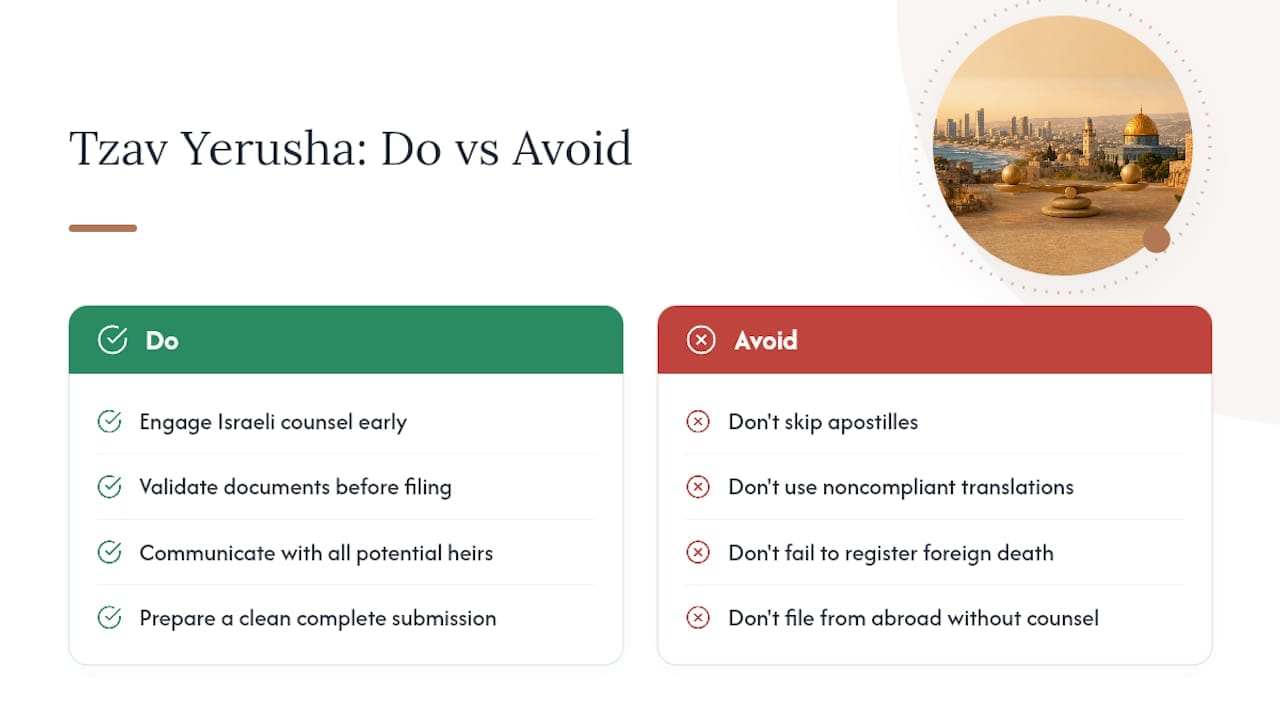
The most common misconception is that a Tzav Yerusha is simply a formality, something you file and wait for. In practice, the quality of what you submit determines almost everything: whether the file stays with the Registrar or moves to Family Court, whether the 40-day benchmark holds or doubles, and whether banks cooperate smoothly or raise procedural objections.
Heirs who try to manage the process from abroad without Israeli counsel frequently discover this the hard way. A missing apostille, a translation that does not meet Registrar standards, or a failure to register a foreign death in Israel’s Population Registry can each add months to the timeline. The Succession Law of 1965 is precise, and the Registrar’s administrative process reflects that precision.
The other underestimated factor is family dynamics. A sibling who feels overlooked, a second spouse, or a child from a prior relationship can file an objection during the publication period and move the entire case to Family Court with a single letter. Pre-filing outreach to all potential heirs, coordinated through counsel, is not just good practice. It is often the difference between a 40-day administrative process and a year-long litigation.
Menora Law’s approach prioritizes keeping files administrative. That means thorough pre-filing validation, early communication with all potential heirs, and precise document preparation before anything is submitted. The goal is a clean, complete submission that gives the Registrar no reason to ask questions.
Menora Law is ready to help you move forward
Dealing with an Israeli estate from abroad is genuinely complex, but it does not have to be slow or uncertain. Menora Law works exclusively with Israeli law and focuses specifically on international clients who need reliable, efficient representation without being physically present in Israel.
For U.S.-based heirs, the firm offers a remote intake process that covers everything from your initial document checklist through Registrar filing, publication monitoring, and post-order coordination with Tabu and Israeli banks. Before your first consultation, prepare the following:
- A copy of the death certificate (or confirmation that one is being obtained)
- Any Israeli identity documents you have located
- A brief list of potential heirs and their relationship to the decedent
- Any documents that may constitute a will
To get started, visit Menora Law’s Israeli inheritance law guide or the quick guide for heirs for fee estimates and intake details. Contact Menora Law directly to schedule a remote consultation and receive a scoped estimate for your case.
This article provides general information about Israeli inheritance law and is not legal advice. Succession rules, fees, and procedures can change. Confirm current requirements with the Registrar of Inheritance Affairs or a qualified Israeli lawyer before taking action.
Useful sources
The following official and practitioner resources are worth bookmarking as you move through the Succession Order process:
- Request an inheritance order | The Guardian General and Director of Inheritance Affairs
- Will registration (Property Registrar) | GOV.UK style service page (Israel)
- מה זה צו ירושה? הגדרה, הסבר ודוגמאות | מידע-הון
- Knesset legislative page (Succession Law references)
- International Heir Israeli Asset Claim: Your 2026 Guide
Store the digital Succession Order file securely once it is issued. It is the document you will present to every Israeli institution involved in the estate, and the Registrar does not reissue it in printed form.
التعليمات
What does Tzav Yerusha mean in Hebrew?
“Tzav Yerusha” translates directly as “Succession Order” or “Inheritance Order” in Hebrew. It is the official decree that identifies legal heirs and their shares under Israel’s Succession Law of 1965 when no valid will exists.
Is a Tzav Yerusha the same as a probate order?
No. A Tzav Yerusha (Succession Order) applies when there is no valid will (intestacy). A Tzav Kiyum Tzava’a (Probate Order) is issued when a valid will exists and needs to be formally recognized. Both are issued by the Registrar of Inheritance Affairs or the Family Court.
How long does it take to get a Succession Order in Israel?
For a complete, uncontested submission, the Registrar typically issues the order within 40 days. If the file is referred to the Attorney General, the benchmark extends to approximately 50 days. Contested cases referred to Family Court take considerably longer.
Can a U.S.-based heir apply for a Tzav Yerusha without traveling to Israel?
Yes. A U.S.-based heir can authorize an Israeli lawyer through a notarized Power of Attorney to file and manage the entire process remotely. Menora Law handles remote intake, document preparation, Registrar filing, and post-order asset coordination for international heirs.
Are there taxes on an Israeli inheritance?
Israel abolished inheritance tax in 1981, so heirs do not pay tax on receiving the estate. However, if inherited real estate is later sold, capital gains tax may apply under Israeli tax law. Confirming your specific exposure with an Israeli lawyer before any sale is the prudent step.
Recommended
- قانون الميراث والخلافة في إسرائيل: دليل شامل للمقيمين الأجانب والورثة |قانون المنصورة
- Inheritance Law In Israel – A Quick How To Guide 4 Great Rules For Heirs | Menora Law
- قانون الميراث في إسرائيل وقانون الميراث لعام 1965
- قانون الخلافة الإسرائيلي / التماسك الإسرائيلي / المحامي الإسرائيلي الولايات المتحدة الأمريكية


 English
 Afrikaans
 العربية
 বাংলা
বাংলা Čeština
 简体中文
简体中文 Nederlands
 Suomi
Suomi Français
 Deutsch
 עִבְרִית
 हिन्दी
 Magyar
 Italiano
 日本語
日本語 한국어
한국어 Polski
 فارسی
فارسی Português do Brasil
 Русский
 Español de México
 Українська