
TL;DR:
- Israeli consulates provide essential administrative support like notarizations and document authentication but do not offer legal representation or advice.
- For complex legal matters such as inheritance, property disputes, or cross-border transactions, consulting qualified Israeli attorneys is necessary beyond consular services.
When people think about getting legal help abroad, the Israeli consulate often comes to mind first. That’s understandable. The role of Israeli consulate legal matters is real and genuinely useful, but it covers far less ground than most people expect. Consulates provide administrative and documentary support — think notarizations, civil status registrations, and form processing — but they do not offer legal representation or legal advice in the way a qualified attorney would. Understanding exactly where consular services begin and end can save you significant time, money, and frustration, whether you’re an individual managing personal legal documents or a business handling cross-border Israeli paperwork.
Key takeaways
| Point | Details |
|---|---|
| Consulates don’t represent clients | Israeli consulates handle administrative legal tasks but do not provide legal counsel or court representation. |
| Authentication requires two steps | Proper document legalization requires both notarization and an apostille, and skipping either step causes rejection. |
| Services vary by consulate location | Fee schedules and available forms differ between consulates, so checking your specific consulate is a must before submitting anything. |
| Forms must be official | Consulates only process requests submitted on their published official forms, and deviations consistently lead to delays. |
| Complex matters need legal counsel | For inheritance, probate, or cross-border legal cases, qualified Israeli legal representation is required beyond what any consulate can provide. |
The role of Israeli consulates in legal matters
The term “consular legal services” is widely used but often misunderstood. The more precise way to describe it is consular administrative legal support, meaning consulates perform specific, form-driven tasks that touch legal processes without crossing into legal practice. Israeli consulates handle document authentication and provide general legal information, but they do not represent clients in disputes, draft legal strategies, or advise on case outcomes.
What consulates actually do is handle the bureaucratic infrastructure that Israeli law requires for citizens and certain foreign nationals living abroad. That includes verifying your identity on documents, certifying signatures, processing civil status changes, and forwarding official forms to the relevant Israeli authorities. These are not small tasks. Done incorrectly, they can block legal proceedings entirely. But they are distinct from the kind of legal work that requires a licensed attorney.
The distinction matters most when something goes wrong. If you’re dealing with an inheritance dispute, a contested property transaction, or a complex business agreement governed by Israeli law, a consulate cannot help you strategize, file motions, or negotiate on your behalf. That’s where private Israeli legal counsel becomes necessary. Understanding this gap upfront prevents the costly mistake of relying on consular services when you actually need a lawyer.
Consular notarization, authentication, and form services
The core legal-related functions of Israeli consulates fall into three categories: notarial services, document authentication (including apostilles), and official form processing. Each of these plays a specific role in how Israeli legal procedures are conducted abroad.
Notarial services
Consular notarization typically involves verifying the identity of the signatory on a document and certifying that the signature is genuine. This is commonly used for powers of attorney, affidavits, and consent forms that need to be recognized under Israeli law. The process is formal: you appear in person, present valid identification, and sign the document in front of a consular officer.
- Signature verification: The consular officer witnesses your signature and certifies it for official Israeli legal purposes.
- Affidavits: Sworn statements that may be required in legal proceedings, estate matters, or civil status applications in Israel.
- Power of attorney notarization: Businesses and individuals frequently use this when authorizing someone in Israel to act on their behalf legally.
Apostille and document legalization
An apostille is a standardized international certification that authenticates the origin of a public document. Apostille-related processing is a distinct consular service with its own fees, separate from standard notarial stamping. Many applicants make the mistake of obtaining only a notarial certification when their document also needs an apostille for it to be legally recognized in Israel.
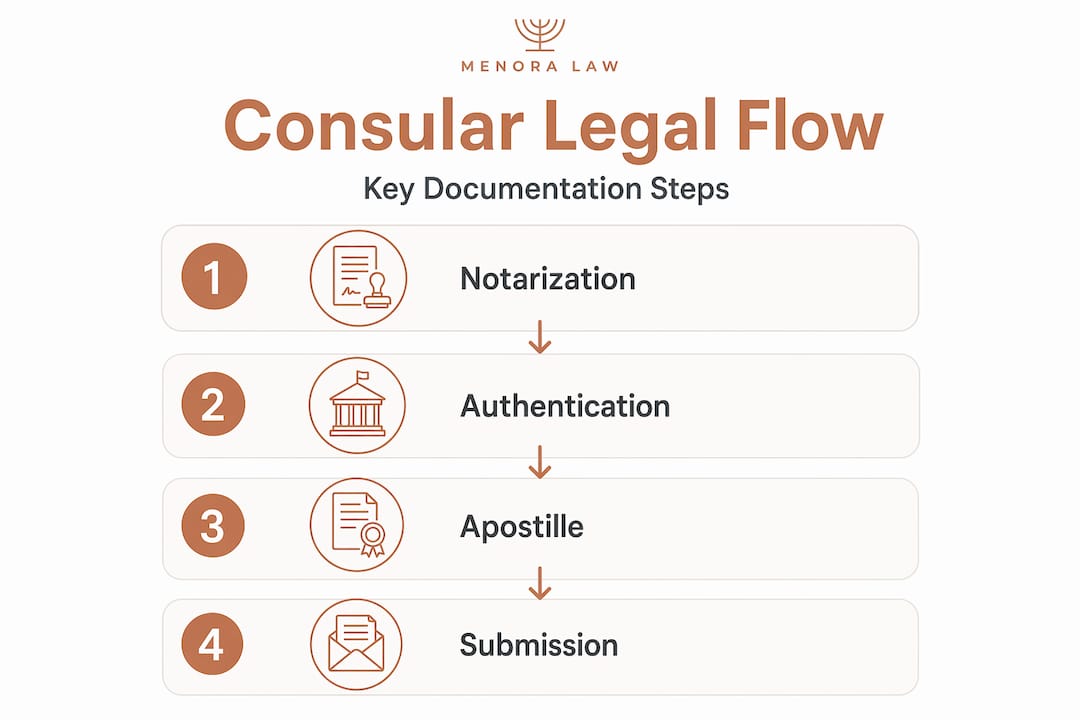
Both notarization and apostille steps are frequently required together, and missing either one leads to document rejection. The fee structures reflect this: consular offices in Saint Petersburg, for example, list separate charges for apostille orders versus notarial signature certification.
Pro Tip: Always Kontakt your specific consulate to ask whether your document requires both notarization and an apostille before your appointment. Assuming one covers the other is one of the most common and avoidable mistakes in this process.
Official form handling
Consulates process requests for civil status changes and other legal updates only through their published official forms. Submitting requests without the correct official forms consistently causes delays, and there is no shortcut around this. The consulate is not in a position to accept informal requests or accept documents that don’t match the required format.
Common forms handled through Israeli consulates include:
- Birth registration for children born abroad to Israeli parents
- Marriage and divorce registration updates for the Israeli population registry
- Status change forms tied to personal legal events
- Police clearance certificate requests
- Applications related to military service deferments for Israelis living abroad
How services differ by consulate location
One of the most frequently overlooked aspects of Israeli consular legal assistance is that not all consulates offer the same services. Service lists, forms, and fee schedules vary meaningfully between consulates, reflecting both jurisdictional differences and the local legal environment each consulate operates within.
Here is a general comparison to illustrate how this plays out in practice:
| Service category | New York consulate | Saint Petersburg consulate |
|---|---|---|
| Military deferment applications | Listed as a standard service | Not prominently listed |
| Apostille fees | Separate fee schedule applies | 1,000 RUB listed per apostille order |
| Notarial signature certification | Available | 1,470 RUB per certification |
| Civil status registration forms | Available via published forms | Registry forms listed on official forms page |
| Processing time expectations | Varies by service and volume | Varies; delays possible for complex documents |
The practical impact of these differences is significant. If you’re based in one consular district but assumed your experience would mirror what a friend in another district described, you could submit the wrong forms, underpay fees, or miss required steps entirely. Each Israeli consulate operates different services, and applicants must research their specific consulate before submitting any documentation.
Processing timelines also differ. High-volume consulates like New York may have longer wait times for appointments, while smaller consulates may have limited officer availability for complex notarial acts. Planning ahead is not optional when legal timelines are involved.
Pro Tip: Download the specific forms and fee schedule directly from your consulate’s official website, not from a general search. Forms are updated periodically, and submitting an outdated form is treated the same as submitting the wrong form.
Understanding the key differences in the Israeli legal system can also help you prepare for the procedural requirements you’ll encounter, whether you’re dealing with a consulate or with Israeli legal institutions directly.
Supporting individuals and businesses with legal documentation
The range of people who use Israeli consulate legal assistance is broad. Israeli citizens living abroad, dual nationals, foreign nationals with Israeli legal connections, and businesses operating across borders all interact with consular services for different reasons. The scope of what the consulate can do for each group is defined and limited, but within those limits, it’s genuinely useful.

Civil status registration
For individuals, civil status updates are among the most legally consequential services consulates provide. These include:
- Birth registration: Parents must register children born abroad to maintain the child’s Israeli legal status and citizenship rights.
- Marriage registration: Couples who marry abroad may need to register that marriage in the Israeli population registry through consular channels.
- Divorce registration: Legal divorces obtained abroad often require formal registration with Israeli authorities through the consulate to have legal effect in Israel.
Specific registry forms are handled through consulate submissions, and the process must follow the prescribed steps precisely. A missed signature or incorrect form can delay what is otherwise a straightforward administrative update.
Military service matters
For Israeli citizens of service age, living abroad doesn’t suspend obligations under Israeli law. Military service deferment applications are a standard consular service, allowing eligible Israelis abroad to formally request deferment through the consulate rather than returning to Israel for administrative processing.
Business and power of attorney services
Businesses that need someone in Israel to sign contracts, manage property, or act on their behalf legally frequently rely on consular notarization to formalize a power of attorney. The notarized document, once properly certified, carries legal weight under Israeli law and allows the designated representative to act without the principal being physically present in Israel.
The clear boundary of consular legal support
What consulates cannot do is equally important to understand. Israeli consulates do not provide legal representation and do not advise on case outcomes, legal strategy, or dispute resolution. For anything involving contested legal matters, court filings, inheritance proceedings, or complex contractual disputes under Israeli law, you need qualified Israeli legal counsel. That boundary is firm, and working with it rather than around it is the right approach.
For those managing cross-border Israeli legal matters, the consulate handles the documentation layer while a licensed attorney handles the substantive legal work.
How to access Israeli consular legal services effectively
Getting consular legal services right the first time requires preparation. Here’s a clear sequence that minimizes delays and avoids the most common errors.
Identify your consulate and its specific services. Find the consulate responsible for your geographic district. Visit its official website and confirm which services are available in your location. Don’t assume that a service offered elsewhere is available to you.
Download the correct official forms. Consulates process requests only using their published forms, and deviations cause delays. Use the forms section of your consulate’s website, confirm the version date, and use the most current version.
Gather required documentation. For most consular legal services, you’ll need a valid Israeli passport or national ID, supporting documents tied to the specific request (e.g., foreign birth certificate for birth registration), and any prior Israeli legal documents that are relevant.
Confirm the fee schedule. Apostille and notarial steps carry separate fees. Confirm the current schedule directly with the consulate, as fees are updated periodically. Ask about accepted payment methods in advance. Many consulates require exact payment in specific forms.
Schedule your appointment correctly. Some services require in-person appointments while others allow postal or online submission. Confirm the required method before you show up or mail anything.
Follow up with a tracking system. Once documents are submitted, keep copies of everything you sent, along with the submission date and any reference numbers provided. If processing extends beyond the stated timeline, Kontakt the consulate with this information ready.
Pro Tip: If your document needs both notarization and an apostille, ask the consulate explicitly whether both can be handled in one appointment or whether separate submissions are required. Some offices handle this sequentially, and knowing in advance prevents a second trip.
For matters involving inheritance and succession law in Israel, the consulate may help with document authentication, but the legal process itself requires proper legal representation.
My take on consular legal matters
I’ve worked with clients from many countries who arrived at Menora Law after spending months trying to resolve complex Israeli legal matters through consular channels alone. The frustration is understandable. The consulate feels like the most accessible Israeli authority when you’re abroad, and it is accessible. But accessible doesn’t mean sufficient for everything.
What I’ve learned is that the real problem isn’t the consulate itself. It performs its administrative role well. The problem is a gap in expectations. People assume that a notarized document from a consulate, combined with a phone call to the consular office, constitutes legal preparation for an inheritance case or a property dispute. It doesn’t. Those are two entirely different categories of support.
The cases that concern me most are those involving time-sensitive legal matters, like inheritance claims under Israeli succession law, where there are actual statutory deadlines. Clients who spent months in consular queues sometimes arrive after critical windows have closed. True legal advice requires qualified Israeli counsel, especially for complex cross-border cases, and acting on that early makes an enormous difference.
My practical advice: use the consulate for what it does well, which is document authentication, status registration, and form processing. Then engage a qualified Israeli attorney for anything involving legal rights, disputes, transactions, or proceedings. These two resources complement each other rather than substitute for one another. The clients who understand that distinction consistently get better outcomes.
— Menora Law
How Menora Law supports clients beyond the consulate
When consular support reaches its limits, Menora Law steps in. For Israelis and foreign nationals managing legal matters in Israel from abroad, having experienced Israeli legal representation is not a luxury. It’s the difference between getting a matter resolved and watching it stall indefinitely.
Menora Law handles Israeli inheritance and estate law for overseas clients, including probate proceedings, estate administration, and succession disputes that consulates simply cannot assist with. If you’re dealing with an Israeli estate, a property transaction, or a cross-border legal matter requiring actual legal strategy, Menora Law provides the kind of representation that moves things forward. The team works remotely with clients worldwide, communicates quickly, and builds legal strategies specific to your situation.
For complex matters involving Israeli estate law or any Israeli legal proceedings that go beyond documentation, Kontakt Menora Law directly. Getting proper counsel early protects your rights and avoids the delays that come from trying to manage substantive legal matters through administrative channels.
FAQ
What legal services do Israeli consulates actually provide?
Israeli consulates provide administrative legal support such as notarization, signature verification, apostille processing, and official form handling for civil status changes. They do not offer legal representation or legal advice.
Can an Israeli consulate represent me in a legal dispute?
No. Israeli consulates do not represent clients in legal disputes, negotiations, or court proceedings. For legal representation under Israeli law, you need a qualified Israeli attorney.
Why do legal documents submitted to consulates get rejected?
Incomplete consular workflows are the most common cause, including missing official forms or skipping required legalization steps like the apostille. Using the correct, current forms and completing both notarization and apostille steps reduces rejection risk significantly.
Do all Israeli consulates offer the same services?
No. Service lists and fee schedules vary between consulates based on jurisdictional and procedural differences. Always verify the available services and current fees directly with your assigned consulate before submitting documents.
When should I hire an Israeli lawyer instead of relying on the consulate?
Whenever your matter involves legal rights, inheritance, property transactions, disputes, or court proceedings, you need qualified Israeli legal counsel rather than consular support. The consulate handles documentation. A lawyer handles the legal substance.


 English
 Afrikaans
 العربية
 বাংলা
বাংলা Čeština
 简体中文
简体中文 Nederlands
 Suomi
Suomi Français
 Deutsch
 עִבְרִית
 हिन्दी
 Magyar
 Italiano
 日本語
日本語 한국어
한국어 Polski
 فارسی
فارسی Português do Brasil
 Русский
 Español de México
 Українська