
TL;DR:
- Israeli legal compliance for foreign clients involves navigating multiple regulators and detailed documentation requirements. Proper mapping of obligations, proactive planning, and expert legal support are essential to avoid gaps and penalties. Menora Law offers tailored, remote legal services to help English-speaking clients meet Israeli regulatory standards effectively.
Israeli legal compliance for English-speaking clients is defined as the process of meeting all regulatory, tax, corporate governance, and documentation obligations imposed by Israeli law on foreign individuals and businesses operating in or with Israel. This is not a single checklist. It is a structured approach to a fragmented regulatory environment that spans the Israeli Tax Authority, the Israel Securities Authority (ISA), the Tel Aviv Stock Exchange (TASE), and multiple sector-specific bodies. Menora Law works with English-speaking clients worldwide to make this process clear, manageable, and strategically sound. The core areas that demand attention are regulatory reporting, transfer pricing documentation, export controls, and corporate governance. Getting these right from the start protects your business, your assets, and your standing under Israeli law.
What are the main Israeli regulatory compliance requirements for English-speaking clients?

Israel’s compliance framework is not governed by a single authority. Foreign individuals and businesses face obligations spread across several regulators, each with its own rules, timelines, and reporting formats. Understanding who regulates what is the first step toward meeting your obligations.
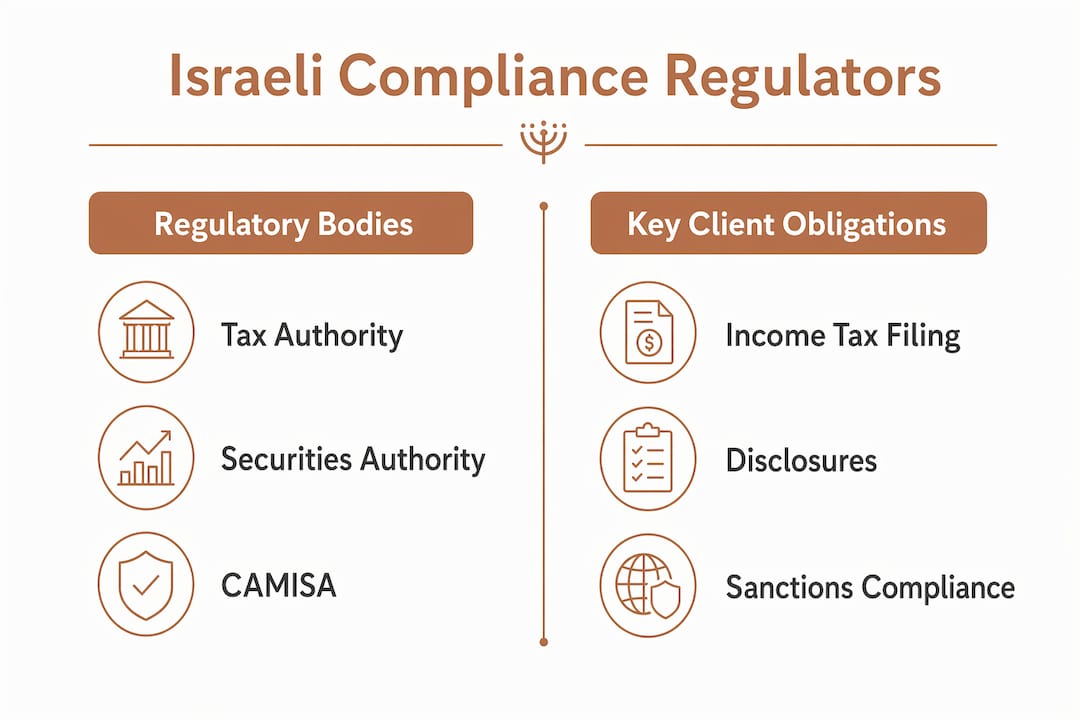
The primary regulatory bodies relevant to English-speaking foreign clients include:
- Israeli Tax Authority (ITA): Governs income tax, VAT, transfer pricing, and reporting for residents and non-residents with Israeli-source income.
- Israel Securities Authority (ISA): Oversees corporate governance and disclosure obligations for public companies and certain investment vehicles.
- Tel Aviv Stock Exchange (TASE): Sets listing and reporting standards for companies traded in Israel.
- CAMISA and MOEP: Handle environmental and sustainability-related compliance, relevant to businesses with Israeli operations.
- Defense Export Controls Directorate: Regulates the export of dual-use goods and defense-related technology, a critical area for tech companies and manufacturers.
Israel’s multi-regulator ESG framework means no single body oversees all compliance obligations. This matters because a foreign business that satisfies the ITA may still be out of compliance with ISA disclosure rules or MOEP environmental standards.
| Regulatory Area | Governing Body | Key Obligation for Foreign Clients |
|---|---|---|
| Income tax and transfer pricing | Israelische Steuerbehörde | File returns, maintain TP documentation |
| Corporate governance and ESG | ISA, TASE, CAMISA, MOEP | Disclose ESG data, follow governance codes |
| Export controls and sanctions | Defense Export Controls Directorate | Obtain licenses, screen transactions |
| VAT and indirect tax | Israelische Steuerbehörde | Register and file if conducting business in Israel |
For multinational groups, transfer pricing is one of the most technically demanding areas. Master File obligations apply when group revenues reach 150 million NIS, and Country-by-Country Reporting (CbCR) is triggered at 3.4 billion NIS. These thresholds are specific to Israel and differ from OECD defaults, so foreign groups that assume their existing documentation satisfies Israeli requirements often find gaps during audits.
Export controls and sanctions compliance add another layer for technology companies and manufacturers. Tailored legal strategies for cross-border Israeli compliance cover sanctions screening, export licensing, and FCPA considerations, all of which require English-language legal support to manage effectively from abroad.
For new immigrants and certain returning residents, a temporary income tax exemption applies to qualifying Israeli-source income from 2026 through 2030. This benefit is significant but comes with specific eligibility conditions that must be documented and reported correctly to the ITA.
How to prepare and maintain effective compliance documentation
Documentary readiness is the foundation of Israeli legal compliance. Israeli regulators, particularly the ITA, operate on a request-based audit model. You may not be asked to submit documents immediately, but when a request comes, you need to produce complete, organized records quickly. Gaps in documentation are treated as compliance failures, not administrative oversights.
The three-tier transfer pricing documentation structure is the most demanding documentation obligation for multinational groups operating in Israel:
- Local File: Documents the specific intercompany transactions of the Israeli entity, including pricing methods, comparability analysis, and supporting financial data. This must be prepared annually and updated to reflect changes in business structure or transaction volumes.
- Master File: Required when group revenues exceed 150 million NIS. Covers the group’s global business, organizational structure, intangible assets, and intercompany financing. Must be submitted to the ITA within 12 months of the tax year end.
- Country-by-Country Report (CbCR): Required at 3.4 billion NIS group revenues. Provides a jurisdiction-by-jurisdiction breakdown of revenue, profit, tax paid, and employee headcount. Israel adopted OECD-aligned CbCR rules effective from the 2022 tax year.
Beyond transfer pricing, a complete compliance documentation program includes:
- Intercompany agreements that reflect actual transaction terms and are updated when business arrangements change
- Invoices and payment records for all cross-border transactions
- Board resolutions and corporate governance records in line with Israeli company law
- Risk assessments covering tax, regulatory, and operational exposures
- Written compliance policies and employee training records
- Incident response documentation for any regulatory inquiries or breaches
Pro Tip: Maintain a compliance calendar that maps each obligation to its specific Israeli regulator, submission deadline, and responsible team member. This approach, recommended by practitioners working with Israel’s fragmented regulatory system, prevents missed deadlines and reduces audit risk significantly.
The comparison below shows how documentary requirements differ between a foreign individual and a foreign-owned Israeli company:
| Compliance Area | Foreign Individual | Foreign-Owned Israeli Company |
|---|---|---|
| Income tax filing | Annual return if Israeli-source income exists | Annual corporate return, transfer pricing docs |
| VAT registration | Required if conducting taxable activity in Israel | Required from first taxable transaction |
| ESG reporting | Not applicable | Applicable if publicly listed or regulated |
| Export controls | Case-by-case licensing | Ongoing screening and licensing program |
Cross-border documentary readiness is not just about having documents. It is about having documents that tell a consistent, accurate story about your transactions and business activities. Inconsistencies between intercompany agreements and actual invoices are a common trigger for ITA audit inquiries.
What are common challenges English-speaking clients face with Israeli compliance?
The most frequent compliance failures among English-speaking foreign clients are not caused by bad intentions. They come from misreading the regulatory environment, missing submission windows, or assuming that compliance frameworks from other jurisdictions translate directly to Israel. They do not.
The core challenges break down into four areas:
- Multi-regulator confusion: Because Israel’s compliance obligations are spread across ISA, TASE, CAMISA, MOEP, and the ITA, foreign clients often satisfy one regulator while unknowingly failing another. A company that files its ITA returns correctly may still be non-compliant with ISA disclosure requirements if it has Israeli shareholders or listed instruments.
- Deadline misalignment: Israeli tax and regulatory deadlines do not align with those in most other jurisdictions. The ITA’s transfer pricing documentation submission window, the ISA’s annual report deadlines, and MOEP’s environmental reporting cycles all run on different timelines. Foreign clients managing compliance from abroad frequently miss these windows.
- Language and translation gaps: While the ISA recommends English-language ESG reporting for public companies seeking international investors, most official regulatory guidance, forms, and correspondence from Israeli authorities are issued in Hebrew. Without qualified legal support, foreign clients cannot reliably interpret regulatory expectations or respond to official inquiries.
- Documentation inconsistencies: Intercompany agreements drafted under foreign law often do not meet Israeli transfer pricing standards. Pricing methods accepted in other jurisdictions may not satisfy the ITA’s comparability requirements.
“The single most common mistake we see from foreign clients is assuming their existing compliance framework covers Israel. It rarely does. Israel has its own thresholds, its own regulators, and its own documentation standards. The gap between what you think you have and what the ITA expects can be significant.”
Pro Tip: When you receive any official correspondence from an Israeli regulatory body, treat it as urgent regardless of the apparent tone. Israeli regulators issue formal requests with strict response deadlines, and missing a response window can escalate a routine inquiry into a formal enforcement action.
Understanding key structural differences in the Israeli legal system is the most direct way to avoid these pitfalls. Israel’s legal system blends civil law principles with common law traditions, which means legal concepts that feel familiar to English-speaking clients often operate differently in practice.
How can English-speaking clients engage Israeli legal services effectively?
Accessing qualified legal advice for English speakers in Israel requires more than finding a firm that speaks English. It requires finding practitioners who understand both the Israeli regulatory environment and the specific context of international clients operating from abroad. The gap between these two things is where compliance failures happen.
The right legal partner for English-speaking clients provides:
- Hebrew-to-English regulatory translation: Not just language translation, but the ability to interpret what Israeli regulators actually expect and communicate that clearly to foreign clients.
- Multi-area coverage: Israeli compliance for foreign clients rarely involves a single legal issue. A firm that handles only tax, or only corporate law, will leave gaps. Menora Law covers inheritance law, business law, real estate, and intellectual property, giving international clients a single point of Kontakt across their Israeli legal needs.
- Remote representation: Most English-speaking clients cannot attend hearings, meetings, or regulatory submissions in person. A firm with established remote representation capabilities handles filings, correspondence, and regulatory interactions on your behalf without requiring your physical presence in Israel.
- Fast, direct communication: Regulatory timelines in Israel are strict. A legal partner who responds within hours, not days, is not a luxury. It is a compliance requirement when deadlines are tight.
- Proactive compliance strategy: The best legal support does not wait for problems to arise. It maps your obligations, identifies gaps, and builds a compliance program before regulators come asking.
Menora Law’s approach to legal matters for foreigners reflects this model directly. International clients get personalized strategies built around their specific business structure, residency status, and Israeli regulatory exposure. Whether you are a foreign individual with Israeli inheritance assets, a multinational group with an Israeli subsidiary, or an expatriate setting up a business, the compliance path is different in each case and needs to be treated that way.
For businesses considering registering in Israel as a non-resident, the compliance obligations begin at registration, not at the point of first revenue. VAT registration, corporate governance setup, and transfer pricing documentation frameworks should be in place before the first intercompany transaction occurs.
Key takeaways
Israeli legal compliance for English-speaking clients requires a regulator-specific, documentation-first approach built on qualified Hebrew-language legal support and a clear map of all applicable Israeli obligations.
| Point | Details |
|---|---|
| Multi-regulator framework | Israel’s compliance obligations span ISA, TASE, ITA, CAMISA, and MOEP, each with separate requirements. |
| Transfer pricing thresholds | Master File applies from 150 million NIS revenues; CbCR applies at 3.4 billion NIS group revenues. |
| Documentary readiness | Maintain intercompany agreements, invoices, and risk assessments to satisfy ITA audit requests. |
| Language and deadline gaps | Official Israeli regulatory guidance is in Hebrew, and deadlines differ from most foreign jurisdictions. |
| Specialized legal support | Firms with English capability and Israeli regulatory expertise prevent the most common compliance failures. |
What working with English-speaking clients on Israeli compliance has taught us
After working with foreign individuals and businesses across dozens of Israeli compliance matters, the pattern is consistent. Clients who struggle most are not the ones with complex structures. They are the ones who assumed their existing compliance framework was close enough to what Israel requires. It almost never is.
Israel’s regulatory environment is genuinely different. The multi-regulator structure means that being compliant with one body gives you no protection from another. The ITA’s transfer pricing documentation standards are specific and detailed. The ISA’s governance expectations for public companies are real obligations, not suggestions. And the deadlines are firm.
What we have found works is a straightforward approach: map every obligation to the specific Israeli regulator responsible for it, build a compliance calendar, and treat documentary readiness as an ongoing operational function rather than a pre-audit scramble. Clients who do this consistently avoid the enforcement inquiries that catch others off guard.
The other thing that matters is communication. Foreign clients need to understand what is happening with their Israeli compliance in plain English, without waiting days for a response. That is not a nice-to-have. When a regulatory deadline is approaching or an ITA inquiry arrives, fast, clear communication is what keeps a manageable situation from becoming a serious one.
Menora Law builds its practice around exactly this model. International clients get direct access to Israeli legal expertise, clear explanations of what is required and why, and representation that works across time zones without requiring them to be present in Israel.
— Menora Law
How Menora Law helps English-speaking clients with Israeli compliance
If you are an English-speaking individual or business with Israeli legal obligations, Menora Law provides the specialized support you need to stay compliant and protected.
Menora Law’s team combines deep Israeli legal expertise with genuine international client focus. From transfer pricing documentation and corporate governance to inheritance matters and real estate transactions, the firm handles the full scope of Israeli legal services for foreign clients. Remote representation, fast communication, and personalized compliance strategies mean you get expert Israeli legal support without needing to be in Israel. Whether you are just starting to understand your obligations or facing an active regulatory inquiry, Menora Law is ready to help. Kontakt the team today to discuss your specific situation and get a clear plan in place.
FAQ
What does Israeli legal compliance mean for foreign clients?
Israeli legal compliance for foreign clients means meeting all tax, regulatory, corporate governance, and documentation obligations imposed by Israeli law on non-residents operating in or with Israel. The specific requirements depend on your business structure, residency status, and the nature of your Israeli activities.
Which Israeli regulators do English-speaking businesses need to know about?
The primary regulators are the Israeli Tax Authority, the Israel Securities Authority, TASE, CAMISA, and the Defense Export Controls Directorate. Each governs a different compliance area, and obligations under one regulator do not substitute for obligations under another.
When does transfer pricing documentation become mandatory in Israel?
The Master File is required when group revenues reach 150 million NIS, and Country-by-Country Reporting applies at 3.4 billion NIS. The Local File is required for any Israeli entity with intercompany transactions, regardless of revenue size.
Are there tax benefits available for new immigrants to Israel?
A temporary tax exemption on qualifying Israeli-source income applies to new immigrants and veteran returning residents for the 2026 through 2030 tax years. Eligibility conditions must be documented and reported correctly to the ITA to claim the benefit.
Why do English-speaking clients need Israel-specific legal support?
Israeli regulatory guidance is issued in Hebrew, deadlines differ from most foreign jurisdictions, and Israel’s compliance thresholds and documentation standards are specific to Israeli law. A firm with both English capability and Israeli regulatory expertise, like Menora Law, bridges this gap and prevents the most common compliance failures foreign clients face.


 English
 Afrikaans
 العربية
 বাংলা
বাংলা Čeština
 简体中文
简体中文 Nederlands
 Suomi
Suomi Français
 Deutsch
 עִבְרִית
 हिन्दी
 Magyar
 Italiano
 日本語
日本語 한국어
한국어 Polski
 فارسی
فارسی Português do Brasil
 Русский
 Español de México
 Українська