
No, Israel does not currently charge an inheritance tax or an estate tax. Receiving an inheritance itself is not a taxable event under Israeli law. That said, heirs regularly face real tax bills down the road, and this is where most people get caught off guard.
Here’s what actually creates tax exposure after you inherit:
- Capital gains or betterment tax (מס שבח) when you later sell inherited real estate
- Capital gains tax on securities or investment accounts you inherit and eventually sell
- Income tax on rental income, dividends, or interest the estate or its assets generate
- Municipal property tax obligations that continue on any real estate you now hold
- Purchase tax in some cases when you buy out a co-heir’s share of jointly inherited property
Israel abolished its estate tax in 1981, and no political effort since has brought it back, despite periodic proposals. But “no inheritance tax” doesn’t mean “no tax consequences.” Before you register a property in your name or agree to sell anything, get a proper valuation, check for liens or mortgages on the asset, and hold off on irreversible moves until you understand where the tax exposure actually sits.
Key Takeaways
Israel abolished its inheritance tax in 1981, but heirs still face capital gains, betterment tax, and income tax on inherited assets once they sell, rent, or invest them.
| Point | Details |
|---|---|
| No inheritance tax exists | Israel repealed estate tax in 1981; receiving an inheritance itself triggers no direct tax. |
| Tax hits later transactions | Selling property, cashing out shares, or earning rental income creates the real tax exposure. |
| Cost basis carries over | The step-over rule means gains are calculated from the deceased’s original purchase price and date. |
| Protect your first division | Keep divisions free of outside cash payments to preserve tax-exempt treatment among heirs. |
| Get professional guidance early | Menora Law helps international heirs manage reporting, division agreements, and Tax Authority negotiations remotely. |
Is There a Mas Yerusha in Israel? The Legal Status Explained
The short legal history matters here, because it explains why so many people search for “מס ירושה בישראל” and find conflicting answers. Israel repealed its estate tax law, חוק מס עיזבון, in 1981. Since then, no statute has imposed a direct tax on the act of inheriting assets, whether that’s cash, real estate, securities, or a business interest.
Die Taxation of Real Estate Act reinforces this by explicitly stating that a transfer of property through inheritance is not treated as a “sale” for tax purposes. That single distinction is the legal backbone of everything that follows in this article. No sale, no immediate capital gains event, no immediate betterment tax.
But here’s the nuance that trips people up: the law doesn’t erase the tax history of the asset, it just pauses it. The tax authority isn’t taxing the transfer. It’s waiting for the next transaction, whether that’s a sale, a rental agreement, or a dividend payout, and taxing that instead.
A few things worth keeping in mind:
- Israel’s government has floated reintroducing an estate tax more than once, usually tied to broader tax reform debates
- None of those proposals has become law as of 2026
- Because the legal landscape can shift, holding inherited assets without a plan is riskier than it looks on paper
This is exactly why families with property, investment portfolios, or business interests in Israel benefit from professional guidance early, not after a sale is already underway. Menora Law’s inheritance law guide walks through how this framework applies to real family situations.
How the Step-Over Rule Triggers Tax After You Inherit
Israeli tax law applies what’s often called a continuity principle, sometimes referred to informally as a “step-over” rule. When you inherit an asset, you don’t get a fresh tax slate. You inherit the deceased’s original cost basis and original purchase date along with the asset itself.
Practically, that means:
- The tax authority calculates any future capital gain using the original purchase price the deceased paid, not the value of the asset on the day you inherited it.
- Die holding period for tax purposes stretches back to the deceased’s original acquisition date, not the date of death.
- When you eventually sell, betterment tax (מס שבח) or capital gains tax gets calculated on the full gain since that original purchase, often decades earlier.
It’s worth pausing on how this differs from other countries’ systems, purely for context: some jurisdictions apply a “step-up” in basis at death, resetting the cost to the date-of-death value. Israel does the opposite. The gain keeps accumulating from the original owner’s purchase.
Here’s a simplified version of how this plays out. Say a parent bought an apartment in 2000 for 500,000 shekels. By the time they pass away, the apartment is worth 3,000,000 shekels. You inherit it and sell it shortly after for 3,000,000 shekels. Your taxable gain isn’t zero just because you sold near the value at death, it’s measured against the original 500,000 shekel base, which can produce a substantial betterment tax bill even though you personally never benefited from the appreciation until the sale.

This is why documentation of the deceased’s original purchase price and any capital improvements made over the years matters enormously. Without it, you may end up overpaying or facing disputes with the tax authority over your cost basis.
What Tax Applies to Each Type of Inherited Asset?
Different assets carry very different tax profiles once you inherit them. Here’s how the major categories break down.
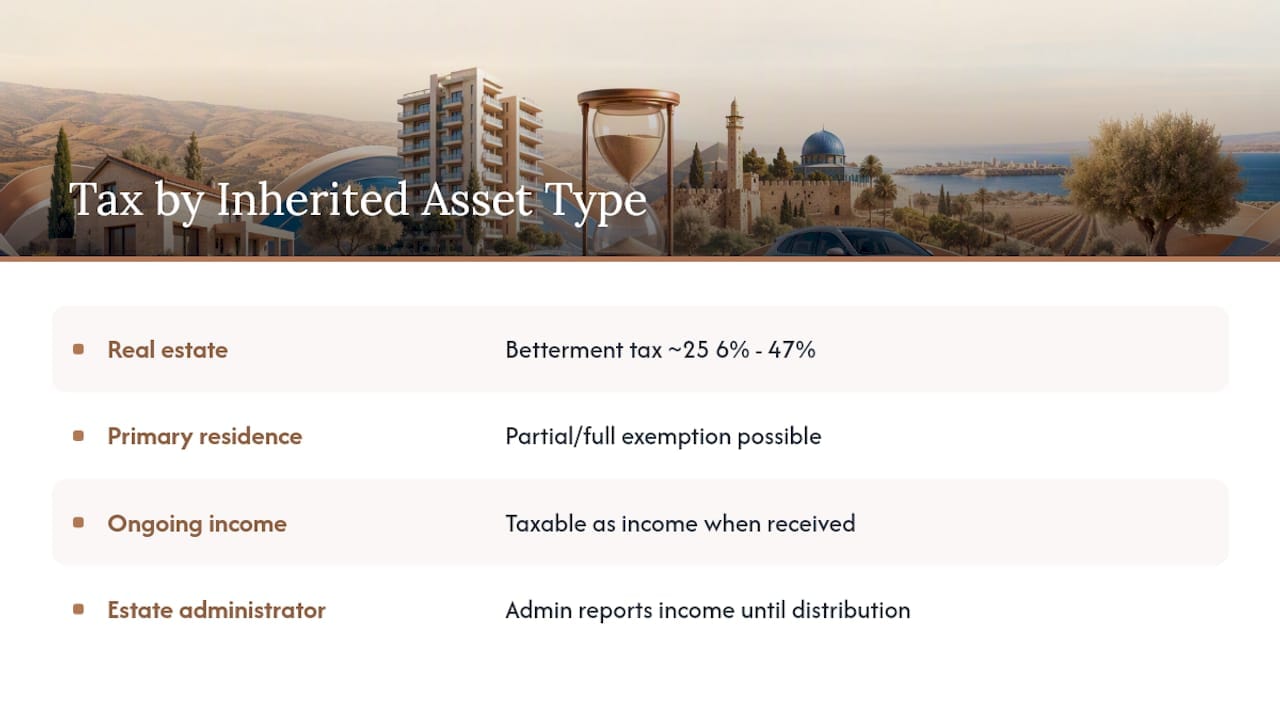
A few notes worth expanding on beyond the table. The effective rate range for real estate betterment tax can run anywhere from roughly 25% up toward 47% depending on the specifics of the sale and the seller’s circumstances, so getting a professional calculation before listing a property is not optional if you want to avoid a nasty surprise.
Exemptions matter too. Selling an inherited apartment that qualifies as your primary residence can trigger a partial or full exemption from betterment tax, but the qualifying conditions are specific and easy to misjudge.
Where things get taxable fast is with ongoing income. Rental payments, dividends from inherited shares, and interest on inherited accounts are all taxable income the moment they’re received, and the estate administrator is typically responsible for reporting that income until the assets are formally distributed.
Protect Your First Division Before You Register or Sell
The “first division” protection is one of the most valuable, and most misunderstood, features of Israeli inheritance tax law.
The protection breaks down fast when outside money enters the picture. If one heir pays another heir cash from their own pocket to “even out” an unequal division, the Israel Tax Authority can treat that as a sale rather than a protected division, triggering purchase tax or capital gains tax that could have been avoided entirely. Staged transfers, where the division happens in pieces over time rather than as one clean agreement, raise similar red flags.
Before you register a property in your name or sign anything related to selling it, work through this checklist:
- Get a professional valuation of the property or asset before any division or sale discussion begins.
- Request a tax clearance certificate confirming there are no outstanding liabilities against the property.
- Confirm there are no existing mortgages, liens, or encumbrances you’d be inheriting along with the asset.
- Preserve estate funds in a separate account until you know what tax liabilities the estate may owe.
- Pause any property registration or sale until the division agreement is finalized and reviewed.
Pro Tip: If siblings or co-heirs are dividing unequal assets, structure the division entirely with estate funds and assets, never outside cash, and get it in writing before anyone signs a property transfer. That single step preserves the tax exemption that outside payments would otherwise destroy.
If your estate involves property, cross-border assets, or multiple heirs, this is the point where pausing and calling a lawyer costs far less than fixing a mistake after the fact.
Reporting Deadlines and Penalties You Need to Know
Even without an inheritance tax, there are real paperwork obligations attached to receiving one, and missing them creates its own financial risk.
Heirs or the appointed estate administrator are generally expected to file an estate declaration, often referenced by Form 1121, disclosing the assets involved. Practitioners commonly point to a six-month window from the relevant triggering event as the practical benchmark for getting this reporting done, along with securing valuations for any real estate or business interests in the estate.
Miss that window, or file something incomplete, and the Israel Tax Authority can issue its own assessment of taxes owed, potentially layering on interest and penalties for the delay. That’s a much worse position than filing accurately and on time, especially since assessments issued by the tax authority can be difficult and expensive to challenge after the fact.
A few habits make this process far smoother:
- Keep a clear chain-of-title record for every asset in the estate, especially property that’s changed hands or been renovated over the years
- Save every valuation report, appraisal, and professional opinion tied to estate assets
- Document all correspondence with the Israel Tax Authority in writing, including phone call summaries
Planning Moves That Reduce Your Tax Exposure Later
You can’t eliminate future tax exposure entirely, but you can reduce it substantially with the right moves made early, before assets change hands or get sold.
- Get an independent valuation of every major asset as close to the date of death as possible, this becomes your reference point for years
- Put the division agreement in writing, signed by all heirs, before anyone takes possession or registers anything
- Avoid outside cash payments between heirs to balance an uneven split, use estate assets instead
- Time any sale of inherited property around exemption eligibility rather than rushing to liquidate
A signed, well-documented division agreement is what preserves the first-division tax protection discussed earlier. Without it, informal handshake arrangements are far more vulnerable to being reclassified as taxable transactions if the tax authority ever asks questions.
Pro Tip: If the estate includes assets outside Israel, don’t handle Israeli reporting in isolation. Coordinate with advisors in both jurisdictions early to avoid double taxation and to check whether any treaty relief applies to your situation.
Menora Law’s Perspective on Inheritance Tax Risk
The gap between what people expect and what actually happens with Israeli inheritance tax comes down to one thing: everyone focuses on the word “tax” in the headline question, and almost nobody focuses on the timing. Yes, Israel has no inheritance tax. That part of the story gets repeated everywhere. What gets buried is that the real financial exposure shows up months or years later, when an heir sells a property, cashes out shares, or simply forgets that rental income from an inherited apartment still needs to be reported.
Menora Law works specifically with international clients navigating exactly this gap, heirs living in the United States or elsewhere who suddenly find themselves responsible for an Israeli estate they can’t manage in person. That distance is where mistakes happen fastest: a rushed sale, an informal cash arrangement between siblings, a missed filing deadline because nobody realized the six-month clock was running.
Our work includes handling estate declarations and reporting, negotiating directly with the Israel Tax Authority when assessments come in higher than expected, drafting division agreements that actually hold up under scrutiny, and representing overseas heirs through probate and property sales without requiring them to fly to Israel for every step. If your case involves cross-border assets or a division that isn’t perfectly clean, that’s exactly when a second set of experienced eyes matters most. Our inheritance law resources go deeper into how we structure that support for clients abroad.
— Menora Law
Israeli Legal Support Built for Heirs Living Abroad
Handling an Israeli estate from Los Angeles, New York, or anywhere outside Israel is a different challenge than handling one locally. You’re dealing with a legal system you don’t navigate daily, a tax authority that communicates in Hebrew, and deadlines that don’t pause because you’re thousands of miles away. Menora Law built its inheritance practice specifically around solving that distance problem for American and international heirs.
Where a general estate attorney might handle probate paperwork, Menora Law coordinates the full picture, tax reporting, division agreements, and negotiations with the Israel Tax Authority, all managed remotely so you’re not stuck flying back and forth while deadlines tick down. We communicate quickly, explain what’s happening in plain English, and structure the legal work so a inherited property, portfolio, or business interest gets handled correctly the first time rather than fixed after a costly mistake.
If you’ve recently inherited assets in Israel, or you’re anticipating that you will, the smartest move is a case review before you sign anything or register a property in your name. Start with Menora Law’s guide to Israeli inheritance law for the full picture, then reach out to have your specific situation reviewed by someone who handles these cases for overseas clients every week.
Sources
- ירושה — מדריך המס הישראלי
- ירושה בישראל פטורה ממס? לכאורה כן, בפועל לא תמיד — גלובס
- מיסוי ירושות: מה צריך לדעת | ירון מאירי
This article is general information, not a substitute for advice from a qualified lawyer. Consult a qualified legal professional about your own circumstances before acting on anything here.
FAQ
Is There Tax on Inheritance Money Received in Israel?
No. Israel does not tax the receipt of inheritance money or assets, but interest, dividends, or rental income generated afterward is taxable as ordinary income.
Does Israel Have an Estate Tax?
No, Israel abolished its estate tax in 1981 and has not reinstated one, though proposals to bring it back have surfaced periodically without becoming law.
Who Qualifies for a Capital Gains Exemption When Selling an Inherited Home?
Heirs selling an inherited property that qualifies as their primary residence may receive a partial or full betterment tax exemption, depending on specific eligibility conditions worth confirming with a professional before listing the property.
How Is Capital Gains Tax Calculated on an Inherited Apartment Sale?
The calculation uses the deceased’s original purchase price and date, not the value at inheritance, meaning the taxable gain can be substantial even if the property is sold soon after death.
What Happens If I Miss the Estate Reporting Deadline?
The Israel Tax Authority can issue its own tax assessment along with interest and penalties, so filing the estate declaration within the commonly cited six-month window helps avoid unnecessary costs.


 English
 Afrikaans
 العربية
 বাংলা
বাংলা Čeština
 简体中文
简体中文 Nederlands
 Suomi
Suomi Français
 Deutsch
 עִבְרִית
 हिन्दी
 Magyar
 Italiano
 日本語
日本語 한국어
한국어 Polski
 فارسی
فارسی Português do Brasil
 Русский
 Español de México
 Українська