
Most international buyers end up with one of two structures: a share purchase for a private Israeli target, or a reverse triangular merger through a new Israeli subsidiary for a public one. Before signing anything, confirm the target’s Israel Innovation Authority grant status, audit the cap table for section 102 option compliance, and check whether the deal crosses Israel Competition Authority or Israel Securities Authority thresholds. Statutory mergers carry mandatory waiting periods between signing and closing, so build that delay into your timeline now, and get Israeli counsel involved before you circulate a term sheet.
TL;DR:
- Foreign buyers must establish an Israeli subsidiary to use statutory merger structures, as mergers can only occur between two Israeli companies.
- An ICA merger filing is necessary if the deal exceeds market share or turnover thresholds, potentially extending closing by weeks or months unless filed early.
- Withholding tax considerations depend on seller residency, requiring advance tax rulings to avoid delays or unexpected costs at closing.
- IIA grant restrictions and compliance with section 102 options significantly influence deal timing and structure, especially in tech acquisitions.
- Post-closing obligations include regulatory disclosures, ongoing tax reporting, and compliance with IIA grants, which can add months to the transfer process.
What Structures Work for a Merger and Acquisition of an Israeli Company?
The right structure depends on whether your target is private or publicly traded, and how much liability you’re willing to inherit. Israel’s Companies Law (1999) governs the mechanics, and it draws a sharper line between “merger” and “acquisition” than many foreign buyers expect.
A statutory merger under the Companies Law combines two companies into one by operation of law, with the target’s assets and liabilities passing automatically to the surviving entity. Here’s the catch that trips up almost every foreign buyer: a statutory merger can only occur between two Israeli companies. If you’re a foreign acquirer, you cannot merge your American or European corporation directly with an Israeli target. You need an Israeli subsidiary first.
That single rule explains why the following structures dominate the market:
- Share purchase. The buyer acquires shares directly from shareholders. This is the default for private deals because it’s contractually simple and avoids the statutory merger’s notice and waiting-period requirements.
- Asset purchase. The buyer selects specific assets and liabilities rather than absorbing the whole entity, useful when you want the technology or contracts but not the litigation history or debt.
- Reverse triangular merger. A foreign buyer incorporates an Israeli subsidiary, which then merges into the target, with the target surviving as a wholly owned subsidiary. This is the standard structure for acquiring Israeli public companies, since it lets a foreign entity achieve full ownership without breaching the “two Israeli companies” rule.
- Tender offers. Special or full tender offers let a buyer accumulate control of a Tel Aviv Stock Exchange-listed company directly from shareholders, bypassing board negotiation entirely in hostile or fragmented-ownership scenarios.
Each path carries different tax timing, closing speed, and liability exposure. A share purchase is fast but pulls in every skeleton in the target’s closet. An asset purchase is cleaner but often triggers separate consent requirements from every counterparty whose contract you want to keep.
How Do Companies Law Approvals and Shareholder Mechanics Work?
Getting a statutory merger approved in Israel involves a defined sequence of corporate steps, and skipping one can unwind the whole transaction months later.
- Board resolutions. Both companies’ boards must approve the merger plan and confirm it doesn’t create unreasonable risk for creditors.
- Shareholder approval by class majority. Each class of shares typically needs a majority vote, and in some structures a special majority applies when controlling shareholders are on both sides of the deal.
- Creditor notice. Companies must notify creditors of the proposed merger, giving them a window to object to the Registrar of Companies or the courts.
- Filing with the Companies Registry. Die Companies Registry’s merger service processes the statutory filings and confirms the notice periods have run before issuing a merger certificate.
- Waiting period. A statutory gap between the merger notice and final approval is built into the law, and this publicity requirement is exactly why secrecy is hard to maintain once you’ve signed a merger agreement rather than a private share purchase.
Two thresholds matter enormously for control transactions. A full tender offer requires acceptance from holders of at least 95% of issued share capital before a buyer can force a squeeze-out of the remaining minority. Anything short of that threshold, and dissenting shareholders can remain on the cap table indefinitely.
If your deal involves shares that passed through inheritance or family succession, the consent mechanics get more complicated. Menora Law’s guide on share transfers tied to inheritance covers how probate and company consent interact when heirs hold target company stock.
What Regulatory Approvals Slow Down Israeli M&A Deals?
Three regulators show up in nearly every Israeli acquisition of meaningful size, and each one can add weeks or months to your closing date if you don’t plan for it.
- Israel Competition Authority (ICA). A merger filing is required when the transaction crosses turnover or market-share thresholds, and the ICA has increasingly interpreted “merger” broadly, so even deals that look like straightforward acquisitions can trigger review. Our overview of ICA merger control basics breaks down the filing thresholds in more detail.
- Israel Securities Authority (ISA) and TASE rules. Public-company deals trigger disclosure obligations tied to specific ownership thresholds, roughly 25%, 45%, and 95%, along with prospectus requirements if new securities are issued as consideration. Founders and investors navigating this alongside a fundraise should also review Israeli securities law basics for startups.
- Sector-specific permits. Banks, insurers, and telecom operators require regulator sign-off from their respective sector authorities, and certain deals may draw national security or foreign-investment screening depending on the target’s technology.
Sequencing matters here more than most buyers expect. File your ICA pre-notice early, since a delayed filing is the single most common reason a signed deal slips its closing date by months rather than weeks.
How Are Israeli M&A Deals Taxed, and Who Withholds What?
Tax treatment often decides the structure before anything else does. Sellers generally prefer a share sale because it produces capital gains, while buyers sometimes prefer an asset purchase for a stepped-up basis on acquired assets. That tension shapes almost every negotiation over price and structure.
The mechanical piece that catches foreign buyers off guard is withholding. Israeli law generally requires withholding tax on consideration paid to sellers, with remittance obligations to the Israel Tax Authority (ITA) that are triggered at or shortly after closing. Because the exact rate depends on seller residency, holding period, and whether an advance ruling has been obtained, most deals of real size get an ITA ruling before signing rather than guessing at the number.
- Confirm seller tax status (Israeli resident vs. non-resident) before drafting the purchase price mechanics.
- Budget time for an advance tax ruling; it’s slow, but it removes withholding ambiguity at closing.
- Appoint a paying agent when multiple sellers with different tax profiles are involved.
- Address section 102 ESOP treatment separately, since option holders often have trustee-lock requirements that don’t disappear just because the company changed hands.
Pro Tip: Don’t wait until the week before closing to start the ITA ruling process. Rulings routinely take longer than buyers plan for, and an unresolved withholding position is one of the fastest ways to freeze a closing that’s otherwise ready to go.
Escrow arrangements, sometimes specifically earmarked to cover withholding shortfalls, and warranty and indemnity insurance are both common ways to manage the risk that the ITA’s final number differs from what the parties estimated at signing.
What Due Diligence Priorities Are Unique to Israeli Targets?
Generic diligence checklists miss the issues that actually kill Israeli deals. Three items deserve attention earlier than a standard playbook would suggest.
- IIA grant history. If the target received Israel Innovation Authority funding, that grant can restrict transferring the underlying IP outside Israel and may require IIA approval plus a redemption payment before the deal can close cleanly.
- IP chain-of-title. Confirm every employee and contractor who touched the core technology signed a proper IP assignment. Gaps here are common in early-stage Israeli companies that grew fast and skipped paperwork.
- Section 102 compliance. Verify the trustee arrangement, the vesting records, and whether past option grants actually followed the statutory filing and holding-period rules. Non-compliant grants can trigger unexpected tax on option holders at exactly the wrong moment.
- Change-of-control consents. Scan every material contract and lease for a clause requiring counterparty consent before ownership changes, since these clauses are more common in Israeli commercial leases than many foreign lawyers expect.
Unresolved IIA issues are consistently cited as one of the leading causes of stalled or collapsed Israeli tech acquisitions, which is why experienced counsel pushes this check to week one of diligence rather than week six.
How Long Does an Israeli M&A Deal Take, and What Does It Cost?
A realistic Israeli acquisition moves through five stages, and the gap between a small private deal and a public-company acquisition is dramatic.
- Letter of intent and exclusivity. Typically a few weeks, setting deal terms and locking out competing bidders.
- Diligence. Runs in parallel with IIA and tax-ruling conversations if either applies; this is usually the longest phase.
- Signing. The purchase agreement or merger agreement is executed, triggering statutory notice obligations for merger structures.
- Sign-to-close gap. Statutory mergers carry a mandatory waiting period, sometimes exceeding 50 days once creditor notice and Registrar processing are factored in, that a share purchase can often avoid.
- Closing and post-closing filings. Includes final regulatory sign-offs, withholding remittance, and Registrar updates.
A small private acquisition with a clean cap table and no IIA exposure can close in a matter of weeks. A public-company acquisition using a reverse triangular merger, with ICA filing, tender offer mechanics, and ISA disclosure, routinely stretches to several months. Cost drivers track the same variables: diligence scope, the number of regulatory filings, whether a tax ruling is needed, and how the escrow is structured.
How Menora Law Supports International Buyers and Sellers
Legal counsel can assist foreign executives and boards on the pieces of an Israeli transaction that trip up out-of-market counsel: setting up an Israeli acquisition subsidiary, structuring the reverse triangular merger, negotiating IIA redemption terms, coordinating tax rulings with the Israel Tax Authority, and clearing section 102 ESOP issues before they become closing blockers.
Consultations happen remotely or on-site, so you don’t need to fly to Israel to get a straight answer on structure or timing. Before your first case assessment, bring the target’s cap table, any IIA grant correspondence, the last two years of financials, and copies of material contracts with change-of-control clauses. That’s usually enough for Menora Law to flag the top three risks in your specific deal within the first conversation.
What Happens After Closing: Integrating an Israeli Company
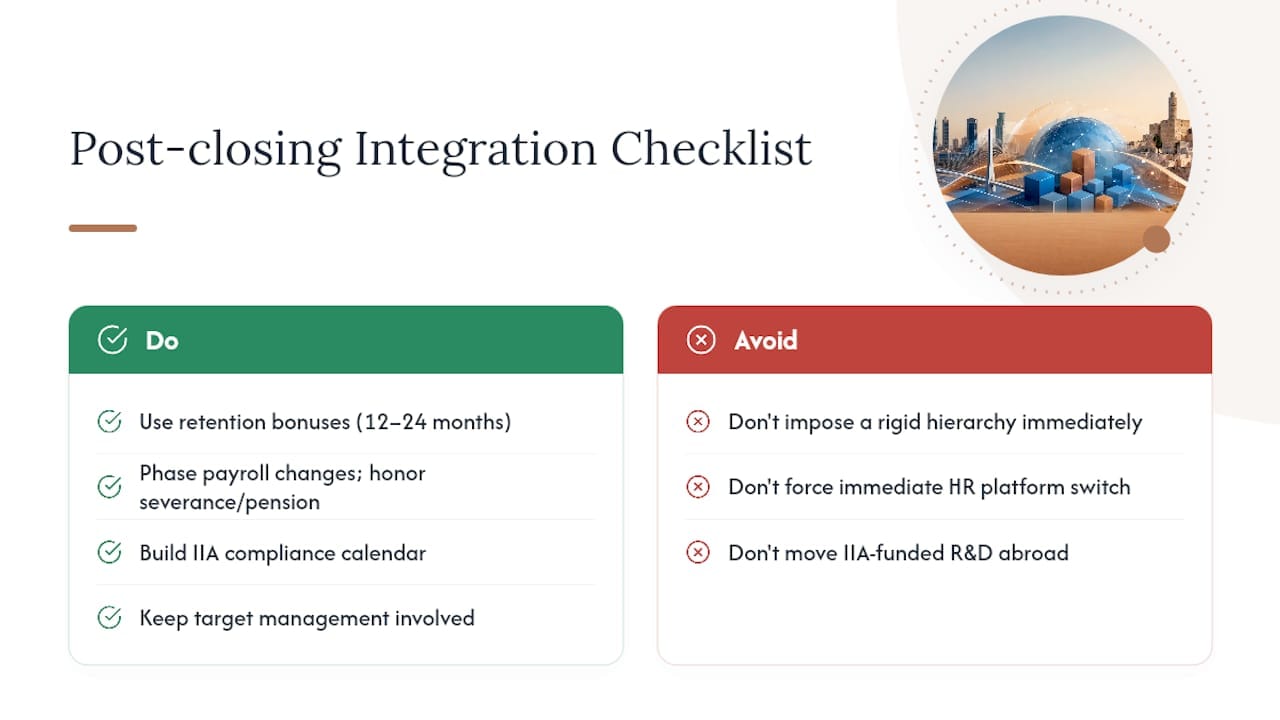
Post-merger integration in Israel runs into friction points that don’t show up on a standard playbook built for other markets. The most common one is cultural: Israeli tech teams tend to expect flat reporting lines and direct pushback on decisions, and a foreign parent that imposes a rigid hierarchy immediately after closing often loses key engineers within the first year.
Retention agreements matter more here than in many acquisitions elsewhere, because the technical talent is frequently the actual asset you bought. Structuring meaningful retention bonuses or accelerated vesting tied to a post-closing period, typically twelve to twenty-four months, keeps the team in place long enough to transfer institutional knowledge.
Payroll, benefits, and employment contract harmonization also take longer than buyers expect, since Israeli employment law includes mandatory severance accrual and pension contributions that don’t map cleanly onto a foreign parent’s HR systems. Trying to force an immediate switch to the acquirer’s global HR platform in month one is a common and avoidable mistake.
IIA-funded technology carries integration obligations too. If the grant conditions required maintaining research and development activity inside Israel, moving that work abroad after closing can violate the grant terms even after the deal has closed, not just before it. Build a compliance calendar for any surviving IIA conditions rather than assuming closing ends the obligation.
Finally, keep the target’s existing management involved in customer-facing decisions during the transition. Israeli founders and executives usually built the client relationships that justified the acquisition price, and sidelining them too fast is one of the more common ways buyers erode the value they just paid for.
How Are Employee Rights Handled in an Israeli Acquisition?
Israeli labor law protects employees through the transition in ways that differ meaningfully from other markets, and getting this wrong creates liability that survives closing.
In an asset purchase, employees generally need to be formally terminated by the seller and rehired by the buyer, which triggers severance pay obligations under Israeli law unless the parties structure continuity of employment terms carefully. A share purchase avoids this because the employing entity doesn’t change, only its ownership does, which is one more reason private buyers often default to share deals when the workforce is a core asset.
Collective bargaining agreements and works councils appear more often in Israeli industrial and manufacturing companies than in tech, but where they exist, the buyer typically inherits the existing agreement’s terms and cannot unilaterally alter compensation or working conditions post-closing. Ignoring an active union relationship during diligence is a common and expensive oversight.
Pension and provident fund contributions are mandatory and accrue continuously; any gap in contribution history during a transition period needs to be identified and remedied before closing, not after. Section 102 option holders also have employment-linked tax benefits that can be jeopardized if the trustee relationship or employment continuity isn’t preserved through the deal structure.
For employees whose equity or benefit entitlements originated through succession or inheritance situations, the interplay between corporate consent and personal legal status can complicate the closing checklist further; Menora Law’s guidance on share transfers connected to inheritance is a useful reference point when those situations arise.
What Disclosure and Reporting Duties Apply After Closing?
Closing an Israeli acquisition doesn’t end your paperwork. Several filings and disclosures kick in specifically because ownership changed.
The Companies Registry requires updated filings reflecting the new ownership structure, officers, and, where relevant, the merger certificate confirming the statutory process completed. For public companies, the Israel Securities Authority requires ongoing disclosure once ownership crosses the reporting thresholds already discussed, and continued compliance with TASE listing rules if the surviving entity remains listed.
Tax reporting to the Israel Tax Authority includes confirming that withholding was properly remitted and, where an advance ruling was obtained, that the actual transaction matched the ruling’s assumptions closely enough to rely on it. Any material deviation can require a supplemental filing or renegotiation of the tax position.
If the target held IIA grants, post-closing reporting to the Innovation Authority typically continues on whatever schedule the original grant required, and a change of control doesn’t erase that reporting obligation. Buyers who assume the paperwork ends at signing routinely discover otherwise a year later when a compliance notice arrives.
What Financing Structures Are Common in Israeli M&A?
Israeli acquisitions get funded through a mix of structures, and the right one depends heavily on target size and buyer profile.
All-cash deals dominate at the smaller end of the private market, particularly for bootstrapped or lightly funded targets where the purchase price is modest enough that a strategic buyer can fund it from balance sheet cash. Larger transactions increasingly use a mix of cash and acquirer stock, especially when a foreign public company is the buyer and wants to preserve cash while giving target shareholders upside exposure to the combined entity.
Earn-outs are common in Israeli tech deals specifically because so much of the value sits in unproven future revenue or unfinished product roadmaps. A seller willing to accept a meaningful earn-out portion signals confidence in the numbers, and a buyer structuring one properly ties payment milestones to metrics the seller’s team can actually control post-closing.
Seller financing, where part of the purchase price is deferred and paid over time, shows up more often in smaller private deals where traditional acquisition financing is harder to arrange for a foreign buyer unfamiliar with Israeli banking relationships. Escrow holdbacks function as a financing tool too, effectively deferring a portion of the price against warranty claims or tax withholding uncertainty.
Buyers structuring cross-border financing, including setting up the acquiring Israeli entity itself, sometimes benefit from understanding comparable incorporation cost structures in other jurisdictions when weighing whether to route the deal through an intermediate holding company.
What Cross-Border Issues Arise When Israel Meets a Foreign Buyer or Seller?
Every Israeli acquisition involving a foreign party runs into a specific set of friction points that purely domestic deals never face.
Currency and payment mechanics matter more than buyers expect. Consideration is often denominated in shekels for Israeli sellers even when the buyer’s home currency is dollars or euros, and the exchange-rate exposure between signing and closing needs to be addressed contractually rather than assumed away.
Foreign ownership verification and know-your-customer requirements apply on both sides of the transaction, particularly when a non-Israeli entity is acquiring a company with sensitive technology. Buyers structuring the acquisition through an offshore holding vehicle should expect Israeli banks and regulators to ask detailed questions about beneficial ownership; a clear process for verifying non-resident shareholders up front saves weeks later in the deal.
Dual-track disclosure obligations can apply when the foreign buyer is itself a public company in its home market, layering that jurisdiction’s disclosure timing on top of Israel’s own ISA rules. Coordinating those two clocks, so a premature leak in one market doesn’t force early disclosure in the other, takes deliberate planning rather than improvisation.
Finally, dispute resolution clauses deserve real attention. Foreign buyers sometimes default to arbitration in their home jurisdiction without appreciating that enforcing an award against Israeli assets, or defending an Israeli employment claim, may still route through Israeli courts regardless of what the contract says about forum.
What Are the Most Common Pitfalls in Israeli M&A?
The deals that go wrong in Israel tend to fail for a handful of repeatable reasons, not exotic ones.
Buyers frequently underestimate how long IIA negotiations take, assuming a quick approval when the reality is a multi-week back-and-forth over redemption payment calculations. Treating this as a closing formality rather than a real negotiation is one of the most common timeline killers in the market.
Skipping a proper IP audit is another recurring problem. Israeli startups often grow so fast that founders never circle back to paper the IP assignments from early contractors or advisors, leaving a gap in chain-of-title that surfaces during diligence and can require tracking down people who left the company years earlier.
Anti-fraud diligence deserves specific attention around financial statement quality in smaller private targets, where formal audited financials may not exist and management representations carry more weight than a buyer would accept in a more mature market. Verifying revenue recognition practices and related-party transactions independently, rather than relying solely on management’s own numbers, catches problems before they become post-closing indemnity fights.
Underpricing the tax withholding risk is a subtler trap. Buyers who assume a standard rate without confirming it through an ITA ruling sometimes discover at closing that the actual withholding obligation is materially higher than modeled, which can blow up a carefully negotiated purchase price allocation at the worst possible moment.
Menora Law’s View: When to Merge, When to Buy
The structure question isn’t really about preference; it’s about which risks you’re willing to inherit. A statutory merger gives you clean, automatic transfer of assets and liabilities, but it costs you secrecy and speed because of the notice and waiting-period requirements. A share purchase is faster and quieter, but you inherit every liability sitting on that balance sheet, disclosed or not.
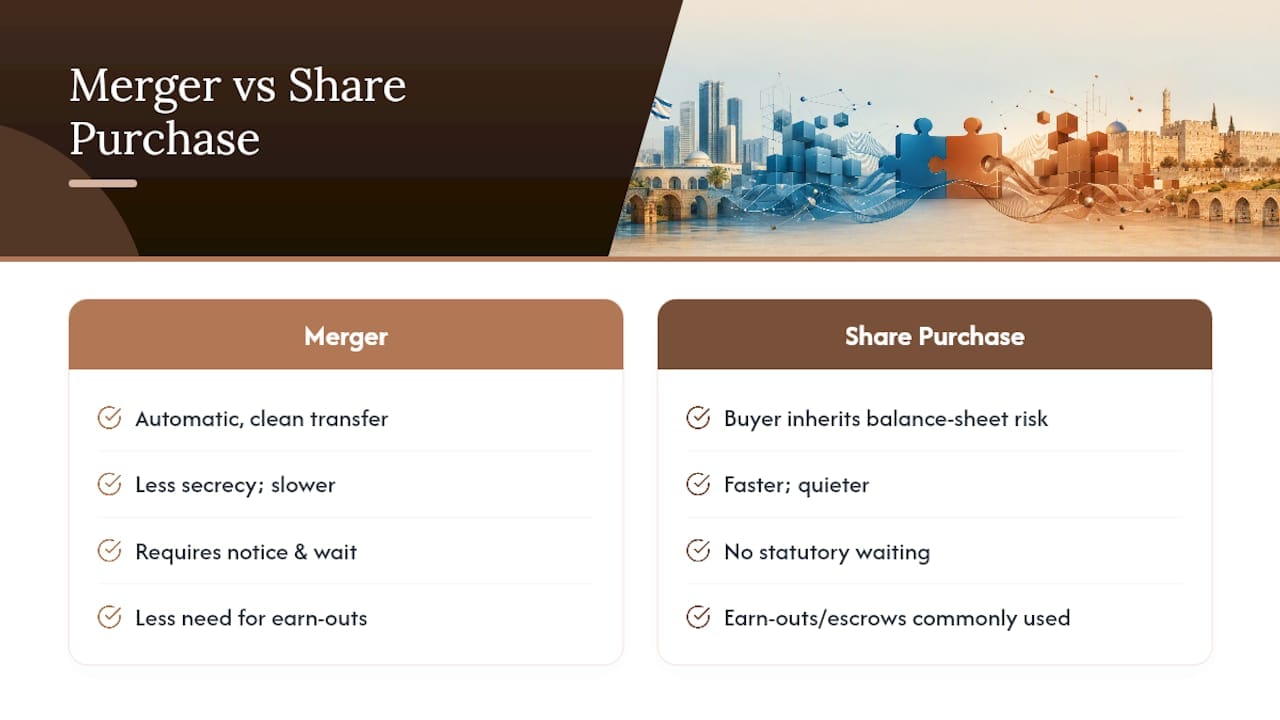
Our own view, formed across cross-border transactions for international clients, is that earn-outs and escrows do more real work in Israeli deals than in most other markets, precisely because so much target value sits in IIA-funded IP and unproven technology roadmaps rather than audited revenue. Indemnities alone rarely bridge that valuation gap the way a properly structured earn-out can.
On regulatory sequencing, file your ICA pre-notice and open your IIA conversation before you finalize price. Waiting until after signing to discover a redemption payment demand is how good deals get renegotiated under pressure.
— Menora Law
Get Israeli M&A Counsel That Moves at Your Speed
Legal counsel can represent international buyers and sellers through issues such as structuring the Israeli subsidiary for a reverse triangular merger, negotiating IIA redemption terms, coordinating the Israel Tax Authority ruling, and clearing ICA and ISA filings before they stall your closing. Unlike counsel that only handles Israeli-side paperwork after a foreign firm has already set the deal terms, some legal practices work the structure from the first term sheet, to avoid renegotiating price after diligence uncovers a grant or option problem nobody flagged early.

Consultations happen remotely or on-site, wherever you and your board are located, so distance from Israel is never the reason a deal stalls. If you’re evaluating a target or already have a signed letter of intent, start with an initial case review through Menora Law’s main site or explore the firm’s business law services for international clients to see the full scope of corporate representation available before your next call.
This article is general information, not a substitute for advice from a qualified lawyer. Consult a qualified legal professional about your own circumstances before acting on anything here.
Sources
- Corporate M&A 2026 – Israel | Global Practice Guides | Chambers and Partners
- Gov
- Your Taxes: So you want to acquire an Israeli company? | The Jerusalem Post
FAQ
What Is the Difference Between a Merger and an Acquisition in Israel?
A statutory merger combines two Israeli companies by operation of law with automatic transfer of assets and liabilities, while an acquisition (share or asset purchase) is a contractual transaction that doesn’t require the same notice and waiting-period mechanics.
Can a Foreign Company Directly Merge With an Israeli Company?
No. Israeli law permits statutory mergers only between two Israeli companies, which is why foreign buyers typically incorporate an Israeli subsidiary and use a reverse triangular merger structure instead.
How Long Does an ICA Merger Filing Take?
Timing varies by case complexity, but ICA review can add weeks to months to a closing timeline, particularly when the transaction raises market concentration concerns; filing early in the process reduces the risk of delay.
Does an IIA Grant Automatically Block a Sale?
No, but it typically requires IIA approval and may involve a redemption payment before the deal can close cleanly, so it needs to be addressed during diligence rather than treated as a formality.
Does Menora Law Handle Israeli M&A for Foreign Buyers?
Yes. Menora Law represents international clients on Israeli company mergers, acquisitions, subsidiary structuring, and related regulatory filings, with remote and on-site consultation options; current service details are available at Menoralaw.


 English
 Afrikaans
 العربية
 বাংলা
বাংলা Čeština
 简体中文
简体中文 Nederlands
 Suomi
Suomi Français
 Deutsch
 עִבְרִית
 हिन्दी
 Magyar
 Italiano
 日本語
日本語 한국어
한국어 Polski
 فارسی
فارسی Português do Brasil
 Русский
 Español de México
 Українська