
TL;DR:
- Israeli legal mediators serve as neutral facilitators aimed at helping parties reach voluntary agreements without court authority. They manage communication, clarify issues, and rebuild trust, often using private caucuses to explore settlement options. Mediation offers faster, more confidential, and flexible resolutions for inheritance, business, and property disputes, but it requires good preparation and honest participation.
When a dispute arises over an inheritance, a business contract, or a property in Israel, most people assume their only option is to go to court. That assumption is costly in both time and money. The role of Israeli legal mediator is widely misunderstood. Many people confuse mediators with judges who issue rulings, or with attorneys who argue on someone’s behalf. Neither is accurate. An Israeli legal mediator is a neutral facilitator whose job is to help parties reach a voluntary agreement, and understanding what that actually means can change how you approach any dispute under Israeli law.
Key takeaways
| Point | Details |
|---|---|
| Mediators are neutral facilitators | They guide communication between parties but hold no power to impose a decision on either side. |
| Israeli mediation is professionalizing fast | The ICC Israel National Committee launched a dedicated Mediation Sub Committee in late 2025 to align with international standards. |
| Mediation fits inheritance, business, and real estate cases | These three dispute categories benefit most from mediation’s flexibility, confidentiality, and relationship-preservation qualities. |
| Preparation directly affects outcomes | Parties who arrive with informed legal counsel and clear documentation get substantially better results from mediation sessions. |
| Litigation is not always the stronger option | Mediation in Israel typically costs less, resolves faster, and produces outcomes courts cannot legally order. |
The role of an Israeli legal mediator: core functions and duties
The single most important thing to understand about an Israeli legal mediator is this: mediators have no legal power to impose decisions. They are not judges. They do not rule in favor of one party. Their authority exists entirely because the parties consent to the process and choose to participate in good faith.
That said, the work a mediator does is substantive and skilled. A trained mediator manages the entire process of structured communication between disputing parties, and their effectiveness determines whether the session produces a workable resolution or falls apart.
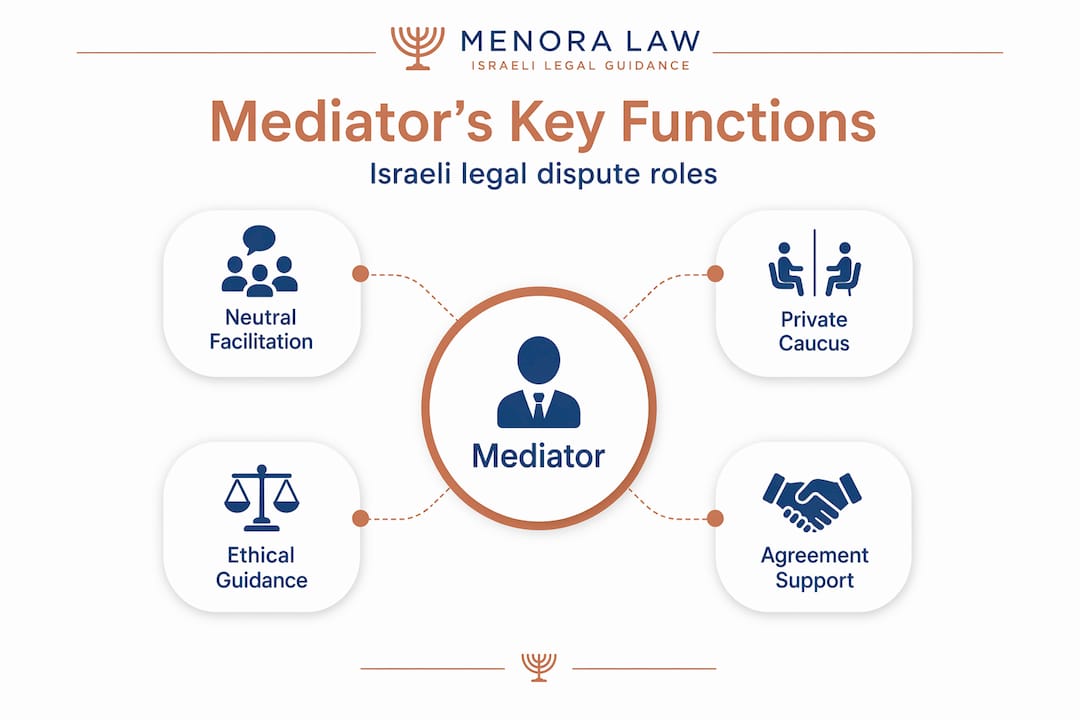
The core functions of a legal mediator in Israel include:
- Facilitating communication: Opening and maintaining dialogue between parties who may have broken off direct Kontakt entirely
- Clarifying issues: Identifying what each side actually wants versus what they say they want, which are often very different things
- Reinterpreting statements: Translating positions into neutral terms so parties hear each other’s concerns without the emotional charge attached to adversarial framing
- Managing process flow: Deciding when to bring parties together in joint sessions and when to separate them into private caucuses
- Rebuilding trust: Especially in family or long-term business disputes where relationships have fractured over time
The private caucus is one of the most powerful tools a mediator uses. In a caucus, the mediator meets with one party alone to understand their underlying interests without the pressure of the opposing side in the room. Mediators use caucus sessions to help recalibrate under-prepared parties and to explore settlement options that parties may be reluctant to propose in front of each other.
The mediator’s ethical obligation is to remain neutral throughout. They cannot advocate for one party, share confidential caucus disclosures without permission, or apply pressure to coerce a settlement. This distinction matters enormously for clients from the United States or other countries who may not be familiar with how dispute resolution in Israel differs from a formal court proceeding.
Pro Tip: Before entering any mediation in Israel, ask your attorney to prepare a one-page summary of your key interests and your bottom line. This gives the mediator a clearer map of your priorities and makes the caucus process significantly more productive.
Israeli mediation practices: professionalization and ethical standards
Israeli mediation has been evolving quickly. For a long time, mediation sat at the margins of the formal legal system, used mostly in family disputes or as a court-referral option. That has changed. The functions of legal mediators are now receiving serious institutional attention, and the standards governing practice are rising to match.
In November 2025, the ICC Israel National Committee established a dedicated Mediation Sub Committee with a clear mandate: advance international commercial mediation practices within Israel and align Israeli standards with ICC frameworks used globally. This is a significant development for businesses and individuals who have cross-border disputes involving Israeli parties, because it signals that Israeli mediation is moving toward a recognized and enforceable professional structure.
The ethical standards governing Israeli legal mediators draw from both domestic frameworks and internationally recognized principles. There are four key obligations that any competent mediator must uphold:
- Neutrality: The mediator must not favor either party, financially, personally, or professionally. Any conflict of interest must be disclosed before the mediation begins.
- Transparency about role: Under principles comparable to ABA Model Rule 2.4(b), lawyer-mediators are required to clarify that they represent no party and are not acting as legal counsel for anyone in the room.
- Avoidance of misrepresentation: Mediators cannot allow either side to develop a false impression of the process, the mediator’s authority, or the likelihood of any particular outcome.
- Vertraulichkeit: Disclosures made during mediation are not to be used as evidence in subsequent court proceedings unless both parties agree.
“Neutrality must be balanced with clear ethical conduct to avoid misleading parties and uphold trust.” This principle, drawn from established mediator ethics guidelines, reflects the standard that Israeli mediators are now being held to as the field professionalizes.
One challenge worth naming directly is power imbalance. In inheritance disputes involving family members with very different levels of legal knowledge, or in business mediations between a large corporation and a smaller counterpart, the power dynamic is rarely equal. Skilled mediators recognize this and actively manage it, often using caucus sessions to give the less-resourced party a private space to process their position and sharpen their thinking.
It is also worth noting that Israeli mediation does not always look like the purely neutral model. Academic research has examined how non-neutral mediators can achieve results in complex crisis contexts. For civil legal disputes, however, strict neutrality remains the governing standard, and any mediator operating outside that standard should be questioned.
Pro Tip: Always confirm that your mediator has disclosed any prior relationship with the opposing party or their legal counsel. In Israel’s relatively close-knit legal community, undisclosed connections are more common than you might expect.
How mediation applies in inheritance, business, and real estate disputes
Understanding the role of Israeli legal mediator in abstract terms is useful. Seeing it applied to the exact types of disputes you may be facing is more useful still.
Inheritance and estate disputes
When a parent or grandparent passes away and leaves assets in Israel, family members abroad often find themselves in conflict with relatives in Israel over the division of an estate. These disputes can involve real property, bank accounts, or business interests, and they carry emotional weight that formal litigation tends to make worse.

An Israeli legal mediator working in an inheritance dispute does not decide who gets what. Instead, the mediator creates a structured space for family members to voice their concerns, clarify the deceased’s intentions where documentation allows, and negotiate a division that all parties can accept. The result can include arrangements courts would never order, such as staggered payments, joint management of a property, or a buyout structure that keeps the peace.
Mediation in inheritance cases preserves family relationships in a way litigation rarely does. A court process produces a winner and a loser. Mediation produces a negotiated outcome that each party has agreed to, which changes the emotional dynamic entirely.
Business disputes
Commercial mediation in Israel addresses a wide range of conflicts: broken contracts, shareholder disagreements, partnership dissolutions, and disputes over service delivery or payment. For international clients doing business in Israel, mediation offers something litigation cannot: speed and confidentiality.
A business dispute that goes through the Israeli court system can take two to four years to resolve. Mediation can produce a binding settlement agreement in a matter of weeks. The benefits of mediation in Israel for commercial disputes are becoming more widely recognized, particularly as the ICC Israel framework provides a structured, internationally credible process.
Real estate conflicts
Property disputes in Israel are common, particularly for foreign buyers who may not have been present for every step of a transaction. Disputes arise over lease agreements, boundaries, construction defects, purchase price adjustments, and co-ownership disagreements.
For someone managing an Israeli lease agreement from overseas, a mediated resolution is far more practical than attending multiple court hearings in Israel. A mediator can facilitate a structured negotiation over video, with both parties represented by local counsel, and reach an agreement that resolves the property conflict without years of litigation.
| Dispute type | Typical mediation benefit | Key mediator function |
|---|---|---|
| Inheritance and estate | Preserves family relationships; flexible asset division | Facilitates emotional communication; builds trust |
| Business and commercial | Fast resolution; confidential process | Clarifies contractual interests; proposes settlement frameworks |
| Real estate | Practical for overseas parties; avoids court delays | Manages documentation review; proposes structured resolutions |
Benefits and limitations of mediation in Israel
Mediation in Israel is not a perfect solution for every dispute. It works well under certain conditions and falls short in others. Understanding where it fits is what allows you to make a strategic decision rather than a default one.
The primary advantages are well documented:
- Cost: Mediation costs a fraction of full litigation. Court fees, extended attorney hours, and expert witness costs in formal proceedings add up quickly. A mediated resolution typically requires far fewer billable hours and no court filing costs.
- Geschwindigkeit: Most mediations in Israel conclude within a few sessions. Contested court proceedings in civil matters routinely take two years or more.
- Vertraulichkeit: Unlike court hearings, which are part of the public record, mediation sessions are private. This matters enormously in business disputes where sensitive financial information is involved.
- Flexibility in outcomes: A court can only order remedies that the law permits. A mediated agreement can include creative arrangements such as ongoing business relationships, phased payments, or shared asset management, none of which a court would typically order.
| Factor | Mediation | Litigation |
|---|---|---|
| Average time to resolution | Weeks to a few months | Two to four years |
| Cost level | Significantly lower | High, including court and expert fees |
| Outcome flexibility | Parties design the resolution | Limited to legal remedies |
| Vertraulichkeit | Yes, fully private | No, public record |
| Binding authority | Only if parties sign an agreement | Court order is enforceable |
That said, mediation has real limitations. If one party refuses to participate honestly, or uses mediation simply to delay litigation, the process breaks down. Mediators have no authority to compel participation or compliance. A party who stonewalls, provides false information, or withdraws from the process cannot be forced to continue.
Mediation is also not appropriate in every situation. Cases involving fraud, situations requiring urgent injunctive relief, or disputes where one party has significantly more power and refuses to negotiate in good faith are all scenarios where proceeding directly to litigation may be the more strategic choice.
Pro Tip: If you are entering mediation while also preserving the right to litigate, make sure your attorney advises you carefully on what you disclose in mediation sessions. In Israel, confidentiality protections apply, but how those protections interact with related court proceedings requires clear legal guidance.
My take on the evolving mediator role in Israel
I’ve worked with clients navigating Israeli legal disputes for years, and the most consistent pattern I see is this: people come in thinking mediation is what you try when you are not serious about your case. That belief costs them.
The mediator is not a consolation prize. In the right dispute, a skilled Israeli legal mediator achieves outcomes that litigation simply cannot produce, faster, cheaper, and with the relationships intact. What I’ve learned is that the preparation side matters at least as much as the mediator’s skill. Parties who arrive having done the work, knowing their priorities, knowing what they will and will not accept, consistently get better results.
The ethical foundation matters too. I’ve seen mediations collapse because the mediator failed to clearly establish their neutral role at the outset, and one party began treating them as an informal ally. Transparency about the mediator’s function is not just a professional obligation. It is the condition under which the whole process has any chance of working.
For international clients dealing with inheritance, business, or real estate matters under Israeli law, my honest advice is this: treat mediation as a first-line tool, not a last resort. Get proper legal representation from an attorney who understands Israeli law, prepare your position thoroughly, and go into the process with clear intentions. The results, when mediation is used correctly, speak for themselves.
— Menora Law
How Menora Law can help with your dispute
Whether you are facing a contested inheritance in Israel, a business partnership breakdown, or a real estate conflict that has gone unresolved, Menora Law brings together Israeli legal expertise and international client service to help you find a path forward. The team advises clients on Israeli inheritance disputes und property conflicts in Israel, including guidance on when mediation is the right strategy and how to prepare for it effectively. Remote consultations are available for clients based in the United States and abroad.
Menora Law provides personalized legal strategies for clients who need trusted Israeli legal representation, wherever they are in the world. Reach out today to discuss your situation.
FAQ
What does an Israeli legal mediator actually do?
An Israeli legal mediator acts as a neutral third party who facilitates communication between disputing parties and helps them reach a voluntary agreement. The mediator does not issue rulings or represent either side.
Is a mediated agreement legally binding in Israel?
Yes, once both parties sign a mediated settlement agreement in Israel, it can be submitted to a court for approval and becomes enforceable as a court order. The agreement itself has no binding force until it is signed by both parties.
When is mediation better than going to court in Israel?
Mediation is typically better when the parties need a faster, more private resolution, when flexibility in the outcome matters, or when preserving a relationship (family or business) is a priority. Court proceedings in Israel can take two to four years, while mediation often resolves in weeks.
Can I use mediation for an Israeli inheritance dispute from abroad?
Yes. Mediation in Israeli inheritance cases can often be conducted remotely with both parties represented by local counsel. This makes it a practical option for family members living outside Israel who need to resolve an estate disagreement without traveling.
How do I choose the right mediator for an Israeli legal dispute?
Look for a mediator with specific experience in the type of dispute you face, whether inheritance, business, or real estate, and confirm they have no undisclosed relationship with the opposing party. An Israeli attorney familiar with local mediation practices can recommend qualified mediators and help you prepare effectively.


 English
 Afrikaans
 العربية
 বাংলা
বাংলা Čeština
 简体中文
简体中文 Nederlands
 Suomi
Suomi Français
 Deutsch
 עִבְרִית
 हिन्दी
 Magyar
 Italiano
 日本語
日本語 한국어
한국어 Polski
 فارسی
فارسی Português do Brasil
 Русский
 Español de México
 Українська