
TL;DR:
- Israeli private trust law governs relationships where trustees hold assets for beneficiaries, emphasizing asset protection and privacy. Trusts are not legal entities in Israel and primarily rely on careful classification, proper structure, and ongoing administration to avoid legal and tax complications. Effective estate planning involves understanding trust types, registration challenges, and the interaction with Israeli inheritance laws and tax regulations.
Israeli private trust law is defined as the legal framework governing the relationship between a trustee who holds property and the beneficiaries for whose benefit that property is managed, regulated primarily by the Trust Law 5739-1979 and the Succession Law 5725-1965. Understanding this framework matters enormously for families with assets in Israel, whether they live there or abroad. A trust in Israel is not a separate legal entity. It is a relationship, and that distinction shapes everything from how property is titled to how taxes are calculated. This guide breaks down the key rules, trust types, tax implications, and practical challenges you need to know before making any estate planning decisions under Israeli law.
What is Israeli private trust law and how does it work?
Israeli private trust law defines a trust as a legal obligation held by a trustee to manage assets for the benefit of one or more beneficiaries or for a specified purpose. The Trust Law 5739-1979 is the primary statute, and it establishes the core duties of trustees, the rights of beneficiaries, and the conditions under which trusts can be created, modified, or terminated. The Succession Law 5725-1965 governs how trusts interact with wills and inheritance proceedings.

One of the most important things to understand is that a trust is not a legal entity in Israel. Legal actions and asset registrations must be made in the trustee’s name, and the trustee holds trust assets separately from their personal property. This is fundamentally different from how trusts operate in common law countries like the United Kingdom or the United States, where a trust can sometimes function more like an independent structure.
The trustee carries full legal responsibility for managing the assets according to the trust’s terms. The beneficiary holds the equitable interest, meaning they are entitled to the benefit of those assets even though legal title sits with the trustee. This separation of legal and beneficial ownership is the core mechanism that makes trusts useful for asset protection and Israeli estate planning.
Él primary motivation for Israeli trusts is asset protection, driven in large part by the absence of inheritance, estate, and gift taxes in Israel. Trusts serve as alternatives to succession and conveyance for both tax and privacy advantages. That combination makes them particularly attractive for families managing multigenerational wealth or cross-border assets.
What types of trusts does Israeli law recognize?
Israeli law recognizes several distinct trust types, each with different legal characteristics and practical uses. Choosing the right structure depends on your goals, your residency status, and the nature of the assets involved.
Inter vivos trusts are created during the settlor’s lifetime and come in several forms:
- Fixed-interest trusts: Beneficiaries receive a defined share of income or capital, with no discretion left to the trustee.
- Discretionary trusts: The trustee decides how and when to distribute assets among beneficiaries, offering greater flexibility for changing family circumstances.
- Revocable trusts: The settlor retains the right to cancel or amend the trust at any time, which provides control but limits some asset protection benefits.
- Irrevocable trusts: Once established, the settlor cannot reclaim the assets, which generally provides stronger protection against creditors and legal claims.
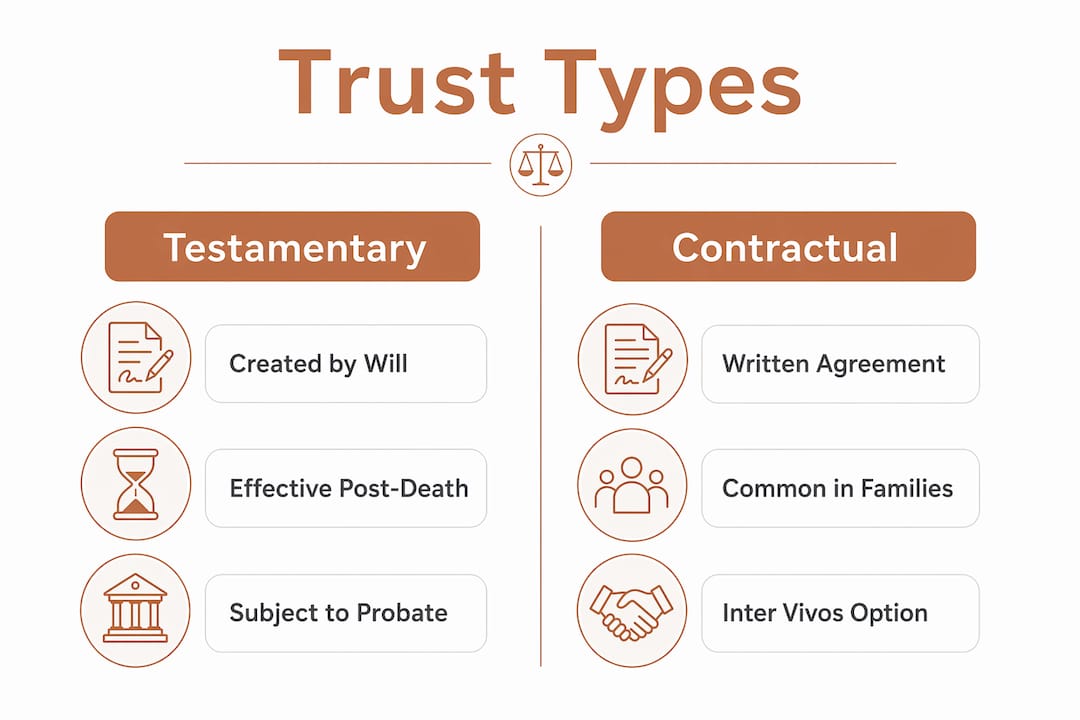
Testamentary trusts are created through a will and only take effect upon the settlor’s death. These trusts are subject to probate court supervision under the Succession Law 5725-1965, which means a court is involved in confirming the will and overseeing the trust’s establishment. This adds a layer of oversight that inter vivos trusts typically avoid.
Contractual trusts arise from a written agreement between the settlor and trustee. They are common in commercial and family contexts and do not require a formal deed. The Hekdesh, or deed of endowment, is a specific form of trust instrument used primarily for charitable or religious purposes, though it can also serve private estate planning goals in certain structures.
Israeli trusts can be structured with spendthrift features that protect beneficiaries from their own creditors, and revocability options give settlors meaningful control during their lifetime. These features make inter vivos trusts particularly useful for families who want flexibility without losing protection.
Pro Tip: If your primary goal is to avoid probate and keep your estate affairs private, an irrevocable inter vivos trust is generally more effective than a testamentary trust, since testamentary trusts require court involvement by definition.
How does Israeli private trust law interact with inheritance and succession laws?
The relationship between trust law and succession law in Israel is one of the most practically significant areas for families doing estate planning. Understanding how these two bodies of law interact helps you decide whether a private trust, a will, or a combination of both best serves your needs.
Here is how the process works when trusts and succession law intersect:
Testamentary trusts require probate. When a trust is created through a will, the will must go through the Israeli probate process before the trust becomes operative. The Family Affairs Court or Registrar of Inheritances must confirm the will’s validity, which takes time and involves public proceedings.
Inter vivos trusts bypass probate entirely. Assets held in a properly structured inter vivos trust at the time of the settlor’s death do not pass through the estate. They transfer directly according to the trust’s terms, avoiding court delays and maintaining privacy.
The Succession Law 5725-1965 governs forced heirship rules. Israeli law does not impose strict forced heirship rules the way some civil law countries do, but the Succession Law still sets out default inheritance rights for spouses and children. A trust must be structured carefully to avoid challenges based on these provisions.
Court enforcement is available for trust disputes. If a trustee breaches their duties or a beneficiary’s rights are violated, Israeli courts will intervene. The Trust Law 5739-1979 gives courts broad authority to supervise trustees, remove them, and order remedies.
Foreign trusts with Israeli assets must comply with Israeli law. Israeli courts generally respect choice of law clauses in trust instruments, but mandatory Israeli rules on tax and real estate still apply regardless of what the trust document says.
For families with assets in multiple countries, the interaction between Israeli succession law and foreign legal systems adds complexity. Menora Law regularly advises foreign residents navigating inheritance in Israel, and the trust versus probate question is one of the first issues that needs to be resolved.
What are the key tax implications for trusts under Israeli law?
Tax classification is where Israeli trust law gets genuinely complex, and getting it wrong has real financial consequences. The Israeli Tax Authority classifies trusts based on the residency of the settlor and the beneficiaries, not just the location of the assets.
The three main classifications are:
| Trust Type | Residency Basis | Tax Scope |
|---|---|---|
| Israeli Resident Trust | Settlor or majority of beneficiaries are Israeli residents | Taxed on worldwide income |
| Foreign Resident Trust | Settlor and all beneficiaries are non-Israeli residents | Taxed on Israeli-source income only |
| Testamentary Trust | Created by will; classification depends on beneficiary residency | Taxed based on beneficiary residency at time of distribution |
An Israeli Resident Trust is taxed on its worldwide income, meaning income earned anywhere in the world is subject to Israeli tax. A Foreign Resident Trust, where both the settlor and all beneficiaries are non-Israeli residents, is only taxed on income derived from Israeli sources. This distinction matters enormously for international families who hold Israeli real estate alongside assets in other countries.
Trust tax classification can change if residency facts change over time. If a beneficiary who was previously a foreign resident moves to Israel, the trust’s classification may shift, triggering new tax obligations. Trustees must monitor residency changes and report them to the Israeli Tax Authority.
Trust reporting in Israel is primarily tax-driven, with no general registry and limited regulatory supervision beyond the tax context. The Tax Authority oversees reporting and compliance, while other regulatory bodies mainly supervise charitable trusts. This means the burden of compliance falls heavily on the trustee and their advisors.
Pro Tip: If you are a foreign resident considering an Israeli trust, document residency status carefully at the time of trust creation and review it annually. A single change in beneficiary residency can shift the entire tax classification of the trust.
For families with international connections, comparing how Israeli trust taxation interacts with other jurisdictions is worth exploring. Swiss tax planning strategies offer one example of how different legal systems approach trust taxation, which can be useful context when structuring cross-border arrangements.
What practical challenges exist when creating a trust in Israel?
Knowing how to create a trust in Israel is straightforward in theory but involves real operational challenges that catch many families off guard. The Trust Law 5739-1979 allows trusts to be created by law, contract, deed of endowment, or will. There is no single prescribed form, and trusts can be created without formal registration since no central trust registry exists in Israel.
Here are the most common practical challenges and how they are typically addressed:
- Property registration. It is generally not possible to register real estate in Israel in the name of a trust. The Israeli Land Registry requires title to be held by a legal person or recognized entity. Since a trust is neither, families who want to hold Israeli property within a trust structure typically use a limited liability company (LLC) or Israeli company as the registered owner, with the trust holding the shares of that company.
- No regulatory oversight beyond tax. Because there is no trust registry and no general supervisory body, the quality of trust administration depends entirely on the trustee’s competence and integrity. Choosing a qualified, experienced trustee is not optional. It is the single most important decision in the trust formation process.
- Lack of formal dispute resolution mechanisms. Trust disputes in Israel go to the regular court system, which can be slow. Including clear dispute resolution provisions in the trust deed reduces this risk significantly.
- Cross-border recognition. Israel is not a signatory to the Hague Convention on the Law Applicable to Trusts and on their Recognition. Foreign trusts with Israeli assets must therefore rely on Israeli courts’ general willingness to recognize foreign law, which is not guaranteed in all circumstances.
- Trustee liability. Because the trustee holds assets in their own name, they carry personal legal exposure if something goes wrong. Professional trustees or corporate trustees are strongly preferred for significant asset structures.
The comparison below shows how inter vivos and testamentary trusts differ on the practical dimensions most relevant to estate planning:
| Factor | Inter vivos trust | Testamentary trust |
|---|---|---|
| Probate required | No | Yes |
| Privacy | High | Lower (court proceedings) |
| Effective date | Immediately | Upon death and probate |
| Court oversight | Minimal | Ongoing during probate |
| Flexibility | High (if revocable) | Fixed once will is probated |
For families considering Israeli asset protection strategies, the inter vivos structure almost always offers more control and speed. The testamentary trust remains useful when the settlor wants to maintain full ownership of assets during their lifetime but direct their distribution through a trust mechanism after death.
Key takeaways
Israeli private trust law requires careful coordination of trust type, residency classification, and asset registration to achieve effective estate planning and asset protection in Israel.
| Point | Details |
|---|---|
| Trusts are not legal entities | All assets and legal actions must be held and taken in the trustee’s name under Israeli law. |
| Tax classification drives obligations | Residency of settlor and beneficiaries determines whether the trust is taxed on worldwide or Israeli-source income only. |
| Probate applies to testamentary trusts | Trusts created through wills require court confirmation before they become operative. |
| Property registration requires a workaround | Israeli real estate cannot be titled in a trust’s name; an LLC or company structure is the standard solution. |
| Residency changes affect tax status | Trustees must monitor beneficiary residency annually, as changes can shift the trust’s entire tax classification. |
Why private trusts in Israel deserve more attention than they get
From working with families on Israeli estate matters, one pattern stands out clearly. Most people arrive with a will in hand and assume that is enough. It often is not. A will in Israel goes through probate, which is a public process that takes time and can invite challenges from other heirs or creditors. A properly structured inter vivos trust sidesteps all of that.
What surprises many international clients is how favorable Israel’s tax environment actually is for trust planning. There is no inheritance tax, no estate tax, and no gift tax. That means the primary driver for using a trust in Israel is not tax minimization in the traditional sense. It is control, privacy, and protection. You decide who gets what, when, and under what conditions, without a court making those decisions for you.
The residency classification issue is where we see the most costly mistakes. A family sets up a trust when all beneficiaries live abroad, classifying it as a Foreign Resident Trust with limited Israeli tax exposure. Then one child moves to Israel, and suddenly the entire trust is reclassified as an Israeli Resident Trust subject to worldwide income taxation. No one told the trustee to monitor this. The tax bill arrives years later with penalties attached.
The practical advice is simple: treat trust administration as an ongoing responsibility, not a one-time setup. Review residency status annually. Keep records of every distribution and every change in beneficiary circumstances. Work with advisors who understand both the legal structure and the tax reporting requirements. A trust that is set up correctly but administered carelessly will eventually create the exact problems it was designed to prevent.
— Menora Law
How Menora Law can help with your Israeli trust and estate planning
Menora Law specializes in Israeli private client law, including trust formation, estate planning, and inheritance matters for families living in Israel and abroad. Whether you need to structure a new trust, understand how an existing arrangement interacts with Israeli succession law, or resolve a dispute involving trust assets, the team at Menora Law provides clear, strategic guidance tailored to your situation. Remote consultations are available for clients outside Israel, with fast response times and direct access to experienced Israeli legal counsel. Start with a review of your inheritance and estate options under Israeli law, and get the clarity you need to make confident decisions for your family’s future. Contacto Menora Law today to schedule a consultation.
Preguntas más frecuentes
What is a private trust under Israeli law?
A private trust under Israeli law is a legal relationship in which a trustee holds and manages assets for the benefit of named beneficiaries, governed by the Trust Law 5739-1979. The trust is not a separate legal entity; all assets are held in the trustee’s name.
How is a trust created in Israel?
A trust in Israel can be created by contract, deed of endowment (Hekdesh), operation of law, or through a will. No formal registration is required, though tax reporting obligations apply once the trust is established.
Do trusts in Israel avoid probate?
Inter vivos trusts created during the settlor’s lifetime avoid probate entirely, since the assets transfer directly according to the trust’s terms upon death. Testamentary trusts created through wills are subject to probate court supervision under the Succession Law 5725-1965.
How are trusts taxed in Israel?
Trust taxation depends on the residency of the settlor and beneficiaries. Israeli Resident Trusts are taxed on worldwide income, while Foreign Resident Trusts are generally taxed only on Israeli-source income. Residency changes can trigger reclassification and new tax obligations.
Can a trust own real estate in Israel?
A trust cannot be registered as the legal owner of real estate in Israel. Families typically use an LLC or Israeli company to hold title to the property, with the trust owning the shares of that company as a practical workaround.


 English
 Afrikaans
 العربية
 বাংলা
বাংলা Čeština
 简体中文
简体中文 Nederlands
 Suomi
Suomi Français
 Deutsch
 עִבְרִית
 हिन्दी
 Magyar
 Italiano
 日本語
日本語 한국어
한국어 Polski
 فارسی
فارسی Português do Brasil
 Русский
 Español de México
 Українська