
TL;DR:
- Israeli legal jurisdiction combines common law and civil law elements within a multi-tiered court hierarchy governed by Basic Laws.
- Understanding proper jurisdiction is crucial for inheritance, investment, and business cases, as it influences court authority, applicable law, and case outcomes.
Israeli legal jurisdiction rules define a hybrid legal system that combines common law traditions with codified civil law elements, operating through a structured multi-tier court hierarchy governed by Basic Laws that serve as quasi-constitutional statutes. If you are dealing with an inheritance, planning an investment, or setting up operations in Israel, understanding how jurisdiction works is not optional. It determines which court hears your case, which law applies, and ultimately, what outcome you can expect. The Israeli legal system is more layered than most foreign clients anticipate, and getting the forum wrong from the start can cost you significantly in time, money, and legal standing.
What is Israeli legal jurisdiction rules and how does the system work?
Israeli legal jurisdiction is the formal authority that courts hold to hear and decide specific types of cases. The Israel legal framework draws from English common law, inherited through the British Mandate period, and from codified civil law statutes passed by the Knesset. This dual heritage means Israeli courts reason through precedent like common law courts, but they also apply detailed statutory codes that govern everything from contracts to succession.

Israel does not have a formal written constitution. Instead, the Knesset has enacted a series of Basic Laws that function as the constitutional backbone of the state. These laws define government powers, protect individual rights, and guide how courts interpret legislation. For anyone dealing with Israeli law from abroad, this distinction matters because there is no single constitutional document to reference. Legal authority is distributed across statutes, court decisions, and Basic Laws simultaneously.
The court system itself is divided into levels with clear subject-matter boundaries. Jurisdiction in Israel is not just about geography. It is about the type of claim, the monetary value involved, and sometimes the religious identity of the parties. Foreign individuals and businesses frequently underestimate this complexity, which is why working with a firm that understands the full picture from day one is so important.
How is jurisdiction divided among Israeli courts?
The Israeli court hierarchy has four main tiers, each with defined subject-matter jurisdiction. Understanding which court handles which type of dispute is the starting point for any legal strategy in Israel.
The four main court levels
- Magistrates’ Courts: These are the courts of first instance for most civil disputes. Magistrate courts hear claims up to ILS 2.5 million and certain real estate cases. Most day-to-day civil litigation in Israel begins here.
- District Courts: These courts handle higher-value claims and land disputes exceeding ILS 2.5 million, corporate matters, and administrative cases. They also serve as appellate courts for magistrate court decisions.
- Specialized Economic Courts: The Tel Aviv and Haifa district courts contain economic divisions with exclusive jurisdiction over specific financial matters, including derivatives claims and complex commercial disputes. Filing a financial claim in the wrong court can result in dismissal or transfer, which delays your case considerably.
- Supreme Court: The Supreme Court holds final appellate authority and also sits as the High Court of Justice, where it reviews government decisions and hears constitutional petitions. This dual role makes it the most powerful court in the Israeli system.
| Court Level | Jurisdiction Type | Monetary Threshold |
|---|---|---|
| Magistrates’ Court | Civil claims, minor real estate | Up to ILS 2.5 million |
| District Court | High-value civil, land, corporate | Above ILS 2.5 million |
| Economic Division (Tel Aviv/Haifa) | Financial instruments, derivatives | Exclusive subject-matter |
| Supreme Court | Appeals, constitutional review | No monetary limit |
Pro Tip: If your claim sits close to the ILS 2.5 million threshold, how you frame the claim and which damages you include can determine whether it goes to a magistrate or district court. That choice affects everything from procedural timelines to the depth of judicial scrutiny.
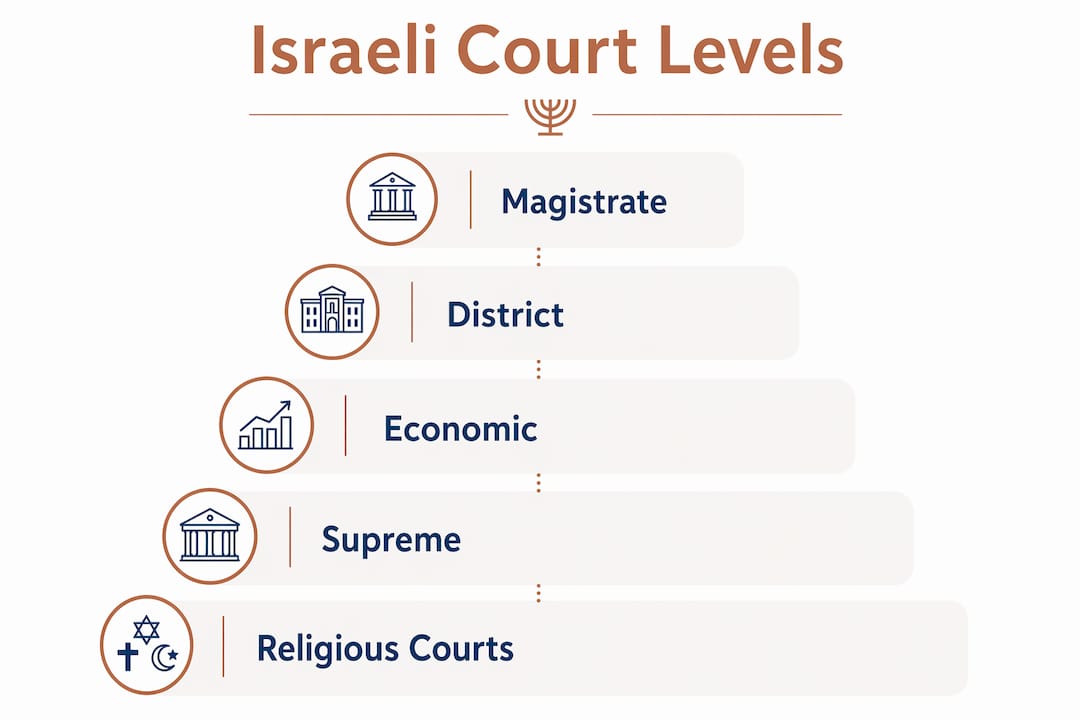
Religious courts represent a separate track entirely. They operate outside the civil hierarchy and hold exclusive authority over personal status matters. This is covered in detail below, but it is worth noting here that the civil and religious tracks can intersect in ways that surprise foreign clients, particularly in inheritance and family property cases.
What role do Basic Laws play in the Israeli legal framework?
Basic Laws are the closest thing Israel has to a constitution, and their influence on Israeli court jurisdiction is direct and significant. The Knesset has passed over a dozen Basic Laws since 1958, covering topics from the Knesset itself to human dignity and liberty. Courts treat these laws as superior to ordinary legislation, meaning a regular statute that conflicts with a Basic Law can be struck down.
The most consequential Basic Law for private individuals is Basic Law: Human Dignity and Liberty, enacted in 1992. This law protects life, body, dignity, property, and privacy as constitutional rights. The Basic Laws enable courts to invalidate legislation that conflicts with these human rights protections, a power that represents a constitutional revolution in Israeli jurisprudence. For foreign investors and individuals, this means Israeli courts have real teeth when it comes to protecting property rights and due process.
Key characteristics of the Basic Laws include:
- They are enacted by the Knesset but carry higher legal weight than ordinary statutes.
- Some Basic Laws require a supermajority or special procedure to amend, making them more stable than regular legislation.
- The Supreme Court applies Basic Laws during judicial review, which means government decisions affecting your property or business can be challenged on constitutional grounds.
- Basic Laws define the structure of government institutions, including the judiciary itself, which gives them direct relevance to understanding Israeli law and how courts derive their authority.
“The Basic Laws represent a constitutional revolution in Israel, enabling courts to invalidate laws that conflict with human rights protections enshrined in Basic Law: Human Dignity and Liberty.”
For businesses operating in Israel, the practical implication is that regulatory decisions affecting your operations can be challenged before the Supreme Court sitting as the High Court of Justice. This is a meaningful protection that many foreign clients do not realize they have access to.
How do religious courts interact with civil courts in Israel?
Religious courts in Israel are not a historical relic. They are active, state-recognized judicial bodies with binding authority over specific matters. The Israeli civil litigation process and the religious court system operate in parallel, and the boundary between them has direct consequences for inheritance and family property disputes.
Religious courts hold exclusive jurisdiction over marriage and divorce for Jewish, Muslim, Christian, and Druze communities in Israel. Each community has its own religious court system. The Rabbinical Courts handle Jewish personal status matters, the Sharia Courts handle Muslim matters, and various ecclesiastical courts handle Christian denominations. This is not a choice. If you are a Jewish Israeli citizen seeking a divorce, the Rabbinical Court has exclusive authority, regardless of where you live or what civil law you would prefer to apply.
The intersection with civil courts becomes particularly complex in these situations:
- Inheritance disputes: When a deceased person was married under religious law, the validity of the marriage and the status of heirs can be determined by religious courts, which then affects how civil courts distribute the estate. The inheritance and estate law framework in Israel reflects this overlap directly.
- Family property: Assets acquired during a marriage may be subject to both religious court rulings on the marriage itself and civil court rulings on property division.
- Foreign nationals: If you are a foreign national who married an Israeli citizen, questions about which court has jurisdiction over your personal status can become genuinely complicated. Religious courts may claim authority based on the Israeli spouse’s status.
- Forum selection in family matters: Filing first in a civil court versus a religious court can determine which forum retains jurisdiction. This is a strategic decision with long-term consequences.
Pro Tip: If you are a foreign national involved in an Israeli inheritance or family property dispute, get legal advice before any court filing. The first filing can lock in jurisdiction in ways that are very difficult to reverse.
What practical jurisdictional considerations should individuals and businesses know?
Jurisdiction in Israel involves two distinct questions. The first is subject-matter jurisdiction: which court type is authorized to hear your kind of case. The second is party jurisdiction: whether an Israeli court has authority over the specific parties involved, including foreign defendants. Both questions must be answered correctly before any legal action proceeds.
Here are the key practical considerations, in order of priority:
Identify the correct court by claim type and value. A commercial dispute worth ILS 3 million goes to district court, not magistrate court. A derivatives claim goes to the economic division in Tel Aviv or Haifa regardless of the parties’ preferences. Getting this wrong means your case gets transferred or dismissed at the outset.
Assess party jurisdiction over foreign defendants. Israeli courts can assert jurisdiction over foreign parties under certain conditions, including when the dispute involves Israeli property, when the contract was performed in Israel, or when the defendant has a presence in Israel. Subject-matter and party jurisdiction are separate analyses, and both must support the filing.
Consider forum selection strategically. Forum selection is a strategic consideration because monetary thresholds and specialized subject-matter jurisdictions create real differences in how cases are managed and decided. Filing first in the right court can prevent the opposing party from choosing a less favorable forum.
Understand how foreign judgments are enforced. If you already have a court judgment from another country, enforcement in Israel is governed by the Foreign Judgments Enforcement Act. The judgment must come from a court with competent jurisdiction, must be final, must not conflict with Israeli public policy, and must meet reciprocity requirements. Time-bar rules also apply, so acting promptly matters.
Check for arbitration agreements. Many commercial contracts include arbitration clauses that remove disputes from the court system entirely. Israeli courts generally respect valid arbitration agreements, and attempting to litigate a matter covered by an arbitration clause can result in a stay of proceedings.
| Jurisdiction Issue | Key Consideration | Practical Action |
|---|---|---|
| Subject-matter | Claim type and monetary value | Verify court level before filing |
| Party jurisdiction | Foreign defendant’s connection to Israel | Assess Israeli nexus factors |
| Forum selection | Strategic timing and venue | File first in the most favorable court |
| Foreign judgment enforcement | Reciprocity and public policy | Review Foreign Judgments Enforcement Act |
| Arbitration clauses | Contract terms | Check agreements before initiating litigation |
Judges in Israeli courts also have broad pretrial and trial management powers, reflecting 2021 civil procedure reforms designed to promote efficient resolution. This means Israeli judges are not passive arbiters. They actively shape how cases develop, which makes early procedural decisions even more consequential.
Key takeaways
Israeli legal jurisdiction rules operate through a multi-tier court system governed by Basic Laws, with subject-matter thresholds, specialized economic courts, and parallel religious court authority creating distinct strategic considerations for every case.
| Point | Details |
|---|---|
| Court hierarchy matters | Magistrate, district, economic, and Supreme courts each have defined subject-matter and monetary jurisdiction. |
| Basic Laws are quasi-constitutional | They protect human rights and allow courts to invalidate conflicting legislation, including in property and business matters. |
| Religious courts have binding authority | Marriage, divorce, and personal status fall exclusively under religious courts, affecting inheritance and family property outcomes. |
| Forum selection is strategic | Filing first in the correct court can determine which forum retains jurisdiction and shapes case outcomes. |
| Foreign judgment enforcement has conditions | The Foreign Judgments Enforcement Act requires competency, finality, public policy compatibility, and reciprocity. |
Menora Law’s perspective on Israeli jurisdiction for foreign clients
After working with foreign clients on Israeli legal matters across inheritance, real estate, and business disputes, the single most common mistake we see is treating Israeli jurisdiction as a formality. Clients assume that because their case involves Israeli property or an Israeli party, any Israeli court will do. That assumption is wrong, and it costs people real money.
The layered nature of Israeli jurisdiction, with civil courts, religious courts, economic divisions, and Basic Law protections all operating simultaneously, means that the strategic decisions made at the very beginning of a case often determine its outcome. We have seen inheritance disputes where the choice between filing in a civil court versus allowing a religious court to retain jurisdiction changed the entire distribution of an estate. We have seen commercial disputes where a claim was filed in a magistrate court that lacked subject-matter jurisdiction, causing months of delay and additional legal costs.
What we tell every foreign client is this: jurisdiction planning is not something you do after a dispute arises. It belongs in your legal strategy from the moment you sign a contract, purchase property, or open a business in Israel. The legal considerations for foreigners in Israel are specific and consequential, and the earlier you understand them, the better positioned you are.
The Basic Laws also offer more protection than most foreign clients realize. If a government decision affects your investment or property rights in Israel, you have constitutional avenues to challenge it before the Supreme Court. That is a meaningful tool, and it is one that experienced Israeli legal counsel will use on your behalf when the situation calls for it.
— Menora Law
How Menora Law can help you with Israeli jurisdiction
Menora Law works with foreign individuals and businesses who need clear, reliable guidance on Israeli legal jurisdiction rules, whether the matter involves an inheritance, a property purchase, a business dispute, or establishing operations in Israel. The firm provides remote representation for overseas clients, meaning you do not need to be in Israel to receive expert legal counsel. Menora Law’s team combines deep knowledge of the Israeli court system with direct experience handling cross-border matters for international clients. If you are facing a jurisdictional question or need to take legal action in Israel, contacto Ley de Menorá today to discuss your situation with a team that knows Israeli law from the inside out. You can also explore Menora Law’s dedicated inheritance law guide for specific guidance on succession matters.
Preguntas más frecuentes
What is Israeli legal jurisdiction?
Israeli legal jurisdiction defines which court has authority to hear a specific case based on subject matter, monetary value, and the parties involved. The system combines common law traditions with codified statutes and Basic Laws, operating through magistrate, district, economic, and Supreme Court levels.
Which Israeli court handles inheritance disputes?
Inheritance disputes in Israel are primarily handled by district courts, though religious courts may have jurisdiction over personal status matters that affect who qualifies as an heir. Foreign heirs should seek legal advice before filing to determine the correct forum.
Can a foreign judgment be enforced in Israel?
Yes, foreign judgments can be enforced in Israel under the Foreign Judgments Enforcement Act, provided the originating court had competent jurisdiction, the judgment is final, it does not conflict with Israeli public policy, and reciprocity requirements are met.
What are Basic Laws and why do they matter for jurisdiction?
Basic Laws are quasi-constitutional statutes enacted by the Knesset that protect human rights and define government powers. Israeli courts apply them to review legislation and government decisions, giving individuals and businesses a constitutional basis to challenge actions that affect their rights or property.
Do religious courts affect civil and business matters in Israel?
Religious courts have exclusive jurisdiction over personal status matters like marriage and divorce, which can directly affect inheritance rights and family property distribution. Businesses are generally not subject to religious court authority, but foreign individuals involved in family-related disputes in Israel should understand how the two court systems interact.


 English
 Afrikaans
 العربية
 বাংলা
বাংলা Čeština
 简体中文
简体中文 Nederlands
 Suomi
Suomi Français
 Deutsch
 עִבְרִית
 हिन्दी
 Magyar
 Italiano
 日本語
日本語 한국어
한국어 Polski
 فارسی
فارسی Português do Brasil
 Русский
 Español de México
 Українська