
Before you file anything, do three things: calculate your real gain, check whether tax was already withheld (look for Form 867), and confirm which reporting form applies to your situation.
TL;DR:
- Capital gains tax rates in Israel range from 15% to 35%, depending on asset type and shareholder status, with higher rates applying to major shareholders and transitional foreign-slice gains.
- Most brokers withhold tax at the point of sale through Form 867, but foreign trades require self-reporting and detailed calculations of cost basis and exchange rates.
- Properly tracking purchase costs, commissions, indexation, and holding periods is essential to accurately determine taxable gains and avoid costly reporting errors.
- Losses from one security can offset gains in another within the same year, but carryforward rules and restrictions on offsetting ordinary income require careful documentation.
- Mistakes such as miscalculating cost basis, ignoring foreign assets, or failing to keep trade records can lead to penalties, emphasizing the importance of professional assistance for complex or cross-border situations.
Understanding Mas Rivchei Hon Mechirat Meniot: Rates and When Tax Applies
Mas rivchei hon mechirat meniot, capital gains tax on the sale of shares, kicks in the moment you realize a gain: when you sell, redeem, or otherwise dispose of a security for more than its adjusted cost. The rate you owe depends on what you’re holding and who you are as a taxpayer.
Él Israel Tax Authority’s annual reporting guidance maps out the current rate structure for individuals:
- 15% typically applies to gains on certain non-indexed debt instruments (bonds not linked to the CPI).
- 20% to 25% covers most real gains on traded securities held by ordinary retail investors.
- 30% applies to specific transitional foreign-slice calculations tied to older acquisition dates.
- 35% is reserved for real gains realized by major shareholders, a status explained in more detail below.
Quick fact: Israel’s tax authority publishes these bands (15%, 20%, 25%, 30%, 35%) in its own annual guidance rather than leaving them to guesswork or broker estimates, which is why matching the right rate to the right asset matters before you file.
Where a broker or bank handles the trade, tax is usually withheld automatically at the point of sale. When you trade through a foreign platform, nobody withholds anything on your behalf, and the reporting burden falls entirely on you.
How to Calculate Your Taxable Gain: A Worked Example
The basic formula is simple in theory: sale proceeds minus adjusted cost equals your gain. The complexity comes from what counts as “adjusted.”
Here’s the calculation sequence the Tax Authority’s ITC-1399 worksheet expects you to follow:
- Start with your original purchase price, including brokerage commissions paid at acquisition.
- Apply indexation where relevant. Gains on assets linked to the CPI get split into an inflationary component (often untaxed or taxed lightly) and a “real gain” component taxed at your applicable rate.
- Subtract sale-side costs, such as commissions paid on the sale itself, from your gross proceeds.
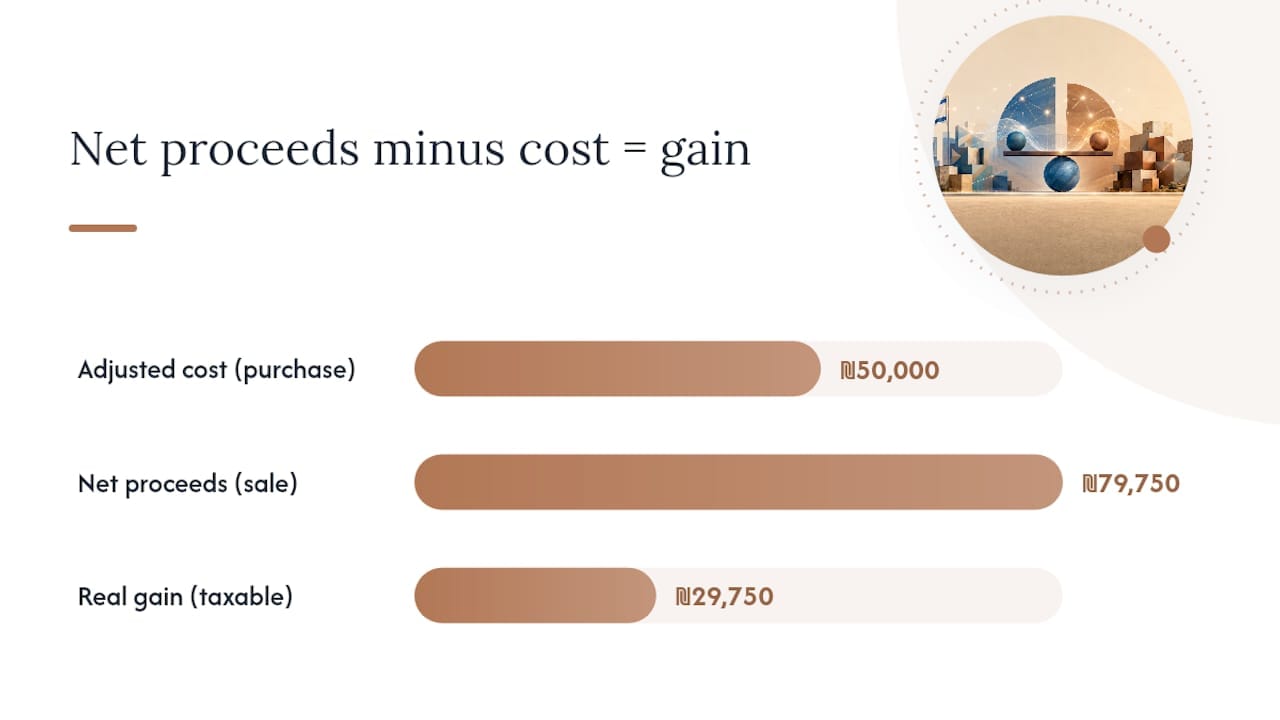
- Calculate the real gain: net proceeds minus adjusted cost basis.
- Apply the correct rate based on the asset type and your shareholder status.
A worked example in NIS: Say you bought 1,000 shares of an Israeli company for ₪50,000, including a ₪200 commission. Three years later you sell them for ₪80,000, paying a ₪250 commission. Your adjusted cost is the original purchase price plus commissions. Your net proceeds are ₪79,750. Your real gain is the difference between adjusted sale proceeds and adjusted cost, taxed at the applicable rate which can be up to 25% for ordinary cases.
If you sold shares in multiple lots bought at different prices, the Tax Authority’s official worksheet generally requires you to track cost basis per lot rather than averaging blindly, which matters if you’ve been dollar-cost-averaging into the same stock over several years.
Which Forms to File and When They’re Due
Most retail investors trading through an Israeli bank or broker never see a form, because the institution withholds tax and reports it for you through Form 867a o 867b. Those forms document what was withheld and when.
Where self-reporting is required, here’s what applies:
- Form 1322 is the main annual return appendix for capital gains, filed alongside your regular income tax return.
- Form 1325 and Form 1326 are supplementary appendices used to itemize specific security transactions, particularly ones involving foreign brokers or transitional cost calculations.
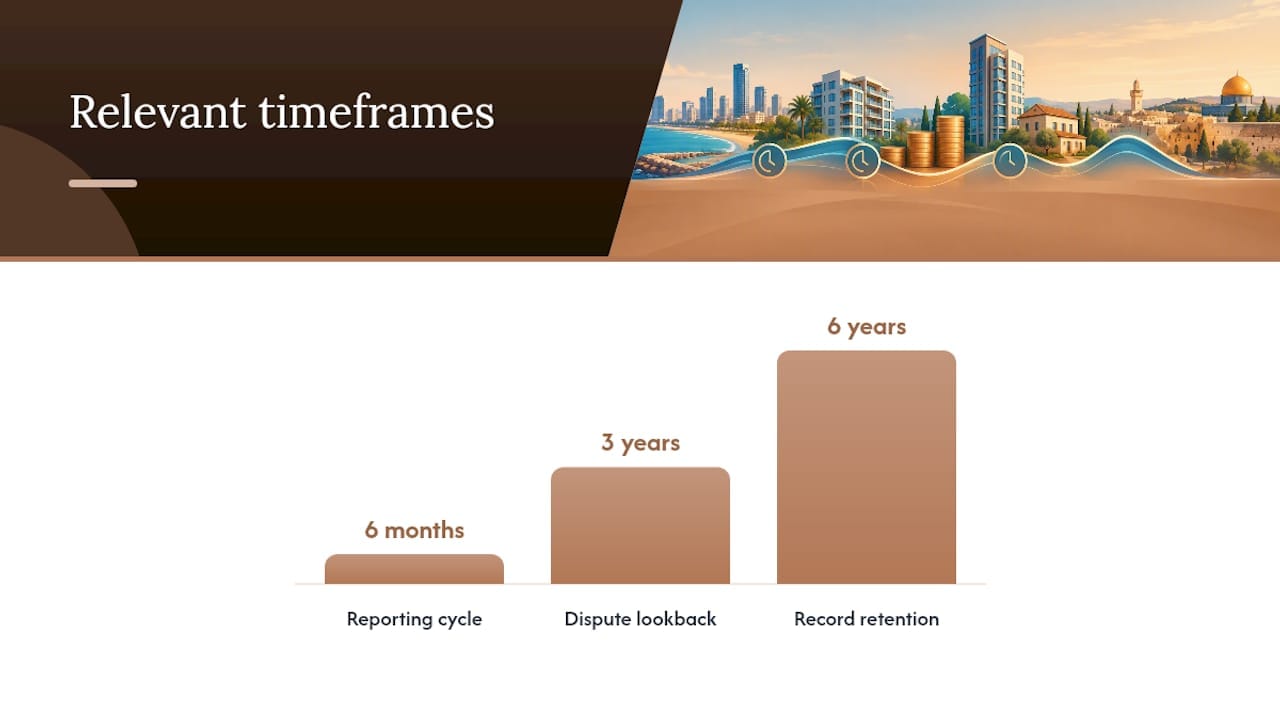
- Securities reporting gets a notable exception to the usual 30-day disposal rule: instead of reporting each sale individually, most investors report on a half-year cycle, with deadlines on January 31 y July 31 each year, according to the Tax Authority’s reporting guidance.
Pro Tip: Reconcile your broker’s Form 867 against your own trade confirmations before filing. Discrepancies between withheld amounts and your own calculation are one of the most common triggers for a follow-up inquiry from the Tax Authority.
Keep every trade confirmation, dividend statement, and 867 form for at least six years. If a dispute arises over a transaction from three years ago, you’ll want the paper trail ready.
Offsetting Capital Losses From Share Sales
Losses on one stock can reduce the tax bill on gains from another, but the rules aren’t as simple as “losses cancel gains.”
- Current-year offset: Capital losses realized in the same tax year can offset capital gains from other securities sold in that year, before any tax is calculated.
- Carryforward: Unused losses can generally be carried forward to offset gains in future years, though losses generated before 2006 follow older, separate transitional rules.
- Limits on offsetting income: Capital losses typically cannot offset ordinary income like salary, and offsetting interest or dividend income carries its own restrictions depending on indexation treatment.
- Documentation matters: A loss you can’t prove with a trade confirmation or broker statement is a loss you can’t claim.
If you’re carrying losses from before 2006 or dealing with a mix of pre- and post-cutoff acquisitions, get a second set of eyes on the calculation. This is exactly the kind of complexity where Menora Law’s clients typically ask us to confirm the numbers before filing.
When You Become a “Major Shareholder” (and Why the Rate Jumps)
Cross a 10% ownership or control threshold in a company, and you’re reclassified as a major shareholder under Israeli tax rules.
Related-party transactions get extra scrutiny too. If you’re selling to or buying from a connected party, the Tax Authority’s guidance treats the transaction differently for valuation and reporting purposes than an arm’s-length trade on the open market.
Pro Tip: *Monitor your percentage ownership before any corporate action, buyback, or family transfer.
Selling Foreign-Listed Shares and Handling Digital Assets
Trade Israeli shares through an Israeli broker, and withholding happens automatically. Trade foreign-listed shares through an overseas platform, and nothing gets withheld at all, leaving you fully responsible for calculating and reporting the gain yourself.
- You’ll need to file Form 1322 with the 1325/1326 appendices, supplying your own proof of cost basis since no Israeli institution issues you a Form 867.
- Assets acquired before key transitional cutoffs (notably December 31, 2004) require prorating the gain across pre and post cutoff periods using days-held calculations from the official formula.
- Convert every transaction to shekels using the exchange rate on the trade date, and keep the broker statement that proves it.
Filing Mistakes That Cost Investors Money
The most expensive mistakes are usually preventable:
- Miscalculating cost basis by forgetting to include commissions or applying indexation incorrectly.
- Skipping foreign trades entirely, assuming a lack of Israeli withholding means no reporting obligation. It doesn’t, according to the Tax Authority’s reporting guidance.
- Losing broker statements needed to prove cost basis years later during an inquiry.
Pro Tip: Build a simple spreadsheet the moment you buy a security: date, price, commission, and broker. Reconstructing this two years later from memory is where most reporting errors start.
If your situation involves inherited shares, a major-shareholder event, or a dispute over how the Tax Authority calculated your indexation, that’s the point to bring in counsel rather than guess.
Where International Investors Actually Need a Lawyer
Foreign brokers, inherited Israeli shares, and major-shareholder reclassifications are where automatic reporting breaks down and mistakes get expensive. Menora Law represents international clients on Israeli tax matters, including cross-border share transactions, inherited shareholdings, and disputes over cost-basis calculations, handled remotely for clients abroad.
— Menora Law
Get Help Filing Your Israeli Capital Gains Tax Correctly
If you’ve read this far, you already know the mechanics of mas rivchei hon mechirat meniot aren’t the hard part. The hard part is applying them to your specific broker, your specific cost basis, and your specific ownership percentage without a costly error. Legal practices focused on Israeli law offer assistance with tax form calculations, filing, and correspondence with the Tax Authority, allowing clients to avoid the need to travel to Israel or manage complex paperwork alone.

Our work spans Israeli wealth management law for international investors, corporate share structuring through our business law practice, and tax compliance for clients who trade through foreign brokers. For readers dealing with cross-border legal complexity beyond taxation, our partners at Legalec also provide broader legal support. If you’ve realized a gain this year and aren’t confident your paperwork is right, contact Menora Law and get a straight answer on what you owe and what to file, before a deadline forces the issue.
Preguntas más frecuentes
How Do You Calculate Tax on a Stock Sale in Israel?
Subtract your adjusted cost basis, original price plus commissions, from your net sale proceeds to get your real gain, then apply indexation where the asset qualifies. The Tax Authority’s ITC-1399 worksheet lays out the exact fields to use.
Who Is Exempt From Capital Gains Tax in Israel?
There’s no blanket exemption for individual investors selling ordinary traded securities. Certain narrow cases, such as some non-indexed debt instruments or specific transitional slices, get preferential rates rather than a full exemption, per the Tax Authority’s rate guidance.
What’s the Tax Rate on Selling Shares in a Private Israeli Company?
If you hold 10% or more of the company, you’re classified as a major shareholder and the rate on your real gain rises to 35%.
When Do You Pay Tax on Dividends From Israeli Shares?
Dividend tax is generally withheld at the source when the payment is made, separate from capital gains tax on a share sale. If you receive dividends through a foreign broker with no Israeli withholding agent, you’re responsible for reporting and paying it yourself, according to Tax Authority guidance.
What Happens if I File Late or Report the Wrong Amount?
Late or inaccurate filings on capital gains from securities can trigger interest charges and penalties from the Tax Authority, plus a higher chance of an audit. Reconciling your own numbers against Form 867 before the January 31 or July 31 deadline is the simplest way to avoid it.


 English
 Afrikaans
 العربية
 বাংলা
বাংলা Čeština
 简体中文
简体中文 Nederlands
 Suomi
Suomi Français
 Deutsch
 עִבְרִית
 हिन्दी
 Magyar
 Italiano
 日本語
日本語 한국어
한국어 Polski
 فارسی
فارسی Português do Brasil
 Русский
 Español de México
 Українська