
Yes, Israeli probate can be granted without the original will, but only through a route the law specifically allows. You can’t simply send a photocopy and hope. Under the Succession Regulations, the Registrar will take your application if you attach the original, a court decision (or pending application) allowing the will to be proved some other way, or a foreign probate order that has been properly proven in Israel. At Menora Law, we help heirs overseas work out which of those three fits their situation, and we handle the filing remotely so you don’t have to fly to Israel.
TL;DR
- The original will is the default requirement, but regulation 14(b)(3) of the Succession Regulations, 5758-1998, lists two other ways in: a request to prove the will without the original, or a foreign probate order proven as a foreign certificate.
- A request to prove a will from a copy turns on evidence: who signed it, who witnessed it, what it said, and why the original is gone.
- Israel does not treat a foreign probate order as enough on its own to move Israeli assets. An Israeli order is still needed.
- If the will can’t be proved, the estate may be handled as if there were no will, and an inheritance order follows the statutory shares.
- Heirs abroad can do all of this through an abogado israelí, remotely, with apostilled and translated documents.
Why the original will matters so much in Israel
In Israel, a will is not self-executing. Before banks, the Land Registry or insurers will release anything, someone has to get a court-issued order from the Registrar for Inheritance Matters. When there is a will, that order is a probate order. When there isn’t one, it’s an inheritance order. Both come from the same office and both are reviewed by the Guardian General, a state body that, according to the IBA’s International Estate Planning Guide for Israel, reviews and accompanies the procedure and may step in when it sees fit.
The original document matters because the registrar has to be sure the will is the real, final one. A signed original shows that. A copy can’t, which is why the system asks for something extra when the original is missing.
If you want the broader picture of how Israeli succession works, our guide to Israeli probate and succession law walks through it. This article stays on one problem: the original is lost, held abroad, or can’t be found.
The three routes the regulations allow
The rule sits in regulation 14(b)(3) of the Succession Regulations, 5758-1998. An application for a probate order is not accepted unless one of these is attached, all in line with section 68(b) of the Succession Law, 5725-1965:
- The original will. The standard route.
- An application to permit proof of the will, or a court decision on such an application. This is the route for a lost or unavailable original, where the court is asked to accept the will on other evidence.
- A foreign probate order on the will, attached together with proof of that order as a foreign certificate.
That’s the whole list. Everything else you read about “probate with a copy” is a description of one of these.
Route 2: asking the court to prove the will without the original
This is the one most people searching this topic need. In practice it’s a separate request, sometimes called a petition to prove a will by copy. The court wants to be satisfied about two things: what the will said, and why the original can’t be produced.
What tends to carry weight is not complicated:
- A clear copy of the signed will, ideally the one the drafting lawyer kept in the file.
- Statements from the witnesses who watched the person sign, or from the lawyer who drafted it.
- An explanation of what happened to the original: misplaced in a move, destroyed in a fire or flood, held by a notary or bank abroad that won’t release it, or lost in the post.
- Anything showing the person didn’t cancel the will on purpose. This is the point judges look at hardest, because a missing original can mean it was destroyed deliberately.
That last point is the real hurdle. If a person tore up their own will, the copy no longer reflects what they wanted. So the more you can show that the original was lost by accident, or is sitting somewhere safe, the stronger the request.
The exact evidence the court asks for depends on the case, and that’s where an abogado israelí earns their fee. We prepare the factual statement, gather and organize the supporting statements, and file the request so the story is clear and consistent before the court reads it.
Route 3: a foreign probate order
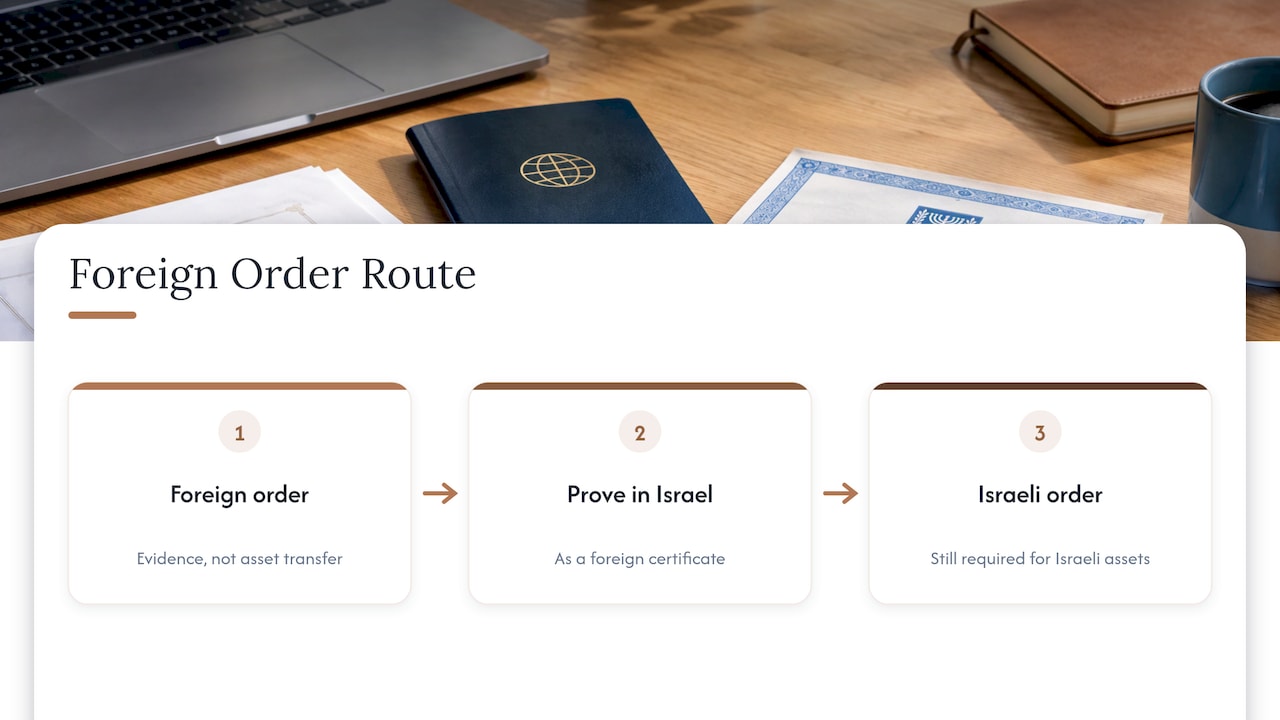
Sometimes the will was already admitted to probate where the person lived. In that case the foreign order can be attached to the Israeli application, but it has to be proven in Israel as a foreign certificate. The IBA guide adds an important warning: Israel does not recognize foreign probate court orders as a way to transfer Israeli assets. You still need an Israeli order, whatever has happened abroad.
So think of the foreign order as evidence that feeds the Israeli process, not a replacement for it. The same IBA guide describes a special procedure for cases where the original has been filed for probate, or is held by a notary, in another country. The Israeli court can be asked to issue an order based on a duly authenticated copy of the will.
Does a foreign-signed will count at all?
Most heirs abroad ask this first. The IBA guide says a foreign will is valid in Israel if it is valid under the law of the place where it was signed, the place where the person lived or held citizenship when signing or at death, or, for real estate, the place where the property sits. So a will signed abroad is not automatically useless in Israel.
Validity and proof are two separate questions, though. A will can be perfectly valid and still need an Israeli order before the bank will talk to you. Our page on how foreign wills are recognized in Israel goes deeper on that. Also worth a look: Israeli multi-jurisdictional estates, if the person owned assets in more than one country.
Authentication: apostille and translation
Israel is party to the 1961 Hague Apostille Convention, according to the IBA guide, so a foreign notary’s confirmation with an apostille is accepted in Israel for all purposes. For documents from abroad, that means:
- Apostille. Get it from the authority in the country where the document was issued. This applies to the copy of the will, death certificate and any statements signed before a notary.
- Translation. Documents not in Hebrew or English generally need translating, and the Israeli side usually wants a certified translation. Ask your abogado israelí before you order one, so you don’t pay twice.
- Notarized statements. Witness or family statements that explain the missing original should be signed before a notary and apostilled, so they can be used as filed.
If the will itself exists in two languages, you can save yourself delays. We wrote about that in stopping 40-day probate delays for bilingual wills.
Step by step: how an heir abroad moves forward
1. Pin down what you have and where the original might be
Before anything is filed, find out whether the original really is lost. Check with the lawyer who drafted it, the notary who handled signing, the family’s bank safe deposit box, and any relatives who might have been given the document. A will that is held somewhere is a very different case from one that has vanished, because holding it means you may only need to move it, not replace it.
Where it goes wrong: heirs assume the original is gone and skip the call that would have found it. That choice is expensive, because proving a will by copy takes a separate court step.
What we do here: we ask the right questions early, in English, and tell you which route fits before anything is filed.
2. Collect the copy and the supporting statements
Get the clearest copy of the signed will you can find. Then identify the people who can speak to it: witnesses, the drafting lawyer, the person who last saw the original. Their statements are what make a copy credible.
Where it goes wrong: statements that don’t line up. One person remembers the will being signed in March, another says June. Small mismatches invite questions from the court.
What we do here: we draft the statements in a consistent, Israel-ready format, and arrange for them to be signed and apostilled where you are.
3. Get the death certificate in order
Per the gov.il page for requesting an inheritance order, where the person had no Israeli ID number, a duly verified death certificate is required. If you can’t produce one, an application to prove the death in another manner is needed. Apostille and translate it as your abogado israelí advises.
4. File the request to prove the will, with or alongside the probate application
The request to prove the will without the original goes to the court. The probate application then relies on the court’s decision, or on the pending application, as the regulation allows. Because Israeli filings are done in Hebrew and online, it is easier and cleaner to have an abogado israelí submit them for you.
If you file online, remember the rule on originals. When an application is filed online, the original will has to be delivered to the Registrar for Inheritance Matters within 7 days of the filing date, according to the Succession Regulations. That’s for cases where the original exists. In a lost-original case, this is exactly why the court request comes first.
5. Publication, objections and the order
The application is published, which gives other heirs and interested parties the chance to object. This is also when a competing will, or a relative who doubts the copy, can surface. If someone objects, the matter can move to the family court, where the will’s authenticity is argued. Our page on heirs abroad unlocking Israeli assets covers how cross-border disputes tend to unfold.
6. Use the order to move the assets
Once the order is issued, it is digital only. The gov.il page says orders are emailed to the applicant or their representative and transmitted to ministries, banks, insurers and the Land Registry, with no printed copies issued. From there the estate can be administered and distributed.
How long does it take?
For a standard application, the gov.il page says an inheritance order should be issued, as a rule, within 40 days of the completed submission, including the newspaper publication. If the application goes to the Counsel for the Attorney General, the window is 50 days. That’s the published target for the order itself.
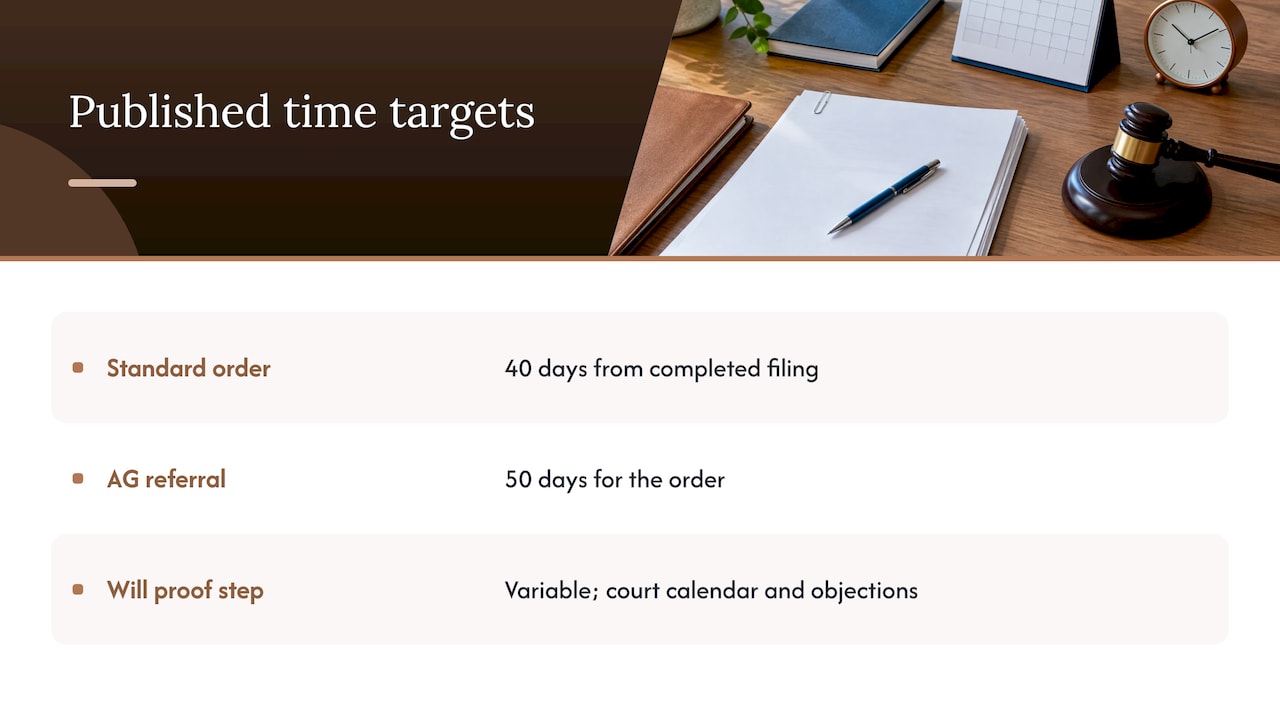
A missing original adds the court step in front of that clock. How long the extra step takes depends on the court’s calendar and on whether anyone objects, so any number someone quotes you without seeing the file is a guess. Treat the 40 and 50 day figures as the base, and plan for more where the will has to be proven first. Check the gov.il page for the procedure as it stands when you file.
What if the will can’t be proved?
Sometimes the evidence just isn’t there. No witnesses are alive, no lawyer’s file survives, and nobody can show the original was lost by accident. In that situation the will may not be accepted, and the estate is treated as if the person died without a will.
Then the route is an inheritance order, which divides the estate according to the shares set out in the Succession Law of 1965. Who inherits, and how much, comes from the statute instead of from the person’s wishes. Our guide to the 1965 Succession Law explains how those shares work.
This is the outcome families most want to avoid, because the people who benefit from the statute can be different from the people named in the will. It’s one reason the evidence work in step 2 deserves care.
Mistakes we’d steer you away from
- Sending a copy and waiting. A copy without a court route attached to it won’t be accepted.
- Relying on the foreign order alone. An Israeli order is needed to move Israeli assets either way.
- Letting the family disagree on the story. A consistent account of what happened to the original is half the case.
- Translating before asking. Get the abogado israelí’s view on which documents need translation and in what form.
- Waiting years. Bank accounts and property sit frozen while the estate is unresolved, and memories of witnesses fade.
Our perspective
In our experience as an Israeli law practice focused on international clients, the missing original is rarely the real problem. The real problem is that the family abroad doesn’t know which of the three routes applies, so they start in the wrong place and lose months.
We think the fix is a clear plan at the start. We look at what exists: a copy, a foreign order, a notary’s file. Then we match it to the route in regulation 14(b)(3) and prepare the filings in Hebrew, with your documents apostilled and translated properly.
Because we work with overseas heirs, we handle this remotely. You don’t have to travel to Israel, and we can arrange on-site consultations abroad when a face-to-face conversation helps. Fast, plain communication matters here, because a family dealing with a loss shouldn’t have to chase answers about their own inheritance.
Israeli probate is an Israeli court process. It’s best handled by lawyers who work inside it every day.
Ley de Menorá
How Menora Law helps
Menora Law offers help with obtaining an Israeli inheritance order, addressing Israeli inheritance tax obligations, distributing estate assets in Israel, and managing inheritance cases in Israeli family courts. If the original will is missing, we assess your documents, choose the route, and represent you from start to finish, remotely.

Send us what you have: the copy, the death certificate, and anything you know about where the original went. We’ll tell you what the next step is.
Planning ahead so your own heirs don’t face this
If you own Israeli property or accounts, the easiest fix is to avoid the problem. A will prepared and filed in Israel can be located later, and our team can prepare, file and modify wills in Israel for clients living overseas. For the planning side of the picture, a practical estate planning guide for families is a good companion.
Preguntas más frecuentes
Can Israeli probate be granted with just a copy of the will?
Not on a bare copy. The regulations allow a probate application when the original is attached, when a request to prove the will has been decided or is attached, or when a foreign probate order is attached and proven as a foreign certificate. A copy works only through the second route, with evidence behind it.
Is a foreign probate order enough to transfer Israeli assets?
No. According to the IBA’s guide, Israel does not recognize foreign probate orders for this purpose, and an Israeli order is required whatever has happened abroad. The foreign order can still be attached to the Israeli application, as long as it is proven as a foreign certificate.
¿Tengo que viajar a Israel?
Usually not. With an abogado israelí acting for you, the filings are made in Israel on your behalf, and your documents can be signed, notarized and apostilled where you live. Menora Law represents overseas heirs remotely.
What if the person had no will at all?
Then you apply for an inheritance order, which follows the statutory shares in the Succession Law of 1965. The gov.il page says these orders should generally be issued within 40 days of a completed submission, including publication, or 50 days if the application goes to the Counsel for the Attorney General.
Sources
- Succession Regulations, 5758-1998, Chapter V
- Request an inheritance order, Guardian General and Official Receiver, gov.il
- IBA International Estate Planning Guide, Israel 2021
- Estate Planning: A Practical Guide for Families


 English
 Afrikaans
 العربية
 বাংলা
 Čeština
 简体中文
 Nederlands
 Suomi
 Français
 Deutsch
 עִבְרִית
 हिन्दी
 Magyar
 Italiano
 日本語
 한국어
 Polski
 فارسی
 Português do Brasil
 Русский
 Español de México
 Українська