
To claim preferential duty treatment under the U.S.–Israel Free Trade Agreement (FTA), you must include a signed Invoice Declaration on the commercial invoice confirming compliance with the FTA’s Rules of Origin, assign the correct Harmonized System (HS) code to your goods, and secure a Certificate of Non-Manipulation for any shipment routed through a third country. Israel Customs (Israel Tax Authority) enforces these requirements at the port of entry, and the U.S. Commercial Service publishes the guidance exporters need to get the paperwork right. Menora Law represents overseas clients through every stage of this process, from pre-shipment document review to customs dispute resolution.
Three things to do before your goods ship:
- Sign the Invoice Declaration. Place the signed declaration on the commercial invoice or company letterhead. Without it, Israeli Customs will not apply the preferential tariff rate.
- Confirm your HS code. If classification is unclear, request a free pre-ruling from Israel Customs before the shipment departs.
- Obtain a Certificate of Non-Manipulation from the transiting country’s customs authority if your goods pass through a third country en route to Israel.
Pro Tip: If your annual exports to Israel are approaching a high threshold, start the Approved Exporter application process early rather than waiting until you hit the required export volume. The examination takes time, and the status simplifies every subsequent shipment.
Key Takeaways
The single most important step for any exporter to Israel is signing a legally accurate Invoice Declaration, backed by verified Rules of Origin evidence, before the shipment leaves origin.
| Point | Details |
|---|---|
| Invoice Declaration is mandatory | Sign it on the commercial invoice or letterhead; it replaced the hard-copy Certificate of Origin as of January 10, 2018. |
| HS classification drives everything | The HS code determines duty rate, permits, and FTA eligibility; use Israel Customs’ free pre-ruling service when classification is uncertain. |
| Transshipment requires extra documentation | A Certificate of Non-Manipulation from the transiting country’s customs authority is required for goods routed through third countries. |
| Approved Exporter status at a high export volume | U.S. exporters with substantial annual Israel exports and a clean customs record may qualify for simplified documentary procedures. |
| Menora Law handles disputes and audits | For detained goods, IP allegations, bank-guarantee negotiations, or post-entry audits, Menora Law provides remote Israeli legal representation. |
What does the US–Israel trade agreement require in practice?
The FTA’s paperwork obligations are more specific than most exporters expect. Getting them right before the vessel sails is far cheaper than resolving a customs hold in Ashdod or Ben Gurion Airport.
Invoice Declaration: the document that triggers zero duty
Effective January 10, 2018, U.S. exporters no longer need a hard-copy Certificate of Origin. A signed Invoice Declaration on the commercial invoice or company letterhead is sufficient to claim preferential tariff treatment under the U.S.–Israel FTA. The declaration must be signed by the manufacturer, consignor, or an authorized agent, and it must affirm that the goods meet the FTA’s Rules of Origin.
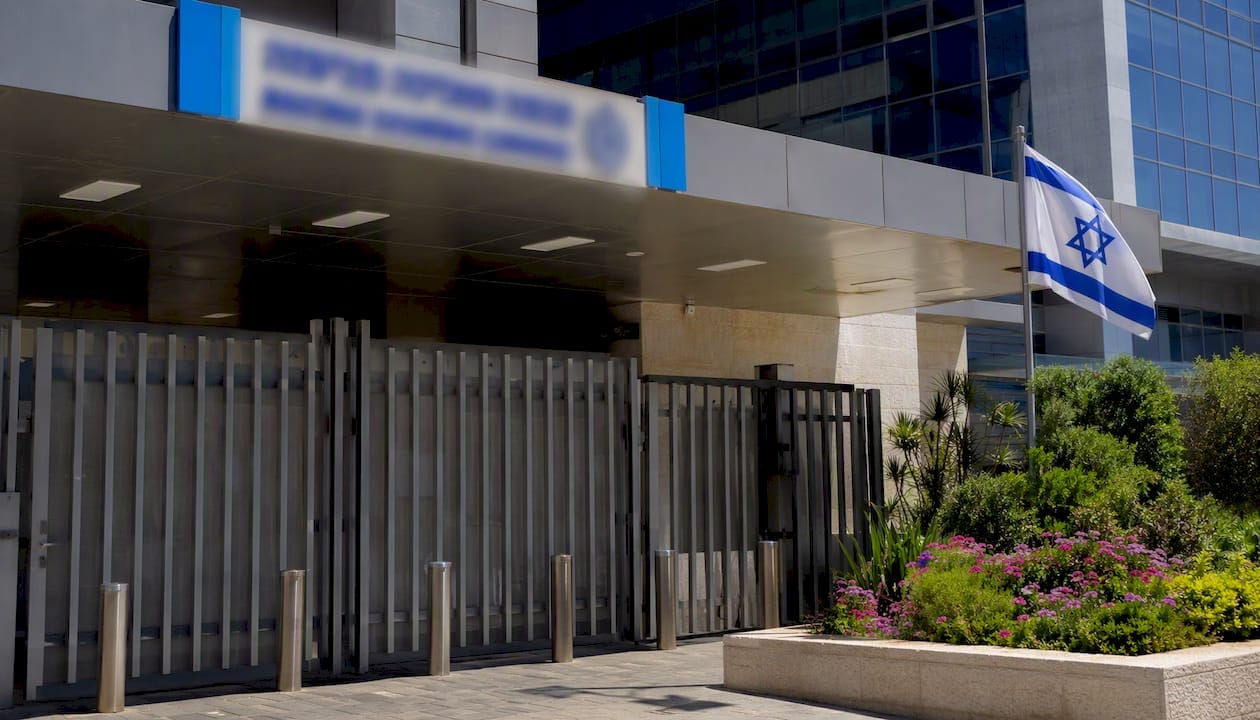
The shift to an Invoice Declaration simplified paperwork, but it raised the legal stakes. Signing a declaration without first verifying origin compliance exposes the exporter to penalties and denial of preferential treatment. Verify the declaration language against the FTA’s Rules of Origin text before the invoice is finalized.
Rules of origin: your responsibility before you sign
Origin verification is the exporter’s obligation, not the importer’s. Before signing the Invoice Declaration, confirm that the goods satisfy the applicable origin criteria, whether that is a tariff-shift rule, a value-content threshold, or a specific processing requirement. Keep the supporting evidence on file; Israel Customs may request it during a post-entry audit.
Approved Exporter status
U.S. firms with a significant volume of total annual exports to Israel and a clean customs record may apply for Approved Exporter status. Israel Customs conducts an examination, and approved exporters receive an identity number to stamp on invoices, which simplifies documentary requirements. Status is typically valid for six months with automatic extension procedures available. For recurring, high-volume shippers, this status reduces per-shipment friction considerably.
Transshipment and the Certificate of Non-Manipulation
Goods routed through a third country must arrive with a Certificate of Non-Manipulation issued by the customs authority of the transiting country. Without it, Israel Customs may deny the preferential tariff claim entirely, regardless of how well the Invoice Declaration is prepared.
Pro Tip: Verify the signed declaration language against the FTA’s Rules of Origin text before finalizing the invoice. A mismatch between the declaration and the actual origin evidence is one of the most common reasons preferential claims are rejected.
How does HS classification affect your duty rate in Israel?
Israel uses the Harmonized System (HS) for tariff classification, and the HS code you assign determines the duty rate, applicable permits, and any licensing conditions that apply to your goods. A wrong code does not just produce the wrong duty rate; it can trigger an import license requirement you did not know existed, or disqualify the shipment from preferential treatment altogether.
Israel Customs offers a free pre-ruling classification service that resolves the HS question before your goods arrive. Commercial Service’s import documentation guide](https://www.trade.gov/country-commercial-guides/israel-import-requirements-and-documentation). Pre-ruling requests typically require detailed technical descriptions, product catalogs, and may require samples or lab results to verify the correct HS heading.
| Pre-Ruling Submission Item | Who Prepares It | Notes |
|---|---|---|
| Detailed technical description | Exporter / manufacturer | Must cover composition, function, and intended use |
| Product catalog or brochure | Exporter | Translated to Hebrew or English |
| Samples or lab test results | Exporter / third-party lab | Required for mixed or composite goods; timing is practice-dependent |
| Proposed HS heading with reasoning | Customs broker or legal counsel | Strengthens the submission materially |
Request a pre-ruling when your goods are:
- Mixed or composite products where composition percentages are not obvious
- New product types with no clear precedent in Israel’s tariff schedule
- Goods that could plausibly fall under two or more HS headings
Pro Tip: Coordinate the pre-ruling submission with your freight forwarder and Menora Law. Customs may request additional technical evidence, and having legal counsel review the submission before filing reduces the risk of a back-and-forth that delays your shipment timeline.
What should a commercial invoice include for Israeli Customs?
Israel Customs expects commercially detailed invoices. Missing fields can negate the duty-free eligibility of an otherwise compliant shipment. The U.S. Commercial Service guidance confirms that Customs expects a signed declaration from the manufacturer, consignor, or authorized agent alongside full cost breakdowns.
Essential invoice fields:
- Supplier details: full legal name, address, and contacto information
- Consignee and agent: Israeli importer’s details and customs agent if applicable
- Full goods description: specific enough to support HS classification
- Tariff heading (HS code): stated on the invoice
- Composition percentages: required for mixed or composite goods
- Origin statement / Invoice Declaration: signed and dated
- Total shipment value: inclusive of packing, shipping, and insurance
- Signature of authorized person
Supporting documents to assemble alongside the invoice: bill of lading or airway bill, packing list, technical specifications, test reports, import licenses where required, and the Certificate of Non-Manipulation for transshipped goods.
Before the shipment leaves origin, have the exporter, freight forwarder, Israeli importer, and Menora Law each review the completed invoice. Catching a missing composition percentage at that stage costs nothing. Catching it after goods are detained in Israel costs storage fees, legal time, and commercial delay.
What can Israel Customs do if your documentation is wrong?
Él Customs Ordinance (New Version) gives Israeli Customs and rights-holders meaningful enforcement tools, and they use them.
| Error Type | Likely Customs Action | Practical Mitigation |
|---|---|---|
| Wrong HS code | Delay of release; reclassification; additional duties | Request pre-ruling before shipment; engage customs broker |
| Missing or defective Invoice Declaration | Denial of preferential tariff; full duty assessed | Verify declaration language before invoice is finalized |
| Transshipment without Certificate of Non-Manipulation | Denial of preferential treatment | Obtain certificate from transiting country’s customs authority |
| IP / trademark / copyright allegation | Delay of release; bank guarantee required; possible seizure | Engage Menora Law immediately; prepare guarantee documentation |
For IP-related holds, the statutory procedure allows an initial 3-work-day delay, with a possible 3-day extension. During that window, the rights-holder or importer must act. Bank guarantees are required during delay periods, and the Ordinance sets defined timelines for return of those guarantees. Storage fees accumulate quickly at Israeli ports, so the window for response is genuinely tight.
If goods are held, act immediately: contacto the Israeli importer’s local customs representative, supply any missing documents, assess whether a bank guarantee is needed, and contacto Menora Law for legal representation.
Pre-shipment checklist before goods leave origin
Follow these steps in order, and assign ownership before the vessel or airway bill is issued.
- Confirm Rules of Origin (Exporter): verify the goods meet the applicable FTA origin criteria and document the evidence.
- Complete and sign the Invoice Declaration (Exporter / authorized agent): use language that matches the FTA’s Rules of Origin text exactly.
- Verify HS codes (Customs broker / Menora Law): if classification is uncertain, file a pre-ruling request with Israel Customs before the shipment date.
- Assemble technical documentation and test reports (Exporter / manufacturer): include composition data, lab results, and product specs.
- Confirm import licenses or permits (Israeli importer / customs agent): some goods require advance licensing; confirm before goods depart.
- Check transshipment routing (Freight forwarder): if goods transit a third country, secure the Certificate of Non-Manipulation from that country’s customs authority.
- Confirm Approved Exporter status or document chain of custody (Exporter): if status is active, stamp the identity number on the invoice; if not, ensure the full documentary chain is in order.
- Final invoice review (Exporter + Israeli importer + Menora Law): all parties sign off before the bill of lading or airway bill is issued.
When should you hire an Israeli lawyer for FTA compliance?
Some situations call for a customs broker. Others call for an abogado israelí. The distinction matters.
Engage Menora Law when:
- Goods have been detained by Israel Customs and a response deadline is running
- Rules of Origin questions involve complex manufacturing processes or multi-country inputs
- Your shipment was transshipped and the Certificate of Non-Manipulation is missing or disputed
- An IP, trademark, or copyright allegation has been raised against your goods
- The shipment is high-value and storage fees or penalties represent material commercial risk
- You are planning recurring shipments and want to pursue Approved Exporter status
Menora Law’s services for FTA compliance include invoice and declaration drafting review, liaison with Israel Customs on classification and documentation issues, pre-ruling file preparation, representation in customs delay and bank-guarantee disputes, management of post-entry audits, and drafting contractual protections for cross-border sales agreements. For foreign businesses, Menora Law provides full business law representation in Israel with remote consultation available from anywhere in the world.
Before an initial call, have ready: the commercial invoice, the Invoice Declaration (signed or draft), the HS code and any pre-ruling correspondence, the bill of lading or airway bill, and any Customs notices or hold letters.
What exporters consistently get wrong, and what actually works
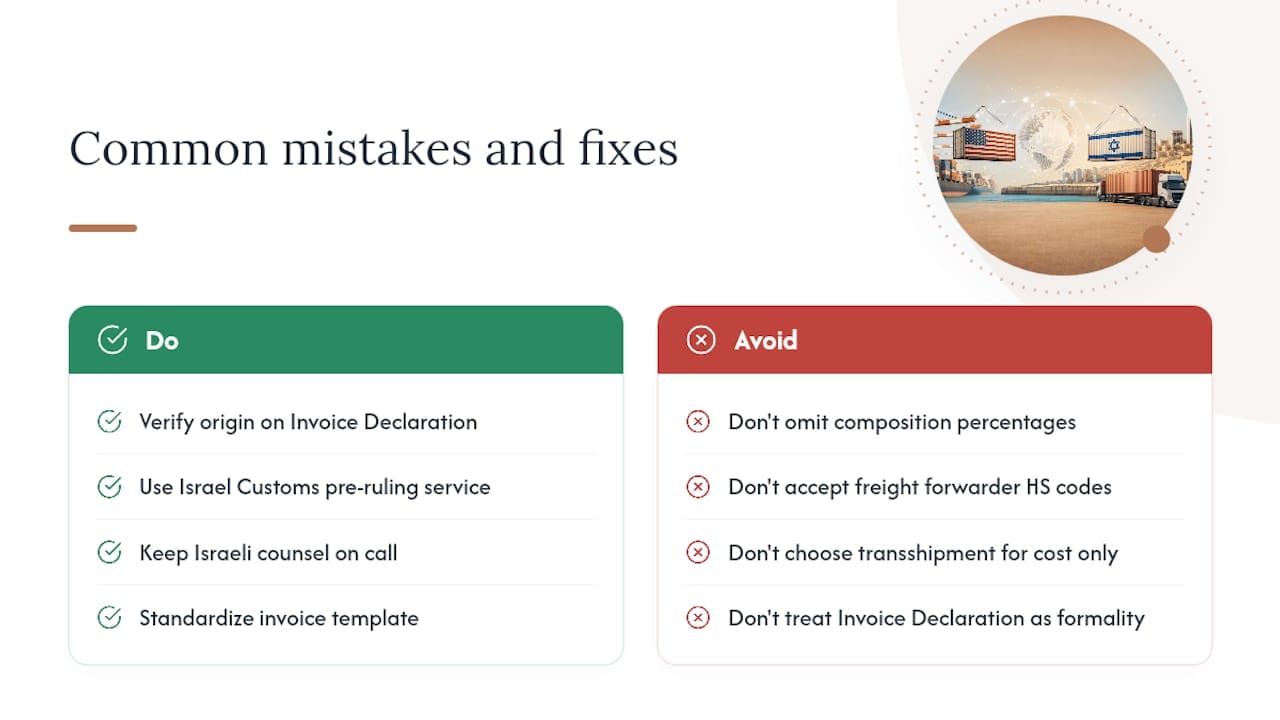
From Menora Law’s perspective, the most common and costly errors in FTA compliance are not the dramatic ones. They are the quiet ones: an invoice that omits composition percentages on a mixed product, an HS code assigned by a freight forwarder without legal review, a transshipment route chosen for cost reasons without anyone checking the Certificate of Non-Manipulation requirement. Each of these is entirely preventable with a structured pre-shipment review.
The firms that move goods through Israel without delays are not necessarily the largest or most experienced. They are the ones that treat the Invoice Declaration as a legal document requiring origin verification, not a formality to fill in quickly. They use Israel Customs’ free pre-ruling service for any product where classification is genuinely ambiguous. And when something goes wrong at the port, they have Israeli legal counsel on call rather than scrambling to find representation under time pressure.
Menora Law’s standard approach for recurring-shipment clients is to implement a standardized invoice template reviewed against the FTA’s requirements, coordinate Approved Exporter status where volume qualifies, and maintain a standing relationship with the Israeli importer’s customs agent. That combination reduces per-shipment manual review and keeps the preferential tariff claim clean. For foreign investors and businesses entering the Israeli market, this kind of structured legal support from the outset avoids the expensive lessons that come from learning compliance requirements after a detention.
Menora Law is ready to handle your Israeli customs matter
Dealing with Israeli Customs from overseas is genuinely difficult. The documentation requirements are specific, the enforcement timelines are short, and a single missing field on an invoice can hold up an entire shipment. Menora Law works with foreign businesses and individuals who need Israeli legal representation, whether that means reviewing a commercial invoice before it ships, preparing a pre-ruling submission, or stepping in when goods are already detained and a bank guarantee deadline is running.

Menora Law offers remote consultation and full representation for overseas clients, with fast response times and direct access to Israeli-law expertise. If you have a shipment heading to Israel, a customs dispute already in progress, or questions about how the FTA’s Rules of Origin apply to your specific goods, contact Menora Law for a consultation. Bring your invoice, your HS code, and any Customs correspondence, and the firm will tell you exactly where you stand. Reach out through Menora Law’s business law practice page to get started.
Sources
The following official resources cover the forms, guidance, and statutory text referenced throughout this article. Save the relevant documents to your shipment file before goods depart.
This article is general information, not a substitute for advice from a qualified lawyer. Consult a qualified legal professional about your own circumstances before acting on anything here.
Preguntas más frecuentes
What is the Invoice Declaration under the US–Israel FTA?
The Invoice Declaration is a signed statement placed on the commercial invoice or company letterhead that affirms the goods meet the FTA’s Rules of Origin. It replaced the hard-copy Certificate of Origin for U.S. exporters effective January 10, 2018.
When is a Certificate of Non-Manipulation required?
A Certificate of Non-Manipulation is required whenever U.S. goods are routed through a third country before arriving in Israel. It must be issued by the customs authority of the transiting country and confirms the goods were not altered in transit.
What happens if Israel Customs detains my shipment?
Israel Customs may delay release, require a bank guarantee, or seize goods if documentation is defective or an IP allegation is raised. The statutory hold period begins at 3 working days, with a possible 3-day extension, so immediate legal response is critical.
Who qualifies for Approved Exporter status in Israel?
U.S. exporters with substantial total annual exports to Israel and a clean customs record may apply. Approved Exporters receive an identity number to stamp on invoices, which simplifies the documentary process for each subsequent shipment.
When should a foreign exporter contact Menora Law?
Contact Menora Law when goods are detained, when Rules of Origin questions are complex, when a transshipment certificate is missing, or when an IP allegation has been raised. Menora Law also assists with pre-ruling preparation and post-entry audit defense for overseas clients.


 English
 Afrikaans
 العربية
 বাংলা
বাংলা Čeština
 简体中文
简体中文 Nederlands
 Suomi
Suomi Français
 Deutsch
 עִבְרִית
 हिन्दी
 Magyar
 Italiano
 日本語
日本語 한국어
한국어 Polski
 فارسی
فارسی Português do Brasil
 Русский
 Español de México
 Українська