
TL;DR:
- Israeli copyright law protects original works automatically upon creation, without requiring registration.
- It grants both economic and moral rights, with protections lasting up to 70 years for individuals.
- Training AI models on copyrighted works is generally permissible, but outputs may still pose infringement risks.
Israeli copyright law automatically protects original works of authorship from the moment they are created, without any registration or formality required. The governing statute is the Israeli Copyright Act 5768-2007, which defines the scope of protection, the rights granted, and the limits on those rights. For individuals and businesses operating in Israel or creating works with Israeli connections, understanding these basics is not optional. It is the foundation for protecting what you create and avoiding liability for what you use. This guide covers the israeli copyright law basics explained in plain terms, from protected work categories to the latest developments around AI-generated content.
What types of works are protected under Israeli copyright law?

Copyright protection in Israel is automatic. The moment an original work is fixed in some tangible form, the law protects it. No filing, no registration, and no government stamp is needed. This is a fundamental difference from patent or trademark law, where formal registration is required to secure rights.
The Israeli Copyright Act 5768-2007 covers a broad range of creative categories. Protected works include:
- Literary works: novels, articles, software code, and databases
- Artistic works: paintings, photographs, sculptures, and architectural designs
- Musical works: compositions, with or without lyrics
- Dramatic works: plays, screenplays, and choreography
- Cinematographic works: films and video productions
- Sound recordings: any fixation of sounds
- Broadcasts: radio and television transmissions
The law does not require a minimum level of creativity. The only threshold is originality, meaning the work must originate from the author and reflect some degree of independent creative effort.
How long does copyright protection last in Israel?
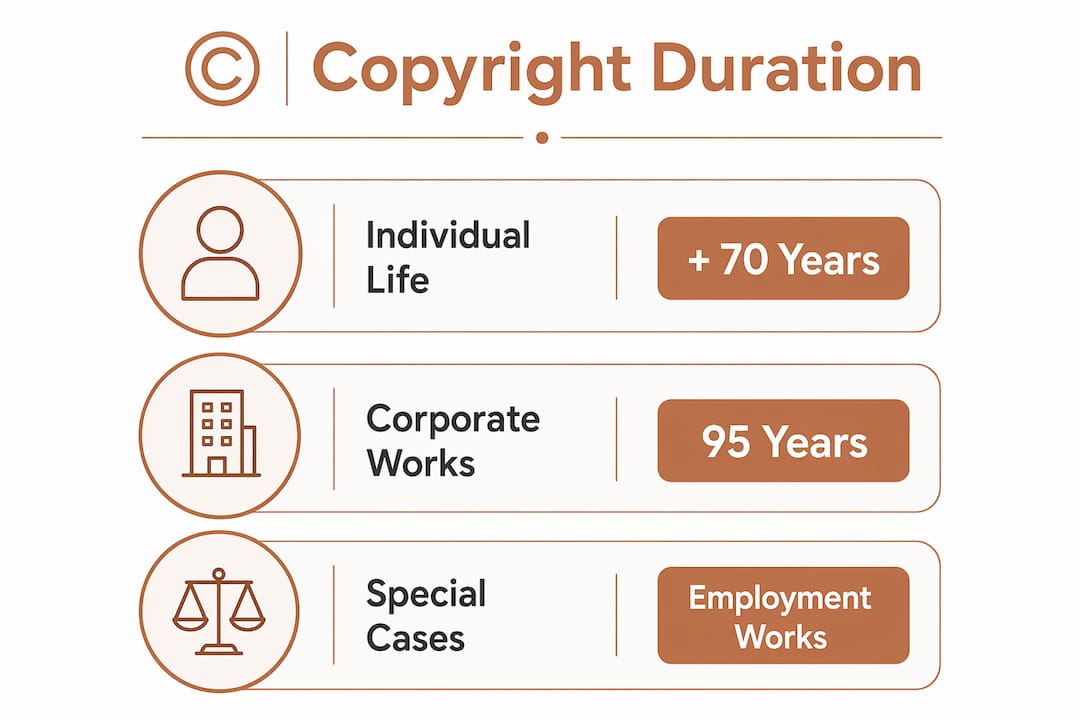
Protection duration depends on who created the work and what type of work it is.
| Work Type | Protection Duration |
|---|---|
| Individual author | Life of the author plus 70 years |
| Corporate or legal entity | 70 years from creation or first publication |
| Sound recordings | 50 years from creation or publication |
| Broadcasts | 50 years from the date of broadcast |
Copyright duration in Israel follows the life-plus-70-years standard for individual creators. That term is consistent with the European Union’s approach and reflects Israel’s alignment with international intellectual property norms.
Special rules apply when an employee creates a work in the course of employment. In that case, the employer typically holds the economic rights unless a contract states otherwise. This is a point many businesses overlook when hiring creative staff or contractors.
Pro Tip: If you hire a freelancer to create content, code, or design, always include a written assignment of economic rights in your contract. Without it, the freelancer may retain ownership under Israeli law.
What rights does Israeli copyright law grant to creators?
Israeli copyright law grants two distinct categories of rights: economic rights and moral rights. Understanding the difference matters enormously when you license your work, hire creators, or use third-party content.
Economic rights
Economic rights are the commercial rights attached to a work. They include:
- Reproduction: copying the work in any form
- Distribution: selling or transferring copies to the public
- Public performance: performing the work before an audience
- Broadcasting: transmitting the work over radio, television, or online
- Making available: uploading or streaming the work so the public can access it on demand
Economic rights are transferable via contract. A creator can license them exclusively or non-exclusively, assign them entirely, or retain them while granting limited use. This flexibility is the basis for most commercial content deals in Israel.
Moral rights
Moral rights protect the personal connection between a creator and their work. They cover two core protections: the right of attribution (to be named as the author) and the right of integrity (to object to changes that harm the work’s reputation). Moral rights cannot be waived or transferred. They remain with the author personally, regardless of any licensing or sale of economic rights.
This distinction creates real-world complications. A business can buy all economic rights to a photograph, but the photographer still has the right to be credited and to object to distortions of the image. Contracts that ignore moral rights create disputes.
Exceptions and limitations
Israeli copyright law includes several important exceptions that allow certain uses without infringement:
- Fair use: educational, research, criticism, news reporting, and personal study uses may qualify
- Incidental use: a work captured accidentally in the background of another work
- Ephemeral copying: temporary technical copies made during digital transmission or processing
Statutory damages for infringement without proof of actual loss are capped at 100,000 NIS (approximately $25,000). That cap means courts can award damages even when the rights holder cannot quantify their exact financial loss.
Pro Tip: Before using any third-party content, run a quick fair use analysis. Ask whether your use is transformative, commercial, and whether it affects the market for the original. Document your reasoning in writing.
How does Israeli copyright law apply to AI and machine learning?
The intersection of Israeli copyright law and artificial intelligence is one of the most actively discussed legal areas in 2026. The core question is whether training an AI model on copyrighted works constitutes infringement.
A december 2022 opinion from the Israeli Ministry of Justice addressed this directly. The opinion concluded that training AI models on copyrighted works is generally permissible under existing fair use, incidental use, and transient copy exceptions in the Israeli Copyright Act. That conclusion gave the technology sector significant legal breathing room.
The Ministry’s analysis rests on a critical distinction. The training phase and the output phase are legally separate events. Lawful training does not automatically make every output lawful.
Here is how to think about AI copyright risk in practical terms:
- Training phase: Using publicly accessible or licensed content to train a model is generally permissible under fair use principles, provided the use is transformative and does not substitute for the original market.
- Output phase: If an AI generates content that is substantially similar to a specific protected work, users can be liable for infringement. The Attorney General’s draft opinion warns that users should check AI outputs for originality before publishing or distributing them.
- Lawful access: Training on works you have lawful access to reduces risk significantly. Using scraped content without authorization adds legal exposure even if the training itself might qualify as fair use.
- Dataset diversity: Diverse training datasets reduce the likelihood that any single output will closely resemble one protected work.
- תיעוד: Maintaining a written fair use analysis for your AI use case creates a defensible record if a dispute arises.
Businesses using generative AI should prioritize platforms that offer clear legal indemnification and use databases built from public domain or properly licensed content. That practical step reduces risk without requiring deep legal expertise on every project.
Pro Tip: Never publish AI-generated content without reviewing it for substantial similarity to known works. A quick originality check before publication is far cheaper than defending an infringement claim.
Legislative developments are also moving quickly. As of may 2026, a private member’s bill is under consideration that would modify personal use rights and damages rules in Israeli copyright law. The bill specifically addresses personal use of one’s own photographs and proposes adjustments to how damages are calculated. Businesses and creators should monitor this legislation closely.
How can you protect your copyrights and stay compliant in Israel?
Protecting your rights under Israeli copyright law does not require a government office or a formal filing. It requires discipline, documentation, and clear contracts. Here is what actually works in practice.
Build an internal evidence trail
Israel has no formal copyright registration system. Proof of ownership in a dispute depends entirely on internal documentation. Dated drafts, version histories, email threads showing creation timelines, and metadata in digital files all serve as evidence. The earlier you start documenting, the stronger your position.
Practical steps to build your evidence trail:
- Save all drafts with timestamps and version numbers
- Use cloud storage platforms that log file creation and modification dates
- Send yourself or your team emails with attached drafts at key milestones
- Keep contracts, briefs, and creative briefs that show the work’s origin
Understand what you own and what you licensed
Many businesses confuse owning a license with owning the copyright. A license gives you permission to use a work under specific conditions. It does not transfer ownership. If you want full ownership of a commissioned work, you need a written assignment of economic rights signed by the creator.
Moral rights add another layer. Even after a full assignment of economic rights, the original creator retains attribution and integrity rights. Your contracts should address how credits will be handled and what modifications are permitted.
Conduct fair use analysis before using third-party content
Using someone else’s content without permission is infringement unless an exception applies. The fair use exception under Israeli copyright law considers factors like the purpose of the use, the nature of the original work, the amount used, and the effect on the original market. None of these factors is automatically decisive. You weigh them together.
For businesses using content in marketing, education, or research, a written fair use analysis for each significant use case creates a defensible record. For foreigners and investors in Israel, understanding these nuances is especially important because Israeli law may differ from what you are used to at home.
Use contracts to transfer and clarify rights
Every creative engagement should have a written contract. The contract should specify:
- Who owns the economic rights after the work is delivered
- What moral rights obligations apply, including credit and approval of modifications
- What uses are permitted and for how long
- What happens to rights if the relationship ends
Pro Tip: For any work created by an employee or contractor, include an explicit clause assigning all economic rights to your organization. Relying on implied ownership is a common and costly mistake.
Stay current with legislative changes
Israeli copyright law is evolving. The 2022 Ministry of Justice opinion on AI training and the 2026 legislative proposals both signal that the legal framework is actively developing. Consulting with a legal expert who tracks these changes is the most reliable way to stay compliant as the rules shift.
Key Takeaways
Israeli copyright law protects original works automatically upon creation, grants both economic and moral rights, and requires no registration, making internal documentation and clear contracts the primary tools for protecting and enforcing those rights.
| Point | Details |
|---|---|
| Automatic protection | Copyright in Israel attaches at creation; no registration or filing is required. |
| Duration varies by creator | Individuals receive life plus 70 years; corporate works receive 70 years from creation or publication. |
| Moral rights are permanent | Attribution and integrity rights stay with the author and cannot be transferred or waived. |
| AI training is generally lawful | The 2022 Ministry of Justice opinion permits ML training under fair use, but outputs require separate infringement review. |
| Documentation is your defense | With no public registry, dated drafts and version histories are your primary proof of ownership in any dispute. |
Menora Law’s perspective on Israeli copyright in the AI era
Working with international clients on Israeli intellectual property matters, one pattern stands out clearly. Most people assume that because Israel is a modern, tech-forward country, its copyright system works like the registration-based systems they know from elsewhere. That assumption creates real problems.
Israel’s automatic protection model is actually more protective in some ways. You do not lose rights because you forgot to file. But it also means that in a dispute, you are entirely dependent on your own records. I have seen well-funded businesses lose credibility in negotiations simply because they could not produce a dated draft or a clear chain of authorship. The law is on your side from day one, but only if you can prove it.
The AI question is the one keeping clients up at night right now, and rightly so. The 2022 Ministry of Justice opinion was a significant clarification, but it did not close the book. The distinction between the training phase and the output phase is legally sound, but it puts real responsibility on the user. If your AI tool generates something that looks like a protected work and you publish it, you are the one facing liability. The tool’s developer is not standing next to you in court.
What I tell clients consistently is this: the legal framework in Israel is workable, but it rewards preparation. Document your creative process. Write clear contracts. Run a fair use analysis before using third-party content. And when the law is changing, which it clearly is right now, get advice from someone who is watching those changes in real time. Reactive legal strategy is always more expensive than proactive legal strategy.
— Menora Law
Menora Law can help with Israeli copyright matters
Navigating Israeli intellectual property law from abroad is genuinely complex. The rules around moral rights, AI-generated content, and the absence of a registration system all require local expertise that most international clients simply do not have on hand.
Menora Law works with individuals and businesses worldwide on Israeli copyright matters, including licensing agreements, compliance reviews, infringement disputes, and AI risk assessments. The firm handles cross-border Israeli legal matters with fast communication and remote representation, so geography is never a barrier. Whether you are a creator protecting your work, a business managing content risk, or a company integrating AI tools into your workflow, Menora Law provides clear, direct legal guidance grounded in Israeli law. Reach out to discuss your situation and get a practical path forward.
שאלות נפוצות
What is the Israeli Copyright Act 5768-2007?
The Israeli Copyright Act 5768-2007 is the primary statute governing copyright protection in Israel. It defines protected works, grants economic and moral rights, sets protection durations, and establishes exceptions like fair use.
Does Israel require copyright registration?
No. Copyright protection in Israel is automatic upon creation of an original work. There is no public copyright registry, and no filing is needed to secure rights.
How long does copyright last in Israel?
For individual authors, protection lasts for the life of the author plus 70 years. For corporate works, protection lasts 70 years from creation or first publication. Sound recordings receive 50 years of protection.
Can AI-generated content infringe copyright in Israel?
Yes. If an AI output is substantially similar to a protected work, the user who publishes that output can be liable for infringement under Israeli law, regardless of whether the training phase was lawful.
What is the difference between economic rights and moral rights in Israel?
Economic rights cover commercial uses like reproduction and distribution and can be transferred by contract. Moral rights cover attribution and integrity and remain permanently with the original author, regardless of any transfer or license.
 English
 Afrikaans
 العربية
 বাংলা
বাংলা Čeština
 简体中文
简体中文 Nederlands
 Suomi
Suomi Français
 Deutsch
 עִבְרִית
 हिन्दी
 Magyar
 Italiano
 日本語
日本語 한국어
한국어 Polski
 فارسی
فارسی Português do Brasil
 Русский
 Español de México
 Українська