
Before launching in Israel, an American company needs four things settled: a registration route, either an Israeli subsidiary or a registered foreign entity, with every supporting document apostilled; a clear answer on where control and management will sit, to avoid unwanted Israeli tax residency; a VAT registration with a local representative if you plan to sell to Israeli customers; and payroll or employer of record arrangements in place before anyone is hired.
TL;DR:
- Companies must apostille and prepare all founding documents before filing to avoid delays, with apostille often taking longer than the registration process itself.
- Crossing the 0.5 million NIS turnover threshold triggers mandatory electronic reporting and requires appointing a local VAT representative in Israel.
- Establishing Israeli tax residency depends on where strategic decisions are made, and board meetings or local staff presence can influence permanent establishment status.
- Hiring Israeli employees requires a registered payroll, and employment arrangements differ in control, speed, and compliance risks, especially for contractors or employer of record setups.
- Data protection regulations effective by January 2025 impose specific duties on personal data processing, requiring early implementation of retention schedules and local איש קשר points.
Company formation and registration: exact documents and procedural traps
Most American companies choose between forming an Israeli private company (a local subsidiary) or operating as a registered foreign entity doing business in Israel. The subsidiary route generally offers cleaner liability separation and is easier for banks and VAT authorities to process, while a foreign entity registration can work for lighter market testing.
Filing happens through the Registrar of Companies, and the online registration manual lays out four filing stages with required attachments: articles of association, shareholder and director declarations, and signed attestations. Many of these submissions must be completed by an Israeli-licensed attorney holding an authorized smart card, which is part of why remote filings so often stall.
- Decide on entity type and confirm it with local counsel before drafting any documents.
- Gather and apostille your founding documents, since Israeli authorities will not accept foreign corporate paperwork without it.
- File through the Registrar’s portal with an attorney who holds the required smart card.
- Track payment confirmations and registration numbers, since incomplete uploads are a common cause of rejection.
Pro Tip: Start the apostille process before you touch the Registrar’s portal. Document authentication routinely takes longer than the filing itself.
VAT and local tax registration: triggers, representative appointment and electronic reporting
Selling to Israeli customers, whether goods or digital services, can trigger a requirement to register for VAT, and foreign suppliers are treated under rules that look at whether the company is “doing business in Israel” rather than whether it has a local office. The Israel Tax Authority’s VAT guidance confirms that foreign corporations carrying on business in Israel must register with the VAT authorities.
- Turnover threshold: Any dealer whose annual turnover exceeds 0.5 million NIS faces mandatory detailed electronic reporting.
- Local representative: Foreign suppliers must appoint a representative in Israel to handle registration and ongoing compliance.
- Electronic reporting: Once the threshold applies, invoicing and reporting must follow Israel’s digital standards.
- Penalties: Late registration exposes the company to fines and back assessments once the authority identifies taxable activity.
0.5 million NIS is the line that separates basic VAT registration from mandatory detailed electronic reporting, and crossing it without adjusting your reporting systems is one of the more common compliance gaps we see.
Corporate tax residency and permanent establishment: the control-and-management test
Israeli tax authorities do not look only at where a company is incorporated. They apply a control and management test, essentially asking where the real strategic decisions get made, and a Knesset research paper on multinational taxation confirms this place of effective management approach, with OECD model tie-breaker guidance used in cross-border disputes.
- Board meetings held in Israel, even occasionally, can shift the residency analysis.
- Accounting, advisors, or senior hires based in Israel add weight to a residency claim.
- Signing contracts or maintaining an office or agent in Israel can independently create a permanent establishment.
- Video or phone attendance at meetings matters: location of participation, not just location of the meeting, gets scrutinized.
The fix is largely procedural. Keep contemporaneous board minutes, document where decisions are actually approved, and separate Israeli operational staff from the company’s strategic governance.
Pro Tip: Treat every board resolution as evidence. Where it was approved, and by whom, is exactly what a tax authority will ask for first.
Employment, payroll and social benefits: hiring methods and employer obligations
Before your first Israeli hire, you need a registered payroll mechanism and an account with Bituach Leumi, Israel’s national insurance institute, since social benefit contributions and withholding both route through it.
- Direct hire through your own registered entity gives full control but requires payroll registration and ongoing statutory filings.
- Employer of record arrangements let you hire quickly without forming an entity first, useful for early-stage market testing.
- Secondment of US staff into Israel carries its own tax and residency flags and should be reviewed before travel, not after.
- Contractor agreements avoid payroll setup but bring misclassification risk if the role functions like employment.
Pension contributions, social benefits, and termination notice periods are statutory obligations regardless of which hiring model you choose, and documents like tax identification and bank details need to be collected before the first pay cycle runs.
Data protection and transfers from the EEA: the 2023 regulations and required operational controls
If your Israeli operation will process personal data originating in the EEA, Israel’s 2023 privacy regulations apply, with obligations phased in through 2024 and 2025, including a set that takes effect by January 1, 2025.
- Deletion duties require removing data once its purpose has been fulfilled.
- Storage limitation caps how long data can be retained without renewed justification.
- Accuracy obligations require correcting or updating inaccurate records.
- Notice duties mean individuals must be told how their data is used.
A contractual safeguard under Regulation 2(4) can substitute for some of these duties when properly documented. Building a retention schedule, a data protection impact assessment, and vendor clauses into your contracts early to avoid retrofitting compliance later. Readers managing cross-border regulatory alignment more broadly may find the overview on EU AI Act requirements for financial institutions useful background.
Pro Tip: Appoint a local איש קשר point for data requests even before you have Israeli customers. It is far easier to build into your structure than to add afterward.
IP, contracts and localization: protect your brand and make enforceable agreements in Israel
Trademark and copyright protection in your home market does not extend automatically to Israel, so registering locally before launch protects your brand from being claimed by someone else first.
- Register trademarks and copyrights in Israel ahead of any public launch or marketing push.
- Draft contracts with clear governing law clauses, since Israeli courts will look to what the agreement actually specifies.
- Distinguish distribution, agency, and reseller arrangements carefully, since each carries different VAT and liability consequences.
- File provisional patent applications early if your technology is still evolving, since priority dates matter later.
For businesses running digital or cross-border transactions, understanding how localization affects enforceability is worth a closer look through resources like Cray’s use case overview, which touches on legal and tax questions specific to digital business models.
Incentives and R&D tax relief: an eligibility checklist and why early filings matter
Israel supports R&D-heavy companies through Israel Innovation Authority grants and reduced tax rates for recognized technological enterprises, as outlined in a government report on R&D tax incentives.
- Track R&D employees and project costs from your first hire, since retroactive documentation rarely satisfies reviewers.
- Recognized technological enterprise status can mean materially reduced corporate tax rates, according to the same government report.
- Missing an early application window can disqualify a company from benefits for that filing period entirely.
- Start with an initial eligibility review rather than assuming your activity qualifies by default.
Practical timeline, fees and a 90-day checklist
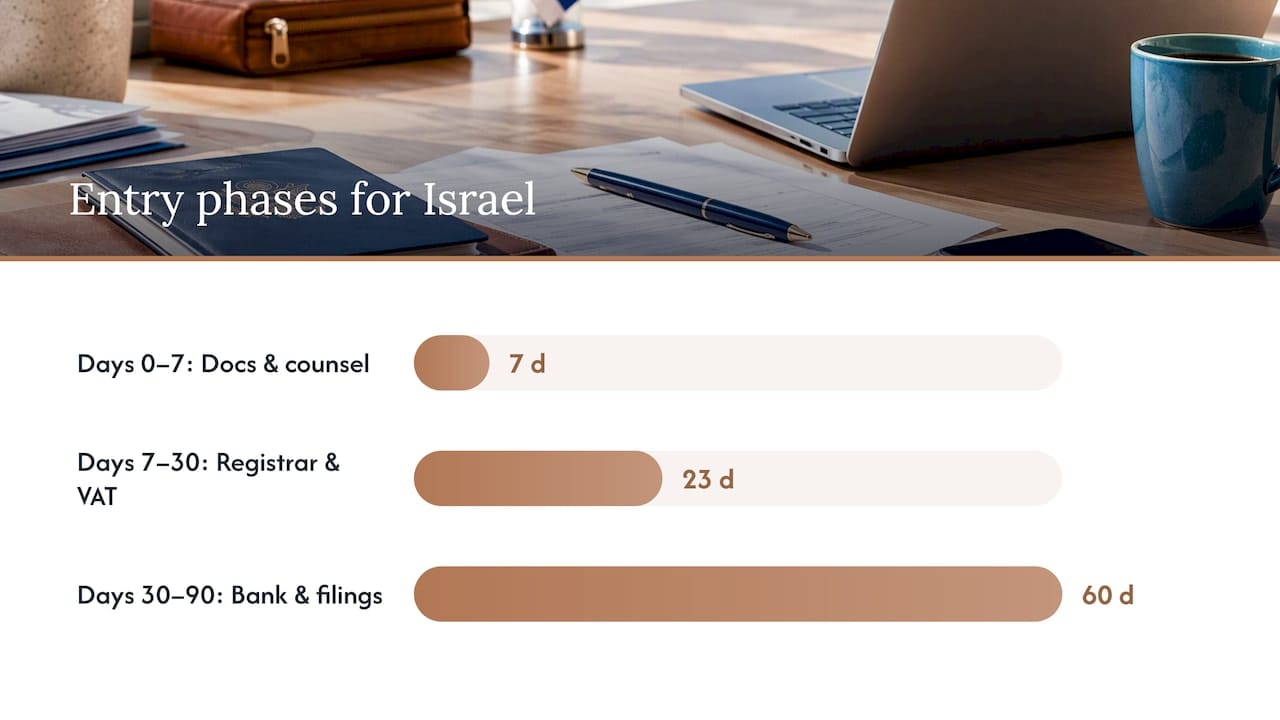
A realistic entry plan breaks into three phases.
- Days 0 to 7: Appoint local counsel, begin gathering apostilled documents, and decide on your legal form.
- Days 7 to 30: File your Registrar application, start VAT registration if you will sell locally, and set up payroll accounts.
- Days 30 to 90: Open a local bank account if needed, register with Bituach Leumi, and submit any required tax filings.
Budget for registration fees, attorney fees, translation and apostille costs, and VAT or accounting setup. These line items vary by case complexity, so ask for a written estimate before committing to a structure.
Pro Tip: Build your 90-day plan around document authentication, not around the registration filing itself. The apostille step is almost always the bottleneck.
Menora Law perspective: real-client pitfalls and how we solve them
We specialize in Israeli law for international clients, and three issues come up again and again: unclear control and management structuring that creates residency exposure, apostille and filing technicalities that stall registration for weeks, and data-transfer compliance gaps that only surface once a regulator asks questions. We handle document intake remotely, file through the Registrar using an attorney smart card, and represent clients before Israeli authorities without requiring them to travel.
— Menora Law
Engage Menora Law for company entry support
Entering the Israeli market involves company registration, VAT and tax planning, payroll setup, IP filings, and data compliance, and getting one piece wrong can delay the rest.

- Legal support for company registration and corporate structuring, from document review through Registrar filing, is available.
- Guidance on VAT registration, local representative appointment, and corporate tax residency planning is provided.
- Support with IP filings, including trademark registration, is offered to help protect your brand before launch.
- Remote and on-site consultations are available to accommodate clients regardless of their location.
Visit חוק מנורה to request a document checklist or book an initial consultation.
Sources
For procedural detail beyond this guide, consult the primary sources directly.
שאלות נפוצות
Do I need an Israeli subsidiary to sell to customers in Israel?
Not necessarily. You can register as a foreign entity doing business in Israel, though many companies find a local subsidiary simpler for banking and VAT purposes, according to Israel Tax Authority guidance.
What triggers Israeli VAT registration for a US company?
Supplying goods or services to Israeli customers can trigger the requirement, regardless of whether you have a physical office in Israel. Once annual turnover passes 0.5 million NIS, detailed electronic reporting becomes mandatory as well.
How does Israel decide if my company is tax resident there?
Israeli authorities apply a control and management test that looks at where strategic decisions are actually made, not just where the company is incorporated, as described in the Knesset’s analysis. Board location, accounting, and senior staff placement all factor into that assessment.
What happens if I process EEA personal data in Israel?
You become subject to Israel’s 2023 privacy regulations, which impose deletion, storage limitation, accuracy, and notice duties, with some obligations taking effect by January 1, 2025, per the official regulations page. A documented contractual safeguard can satisfy part of this requirement.
Can Menora Law handle my company registration without me traveling to Israel?
Yes, Menora Law offers remote and on-site consultations and manages document intake and Registrar filings using attorney smart-card access, so you do not need to be physically present in Israel to complete registration.


 English
 Afrikaans
 العربية
 বাংলা
বাংলা Čeština
 简体中文
简体中文 Nederlands
 Suomi
Suomi Français
 Deutsch
 עִבְרִית
 हिन्दी
 Magyar
 Italiano
 日本語
日本語 한국어
한국어 Polski
 فارسی
فارسی Português do Brasil
 Русский
 Español de México
 Українська