
TL;DR:
- An Israeli multi-jurisdictional estate involves assets in Israel and abroad, requiring separate probate procedures in each country.
- Proper coordination through jurisdiction-specific wills and early preparation can reduce delays, costs, and family conflicts.
An Israeli multi-jurisdictional estate is a legal framework that governs assets held in Israel alongside assets in one or more foreign countries, each subject to its own succession law. This situation is far more common than most families expect. Israeli citizens living abroad, foreign nationals who own Israeli property, and diaspora families with ties to Israel all face this challenge. Understanding the Israeli multi-jurisdictional estate explained here is the first step toward protecting what you have built across borders.
What is an Israeli multi-jurisdictional estate?
An Israeli multi-jurisdictional estate exists when a deceased person leaves assets in Israel and in at least one other country, requiring separate legal proceedings in each place. The formal term used in international estate law is a “cross-border estate.” The Israeli component is always governed by Israeli succession law, regardless of where the deceased lived or held citizenship.

Israel’s חוק הירושה משנת 1965 is the foundational statute. It controls who inherits, how assets are distributed, and what court procedures apply. For real estate specifically, Israeli law applies exclusively. No foreign court order, no matter how valid in its home country, can transfer ownership of Israeli property without going through the Israeli probate system.
The 2026 procedural environment adds specific requirements. The Israeli probate process is now digital in submission, but still demands original physical documents, Apostille stamps, and professional Hebrew translations. Families managing assets across borders need to plan for both the legal framework and the practical paperwork.
How does Israeli succession law govern multi-jurisdictional assets?
Israeli succession law applies the lex situs principle strictly. Lex situs means the law of the place where an asset is located controls how that asset is transferred after death. For Israeli real estate, this means only Israeli law applies, full stop.
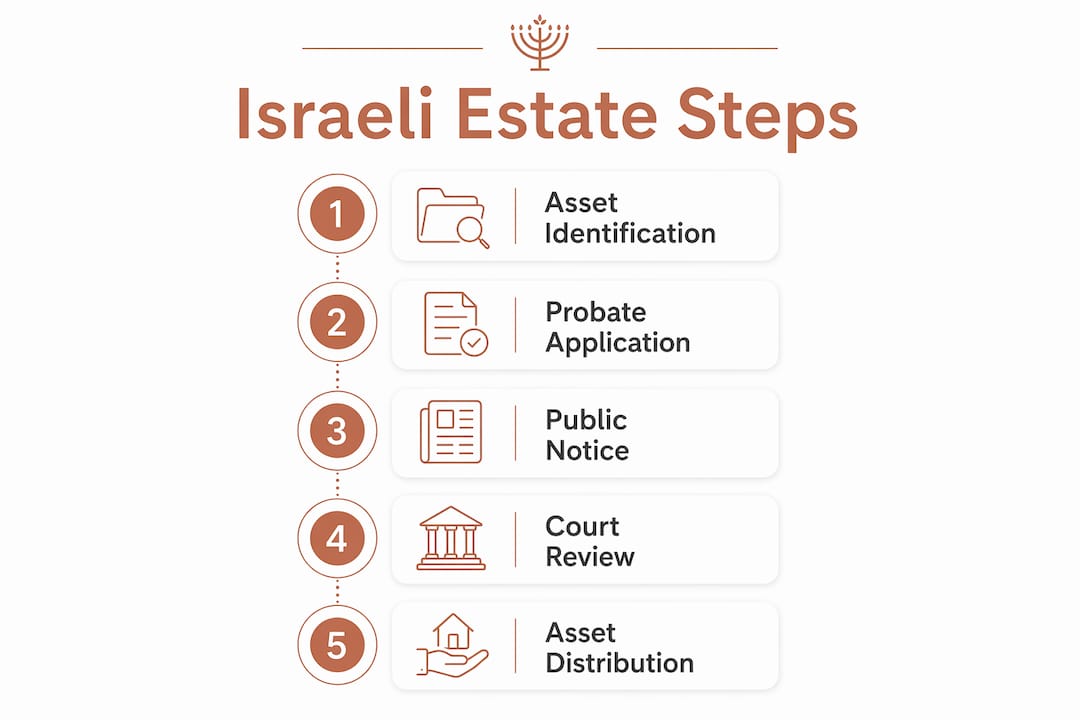
The Israeli Land Registry, known as the Tabu, exclusively governs property transfers. No inheritance of Israeli real estate can be completed without a valid Israeli court order presented to the Tabu. A foreign probate order alone is not sufficient.
Probate Order vs. Succession Order
Two distinct court orders exist under Israeli law, and families need to understand the difference:
- Probate Order (Kiyum Tzavaah): Issued when the deceased left a valid will. The Israeli court validates the will and authorizes distribution according to its terms.
- Succession Order (Tzav Yerusha): Issued when there is no will, or when the will does not cover Israeli assets. Distribution follows the statutory rules of the Succession Law of 1965.
Both orders require a formal application to the Israeli Registrar of Inheritance or the Family Court, depending on the circumstances.
2026 mandatory requirements
The current procedural requirements for Israeli probate include:
- Original documents with valid Apostille stamps from the issuing country
- Professional Hebrew translations certified by a licensed translator
- A mandatory public notice fee of 215 NIS, which is published to allow potential creditors or claimants to come forward
- Submission through the digital probate portal, with physical originals sent separately
Pro Tip: Start gathering Apostille-stamped documents as early as possible. Consular authentication and translation can take several weeks, and delays at this stage push back the entire probate timeline.
What challenges come with cross-border estate settlement in Israel?
Cross-border estate management involving Israeli assets introduces legal and financial complexity that surprises most families. The single most important fact to understand is this: there is no global probate system. Every country where the deceased held assets requires its own separate legal proceeding.
“Cross-border estates always require separate local proceedings and trusted legal management in each jurisdiction. Assuming one probate covers all assets is the most expensive mistake families make.”
The cost and time burden of ancillary probate
When an estate spans multiple countries, families must open what is called “ancillary probate” in each jurisdiction. Ancillary probate costs typically run 3–7% of the asset value in each jurisdiction, and each proceeding can take 6–18 months to complete. For a family managing Israeli real estate alongside assets in Europe or elsewhere, the total cost and delay can be substantial.
The Renvoi problem
The Renvoi doctrine is a legal trap that catches families off guard. It occurs when Israeli law refers a legal question to a foreign law, and that foreign law refers it back to Israeli law, creating a circular loop. The Renvoi doctrine can alter asset distribution in ways the deceased never intended. Resolving it requires a lawyer who understands both Israeli and foreign succession frameworks simultaneously.
Religious courts and consent requirements
Israel has a parallel court system where religious courts hold concurrent jurisdiction over inheritance matters. However, religious courts require unanimous written consent from all heirs before they can proceed. This consent requirement has significant implications for gender equality in inheritance distribution, since religious law and civil law treat heirs differently. Families with any disagreement among heirs should proceed through the civil court system to avoid complications.
The practical lesson is straightforward. Ignoring the Israeli component of an estate does not make it go away. Israeli assets, especially real estate, remain legally frozen until the Israeli probate process is completed.
How do you coordinate Israeli and foreign wills effectively?
Coordinated wills are one of the most practical tools available to families with multi-jurisdictional assets. The core strategy is to draft a separate Israeli will that covers only Israeli assets, written in Hebrew, executed before Israeli witnesses, and explicitly limited in scope to Israel.
Why a separate Israeli will matters
A foreign will valid in its home country can be recognized in Israel, but the process is slow. Foreign wills need proper foreign execution, consular authentication, Hebrew translation, and a court review to confirm they do not conflict with Israeli law. Authentication and translation alone add weeks to the process. A will drafted in Hebrew and executed under Israeli formalities skips most of that delay.
The revocation risk families overlook
Independent wills in different jurisdictions can revoke each other unintentionally. This happens when a new will contains broad language like “this will revokes all prior wills.” If your Israeli will and your foreign will both contain that clause, one may cancel the other. Explicit limitation clauses in each will, stating clearly that the will applies only to assets in a named jurisdiction, prevent this conflict.
| Approach | Effect on Israeli assets |
|---|---|
| Single foreign will, no Israeli will | Requires authentication, translation, and court review; adds months of delay |
| Separate Israeli will without limitation clause | Risk of inadvertent revocation by foreign will |
| Coordinated wills with explicit limitation clauses | Clean probate in each jurisdiction; no revocation conflict |
| Israeli will drafted in Hebrew before Israeli witnesses | Fastest path through Israeli probate; no translation needed |
Pro Tip: Ask your Israeli attorney to include a clause that explicitly states the Israeli will covers only assets located in Israel. Ask your foreign attorney to include a matching clause. This one step prevents the most common and costly coordination failure.
Coordinating cross-border Israeli legal matters requires both attorneys to communicate directly. Do not assume they will do this automatically.
What are the practical steps to settle an Israeli estate in 2026?
Settling an Israeli estate as part of a cross-border estate administration follows a defined sequence. Families who understand the steps avoid the most common delays.
Document preparation
Gather the following before filing:
- Death certificate with Apostille stamp from the issuing country
- Original will (if one exists), also Apostille stamped
- Identity documents for all heirs
- Proof of Israeli asset ownership, such as Tabu extract for real estate
- Certified Hebrew translations of all foreign-language documents
Filing and fees
The application goes to the Israeli Registrar of Inheritance or the Family Court. The 215 NIS public notice fee is mandatory and triggers a waiting period during which creditors may file claims. The digital submission portal accepts the application, but original documents must follow by mail or courier.
The executor’s role
Executors in Israel carry rigorous legal responsibilities. They must report to the court, manage estate assets during the probate period, and distribute assets only after the court order is issued. An executor who is not familiar with Israeli inheritance law creates real risk of procedural errors and personal liability.
Remote representation for overseas families
Families living outside Israel do not need to travel to complete Israeli probate. An Israeli attorney holding a valid power of attorney can file applications, appear before the Registrar, and manage the entire process remotely. This is the standard approach for non-resident heirs and it works well when the attorney is experienced in cross-border estate administration in Israel.
Key Takeaways
An Israeli multi-jurisdictional estate requires separate Israeli probate proceedings governed by the Succession Law of 1965, coordinated with any foreign estate process through properly drafted, jurisdiction-limited wills.
| Point | Details |
|---|---|
| Lex situs controls Israeli property | Only Israeli law governs Israeli real estate; foreign probate orders alone cannot transfer ownership. |
| Separate Israeli will saves time | A Hebrew will executed before Israeli witnesses avoids authentication and translation delays. |
| Limitation clauses prevent revocation | Each will must explicitly state it covers only assets in its named jurisdiction. |
| Ancillary probate adds cost and time | Each jurisdiction requires its own proceeding, costing 3–7% of asset value and 6–18 months per jurisdiction. |
| Remote representation is available | An Israeli attorney with power of attorney can manage the full Israeli probate process for overseas families. |
What we have learned from handling Israeli cross-border estates
The families who come to Menora Law in the most difficult situations share one thing in common: they assumed the estate would sort itself out. They had a valid will in their home country, they thought that was enough, and they discovered too late that Israeli real estate was frozen because no one had started the Israeli probate process.
The Renvoi problem is another one we see regularly. A family’s foreign attorney applies their country’s conflict-of-law rules, those rules point back to Israeli law, and suddenly the distribution looks nothing like what the deceased intended. This is not a theoretical risk. It happens, and it is expensive to fix after the fact.
What actually works is straightforward: treat Israeli assets as a separate legal matter from day one. Draft a dedicated Israeli will. Make sure both your Israeli attorney and your foreign attorney know about each other’s documents. Use limitation clauses. Start the Apostille process early.
The families who do this right spend less money, wait less time, and avoid the kind of family conflict that comes from frozen assets and unclear distribution. The ones who try to handle Israeli probate as an afterthought to their foreign estate plan pay for that choice in delays, legal fees, and sometimes in relationships.
Menora Law works with families across the world who have Israeli assets. We handle the Israeli side completely, communicate in plain English, and coordinate with foreign counsel when needed. The process is manageable when you have the right team in place.
— Menora Law
Menora Law’s services for Israeli estate matters
Families managing assets in Israel alongside assets abroad need an Israeli legal team that understands both sides of the equation.
Menora Law handles the full Israeli probate process for international families, from drafting coordinated Hebrew wills to filing with the Israeli Registrar of Inheritance and representing clients remotely through power of attorney. The firm works with non-resident heirs in real time, communicates in English, and manages every document requirement under the 2026 Israeli probate rules. Whether you are starting estate planning now or settling an estate that is already open, Menora Law’s Israeli inheritance law guide is a practical starting point. איש קשר Menora Law directly to discuss your specific situation.
שאלות נפוצות
What is an Israeli multi-jurisdictional estate?
An Israeli multi-jurisdictional estate is an estate where the deceased held assets in Israel and in at least one other country, requiring separate probate proceedings in each jurisdiction under local law.
Does a foreign will work for Israeli real estate?
A foreign will can be recognized in Israel, but it requires consular authentication, a certified Hebrew translation, and court review to confirm it does not conflict with Israeli law. A separate Israeli will drafted in Hebrew is faster and more reliable.
What is the lex situs principle in Israeli inheritance?
Lex situs means the law of the country where an asset is located governs its transfer after death. For Israeli real estate, Israeli law applies exclusively, and only an Israeli court order can authorize a transfer through the Tabu.
How long does Israeli probate take for overseas families?
The timeline depends on document readiness and whether a will exists, but the mandatory public notice period alone adds weeks. Ancillary probate across multiple jurisdictions can take 6–18 months per jurisdiction.
Can an Israeli estate be managed without traveling to Israel?
Yes. An Israeli attorney holding a valid power of attorney can manage the entire Israeli probate process on behalf of non-resident heirs, including filing, court appearances, and asset distribution.


 English
 Afrikaans
 العربية
 বাংলা
বাংলা Čeština
 简体中文
简体中文 Nederlands
 Suomi
Suomi Français
 Deutsch
 עִבְרִית
 हिन्दी
 Magyar
 Italiano
 日本語
日本語 한국어
한국어 Polski
 فارسی
فارسی Português do Brasil
 Русский
 Español de México
 Українська