
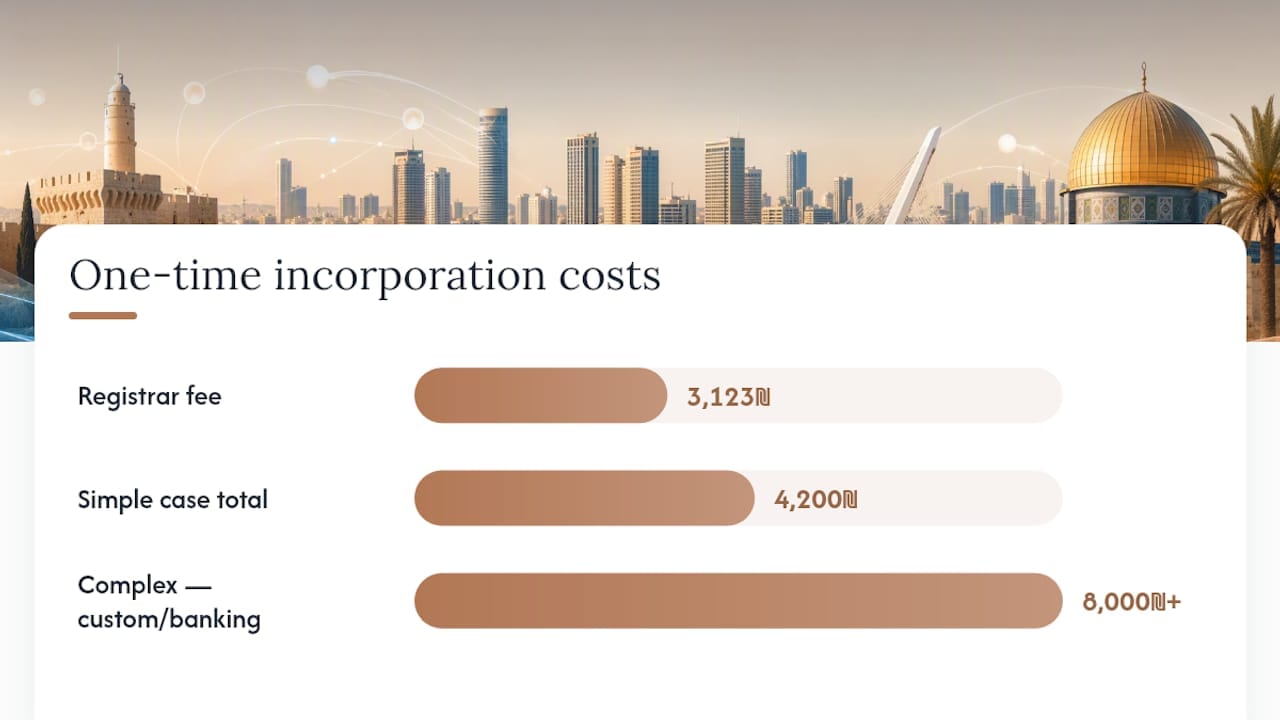
Opening a limited company in Israel typically costs between 4,200₪ and 8,000₪ or more in one-time fees, driven mainly by four items: the Registrar of Companies fee, attorney charges, accountant setup, and bank account costs. That range covers a simple, single-founder company on the low end and a multi-founder company with custom governance documents on the high end. Annual costs, including the yearly Registrar fee and ongoing accounting, come on top of that and continue for as long as the company exists.
TL;DR:
- Filing online with the Registrar of Companies reduces the registration fee to 3,123₪, compared to higher costs for paper filings or complex cases.
- Attorney fees vary significantly depending on the complexity of the articles of association, from simple templates to tailored legal documents.
- Opening a foreign-owned company’s bank account can cause delays due to KYC requirements, apostille certification, and document legalization if not prepared in advance.
- Total startup costs range from approximately 4,200₪ for a straightforward, single-founder setup to over 8,000₪ for more complex, multi-founder companies with international banking needs.
- Ongoing annual costs include a Registrar fee of roughly 1,777₪ that increases penalties if unpaid and ongoing accounting, VAT, payroll, and possible audit expenses.
What Does It Actually Cost to Register a Company in Israel?
The single biggest fixed number in this whole process is the Registrar of Companies fee, and it’s non-negotiable no matter who files your paperwork. As of the 2026 fee regulations, registering a new company costs 3,123₪ when filed through the standard process, with a lower rate available for founders who file online through the Registrar’s electronic system. That online discount is worth grabbing. Most attorneys who handle Israeli incorporations file electronically as a matter of course, so ask your lawyer directly whether their quoted fee already reflects it.
Attorney fees for the incorporation itself vary more than any other line item, because “incorporation” can mean two very different jobs. A simple filing using standard articles of association for one or two founders typically runs on the lower end of the market. A custom-drafted תקנון (articles of association) with tailored shareholder rights, share classes, or founder vesting terms costs meaningfully more, since it involves real legal drafting rather than filling in a template. Market guides on establishing a company in Israel show this gap clearly: complexity, not paperwork volume, is what drives legal fees up.
Accountants add a separate setup cost, usually billed apart from the attorney’s fee. This covers registering the company for VAT (מע"מ) and setting up payroll infrastructure if you plan to hire employees right away. Some accountants bundle this into a first-year package; others bill it as a standalone onboarding fee.
Banking costs are the most unpredictable part of the budget, especially for founders based outside Israel. Opening a corporate account involves:
- A corporate seal or stamp, which most banks require before activating the account
- Bank-mandated certifications confirming company officers and ownership structure
- KYC (know-your-customer) document review, which can add days or weeks for foreign-owned entities
Pro Tip: If any shareholder or director lives abroad, ask your bank which documents need apostille certification before you submit anything. Banks in Israel apply strict KYC standards to foreign-owned companies, and a missing certification is the single most common reason account opening drags on.
Market data from Perfect1’s cost guide puts total one-time costs at roughly 4,200₪ for the simplest cases and 8,000₪ or higher once you add custom drafting, multiple founders, or international banking complications.
How Do You Register a Company in Israel Step by Step?
Each step in the incorporation process carries its own cost, and knowing which ones are fixed versus negotiable helps you budget accurately.
- Draft your founding documents. Decide whether to use the standard articles (תקנון מצוי) or a custom version. This decision alone can shift your legal fee by a wide margin.
- Submit your filing to the Registrar of Companies. Filing online triggers the discounted fee rate; paper filing costs more and takes longer to process.
- Open your corporate bank account. This requires your certificate of incorporation, a corporate seal, and identity documentation for all directors and shareholders.
- Register your tax files. Opening files with מס הכנסה (Income Tax Authority), מע"מ (VAT Authority), and ביטוח לאומי (National Insurance) carries no direct government filing fee, though most founders pay their accountant to handle this paperwork correctly the first time.
Skipping professional help on step four is tempting since there’s no government fee attached, but errors in your initial VAT or National Insurance registration tend to surface later as costly corrections.
What Are the Ongoing Annual Costs After Incorporation?
Incorporation is a one-time expense, but keeping the company alive isn’t. The 2026 Registrar fee schedule sets the annual company fee at 1,777₪ at the standard rate, dropping to 1,338₪ for companies that pay early in the year. Missing that deadline doesn’t just cost you the discount.
According to a summary of Registrar enforcement powers, nonpayment can lead to the company being flagged as noncompliant, along with escalating fines and restrictions on certain corporate actions. Beyond the Registrar fee, expect:
- Ongoing accounting fees for VAT filings, payroll, and annual financial statements
- Audit costs once your company crosses statutory audit thresholds, which vary by revenue and structure
- Business insurance, with basic liability coverage for small companies typically priced modestly but rising with headcount and industry risk
Budgeting for the annual Registrar fee is the cheapest insurance you’ll ever buy against administrative penalties.
What Are Legitimate Ways to Lower Incorporation Costs?
Cutting costs the smart way means eliminating waste, not eliminating protection. A few approaches actually work:
- File online through your attorney to capture the Registrar’s discounted electronic filing rate rather than paying the standard fee.
- Use the standard articles (תקנון מצוי) if you’re a single founder with no complex ownership plans. There’s no reason to pay for custom drafting you don’t need.
- Phase your professional services: start with basic incorporation, then upgrade to a custom shareholder agreement once you bring in investors or additional founders.
Pro Tip: Don’t cut corners on legal drafting if you’re bringing in outside investors soon. Fixing an inadequate תקנון after a funding round is far more expensive than drafting it correctly the first time.
How Long Does It Take to Open a Company in Israel?
A clean, single-founder case with an Israeli resident director can move through the Registrar in days once filed online. Cases involving foreign shareholders usually take longer, mostly because of bank KYC review and document legalization.
- Apostille certification and certified translations for foreign documents can add real delay if not prepared in advance
- Bank account activation for foreign-owned companies often takes longer than the Registrar filing itself
- Pre-arranging notarized signatures before you start the process shortens the timeline noticeably
What Should You Ask Before Hiring an Attorney or Accountant?
A vague quote is a warning sign. Before you commit to a professional, ask for specifics.
- Request a fixed-fee, itemized quote that spells out exactly what’s included: filing, document drafts, notarization, and any government fees.
- Confirm whether the attorney files online and whether their quote already reflects the Registrar’s discounted rate.
- Ask your accountant whether billing is monthly or annual, and how VAT, payroll, and audit prep are handled.
- Be cautious of open-ended hourly billing for routine incorporation work. That’s a task with a known scope, and it should have a known price.
The Menora Law Perspective on Incorporation Costs
Most cost surprises we see at Menora Law come from founders who chose the cheapest quote without asking what it excluded. International founders face an added layer: cross-border ownership, foreign directors, and bank KYC requirements that a purely domestic filing never encounters. We often recommend custom articles specifically when a company has multiple founders, foreign holding structures, or investors who will need protections a standard תקנון can’t provide. For clients abroad, we handle document collection, virtual signatures, and remote guidance so a founder in לוס אנג'לס or New York never has to fly to Israel just to incorporate.
— Menora Law
Ready to Form Your Israeli Company the Right Way?
If you’ve compared attorney quotes and they all look like the same vague hourly-rate promise, that’s the gap Menora Law fills for founders forming a company from outside Israel. We build fixed-fee incorporation packages so you know your total cost upfront, whether you’re a solo founder using standard articles or a multi-founder team that needs custom governance documents. Because we serve clients across the United States and internationally, everything from document review to signing can happen remotely, without a trip to Israel.

Our staged approach means you’re not paying for legal work you don’t need yet. You get the essentials for launch first, then add shareholder agreements or investor protections once your company actually needs them. If you’re weighing whether to incorporate on your own or bring in counsel who understands both Israeli corporate law and the realities of managing a company from abroad, visit our business law practice page to see how we structure engagements for international founders, or reach out for a virtual consultation to get a fixed-fee quote for your specific situation.
Sources
- Regulations amending Registrar fees (1 January 2026)
- Registrar fee and enforcement summary (Spitz Tax)
This article is general information, not a substitute for advice from a qualified financial advisor. Consult a qualified financial professional about your own circumstances before acting on anything here.
שאלות נפוצות
How much is the company registration fee in Israel?
The Registrar of Companies charges 3,123₪ for standard company registration in 2026, with a discounted rate available for founders who file online through the official regulations.
How do you open a limited company (חברה בע"מ) in Israel?
You draft founding documents, file with the Registrar of Companies (ideally online for the fee discount), open a corporate bank account, and register tax files with מס הכנסה, מע"מ, and ביטוח לאומי.
What is the Registrar’s annual company fee for 2026?
The annual fee is 1,777₪ at the standard rate, reduced to 1,338₪ for companies that pay before the early-payment deadline set in the 2026 fee schedule.
What are the total costs of opening a company in Israel?
Total one-time costs typically range from about 4,200₪ for a simple single-founder company to 8,000₪ or more for companies with multiple founders or custom articles, based on market cost data, on top of ongoing annual Registrar and accounting fees.


 English
 Afrikaans
 العربية
 বাংলা
বাংলা Čeština
 简体中文
简体中文 Nederlands
 Suomi
Suomi Français
 Deutsch
 עִבְרִית
 हिन्दी
 Magyar
 Italiano
 日本語
日本語 한국어
한국어 Polski
 فارسی
فارسی Português do Brasil
 Русский
 Español de México
 Українська