
Yes, you can renounce an inheritance in Israel, and Section 6 of the Succession Law gives you that right in writing to the Registrar or the court. The waiver takes effect the moment it’s filed, not before, and once it’s approved, it’s generally final. There are limits on who you can direct your share to, and if a minor or an incapacitated heir is involved, a judge has to sign off first. Complex or cross-border estates almost always call for a lawyer before you file anything.
TL;DR:
- Renunciations must be filed with the Registrar or court, and approval is often final unless involving minors, incapacitated heirs, or contested estates.
- Filing requires precise documentation, including an affidavit attested by a lawyer, and is most straightforward if combined with the original inheritance application.
- Directed renunciations are limited to spouses, children, and siblings, while general renunciations redistribute assets according to the will or intestacy laws.
- Renunciation is typically motivated by estate tax considerations, protection for surviving family members, or estate simplification, not altruism.
- Legal counsel is advisable for complex cases, foreign assets, or if creditors or minors are involved, ensuring proper compliance and avoiding delays.
Who Can Renounce an Inheritance Under Israeli Law?
Any heir named in a will, or any statutory heir entitled to a share under intestacy rules, has the right to renounce (הסתלקות) part or all of that share. This applies whether you’re a spouse, child, parent, or sibling standing to inherit. Heirs of heirs can renounce too. If your late uncle’s estate passed a share to your mother and she died before claiming it, you may be able to waive that inherited interest as well.
Two situations require extra care:
- Minors and incapacitated heirs. A parent or guardian cannot renounce on a minor’s behalf without court approval, and the same goes for anyone declared legally incompetent, since the Registrar and courts scrutinize these waivers closely.
- Heirs who already took possession. Once you’ve physically received assets, actually spent inherited funds, or registered property in your name, renouncing becomes far harder and may not be recognized at all.
How Do You File a Renunciation Affidavit in Israel?
The affidavit itself is short but it has to be precise. It needs to identify the deceased, describe your share, state clearly whether the waiver is general or directed to a specific person, and carry your signature attested by a lawyer or authorized official.
From there, the process runs like this:
- Prepare the affidavit alongside your application for a probate or inheritance order.
- File with the Registrar for Matters of Succession, either through the online portal or a district office, unless the case is contested, in which case it goes to Family Court instead.
- Wait for publication and review. The Registrar publishes notice of the application so other interested parties can object.
- Receive the digital succession order, which the Registrar typically issues within about 40 to 50 days in uncontested cases.
Pro Tip: File the renunciation affidavit alongside the original inheritance-order application whenever possible. Filing it separately, after an order already exists, often means reopening the process and adding weeks to the timeline.
Overseas heirs usually need a lawyer at this stage anyway, since attestation requirements and translated documents can trip up a filing that would otherwise sail through.
General vs. Directed Renunciation: What’s the Difference?
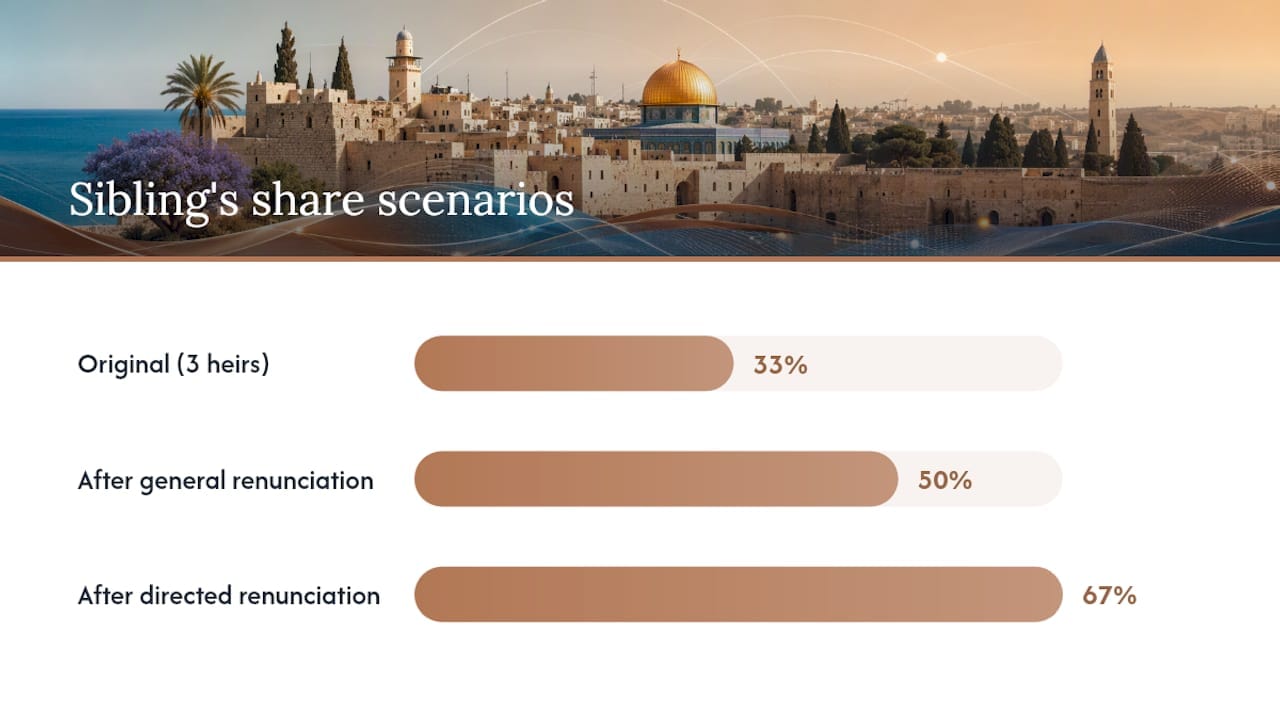
A general renunciation means you step aside entirely and your share gets redistributed as if you’d never been an heir. Under a will, that share usually passes according to the will’s own terms for a lapsed gift. Under intestacy, it splits among the other heirs in your same category.
A directed renunciation lets you steer your share toward one specific person, but Israeli law only permits this for a narrow group:
- Your spouse
- Your child
- Your sibling
Say three siblings inherit a parent’s apartment equally. One sibling can direct her third specifically to her brother, who then owns two thirds outright. What she cannot do is direct her share to a cousin, a friend, or a charity. Attempting that either fails outright or gets treated as a taxable gift once the assets change hands, which pulls in a different set of legal and reporting obligations entirely.
Why Do Heirs Actually Renounce Their Share?
Most renunciations in Israel trace back to one of three motivations, and they’re rarely about generosity for its own sake.
- Protecting a surviving spouse or parent. Adult children often waive their share in the family home so a widowed parent keeps full ownership and can’t be forced into a partition sale by other heirs.
- Real estate tax planning. Inheriting even a fraction of an apartment can count as owning an additional dwelling, which raises your purchase tax bracket on a future home purchase or triggers exposure to Mas Shevach (betterment tax) down the line.
- Simplifying a messy estate. Renouncing can defuse a standoff between siblings who can’t agree on how to split property.
Pro Tip: If your main goal is protecting a parent’s housing, ask whether a lifetime lease or usufruct arrangement gets you there without permanently giving up your inheritance. Renunciation is one tool, not the only one.
None of this replaces planning that should have happened before the death. Renunciation is a fix applied after the fact, and it works best when the motivation is specific rather than a general sense that it seems like the right thing to do.
What Happens Legally Once You Renounce?
Renunciation is meant to be final. Reversing one requires going back to court and proving narrow grounds, like fraud, duress, or a genuine mistake at the time of filing. Courts don’t reopen these lightly.
A few risks catch people off guard:
- Creditors. You can’t renounce simply to keep an inheritance out of reach of your own creditors. The Registrar and courts examine waivers that look timed to dodge a debt, and a suspicious pattern can get the renunciation set aside.
- Tax exposure. Israel has no inheritance or estate tax, but that’s not the end of the story. Selling inherited property later can still trigger Mas Shevach, and directing your share to someone outside the permitted spouse, child, or sibling list can be treated as a taxable gift rather than a clean waiver.
- Irreversibility for the wrong reasons. People renounce under family pressure and regret it years later once property values climb. Once filed and approved, that regret usually doesn’t change anything.
Before you sign anything, get a straight answer on the tax side from someone who actually works in this area, not a general assumption that “no inheritance tax” means no tax consequences at all.
What Documents Do You Need and What Happens After Filing?
Getting the paperwork right the first time saves weeks. Here’s the practical sequence:
- Gather your documents: the death certificate, IDs for all heirs, the original will if one exists, and the signed, attested renunciation affidavit.
- File through the Registrar’s online system, where publication happens automatically once your application clears initial review.
- Wait for the digital succession order. It goes out directly to banks, the Land Registry (Tabu), and relevant government ministries, so you’re not stuck requesting certified copies for every institution.
- Handle the follow-up. Update the Land Registry if real estate is involved, confirm any tax filings your accountant needs to make, and revisit beneficiary designations on insurance or pension accounts if the estate touches those.
Pro Tip: Keep a digital folder with every document from day one. Overseas heirs especially lose time re-requesting paperwork that a local relative could have scanned in five minutes.
When Should You Bring in an Israeli Inheritance Lawyer?
Some renunciations are genuinely simple. Others aren’t, and you’ll know the difference fast if any of these apply to your situation:
- The decedent left a foreign will alongside Israeli assets
- The decedent lived abroad but owned Israeli real estate
- Creditors have already made claims against the estate
- A minor or incapacitated heir needs court approval to renounce
- Other heirs are contesting the will or the distribution itself
A lawyer handling this drafts the affidavit correctly the first time, secures the required court approvals for minors, and coordinates directly with foreign counsel so nothing gets lost between two legal systems. For overseas families, that coordination is often the difference between a six week process and a six month one.
Menora Law’s Perspective: Renunciation Should Be a Last Resort
Renunciation gets treated as a quick fix, but Menora Law sees it more accurately as a repair job done after the fact, when better options were available earlier. If a family had coordinated an Israeli will, reviewed beneficiary designations, or set up a continuing power of attorney before a parent lost capacity, half the renunciations we see would never have been necessary. That doesn’t mean renunciation is the wrong move. It means it should be the considered choice, not the default one.
What we’d tell any overseas heir is this: get the tax and creditor questions answered before you sign, not after. We work with clients scattered across time zones every week, and the renunciations that go smoothly are the ones where someone checked the details first.
— Menora Law
How Menora Law Helps With Renunciation and Probate in Israel
If you’re weighing whether to renounce a share of an Israeli estate, it is advisable to seek local counsel to assist with navigating the Registrar’s process and to clarify what each form and deadline means for your case. Legal professionals can draft and file renunciation affidavits, represent heirs before the Registrar for Matters of Succession and Family Court when a case is contested, and coordinate with foreign attorneys when a decedent’s estate spans two countries.

Many inheritance cases involve clients living outside Israel, so practices may offer remote representation and aim for fast turnaround. Routine filings should not require travel, and timely responses to inquiries are important. If you’re dealing with a renunciation decision, a contested estate, or you’re trying to sort out what your options look like as an overseas heir, our Israeli inheritance law guide walks through the details, and reaching out to Menora Law directly gets you a real answer on your specific situation rather than a generic explanation of the statute.
Sources
For readers who want the primary documents rather than a summary, start here:
For estate planning alternatives worth reviewing before you file a waiver, see this outside guide on common estate planning pitfalls, and if your renunciation decision is tangled up with a broader move or change in tax residency, this overview of pre-immigration and exit tax planning is worth a read too.
This article is general information, not a substitute for advice from a qualified lawyer. Consult a qualified legal professional about your own circumstances before acting on anything here.
שאלות נפוצות
Is There Tax on Inheritance Money in Israel?
Israel imposes no inheritance or estate tax on assets you receive. Selling inherited property later can still trigger Mas Shevach (betterment tax), so check with a tax advisor before assuming a clean pass-through.
How Do I Get a Digital Copy of an Inheritance Order or Probate Order?
The Registrar issues a digital succession order directly to banks, the Land Registry, and relevant ministries once your application clears review, and you can also request copies through the Registrar’s online portal.
Can I Renounce My Inheritance in Favor of My Mother?
Yes, directed renunciation to a parent isn’t on the statutory list of permitted recipients (spouse, child, sibling), so waiving in favor of a mother specifically requires structuring it as a general renunciation or getting legal guidance on how the redistribution actually plays out.


 English
 Afrikaans
 العربية
 বাংলা
বাংলা Čeština
 简体中文
简体中文 Nederlands
 Suomi
Suomi Français
 Deutsch
 עִבְרִית
 हिन्दी
 Magyar
 Italiano
 日本語
日本語 한국어
한국어 Polski
 فارسی
فارسی Português do Brasil
 Русский
 Español de México
 Українська