
TL;DR:
- Understanding Israeli legal aid eligibility depends on means-testing, case type, and residency status, affecting inheritance disputes significantly. Only licensed Israeli attorneys can represent clients in Israeli courts, and foreign lawyers cannot practice without Israeli bar admission, complicating cross-border inheritance cases. Early consultation with licensed Israeli counsel and proper documentation increase the likelihood of securing aid and achieving favorable legal outcomes.
If you are dealing with an inheritance dispute or a complex legal matter in Israel, understanding Israeli legal aid eligibility explained in plain terms can make a real difference in how you approach your case. Many families, including those living abroad, assume that legal aid in Israel is either freely available to everyone or strictly limited to the very poor. Neither assumption is accurate. The rules are more nuanced, and the stakes are high, especially in inheritance cases where the wrong move early on can cost you significantly more than the legal fees you were trying to avoid.
Key takeaways
| Point | Details |
|---|---|
| Eligibility is means-tested | Financial thresholds determine aid levels, but case type and social policy create important exceptions. |
| Licensed Israeli counsel is required | Only lawyers admitted to the Israel Bar Association can legally represent you in Israeli courts. |
| Foreign residents and olim can qualify | Foreigners and new immigrants may access legal aid, but face additional documentation and language hurdles. |
| Early application matters | Submitting your application with complete documentation from the start reduces delays and improves outcomes. |
| Inheritance cases carry special complexity | Cross-border inheritance disputes require coordinated legal strategy, not just basic eligibility approval. |
Israeli legal aid eligibility explained: the legal framework
Legal aid in Israel is governed by a combination of statutory law, administrative regulations, and the policies of the Legal Aid Administration, which operates under the Ministry of Justice. The system is designed to give individuals who cannot afford private legal representation access to qualified counsel. However, understanding who qualifies, and under what circumstances, requires a closer look at the rules that actually apply.
Financial eligibility and income thresholds
The most fundamental requirement is financial. Means testing considers household income, and applicants whose income exceeds the threshold may receive only partial aid or none at all. The thresholds are updated periodically and account for household size, so a single applicant is assessed differently than a family of four. High earners are generally excluded, though some exceptions apply based on case type or social policy priorities.
Key eligibility factors under Israeli legal aid rules include:
- Household income and assets: Both are assessed together. Owning property, including inherited property under dispute, can affect your eligibility calculation.
- Type of legal matter: Criminal defense, family law, and certain civil matters each have distinct eligibility tracks. Inheritance disputes typically fall under civil proceedings.
- Residency status: Israeli citizens and permanent residents have the clearest access. New immigrants (olim) generally qualify under the same framework, though documentation requirements differ.
- Case merit: The Legal Aid Administration does not grant aid for cases it considers frivolous or without legal basis.
Who is eligible for legal aid in Israel
The following table summarizes eligibility categories relevant to inheritance and family legal matters:
| Applicant type | General eligibility status | Key conditions |
|---|---|---|
| Israeli citizen (low income) | Eligible | Must meet income and asset thresholds |
| Olim (new immigrants) | Generally eligible | Additional documentation required |
| Foreign resident with Israeli estate interest | Conditional | Depends on case type and residency status |
| High-income applicant | Partial or ineligible | Exceptions for specific case categories |
| Applicant in family court proceedings | Often eligible | Subject to case merit review |
One point that surprises many families: only lawyers admitted to the Israel Bar Association may practice Israeli law or represent clients in Israeli courts. This means that even if you have a trusted attorney in the United States or elsewhere, that person cannot represent you in Israeli proceedings unless they hold Israeli bar admission. Unauthorized practice is a criminal offense under Israeli law.
Eligibility pitfalls in inheritance and family legal aid
Knowing the basic criteria is a starting point, but many families run into problems because of details they did not anticipate. Inheritance cases, in particular, involve layers of complexity that standard legal aid guidelines do not always address clearly.
Income and asset thresholds in practice
The income threshold sounds straightforward until you factor in inherited assets. If you are an heir to an Israeli estate, the value of that estate may be counted against you during the means test, even before you have received any distribution. This is a common source of confusion for families who consider themselves middle-income but suddenly appear “asset-rich” on paper because of a pending inheritance.

Similarly, applicants who receive a Long-Term Care Benefit from Israel’s National Insurance Institute face their own eligibility nuances. Eligibility for the Long-Term Care Benefit requires retirement age residency, community living, and an ADL (Activities of Daily Living) score threshold assessed by a professional. The minimum ADL score is 2 points if living alone, or 2.5 points if living with others. This benefit intersects with legal aid when elderly family members are parties to inheritance or guardianship proceedings.
Language and documentation barriers
Israeli legal proceedings require Hebrew fluency. All filings, court procedures, and laws operate in Hebrew, which creates a real practical barrier for non-Hebrew speakers. Foreign-qualified lawyers face the same obstacle unless they are fluent in Hebrew and licensed locally. For families managing an Israeli inheritance from abroad, this means that even gathering and submitting the right documents can become a serious challenge without proper legal support.
Common documentation pitfalls include:
- Submitting translated documents without certified Hebrew translations
- Failing to include proof of familial relationship in the format Israeli courts accept
- Missing deadlines because of unfamiliarity with Israeli procedural timelines
- Providing financial statements in foreign currencies without proper conversion documentation
Cross-border and foreign-resident heir complications
If you live outside Israel and have an interest in an Israeli estate, your eligibility for legal aid is not automatic. Foreign clients often encounter unexpected jurisdictional hurdles without strategic Israeli legal counsel in place. The Legal Aid Administration will assess your connection to Israel, the nature of your legal interest, and whether the matter falls within its jurisdictional scope.
Pro Tip: If you are a foreign resident pursuing an Israeli inheritance claim, do not attempt to coordinate your case through a non-इज़राइली वकील. Engage a licensed Israeli attorney from the outset, even if you are only in the early information-gathering stage. The cost of early strategic advice is far lower than correcting procedural errors later.
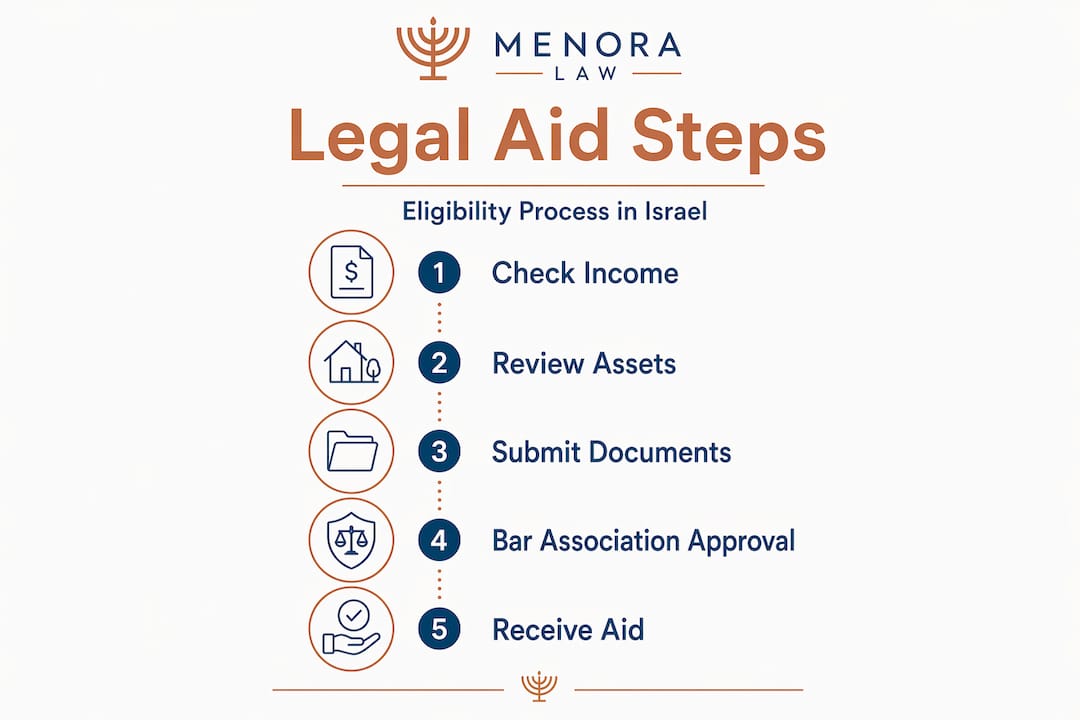
How to apply for Israeli legal aid: step by step
Once you understand the eligibility criteria, the application process itself requires careful preparation. Here is a practical breakdown of how to move through it effectively.
Determine your legal matter category. Identify whether your case falls under criminal, civil, family, or administrative law. Inheritance disputes are typically civil matters, though they may intersect with family law when minors or incapacitated persons are involved.
Gather your financial documentation. You will need recent pay stubs or income statements, bank account records for all household members, property ownership documents, and any documentation related to assets under dispute including the estate in question.
Prepare inheritance-specific documents. This includes the deceased’s death certificate, a copy of any will or probate order, proof of your relationship to the deceased, and any prior court filings related to the estate.
Submit your application to the Legal Aid Administration. Applications can be submitted through the Ministry of Justice’s Legal Aid Administration offices. In some cases, online submission is available, though complex civil matters often require in-person or attorney-assisted filing.
Attend any required assessment or interview. For certain benefit-related matters, a home assessment may be required. Have family present during official assessments to accurately document needs and avoid understating conditions, as assessment outcomes directly affect benefit levels and legal standing.
Follow up on your application status. The Legal Aid Administration has defined processing timelines, but delays do occur. Track your application and respond promptly to any requests for additional information.
Engage licensed Israeli counsel in parallel. Even while your legal aid application is pending, consult with a licensed Israeli attorney. They can advise you on whether your case qualifies, help you prepare documentation correctly, and represent you if aid is granted.
Pro Tip: Never understate your medical or financial situation during official assessments. Israeli assessors are trained to evaluate what they observe, and understating your circumstances can result in lower benefit levels or a denied application that is difficult to reverse.
A word on timing: recent legal trends show the relaxation of moderation rules in civil litigation cost awards, which means that mismanaging your case strategy can result in higher costs even for legal aid recipients. Starting the process correctly, with proper documentation and licensed counsel, protects you from avoidable financial exposure.
The role of legal counsel in the eligibility process
Understanding the legal aid eligibility criteria is one thing. Applying them correctly to your specific situation, especially in an inheritance or cross-border matter, is another. This is where experienced Israeli legal counsel becomes not just helpful but genuinely necessary.
Foreign-qualified lawyers cannot represent clients or draft Israeli legal documents unless admitted to the Israeli Bar Association. This rule catches many families off guard, particularly when they have an attorney they trust in the United States who has been handling other aspects of an estate. That attorney may be able to advise on American legal questions, but they cannot file documents, appear in Israeli court, or formally represent you under Israeli law. You can learn more about the licensing requirements for Israeli practice to understand exactly what qualifications your legal representative must hold.
Menora Law works specifically with individuals and families in this situation. The firm’s approach addresses several critical needs at once:
- Hebrew-language legal fluency: All filings, correspondence, and court appearances are handled in Hebrew by attorneys who are fully admitted to the Israel Bar Association.
- Cross-border coordination: Menora Law manages the connection between Israeli legal proceedings and the practical realities facing clients in the United States and elsewhere, including remote consultations and digital document handling.
- Inheritance law expertise: From Israeli succession law to probate proceedings, the firm handles the full range of inheritance-related legal matters that intersect with legal aid eligibility questions.
- Strategic case management: Experts advise against choosing lawyers solely by price, and Menora Law’s approach focuses on integrated strategy rather than piecemeal advice. This reduces both legal risk and long-term cost.
- Early-stage guidance: Many families संपर्क Ajay करें Menora Law before they fully understand their eligibility status. That early engagement often determines whether the case proceeds efficiently or gets stuck in procedural delays.
Legal outcomes in complex inheritance disputes depend heavily on early-stage structuring and centralized legal management. Waiting until a crisis point to engage qualified Israeli counsel is one of the most common and costly mistakes families make.
What I’ve learned about Israeli legal aid after years of practice
Over the years, I’ve seen the same patterns repeat themselves with families dealing with Israeli inheritance matters from abroad. The most common mistake is not a lack of effort. It’s fragmented planning. A family will have one attorney in New York handling the American side of an estate, another person “helping” with translations, and no licensed इज़राइली वकील coordinating the Israeli proceedings. The result is almost always delays, missed filings, and unnecessary costs.
What I’ve found is that families who engage experienced Israeli counsel early, before the application is submitted and before any court filings are made, consistently get better outcomes. Not just because of legal expertise, but because someone who knows the system can anticipate what the Legal Aid Administration or a probate court will ask before they ask it.
The language barrier is also more serious than most people expect. It’s not just about translation. It’s about understanding how Israeli legal concepts map onto the situation you’re dealing with. Terms like “inheritance order” and “probate order” are not interchangeable in Israeli law, and using the wrong framing in an application can create problems that take months to untangle.
My honest advice: treat legal aid eligibility not as a checkbox exercise but as a strategic legal question. Get the right people involved early, document everything carefully, and don’t assume that what worked in another country will work in Israel. The system is accessible, but it rewards preparation.
— Menora Law
How Menora Law can help you move forward
If you are trying to understand your eligibility for Israeli legal aid in connection with an inheritance, estate dispute, or other legal matter, Menora Law is ready to help. The firm specializes in Israeli inheritance law and serves clients across the United States and internationally, offering consultations remotely and in person.
Whether you need to understand the rules for heirs under Israeli law, assess your eligibility for legal aid, or pursue a probate order for an Israeli estate, Menora Law provides the kind of focused, experienced guidance that makes a real difference. The firm’s attorneys are fully admitted to the Israel Bar Association, fluent in Hebrew, and experienced in managing the intersection of Israeli and American legal contexts. You do not need to be in Israel to get started. Reach out to Menora Law today to schedule a consultation and get clear answers about your legal position.
सामान्य प्रश्न
What are the basic requirements for legal aid in Israel?
Applicants must meet financial means-testing criteria based on household income and assets, and their case must have legal merit as assessed by the Legal Aid Administration. Certain case types, including family law and criminal defense, have distinct eligibility tracks.
Can foreigners or Americans qualify for Israeli legal aid?
Foreign residents with a legal interest in an Israeli matter may qualify for legal aid, though eligibility depends on residency status, case type, and documentation. New immigrants (olim) generally qualify under the same framework as Israeli citizens.
Does owning inherited property affect legal aid eligibility in Israel?
Yes. Assets under dispute, including an estate you are set to inherit, may be counted during the means test even before distribution occurs. This can affect whether you qualify for full aid, partial aid, or none at all.
Who can legally represent me in Israeli legal proceedings?
Only lawyers admitted to the Israel Bar Association may represent clients in Israeli courts or draft Israeli legal documents. A foreign-qualified attorney, including one licensed in the United States, cannot legally represent you in Israeli proceedings without Israeli bar admission.
How long does the Israeli legal aid application process take?
Processing times vary depending on case complexity and documentation completeness. Submitting a thorough application with all required financial and case-specific documents from the start is the most reliable way to avoid delays.


 English
 Afrikaans
 العربية
 বাংলা
বাংলা Čeština
 简体中文
简体中文 Nederlands
 Suomi
Suomi Français
 Deutsch
 עִבְרִית
 हिन्दी
 Magyar
 Italiano
 日本語
日本語 한국어
한국어 Polski
 فارسی
فارسی Português do Brasil
 Русский
 Español de México
 Українська