
An arbitration clause (se’if borerut या tni’at borerut) is a few lines in your contract that send any future dispute to a private arbitrator instead of an Israeli court. Under Israel’s Arbitration Law it must be in writing, and it works best when it says clearly who decides, where, under which rules and in which language. If you sign a contract in Israel without reading that clause, you may be giving up the right to a court hearing. This guide explains how the clause works in practice, what to write, and where it commonly goes wrong.
TL;DR
- नीचे 1968 Arbitration Law, an arbitration agreement must be in writing. It can cover disputes that already exist or ones that may arise later.
- If someone sues in court despite the clause, the other side can ask the court to stay the case, but only if that side is ready and willing to arbitrate.
- International commercial arbitration seated in Israel now has its own statute, the 2024 International Commercial Arbitration Law, which displaces the 1968 Law for those cases.
- Winning or losing is hard to reverse. Courts cancel an award only on narrow statutory grounds, so the drafting is where you protect yourself.
What an arbitration clause actually does
Most people meet the clause on the last page of a contract, in a paragraph that starts with something like “any dispute arising from this agreement will be decided by arbitration.” It looks like boilerplate. It is not. It decides who judges you, how fast, how publicly, and whether you can appeal.
The Arbitration Law defines an “arbitration agreement” as a written agreement to submit a dispute to arbitration, whether the dispute already exists or may arise in the future, and whether or not the agreement names the arbitrator (Arbitration Law, section 1). A clause inside a larger contract qualifies. So does a separate arbitration agreement signed after a dispute starts.
In practical terms, signing the clause means:
- You give up the Israeli court as the first stop. If the other side files a lawsuit anyway, you can ask the court to stay it and send the parties to arbitration.
- You get a private process. Hearings are not public, which matters for commercial secrets, family businesses and sensitive partner disputes.
- You choose, or help choose, the decision-maker. Instead of whichever judge is assigned, you can pick someone with experience in construction, technology, real estate or finance.
- You accept limited review. This is the part people underestimate. We come back to it below.
Which law applies: the 1968 Law or the 2024 Law
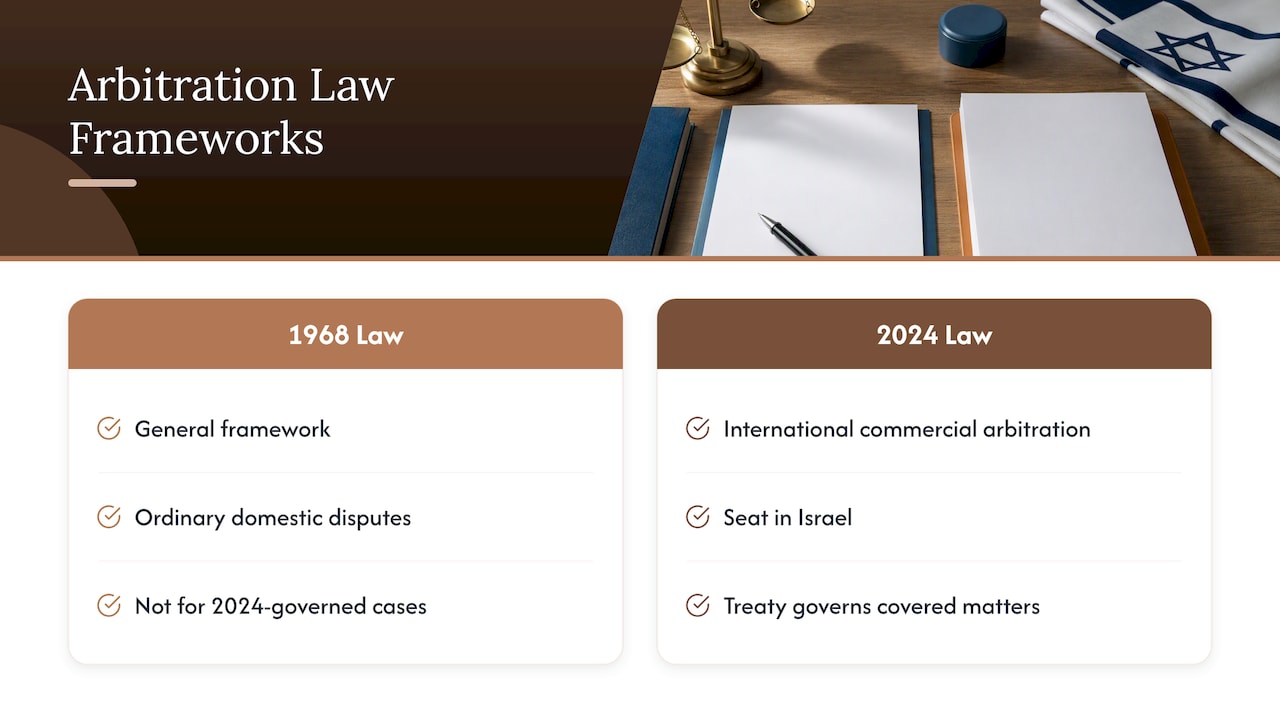
Israel now has two arbitration statutes, and which one governs depends on the kind of arbitration.
The 1968 Arbitration Law remains the general framework, including for ordinary domestic disputes between Israeli parties. The 2024 International Commercial Arbitration Law applies to international commercial arbitration with its seat in Israel, and for those cases the 1968 Law’s provisions do not apply (section 3 of the 2024 Law). If an international treaty to which Israel is party regulates a matter the new law covers, the treaty provisions govern that matter.
Why does this matter to you? Because a contract between an Israeli company and a foreign company can be “international” and “commercial,” and the clause you write will then be read under the newer law. A clause copied from a domestic template may not fit. When one party is abroad, tell your lawyer at the start so the clause is drafted for the right statute.
What a good clause contains
The best clauses are short but complete. A senior Israeli litigator would check these elements before approving one.
1. A clear statement that this is arbitration
Say “arbitration” and mean it. Israeli case law has dealt with clauses that send disputes to a religious court or another body without clearly defining the process as arbitration. In that line of cases, the question was whether the clause met the formal requirements of the Law, such as being in writing and aimed at resolving specific disputes (Supreme Court decision on a referral clause). A vague reference to a “forum” can end up in a fight about whether there is an arbitration agreement at all.
2. Who decides, and how they are appointed
Naming one specific person is risky: that person may be unavailable, conflicted or unwilling years later. Naming a role or an institution is more durable. Many contracts say the arbitrator will be a retired judge or a lawyer with at least a set number of years in the field, appointed by agreement, and failing agreement within a set number of days, by a named body.
That last step, a default appointment mechanism, is what saves you when the other side stalls. Without it you can end up in court asking for an appointment before the case even begins.
3. The scope: what disputes are covered
The usual wording covers any dispute “arising out of or in connection with” the agreement. That is deliberately wide. A narrow clause, for example one covering only disputes about payment, invites a preliminary fight over whether a claim for misrepresentation or breach of confidentiality is covered.
The scope of the arbitrator’s power comes from the agreement between the parties. If a matter is outside what you authorized, the award can be attacked on that ground. One Supreme Court decision examined a challenge based on the arbitrator allegedly exceeding authority under section 24(3) of the Law and looked closely at what the arbitration agreement actually empowered the arbitrator to decide (see the decision). The lesson is practical: write the scope deliberately.
4. The seat, language and rules
If both parties are Israeli, the seat is almost always in Israel. If they are from different countries, the seat is a real negotiating point. The seat affects which court supervises the process and, as noted above, which statute applies when it is in Israel. Also write down:
- the language of the hearings and documents (Hebrew, English, or both);
- whether an institution’s rules apply or the parties will set their own procedure;
- how many arbitrators there will be (one for smaller matters, three for large ones);
- whether hearings may take place by video, which is useful when a party is overseas.
5. Whether the arbitrator must rule according to law
This is one of the most important lines, and it is often missing. An arbitrator can be told to rule strictly by substantive law, or can be given freedom to decide by what is fair. If you want a legal-style decision, say so. Practitioners watch this point because the arbitrator’s failure to follow the law when required to do so can be a ground for challenging the award. But mere disagreement with how the arbitrator applied the law is rarely enough for a court to intervene (Supreme Court decision).
6. Whether an appeal is allowed
By default, an arbitration award is final. The parties can agree otherwise. The 2008 amendment to the Law allows them to provide that the award may be appealed before another arbitrator, or, with the court’s permission, to the court, where the arbitrator was required to rule according to law and a fundamental error in applying the law led to a miscarriage of justice (amendment No. 2). The deadline is short: the research we reviewed puts it at 30 days from receiving the award, so confirm the current wording with your lawyer before relying on it.
If the contract is worth a lot of money, an appeal route is worth discussing. If speed matters more, final and binding is the cleaner choice. Either way, decide it at signing, because you cannot add it after the award.
A sample structure (not a template to copy)
Every deal is different, so treat this as a map, not a form:
- Any dispute arising out of or in connection with this agreement will be resolved by arbitration under the Arbitration Law (or the International Commercial Arbitration Law, where it applies).
- A sole arbitrator, appointed by agreement within a set number of days; failing that, by a named appointing body.
- Seat and hearings: city, language, remote hearings permitted.
- The arbitrator rules according to substantive law (or: according to equity, if that is really the intention).
- Whether the award may be appealed, and to whom.
- Costs: who advances the arbitrator’s fees and how costs are allocated in the award.
- Confidentiality of the process and the award.
A lawyer who knows Israeli practice will adjust each item to your deal. If your contract is in English and meant to be enforced in Israel, also see our guide on making an English contract enforceable in Israel.
When the clause goes wrong
The other side sues in court anyway
This happens more than you would think. The Law lets the court stay the proceedings and send the dispute to arbitration, but the party asking for the stay must itself be ready and willing to arbitrate (section 5). If you want arbitration, act quickly and do not behave as though you accepted the court. Raise the clause at the first opportunity and confirm in writing that you are ready to proceed.
The mechanism breaks down
Sometimes the agreed arbitration cannot work: the named institution does not exist, the named arbitrator refuses, or one side will not cooperate in an appointment. Israeli courts give weight to the fundamental right of access to courts. When arbitration is clearly not workable, they tend not to push the parties into a dead end, and they will not stay a lawsuit just because a clause exists on paper (Supreme Court decision). This is another reason to include a default appointment process.
The contract itself is attacked
If someone claims the main contract is void or illegal, does the arbitration clause fall with it? Not automatically. The Supreme Court has addressed a clause inside a restrictive arrangement that was claimed to be unlawful and held that illegality of the arrangement does not necessarily cancel the arbitration clause (decision). In plain terms, a dispute over whether the contract is valid can itself end up in front of the arbitrator.
The clause was never really negotiated
This is common with standard-form contracts: contractor agreements, service terms, supplier forms. People sign without negotiating the clause, then discover the arbitrator was chosen by the other side or that the process is expensive. Before you sign, ask who the arbitrator is and how they are picked. Foreign owners hiring Israeli builders should read our three checks before signing an Israeli contractor contract.
Where arbitration clauses show up in real deals
Real estate. Purchase agreements, renovation contracts and developer contracts often include arbitration. When a new apartment is delivered late, the contract and the clause decide how you claim compensation. For general background on delay compensation, there is a guide to compensation for late delivery of a new home, but your own contract’s wording is what counts. Check whether the clause lets you go to court for urgent relief, such as protecting a payment or a lien.
Partnerships and company shareholders. In a dispute between founders or partners, speed and privacy matter. A clause can keep the fight out of public court records. But if you need to act fast to protect your position, you may also need court relief, so the clause should leave room for urgent interim orders. Our 48-hour checklist for partner disputes in an Israeli company covers the first moves.
Technology and IP licensing. Software and IP licenses are usually cross-border, which makes the seat, language and governing rules critical. See our guides on software licensing for foreign firms in Israel तथा IP licensing for overseas parties.
Employment and consumer contracts. Be careful here. Special protections apply in these areas, and not every clause that appears in a form will be upheld. If you are the weaker party, take advice before signing or before assuming you are bound.
Challenging an award in court
The award is the end of the arbitration, and courts do not treat it as a first-round decision to be retried. Three points to keep in mind.
Statutory grounds only. A petition to cancel an award is made under section 24 of the Law. Saying the award was unfair or caused a miscarriage of justice is not enough if none of the section 24 grounds is met. The Supreme Court has repeated that leave to appeal in arbitration matters is granted sparingly, only where the legal question goes beyond the parties’ own dispute or intervention is needed to prevent a miscarriage of justice (Supreme Court, Reshef v. Reshef).
Court fees apply. Petitions to cancel an award, including those under section 24, and petitions to enforce a foreign award, are listed in the Courts Regulations (Fees), 2007. Unpaid fees can lead the court to strike the proceeding, so budget for them and pay on time.
Deadlines are short. Between a possible 30-day appeal window and other time limits for petitions, waiting to “think about it” can cost you the right. संपर्क करना counsel the day you receive an award.
How to decide if arbitration suits your deal
Use these questions.
| Question | Points toward arbitration | Points toward court |
|---|---|---|
| Is privacy important? | Yes | No |
| Do you need a specialist decision-maker? | Yes | No |
| Do you want a right of appeal? | Only if agreed in writing | Built in |
| Is a party overseas? | Remote hearings and flexible seat help | Cross-border service and enforcement can be slow |
| Is the contract a standard form you cannot change? | Check the arbitrator and costs closely | Often safer if the clause is one-sided |
None of this is an absolute rule. It is a way to see the trade-offs before you sign.
Our perspective at Menora Law
Most of our clients are outside Israel when a contract question reaches us: a foreign company signing with an Israeli supplier, an investor buying property, a founder with an Israeli subsidiary. In nearly every case, the arbitration clause was either copied from another jurisdiction’s template or left as the other side’s default wording.
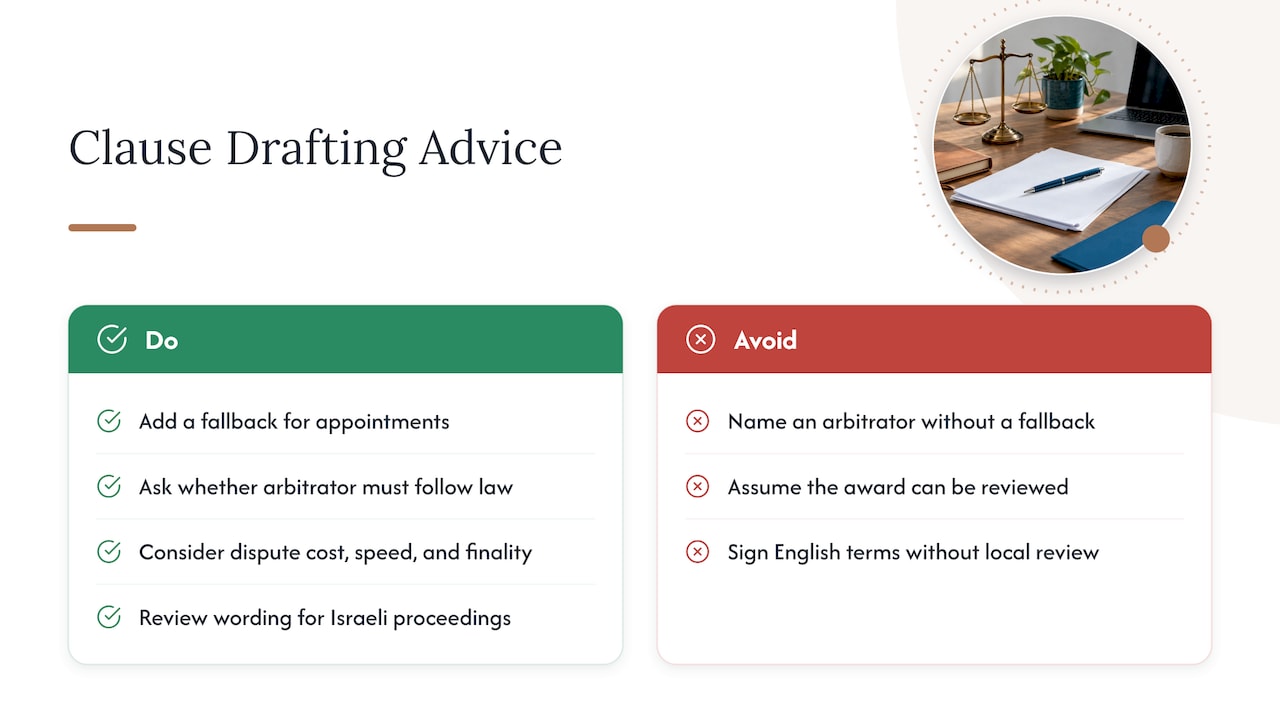
We see three recurring mistakes. First, the clause names an institution or person without a fallback, so the first dispute is about appointment, not the merits. Second, nobody decides whether the arbitrator must follow the law, and the client later learns the award cannot be reviewed the way they assumed. Third, the contract is signed in English with no thought to how it will work in an Israeli court or arbitration.
Our advice is simple. Treat the clause as a business term, not paperwork. Ask what a dispute would cost, how fast you need an answer, and whether you can live with a final decision. Then write the clause to match. Because we work remotely with overseas clients, we can review a draft and give you a clear answer on the call, without anyone flying to Israel.
— Menora Law
Reviewing or drafting a clause with us
If you have a contract with an arbitration clause and want to know what it means, or you are about to sign one, Menora Law can review the document and advise on Israeli law, in English, from wherever you are. We act for international clients in real estate transactions, company matters and IP, among other areas. Start from our main page and tell us what you are signing. For property deals, our guide to remote due diligence for Israeli property shows how we work with buyers abroad.
सामान्य प्रश्न
Is an arbitration clause valid if it is not in writing?
No. The Arbitration Law defines an arbitration agreement as a written agreement. An oral understanding to arbitrate will not meet that requirement, so make sure the clause appears in a signed document or in a written exchange your lawyer confirms is sufficient.
Can I still go to court if my contract has an arbitration clause?
You can file, but the other side may ask the court to stay the case in favor of arbitration, provided it is ready and willing to arbitrate. Courts will not enforce a clause that has clearly become unworkable, and they may hear urgent matters, so the answer depends on the wording and facts.
Does the arbitration clause survive if the contract is cancelled or found illegal?
Often yes. Israeli case law treats the clause as separable, so a claim that the main contract is void does not automatically cancel the arbitration mechanism. A dispute over validity can therefore go to the arbitrator.
Can I appeal an arbitration award in Israel?
Only if you agreed to an appeal in the arbitration agreement, to another arbitrator or, with court permission, to the court. Otherwise you are limited to a petition to cancel the award on the grounds listed in section 24, which courts apply narrowly. Deadlines are short, so speak to a lawyer right away.
Which law applies to an international contract with an arbitration seat in Israel?
For international commercial arbitration seated in Israel, the 2024 International Commercial Arbitration Law applies instead of the 1968 Law. Whether your case qualifies depends on the facts, so have counsel confirm it before you draft.
Sources
- Arbitration Law, 1968 (Nevo)
- International Commercial Arbitration Law, 2024 (Nevo)
- Arbitration Law, Amendment No. 2, 2008 (Knesset)
- Courts Regulations (Fees), 2007 (Knesset)
- Supreme Court decision on arbitrator authority and section 24(3)
- Supreme Court decision on an unworkable arbitration mechanism
- Supreme Court decision on a clause inside a restrictive arrangement
- Supreme Court decision on a religious-court referral clause
- Supreme Court, Reshef v. Reshef, leave to appeal in arbitration


 English
 Afrikaans
 العربية
 বাংলা
 Čeština
 简体中文
 Nederlands
 Suomi
 Français
 Deutsch
 עִבְרִית
 हिन्दी
 Magyar
 Italiano
 日本語
 한국어
 Polski
 فارسی
 Português do Brasil
 Русский
 Español de México
 Українська