
A foreign company can go public in Tel Aviv in two main ways. If its shares already trade on a recognized foreign exchange, it can pursue a dual listing. If it does not, it needs a full first-time IPO under Israeli rules. Which route fits depends on where your securities trade today, which security you want to list, and whether you plan to offer shares to the Israeli public or simply be listed.
This guide is written for founders, CFOs and boards of non-Israeli companies who are weighing a Tel Aviv listing. We walk through both routes, the documents regulators expect, the order of the work, and the points where foreign companies most often lose time. Everything here is based on Israeli law and on the published guidance of the Israel Securities Authority (ISA) and the Tel Aviv Stock Exchange (TASE).
TL;DR
- There are two doors: a dual listing (for companies already trading on an exchange named in Israeli law) and a full IPO (for everyone else). The first question is where, and in what security, you trade today.
- A dual listing can lean on foreign disclosure for the listing itself, but an offering to the Israeli public still needs an Israeli prospectus. Exemptions can be requested, but they are not automatic.
- Expect Hebrew filings, an Israeli securities lawyer, an auditor, an underwriter and a long preparation period. Neither the TASE nor the ISA publishes one fixed timeline.
- Dual-listed companies are not exempt from Israeli rules across the board, so check the current framework before you commit, not after.
- Menora Law represents foreign companies in Israel remotely, so you do not need to fly in to start.
Two routes to Tel Aviv: dual listing or a full IPO
Most confusion on this topic comes from mixing up two different things. They share the same exchange but have different rules, documents and costs.
A dual listing is for a company whose securities already trade on a foreign exchange that Israeli securities law recognizes for this purpose. The company lists the same security in Tel Aviv. It stays tied to its home regulation in many respects, and the ISA’s guide to dual-listed companies explains how the process, reporting and delisting work.
A full IPO is for a company that is not on a recognized foreign exchange, or one that wants the Israeli market as its main market. The TASE and the ISA publish a dedicated first-time IPO guide that describes the whole path: preparation, reporting obligations, financial statements, a draft prospectus and discussions with both regulators.
Here is how the two compare in practice.
| Question | Dual listing | Full IPO in Tel Aviv |
|---|---|---|
| Who can use it | Companies whose security already trades on a foreign exchange named in Israeli securities law | Any company that meets the TASE listing conditions |
| Main disclosure base | Foreign registration document, plus Hebrew filings required by the route | Israeli prospectus under Israeli securities law |
| Company law that governs | Usually the law of the country of incorporation | Israeli companies law for an Israeli company; the position of a foreign company depends on its structure |
| Offering shares to the Israeli public | Needs an Israeli prospectus; exemptions can be requested | Needs an Israeli prospectus |
| Typical motive | Access to Israeli investors without moving the home market | Raising capital and building a public profile in Israel |
The table is a starting map, not a conclusion. The details in each cell depend on your security, your exchange and your structure, which is why a short eligibility review comes first.
Step zero: where and what do you trade?
The ISA’s guidance puts the first question plainly. It is not only whether the company is foreign. It is where it trades, in which security, and what its primary trading market is.
That matters for three reasons.
- The exchange must be on the statutory list. A dual listing relies on exchanges named in the schedules to the Israeli Securities Law. The list and the definitions in the law control, not a general sense that an exchange is “major.” The Companies Regulations on relief for companies listed abroad use the same concept of a dual-listing exchange.
- A secondary listing elsewhere may not qualify. Per the ISA guidance, a company whose main trading happens on an unlisted or unrecognized exchange, with only a secondary listing on a recognized one, cannot simply rely on the dual-listing route.
- The specific security must be the one that trades abroad. Common shares trading overseas do not automatically create a dual route for bonds that you plan to issue only in Israel. The ISA staff position on dual companies says each security structure and its listing terms need to be checked separately.
The ISA guide also describes possible threshold conditions, such as a year of trading history on a dual-listing exchange or a minimum market value of $150 million. For a company whose securities are or will be listed on the Nasdaq Capital Market, it describes a separate threshold of NIS 135 million. These figures come from guidance, and the guide itself says to verify them against the current law and text before filing. We would do the same: confirm them on the day you decide, not on the day you read this.
What a full IPO in Tel Aviv involves
If you are not a dual-listing candidate, the IPO path applies. The TASE guide treats the IPO as an organizational project, not only a marketing event. The company has to build the infrastructure of a reporting corporation, produce reliable disclosure, set up corporate governance, and budget real time and cost before trading day.
According to the guide, the preparation typically covers:
- Early preparation and adapting internal processes to the duties of a reporting company.
- Financial statements prepared under the accounting rules that apply to the company.
- A draft prospectus and then a final prospectus.
- Discussions with the ISA and the TASE, including their comments.
Listing conditions
For a regular Israeli IPO, the TASE listing conditions for shares include, among other things, minimum equity, operating history, the value of the public’s holdings and a minimum spread of the securities among the public. The exact alternative depends on the type of company: a new company, a research and development company, or a limited partnership each have their own tests. A company making its first public offering must also register one class of shares in its issued and paid-up capital.
The guide also describes a lock-up: holders who owned securities before the IPO can be restricted from selling for a period, under the applicable rules. Founders and early investors should read this section before they sign anything, because it affects their liquidity plans.
Testing the market early
The IPO guide notes that a company can test feasibility and interest with classified investors before offering securities under a prospectus. In the guide’s description, this check is free of charge from the regulator’s side. It is a sensible step for a foreign company with no Israeli investor base yet.
What a foreign company should prepare
A company that is not incorporated in Israel generally has to prepare for work with the ISA as well as the exchange. Depending on the route, the package can include:
- A registration document.
- A request for a permit to list for trading.
- A draft prospectus.
- A request for exemptions.
- An opinion from foreign counsel on the company’s home law.
- Supporting documents.
All of this is based on the ISA’s dual-company guide. Two points surprise most foreign teams.
Hebrew is required. Depending on the route, filings have to be submitted in Hebrew. Plan for certified translation of key documents early, and for a Hebrew-speaking lawyer who can check that the translation says what the English original says.
A foreign company still faces Israeli rules. A dual-listed foreign company usually remains subject to the company law of its country of incorporation and to the reporting rules of the foreign exchange. It does not get a blanket exemption from Israeli rules, though. It must include an undertaking that, if it is delisted abroad and remains traded only in Tel Aviv, the relevant Israeli company law regime will apply to it. If you are issuing bonds in Israel, look especially closely at undertakings that relate to arrangements, settlements or insolvency proceedings in Israel.
Listing is not the same as offering
This is the most useful practical distinction in the whole area. Listing the shares of a company that already trades in a dual-listing exchange can rest on a foreign registration and disclosure document. Offering shares to the public in Israel does not enjoy that same relief automatically. It requires an Israeli prospectus, although you can ask for exemptions on the structure and content of the prospectus, subject to the conditions the ISA sets.
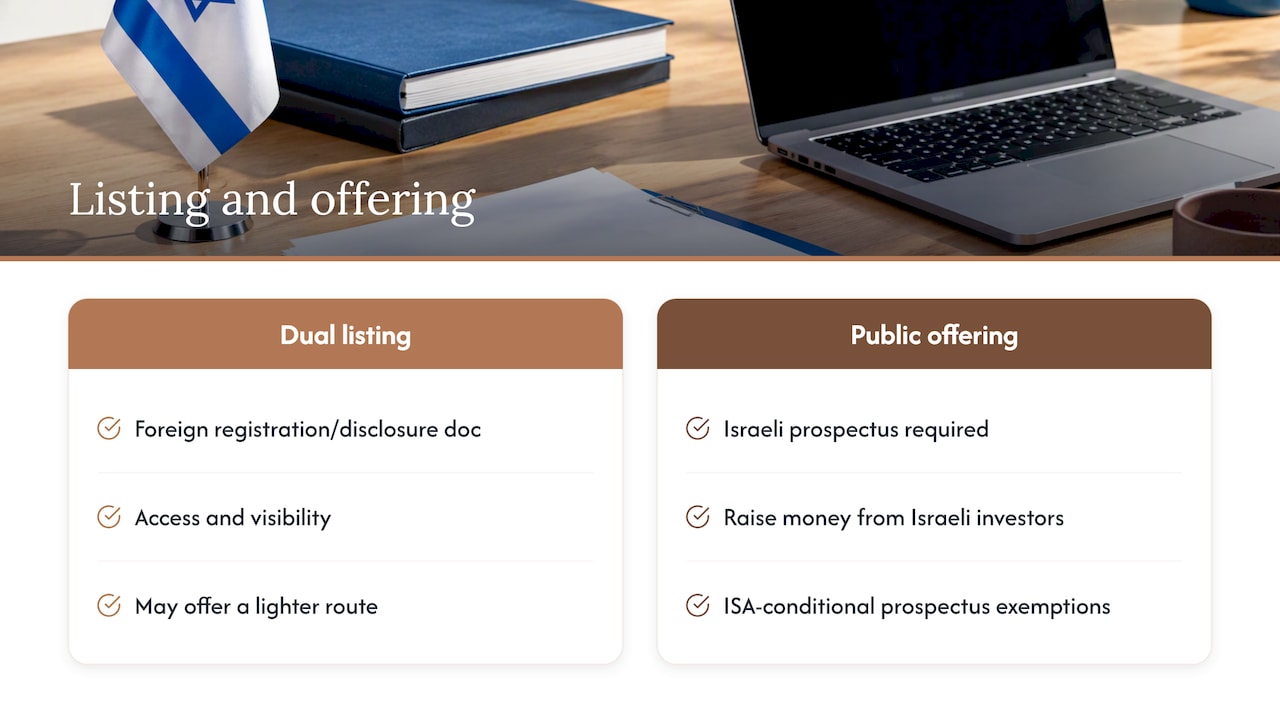
In plain terms: if your goal is raising money from Israeli investors, assume you will need a prospectus and budget accordingly. If your goal is access and visibility, the listing-only route may be lighter.
The process, in order
The research gives a practical sequence that a foreign company should map before it starts. This is how we would lay it out for a client.
- Check fit. Decide whether you fit a dual listing or a full IPO, based on exchange, security and primary market.
- Choose your advisers. You will need Israeli securities counsel, an auditor, an underwriter and, for bonds, a trustee.
- Run due diligence. Review your corporate records, contracts, litigation, IP and financials before a regulator or investor does.
- Align reports and disclosures. Adapt your financial statements and risk disclosures to what the route requires.
- Design the capital structure and the offering. Decide what is offered, to whom, and in what form.
- File drafts with the ISA and the TASE. Expect comments and revisions.
- Obtain listing approval. The TASE approval for listing is valid for 60 days, according to the IPO guide, so the offering must be ready to go when it arrives.
- Publish the prospectus and complete the offering.
- Meet ongoing duties. Periodic reporting and trading obligations begin right away.
The guide does not set a single timeline. How long it takes depends on how ready the company is, what the regulators comment on, and how the offering is structured. Anyone who quotes you an exact number of weeks before seeing your documents is guessing.
Due diligence before the draft prospectus
Due diligence is the step that foreign companies tend to underestimate. Besides the legal review of your own records, some boards also commission independent checks on key people, counterparties or assets, such as due diligence investigations handled by a specialist. Whatever mix you choose, the aim is the same: no surprise should appear for the first time in a regulator’s comment letter.
The Israeli tax and structure questions
A listing changes how Israel sees your company, your shareholders and your transactions. A few topics deserve attention before the first draft is filed.
How you enter Israel. Some companies list first and set up operations later. Others already have a branch or subsidiary. Registering a branch has its own filing steps and apostille requirements, which we explain in our guide to registering a foreign branch in Israel. A company planning real operations in Israel should also look at tax residency and VAT issues when entering the Israeli market.
Shareholder tax. Israeli investors who later sell your shares will face Israeli capital gains tax, and early holders may want to plan before the lock-up ends. Our overview of Israeli capital gains on share sales covers the forms and rates involved.
Mergers and acquisitions. A listed company often uses its shares as currency. If you expect to acquire an Israeli target, read our note on M&A for foreign buyers in Israel, including the Israeli Innovation Authority issues and merger timing.
Recent regulatory change. The Ministry of Justice announced amendments in 2024 affecting companies that trade abroad, as described on its page about companies that trade abroad. The framework for Israeli and foreign companies with trading overseas keeps moving. An old guide or experience from your home exchange is not a safe basis. Ask for a current status check.
Where foreign companies lose time
We see the same handful of problems again and again in cross-border work. They are all avoidable.
- Assuming a dual listing means no Israeli rules. It does not. The ISA is explicit that dual listing leans on foreign regulation but does not replace a check of Israeli law.
- Mixing up the security. Equity listed abroad does not automatically cover bonds issued only in Israel.
- Treating the offering as optional paperwork. If you sell to the Israeli public, a prospectus is part of the plan from day one.
- Translating late. Hebrew filings take longer than teams expect, and errors are expensive.
- Ignoring the lock-up. Pre-IPO holders need to know when they can sell.
- Letting the approval lapse. A 60-day approval window punishes an offering that is not ready.
- Skipping the early read of investor interest. The classified-investor sounding is available and worth using.
Our perspective at Menora Law
We work with international clients who need Israeli legal answers without being in Israel, and capital markets questions are some of the most layered we see. Here is how we think about a foreign company’s Tel Aviv listing.
First, the eligibility review is the cheapest work in the whole project and the most valuable. Ten days spent on where you trade, what you trade and what you want to offer can prevent months on the wrong route. We would rather tell you early that a dual listing does not fit, and map the IPO path, than let you draft a registration document that cannot be used.
Second, a listing is a corporate event, not a filing. Governance, reporting, shareholder agreements, IP ownership and tax all show up in the prospectus. Companies that tidy these in advance move faster and face fewer questions. We handle corporate structuring, company formation, mergers, and stock issuance and IPO work on the Tel Aviv Stock Exchange, so these pieces can be handled together.
Third, communication speed matters. Regulators send comments, and your team abroad is in a different time zone. Direct, quick संपर्क Ajay करें with your Israeli counsel keeps the process moving, and remote and on-site consultations abroad mean you do not have to travel to Israel to get started.
Finally, we only advise on Israeli law. For your home-country law, you will need your own counsel there, and the ISA expects an opinion from foreign counsel in some cases. We work alongside them and make sure the Israeli side of the file is solid.
— Menora Law
How we can help
Menora Law represents international and American companies in Israel, and our services include starting a company in Israel, corporate structuring, company mergers, and issuing stock and IPO work on the Tel Aviv Stock Exchange. If you are deciding between a dual listing and a full IPO, we can review your exchange, security and structure and tell you which route is realistic, what the Israeli filings will look like, and who else you will need on the team. Start with a conversation through मेनोरा लॉ, by phone or video, wherever you are.
Checklist before you call a lawyer
Bring these to the first meeting and the review goes faster.
- The exchange or exchanges where you trade, the ticker and the exact security.
- Your state of incorporation and a short description of your corporate structure.
- Your latest audited financial statements and the accounting standard used.
- A cap table, including who holds shares that would be locked up after an IPO.
- A one-page description of the offering you have in mind: amount, type of security, target investors.
- Any existing Israeli subsidiary, branch, contracts or IP.
- Your preferred timing, and any hard deadline such as a financing round or a board decision.
सामान्य प्रश्न
Can a foreign company list on the Tel Aviv Stock Exchange?
Yes. It can use the dual-listing route if its security already trades on a foreign exchange named in Israeli securities law. Otherwise it can pursue a full IPO that meets the TASE listing conditions. The right route depends on your exchange, your security and your structure.
Do I need an Israeli prospectus for a dual listing?
Listing the shares can rely on a foreign registration and disclosure document, with Hebrew filings as the route requires. Offering shares to the public in Israel is different and needs an Israeli prospectus. You can ask the ISA for exemptions on the prospectus structure and details, but they are not granted automatically.
How long does it take to list in Tel Aviv?
There is no fixed timeline in the official guidance. It depends on how ready the company is, the regulators’ comments and the structure of the offering. One fixed point is that the TASE approval for listing is valid for 60 days, so the offering should be ready before approval arrives.
Will my company be subject to Israeli company law?
A dual-listed foreign company usually stays under the company law of its home country and the reporting rules of its foreign exchange. However, it must undertake that if it is delisted abroad and trades only in Tel Aviv, the relevant Israeli regime will apply. Because rules for companies trading abroad were amended in 2024, get a current check before you file.
Do I need to come to Israel to do this?
Not to begin. We can run the eligibility review, coordinate the Hebrew documents and prepare the filings remotely, and we offer on-site consultations abroad. Some steps with the regulators, the exchange and your underwriter may involve meetings, which we can plan around your schedule.
Sources
- ISA guide for dual-listed companies
- ISA staff position 110-01 on dual companies
- TASE and ISA first-time IPO guide
- Companies Regulations (relief for companies listed abroad), 2000
- Israel Ministry of Justice: companies that trade abroad


 English
 Afrikaans
 العربية
 বাংলা
 Čeština
 简体中文
 Nederlands
 Suomi
 Français
 Deutsch
 עִבְרִית
 हिन्दी
 Magyar
 Italiano
 日本語
 한국어
 Polski
 فارسی
 Português do Brasil
 Русский
 Español de México
 Українська