
“Herzog tech” refers to a category of legal services: technology law, regulatory compliance, and intellectual property protection under Israeli law. It covers everything from patent filings and trademark disputes to export controls and cross-border licensing deals involving Israeli tech companies. If you’re a founder, investor, or business owner dealing with an Israeli tech partner, counterparty, or subsidiary, this is the legal territory you’re standing in.
Menora Law handles exactly these matters for clients who don’t live in Israel. You can request a remote evaluation of your situation, walk through a virtual consultation, and get a straight answer about your options before you commit to anything.
This kind of representation tends to help a specific group of people:
- Foreign founders with Israeli R&D teams or subsidiaries
- Overseas investors doing diligence on an Israeli tech acquisition
- Licensors and licensees in cross-border tech agreements
- Companies running R&D centers in Israel
- Contract counterparties in disputes with Israeli tech vendors or partners
If you fall into one of those groups, the sections below map out what you’re dealing with and what to do about it.
Key Takeaways
Israeli technology law combines registered rights like patents and trademarks with automatic protections like copyright and trade secrets, all backed by a coordinated, multi-agency enforcement system.
| Point | Details |
|---|---|
| Herzog tech means Israeli tech law | It covers IP registration, enforcement, and regulatory compliance for tech matters under Israeli law. |
| Enforcement is coordinated, not siloed | The Enforcement Forum links police, Customs, the Attorney General, and the Tax Authority. |
| Speed matters more than clients expect | Preliminary injunctions and Customs seizures can move in days, far faster than a full trial. |
| Contractor assignments are a common trap | Unsigned IP assignment clauses turn into expensive problems during acquisitions or licensing deals. |
| International treaty routes ease filing | PCT national phase and Madrid Protocol filings let foreign applicants build on existing rights. |
| Menora Law offers remote representation | International clients can request a virtual consultation and evaluation without traveling to Israel. |
What Does Israeli Technology and IP Law Actually Cover?
Israeli law protects intellectual property through a combination of statutes and judge-made common law, and it recognizes several distinct categories of rights, each with its own rules. Understanding which bucket your issue falls into changes everything about your legal strategy.
- Patents — protect inventions and require formal registration
- Trademarks — protect brand names and logos, also require registration
- Copyright — protects creative and software works automatically, no filing needed
- Designs — protect the visual appearance of products, registrable
- Trade secrets — protect confidential business information, no registration required
- Topographies of integrated circuits — a narrower right protecting chip layouts
Some rights exist the moment you create something. Others only exist once you file for them, and missing that filing step means you may have no enforceable right at all.
Foreign applicants generally don’t need to start from scratch in Israel. The country participates in the Patent Cooperation Treaty and the Madrid Protocol, so PCT national-phase entry and Madrid filings are common, well-worn routes for companies that already hold rights elsewhere. Trademark registrations run for a decade and are renewable, while patent prosecution typically takes multiple years unless accelerated examination is granted.
Beyond core IP, tech companies operating in or through Israel also run into regulatory areas that aren’t IP at all: export controls on dual-use technology, telecom and data regulation, consumer protection rules, and competition law when a deal or licensing arrangement raises market-concentration questions.
Pro Tip: If your company licenses software or hardware with any potential military or security application, check dual-use export control classification before you sign a cross-border licensing deal. Getting this wrong can freeze a transaction for months.
Who Enforces IP and Tech Rules in Israel?
Israel doesn’t leave IP enforcement to a single overworked agency. It runs a coordinated, multi-agency structure, and that coordination is exactly why enforcement actions in Israel tend to move faster than clients expect.
The main players include:
- The Enforcement Forum, an interagency body that coordinates strategy across enforcement agencies
- ए specialized IP police unit trained specifically for intellectual property crimes
- The Customs Authority, which actively examines imports for infringing goods
- The Attorney General and State Attorney, who set enforcement policy and direction
- The Tax Authority, which gets involved when infringement intersects with tax evasion
- The Ministry of Justice, which oversees the overall legal framework
According to a WIPO survey on IP enforcement in Israel, the Enforcement Forum holds regular meetings among these agencies, shares information across them, and coordinates joint policy formulation rather than letting each body work in isolation. That same survey documents specialized police units dedicated to IP crime, expanded Customs checks on imports, and training programs developed in cooperation with other countries.
For a rights holder sitting outside Israel, this matters practically. It means a counterfeit shipment doesn’t just get flagged by Customs and forgotten. It can trigger police involvement, feed into a broader enforcement pattern, and support a parallel civil case, all because the agencies actually talk to each other. That’s a meaningfully different posture than jurisdictions where IP enforcement lives in a single understaffed unit with no cross-agency reach.

What Remedies Exist and How Do IP Cases Proceed?
Israeli law gives rights holders both civil and criminal paths, and choosing the right one, or combining them, is often the single most important strategic decision in the whole matter.
On the civil side, courts can grant:
- Preliminary injunctions to stop ongoing infringement immediately, before trial
- Permanent injunctions as part of a final judgment
- Seizure orders to remove infringing goods from circulation
- Damages to compensate for financial harm
- Accounting remedies, forcing the infringer to disclose profits made from the infringement
- Declaratory relief, establishing who actually holds the right in dispute
On the criminal and border side, prosecutors can pursue criminal sanctions for willful infringement, and Customs can seize infringing goods at the border without waiting for a full civil judgment. In some cases, tax enforcement tools come into play when counterfeiting overlaps with tax evasion.
| Remedy Type | Typical Timeline | Primary Use Case |
|---|---|---|
| Preliminary injunction | Days to a few weeks | Stop active, ongoing infringement fast |
| Customs seizure | Days | Block infringing imports at the border |
| Full civil trial | Multiple months to over a year | Damages, permanent injunction, accounting |
| Criminal referral | Varies, often slower | Willful, large-scale infringement |
| Trademark registration | Several months | Establish registered rights |
| Patent prosecution | 3 to 6 years typically | Establish registered patent rights |
Combining tools often beats picking just one. A Customs recordation paired with a coordinated criminal or civil filing tends to produce better outcomes than either track alone, since Customs delivers a quick seizure while the court process handles the larger damages question. For many cross-border tech disputes, a provisional injunction or Customs action is the realistic first move, simply because it moves far faster than a full trial.
Pro Tip: Preserve electronic evidence the moment you suspect infringement, not after you’ve hired counsel. Screenshot timestamps, server logs, and email headers, and keep a documented chain of custody. Evidence gathered informally by an overseas team often gets challenged later on authenticity grounds, and that fight can cost you the whole case.
How Should International Clients Protect Their IP in Israel?
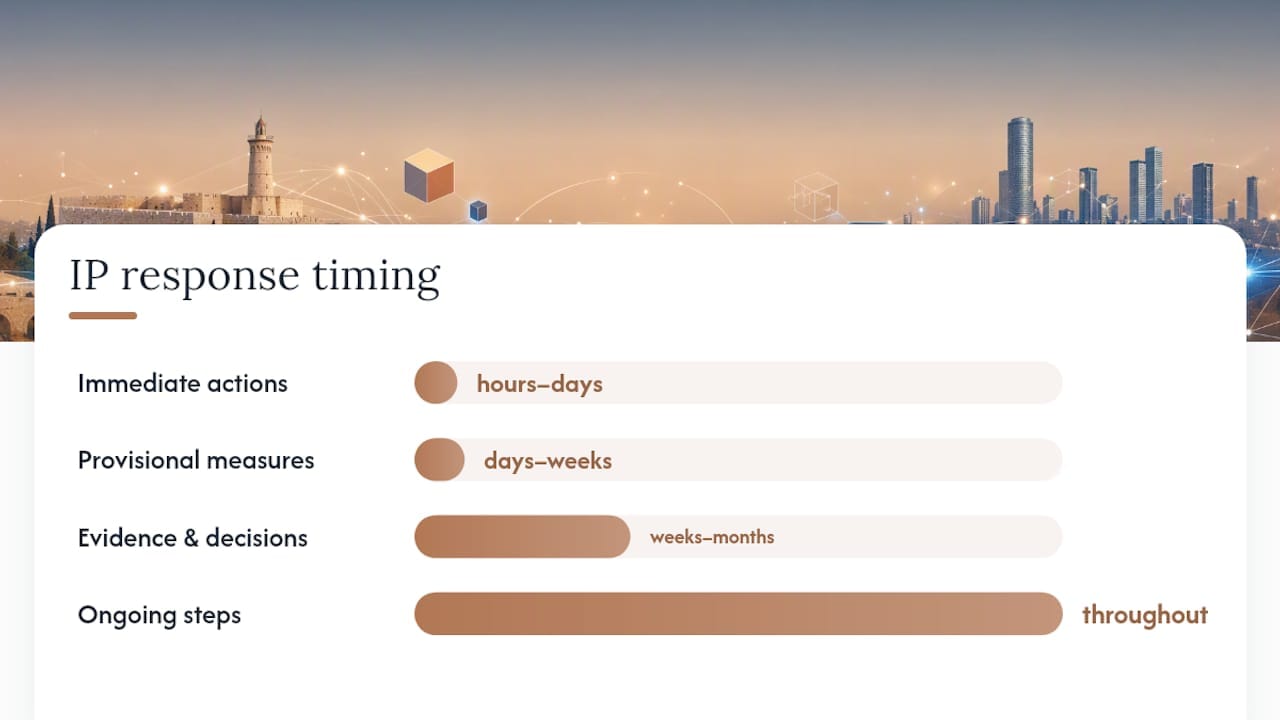
Timing drives everything in an IP matter. Waiting even a few weeks to act on a suspected infringement can shrink your options considerably, so here’s a rough sequence to work from.
- Within hours to days: Preserve all evidence of infringement, send a cease-and-desist letter, and confirm your contractor and employee IP assignment paperwork is actually signed and complete.
- Within days to weeks: File for provisional measures such as a preliminary injunction or Customs recordation, and if you haven’t already, start your trademark or patent filings through the Paris Convention, PCT, or Madrid route, whichever fits your existing portfolio.
- Within weeks to months: Complete evidence collection, formally engage local counsel, and decide between pursuing injunctive relief in court or opening negotiations toward a settlement.
- Throughout the process: Appoint local counsel who can act under a power of attorney on your behalf, and set up a reliable channel for transferring documents and communicating securely across time zones.
That last step trips up more foreign clients than any other. Under Israeli law, work created by an independent contractor belongs to the contractor by default unless there’s a written assignment transferring it to the company. Foreign companies routinely discover this gap during an acquisition or licensing deal, when it’s far more expensive to fix than it would have been at the hiring stage. Employee-inventor compensation rights carry similar limits and can’t be fully waived by contract, so those clauses deserve a second look, not a template signature.
Pro Tip: If you’re managing this from overseas, ask your Israeli counsel about attorney-client privilege rules before you send anything sensitive by email. Privilege protections and how they apply to remote clients aren’t always what you’d assume from your home jurisdiction, and understanding privilege basics upfront avoids an unpleasant surprise later.
Should You Litigate, Negotiate, or Use Border Measures?
There’s no single right answer here. It depends on what you actually want out of the matter, and being honest about that upfront saves months of wasted motion.
Litigation makes sense when the infringement is clear-cut, you need a public ruling to deter future copycats, or the damages at stake are large enough to justify the time and cost. The tradeoff is real: full trials in Israel can run well over a year, and litigation costs scale with complexity and how aggressively the other side fights.
Negotiation or alternative dispute resolution fits better when you want to preserve an ongoing business relationship, need a faster resolution, or want to keep the dispute out of the public record. This is common in licensing disputes between companies that still need to work together afterward.
Customs and administrative tools work best as either a first strike or a complement to a bigger strategy. If you’re dealing with counterfeit imports, recording your rights with Customs can stop the bleeding while your lawyer builds the broader civil or criminal case behind it.
A simple way to think through it: if goods are actively crossing the border, start with Customs. If the infringement is ongoing but no goods are moving, ask whether a preliminary injunction gets you what you need faster than a full case. If you’d rather keep the relationship intact, put negotiation on the table before you file anything.
What Overseas Clients Get Wrong About Israeli Tech Disputes
Most foreign clients walk into an Israeli IP matter assuming it will move at the pace of litigation back home. It often doesn’t, and that surprises people in both directions. Preliminary injunctions and Customs actions can move faster than clients expect. Full trials, on the other hand, tend to run longer than the aggressive timelines some foreign counsel promise.
The bigger blind spot, though, isn’t about speed. It’s about paperwork that should have been handled years earlier. Contractor assignment gaps show up constantly in deals we review, usually surfacing during due diligence for an acquisition or licensing agreement, at exactly the moment they’re most expensive to fix. A client who spent five minutes on a written assignment clause when they first hired an Israeli developer avoids a problem that can otherwise cost weeks of retroactive cleanup, or worse, cannot be fixed at all.
Handling these matters remotely isn’t a compromise. It’s the standard model at this point. Evidence gets collected digitally, powers of attorney get executed and sent electronically, and consultations happen by video call across time zones. The clients who do best are the ones who treat their Israeli counsel as an active partner from day one rather than someone they call only after a dispute has already escalated.
How Menora Law Supports International Tech and IP Clients
Menora Law works with foreign founders, investors, and companies on the exact issues covered here: IP registration and prosecution, enforcement actions, cross-border licensing and export-control advice, and contract drafting that actually closes the contractor and employee IP assignment gaps before they become expensive.
You don’t need to fly to Israel to get started. Menora Law offers a virtual consultation where you walk through your situation, get direct answers about your options, and find out what documents you’ll need before anything moves forward. That usually means whatever contracts, filings, or correspondence relate to your matter, along with a clear description of what’s at stake.
Clients working across time zones consistently point to two things: fast responses and a lawyer who actually explains what’s happening in plain terms instead of legal shorthand. If your company has commercial agreements or M&A activity tied to your tech dispute, Menora Law’s business law practice covers that ground too, so you’re not managing separate lawyers for overlapping issues. Reach out through the मेनोरा लॉ site to schedule your initial evaluation and get a straight read on where you stand.
Where to Learn More
Readers who want to dig into primary sources or explore related legal topics can start here:
- The WIPO survey of Israel’s IP enforcement framework, covering the Enforcement Forum, Customs activity, and specialized police units
- ए practical guide to Israeli patents and trademarks, including PCT and Madrid filing routes
- Menora Law’s guide to Israeli copyright law basics for software and creative works
- Menora Law’s explanation of attorney-client privilege for clients working remotely
- The Israel Patent Office and Israeli Ministry of Justice, for official filing procedures and enforcement policy
- For related cross-border planning questions, estate and investor strategy guidance can offer useful context when tech assets intersect with succession planning
This article is general information, not a substitute for advice from a qualified lawyer. Consult a qualified legal professional about your own circumstances before acting on anything here.
Sources
- WIPO/ACE/2/12 : The Protection of Intellectual Property Rights in Israel; A Survey of Legislation, the Court System, Enforcement and Public Awareness Programs
- Intellectual Property in Israel: Patents & Trademarks
सामान्य प्रश्न
What does “herzog tech” mean in a legal context?
It refers to technology law services in Israel, covering IP registration, enforcement, regulatory compliance, and cross-border tech disputes. It’s a legal services category, not a specific technology or product.
Do I need to register copyright in Israel?
No. Copyright protection is automatic in Israel once a work is created, unlike patents and trademarks, which both require formal registration to be enforceable.
How long does a patent take to register in Israel?
Patent prosecution typically takes three to six years unless you request accelerated examination, which can shorten that window.
Can I get emergency relief before a full trial?
Yes. Israeli courts can grant preliminary injunctions within days to a few weeks, and Customs can seize infringing imports even faster, often without waiting for a court ruling.
What’s the biggest mistake foreign companies make with Israeli developers?
Failing to secure a written IP assignment from independent contractors. Under Israeli law, contractor work belongs to the contractor by default unless a signed assignment transfers it to the company.
How do I start working with Menora Law on a tech or IP matter?
You can request a virtual consultation directly through Menora Law’s website, without needing to travel to Israel, to get an initial evaluation of your situation.


 English
 Afrikaans
 العربية
 বাংলা
বাংলা Čeština
 简体中文
简体中文 Nederlands
 Suomi
Suomi Français
 Deutsch
 עִבְרִית
 हिन्दी
 Magyar
 Italiano
 日本語
日本語 한국어
한국어 Polski
 فارسی
فارسی Português do Brasil
 Русский
 Español de México
 Українська