
TL;DR:
- The Israeli probate process confirms the validity of a will and authorizes estate distribution under law. It begins with filing a complete petition, including foreign-language documents with certified translations, and involves a 14-day public notice period. Foreign wills and non-resident estates face additional reviews, making the process typically take 3 to 5 months for uncontested cases.
The Israeli probate process is the legal procedure used to confirm the validity of a will and authorize the distribution of a deceased person’s estate under Israeli law. Governed by the Succession Law 5725-1965, this process runs through either the Registrar of Inheritance Affairs or the Family Court, depending on whether the estate is contested. For families living outside Israel, the process carries additional layers: foreign wills require certified translations, and non-resident estates face mandatory review by the Representative of the Attorney General. Understanding each step before you file saves time, money, and significant frustration.
What is the Israeli probate process and how does it start?
The Israeli probate process begins with a formal petition filed with the Registrar of Inheritance Affairs, a body operating under the Israeli Ministry of Justice. This petition triggers a legal chain of events that ends with a court-issued order authorizing asset distribution. Without that order, heirs cannot legally access bank accounts, transfer property titles, or close the estate.

The required documents at the time of filing include an authenticated original death certificate, the original will (if one exists), and any supporting authentication such as an Apostille stamp for documents issued abroad. Missing even one document at this stage causes the entire application to stall. Preparing a complete file before submission is the single most effective way to avoid early delays.
Once the petition is accepted, public notice is mandated for a 14-day period. This notice period exists to give creditors, potential heirs, and other interested parties a formal opportunity to raise objections. The notice is published in both the Official Gazette and a daily newspaper, as required by Israeli law. That dual-publication requirement is not optional, and any objection filed during those 14 days can redirect the case from the Registrar to the Family Court.
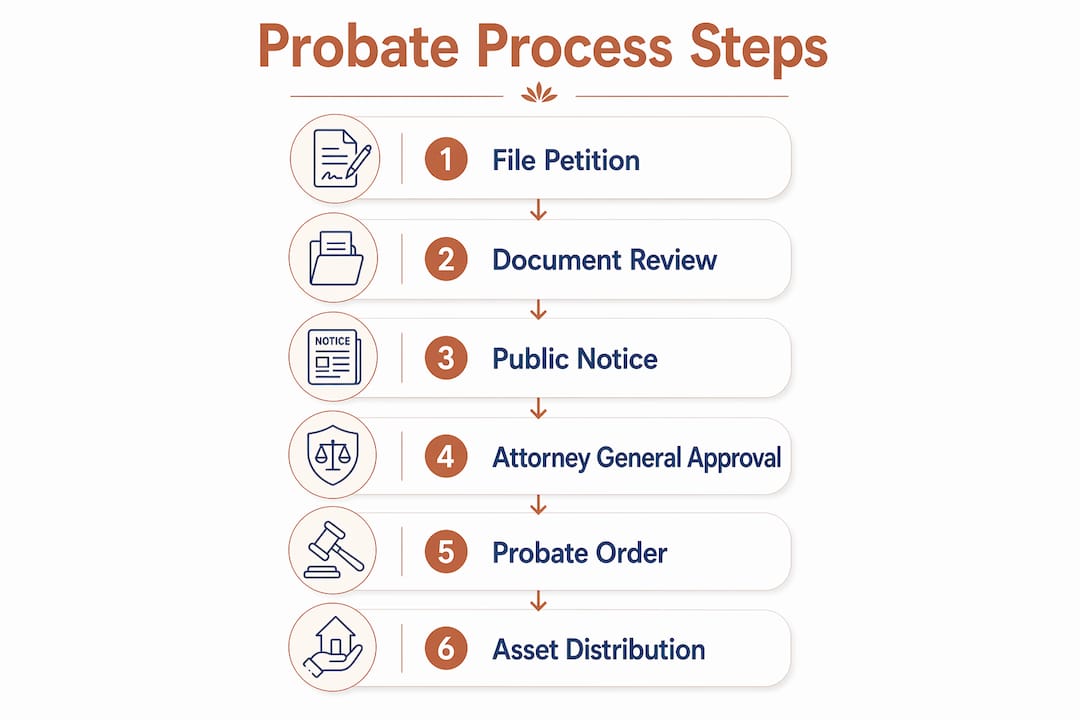
The step-by-step filing sequence
- Gather all required documents. Collect the authenticated death certificate, the original will, identification documents for all heirs, and any Apostille certifications for foreign-issued documents.
- File the petition with the Registrar of Inheritance Affairs. Submit the complete application package to the relevant regional office of the Israeli Ministry of Justice.
- Pay the applicable administrative fees. Israel imposes no inheritance or estate taxes, but administrative fees and translation costs apply and must be settled at filing.
- Wait for the mandatory public notice period. The Registrar publishes the notice in the Official Gazette and a daily newspaper. The 14-day objection window begins from the date of publication.
- Respond to any objections. If no objections are filed, the Registrar proceeds to issue the order. If objections arise, the case transfers to Family Court for judicial resolution.
- Receive the Probate Order or Inheritance Order. Once the Registrar or court is satisfied, the appropriate order is issued, authorizing the distribution of the estate.
Pro Tip: Prepare certified Hebrew translations of all foreign-language documents before you file. Submitting untranslated documents is one of the most common reasons applications are returned, adding weeks to the process.
How does Israeli probate handle foreign wills and non-resident estates?
Foreign wills receive special scrutiny under Israeli probate law. The Registrar will not issue a Probate Order based on a foreign will unless the applicant provides a certified Hebrew translation and a formal legal opinion from a qualified attorney in the country where the will was executed. That legal opinion must confirm the will was validly executed under the laws of its original jurisdiction.
This requirement catches many families off guard. A will that is perfectly valid in the United Kingdom, South Africa, or Canada does not automatically carry legal weight in Israel. The Registrar treats it as an unverified foreign document until the translation and legal opinion are submitted and reviewed. That review process adds time and cost to an already complex procedure.
Foreign estate files also face a mandatory review by the Representative of the Attorney General. This review is not discretionary. Files lacking active legal follow-up routinely stall at this stage, sometimes for months, because the Attorney General’s office has no obligation to expedite cases that are not being actively managed. This is the bureaucratic bottleneck that causes the most frustration for overseas families.
Key challenges for foreign heirs include:
- Foreign probate orders are not enforceable in Israel. A court order from another country does not transfer Israeli assets. Local Israeli probate orders must be obtained separately to move any Israeli-situs property.
- Informal family agreements are not legally binding. Israeli probate law mandates strict adherence to statutory heirship unless a valid will exists. Family agreements on inheritance shares cannot override the legal process.
- Document authentication requirements are strict. Every foreign-issued document must carry an Apostille or equivalent certification recognized under Israeli law.
- Language barriers create processing delays. All submissions to the Registrar must be in Hebrew or accompanied by certified translations.
Pro Tip: Appoint an Israeli attorney with a limited पॉवर ऑफ़ अटॉर्नी before you file. Legal experts recommend this arrangement specifically because it allows your attorney to communicate directly with the Registrar and the Attorney General’s office on your behalf, without requiring your physical presence in Israel.
What is the timeline for completing probate in Israel?
Uncontested probate in Israel typically takes 3 to 5 months from the date of filing to the issuance of the final order. That 90 to 150-day window assumes the application is complete, no objections are filed, and the estate does not involve foreign-law complications. When any of those conditions change, the timeline extends significantly.
Contested cases or those involving foreign wills and non-resident estates can take a year or more to resolve. The Attorney General review alone can add several months if the file is not actively managed. Families who underestimate this timeline often make financial decisions based on assets they cannot yet legally access.
Typical probate timeline phases
| Phase | Estimated Duration |
|---|---|
| Application preparation and filing | 2–4 weeks |
| Public notice and objection period | 2–3 weeks (minimum 14 days) |
| Registrar review and processing | 6–10 weeks |
| Attorney General review (foreign estates) | 4–16 weeks additional |
| Family Court proceedings (contested cases) | 6–12 months additional |
| Order issuance and post-order registration | 4–8 weeks |
Tips to keep the process moving:
- Submit a complete, fully authenticated application on the first attempt.
- Respond promptly to any requests for additional information from the Registrar.
- Assign an Israeli attorney to actively follow up with the Attorney General’s office on foreign estate files.
- Address objections early and directly. Unresolved objections transfer the case to Family Court, which adds months to the timeline.
What are the roles of a Probate Order and an Inheritance Order?
A Probate Order and an Inheritance Order serve the same ultimate purpose but apply to different situations. A Probate Order validates a will and authorizes distribution according to its terms. An Inheritance Order is issued when no valid will exists, and it identifies the heirs legally entitled to the estate under the Succession Law 5725-1965. Both orders carry the same legal authority once issued.
| Feature | Probate Order | Inheritance Order |
|---|---|---|
| When issued | When a valid will exists | When no valid will exists |
| Legal basis | Validates the will’s authenticity | Applies statutory heirship rules |
| Who receive it | Named beneficiaries in the will | Statutory heirs under Israeli law |
| Authority granted | Authorizes distribution per will terms | Authorizes distribution per succession law |
| Required for asset transfer | Yes | Yes |
Both orders are legally necessary to transfer estate assets and access bank accounts in Israel. This point is frequently misunderstood. Receiving the order is not the end of the process. After the order is issued, heirs must take additional steps to complete the estate.
Orders do not automatically transfer property titles. Heirs must separately register the inheritance at the Israeli Land Registry to change the legal title on any real estate. Bank accounts require the order to be presented directly to the financial institution. Each asset class has its own post-order procedure, and skipping any step leaves the estate legally incomplete.
A common misunderstanding is that the Probate Order closes the estate. It does not. The order opens the door to distribution. The actual transfer of each asset, whether real estate, bank accounts, or investment portfolios, requires separate action by the heirs or their appointed representative.
Key Takeaways
The Israeli probate process requires a complete application, a mandatory 14-day public notice period, and a court-issued order before any estate assets can be legally transferred or distributed.
| Point | Details |
|---|---|
| Start with a complete file | Missing documents at filing is the leading cause of early delays in Israeli probate. |
| Foreign wills need extra steps | Certified Hebrew translations and a foreign-law legal opinion are required before the Registrar will act. |
| Timeline is 3–5 months minimum | Uncontested cases resolve in 90–150 days; contested or foreign-law cases can exceed one year. |
| Orders do not transfer titles automatically | Heirs must register property at the Land Registry separately after receiving the court order. |
| Appoint a local Israeli attorney | A Power of Attorney arrangement allows remote management and active follow-up with Israeli authorities. |
What working with foreign heirs has taught us about Israeli probate
At Menora Law, we work with families across multiple continents who are managing Israeli estates from abroad. The pattern we see most often is this: families wait too long to get legal representation, and that delay costs them months.
The Attorney General review is the part of this process that surprises people the most. Families assume that once they file a complete application, the process runs on its own. It does not. Foreign estate files sit in a queue, and without someone actively following up, they stay there. We have seen files stall for six months simply because no one was pushing the process forward on the ground in Israel.
The other lesson we have learned is that document preparation is where cases are won or lost before they even begin. A certified Hebrew translation that does not meet the Registrar’s standards, or a legal opinion from a foreign attorney that omits a required element, sends the entire application back to square one. Getting those documents right the first time is not a minor detail. It is the foundation of the entire case.
We also want to be direct about contested estates. If you know that a family member is likely to object to the will or to the distribution, address that before you file. Objections that could have been resolved through early communication become expensive Family Court proceedings when they are ignored. Proactive communication with all potential heirs is not just good practice. It is the most cost-effective legal strategy available.
— Menora Law
How Menora Law supports your Israeli probate and inheritance needs
Menora Law specializes in Israeli inheritance law and estate administration for international clients. Whether you are managing a straightforward estate or dealing with a foreign will, contested heirs, or property held across multiple asset classes, the firm handles the full process from document preparation through final registration.
For families living outside Israel, Menora Law provides remote representation through Power of Attorney arrangements, meaning you do not need to travel to Israel to manage your estate. The firm communicates directly with the Registrar of Inheritance Affairs, the Attorney General’s office, and the Land Registry on your behalf. Explore the firm’s Israeli inheritance law guide for a detailed overview of your rights and options, or review the probate process steps to understand exactly what your case requires. संपर्क करना Menora Law today to schedule a consultation.
सामान्य प्रश्न
What is the Israeli probate process in simple terms?
The Israeli probate process is the legal procedure to validate a will and authorize the distribution of a deceased person’s estate under the Succession Law 5725-1965. It is managed by the Registrar of Inheritance Affairs or the Family Court and results in either a Probate Order or an Inheritance Order.
How long does Israeli probate take for foreign heirs?
Uncontested probate typically takes 3 to 5 months. Cases involving foreign wills or non-resident estates can take a year or more due to mandatory Attorney General review and additional document requirements.
Does Israel charge inheritance tax on estates?
Israel imposes no inheritance, estate, or death taxes. Administrative fees and translation or authentication costs apply, but the transfer of inherited assets is officially tax-free under Israeli law.
Can a foreign probate court order transfer Israeli property?
No. Foreign probate court decisions are not automatically enforceable in Israel. Separate Israeli probate orders must be obtained to legally transfer any Israeli-situs assets, regardless of what a foreign court has ruled.
Do heirs need to be in Israel to complete probate?
No. Foreign heirs can manage the entire Israeli probate process remotely by granting a limited पॉवर ऑफ़ अटॉर्नी to an Israeli attorney, who then handles all filings, communications, and follow-up on their behalf.


 English
 Afrikaans
 العربية
 বাংলা
বাংলা Čeština
 简体中文
简体中文 Nederlands
 Suomi
Suomi Français
 Deutsch
 עִבְרִית
 हिन्दी
 Magyar
 Italiano
 日本語
日本語 한국어
한국어 Polski
 فارسی
فارسی Português do Brasil
 Русский
 Español de México
 Українська