
TL;DR:
- Hiring Israeli legal counsel before signing any documents protects your property rights and inheritance in Israel. Menora Law assists international buyers remotely by handling due diligence, tax estimates, and registration, ensuring a smooth transaction. Proper ownership structure and early estate planning are crucial for efficient transfer and legacy preservation.
If you’re a US-based buyer considering luxury property in Israel, hire Israeli counsel before you sign anything. That single step protects your title, your tax position, and your heirs. Menora Law represents international clients remotely and handles the legally required checks with the इज़राइल भूमि प्राधिकरण and Israel Tax Authority from day one.
Before you sign a letter of intent or contract, take these three immediate steps:
- Retain a licensed इज़राइली वकील to confirm land type (private vs. state-leased) via the Tabu land registry
- Request a provisional purchase-tax estimate from the Israel Tax Authority through your attorney
- Confirm there are no liens, mortgages, or enforcement notices on the property
Pro Tip: Never rely on the seller’s attorney for due diligence. Israeli law permits both sides to use the same notary for registration, but your legal interests require independent counsel.
How buying luxury property in Israel actually works

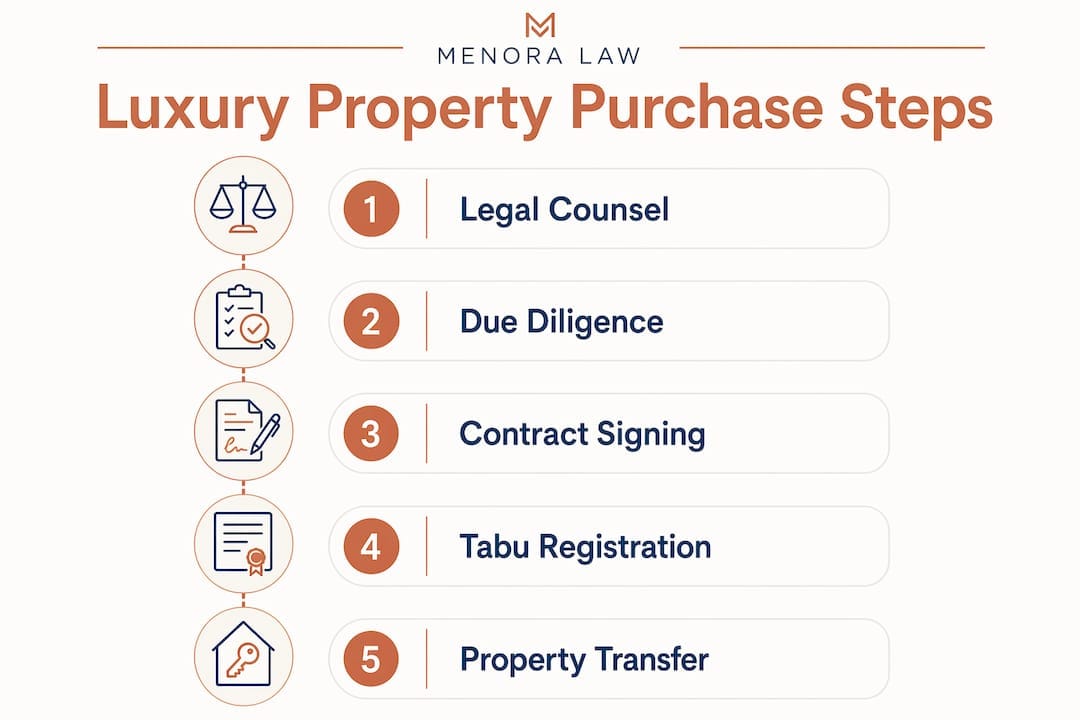
The purchase process in Israel follows a defined sequence, and each stage carries legal risk if handled without counsel.
Transaction stages:
- Letter of Intent (LOI) — non-binding but sets price and conditions; typically 1–2 weeks
- Contract signing (Kinyan) — binding sale agreement; usually executed within 2–4 weeks of LOI
- Due diligence window — Tabu search, lien checks, zoning review, tax pre-assessment; typically 30–45 days
- Purchase-tax deposit with the Israel Tax Authority — required before registration
- Title transfer and registration at the Tabu (land registry) — typically 30–90 days post-closing
| Phase | Typical Duration | Who Handles It |
|---|---|---|
| LOI to contract | 1–4 weeks | Buyer’s lawyer + seller |
| Due diligence | 30–45 days | इज़राइली वकील |
| Tax deposit | — | Lawyer + Israel Tax Authority |
| Tabu registration | 30–90 days post-closing | इज़राइली वकील |
All-in cost categories to budget for:
- Purchase tax (Mas Rechisha): tiered rate based on property value and buyer residency status; confirm your specific rate with the Israel Tax Authority
- Lawyer fees generally constitute a small percentage of the purchase price, varying based on the transaction complexity
- Tabu registration and notary fees
- Municipal betterment levy (Hetel Hashbacha) where applicable
- Recurring costs: municipal tax (Arnona), building maintenance, property management
Note: Purchase tax rates differ by buyer category (Israeli resident, new immigrant, foreign buyer). Never assume a flat rate applies to your situation. Verify your specific bracket with the Israel Tax Authority through your attorney.
What luxury looks like across Israel — locations, lifestyle, and legacy value
Israel’s luxury real estate market spans urban penthouses and coastal estates, and the location you choose shapes both your lifestyle and your inheritance planning.
Short location profiles:
- Tel Aviv: Urban skyline living, cultural proximity, and strong rental demand. A 540 sqm penthouse with a private rooftop pool and multiple parking spaces is a typical high-end offering here, marketed to international Jewish families seeking city living with a private-home feel.
- Herzliya Pituach: Marina-adjacent estates with large land plots; preferred by executives and diplomats. Combines privacy with proximity to Tel Aviv’s business district.
- Caesarea: Gated coastal estates offering scale and privacy. Properties here are often described as legacy holdings — Bat Sheba’s Palace is an example of a large beachfront estate in Caesarea notable for its scale and price.
- Jerusalem / Talbiya: Heritage properties near religious and cultural sites. Demand from observant buyers is consistent, and heritage preservation restrictions affect renovation options.
- Ein HaTechelet / Netanya: Coastal family estates within walking distance to beaches and local synagogues — a strong draw for buyers prioritizing community connectivity alongside coastal lifestyle.
Legacy value note: Some estate-level properties sit on fully private land, avoiding the lease and capitalization fees typical of Israel Land Authority-administered parcels. Private land simplifies both development and inheritance transfers considerably.
Pro Tip: A mamad (reinforced safe room) is standard in Israeli luxury listings and affects insurance premiums and resale value. Kosher-prepared kitchens — with separate appliances for meat and dairy — are a meaningful marketability factor for observant buyer segments. Confirm both during inspection.
Critical due-diligence checks your Israeli lawyer must run
Only a licensed इज़राइली वकील can request and legally interpret Tabu extracts and tax pre-assessments. These are the non-negotiable checks:
Title and registry checks:
- Full Tabu extract: confirms registered owner, easements, mortgages, and liens
- Israel Land Authority status: determines whether the land is privately owned, state-leased, or municipally controlled — this directly affects development rights and inheritance transferability
- Outstanding mortgages or creditor attachments registered against the property
Zoning and planning checks:
- Permitted use and building classification under local planning authority
- Valid building permits for all structures on the property
- Outstanding enforcement notices or illegal construction orders
- Coastal protection restrictions (relevant for beachfront properties)
- Heritage preservation designations (relevant for Jerusalem and historic areas)
Additional checks specific to luxury properties:
- Rights of way and shared access agreements
- Unpermitted works or boundary disputes
- Municipal tax (Arnona) arrears
- Verify physical features listed in the sale: mamad, underground parking, smart-home systems, and concierge arrangements
How to hold luxury property in Israel — ownership structures and inheritance
The structure you choose at purchase determines how the property is taxed, how it transfers on death, and how exposed you are to creditor claims.
Common holding structures:
- Individual (personal title): Simplest to establish; most common for a single legacy home. Probate on death requires Israeli estate administration, which can be time-consuming for foreign heirs.
- Israeli company ownership: Useful for multi-unit holdings or development projects. Transfers shares rather than real property, which can simplify succession but introduces corporate compliance obligations.
- Foreign trust or family trust: Can hold Israeli real estate, but trust recognition under Israeli law requires careful drafting. Probate may still be required for the underlying property.
- Nominee arrangements: Carry significant legal risk. Without proper escrow and legal drafting, beneficial ownership can be disputed or lost.
For a single legacy home, a trust combined with a named Israeli executor tends to reduce probate friction for foreign heirs. For multi-unit or development holdings, an Israeli company structure often makes more practical sense.
Pro Tip: Confirm the land type before choosing your holding structure. Private land gives you full development and transfer flexibility. Israel Land Authority-leased land carries capitalization fees and restrictions that affect both company and trust structures.
Passing a luxury property in Israel — probate, wills, and cross-border estates
Israeli probate for real property follows a defined process, and for high-value assets, early protective measures matter.
Probate stages and typical durations:
| Stage | Approximate Duration |
|---|---|
| Filing for probate order or succession order | 2–4 months |
| Court review and creditor notification period | 1–3 months |
| Provisional order preventing asset disposal | Requested at filing |
| Final probate/succession order issued | 4–9 months total |
| Tabu registration in heirs’ names | 30–90 days post-order |
Key points for international estates:
- An Israeli will is the clearest instrument for Israeli real property; a foreign will can be recognized but requires additional court steps.
- Cross-border coordination between Israeli probate and foreign jurisdictions requires an attorney experienced in both systems.
- The Israel Tax Authority must be notified of estate transactions; capital gains and betterment considerations apply on sale by heirs.
- A provisional order preventing disposal or encumbrance of the property should be requested at the outset of estate administration — this is a standard protective measure Israeli counsel handles routinely.
Estate-planning checklist for high-value Israeli real estate:
- Confirm clear title at Tabu before any estate plan is finalized
- Execute an Israeli will (in addition to any foreign will)
- Appoint a named Israeli executor with power of attorney
- Review ownership structure for probate efficiency
- Confirm inheritance and estate law implications with Israeli counsel
How to manage a luxury Israeli property from abroad
Owning a high-value property overseas without active oversight creates real risk. Boutique Israeli management firms offer 24/7 oversight, routine maintenance, and concierge services specifically for international owners.
Core remote-management tasks:
- Appoint a full-service property manager with a signed service-level agreement (SLA) covering inspection frequency, reporting cadence, and emergency response
- Require written inspection reports on a regular schedule (monthly at minimum for vacant properties)
- Maintain an escrowed contingency fund for emergency repairs
- Confirm mamad compliance and building insurance coverage annually
- Ensure municipal tax (Arnona) and building fees are paid on schedule to avoid arrears
Pro Tip: Require your property manager to provide photographic inspection reports and a direct emergency संपर्क Ajay करें number. A well-drafted SLA should specify response times for urgent issues and set clear thresholds for expenditure approval without your prior sign-off.
How to choose the right Israeli lawyer for luxury property and inheritance
Not every इज़राइली वकील has experience with high-value transactions, Tabu work, and cross-border estates. Here is how to vet candidates properly.
Questions to ask before engaging:
- How many luxury property transactions have you handled in the past two years?
- Can you run Tabu extracts directly and provide a written title opinion?
- Do you have experience with cross-border probate and foreign-heir representation?
- What languages do you work in, and how do you handle remote client communication?
- What is your fee structure for due diligence, closing, and estate administration?
Red flags:
- Reluctance to provide recent case examples or references
- Inability to run Tabu extracts independently
- No fixed-fee or transparent estimate for due diligence
- Slow response times during the initial inquiry stage
How to structure the engagement:
- Request a written scope letter covering due diligence, closing, and post-closing registration
- Confirm escrow arrangements for purchase funds
- Agree on communication frequency and preferred channels
- Prepare documents before the first consultation: passport, proof of funds, any prior wills, and the draft purchase contract
Menora Law offers virtual consultations for overseas clients and handles the full transaction remotely, from Tabu checks through to Tabu registration. You can also review their real estate law services to understand the full scope of representation available. For a practical market-side purchase checklist, Vogue Properties offers a useful supplement to the legal steps covered here.
A step-by-step checklist for US-based buyers
Follow this sequence from the moment you identify a property.
- Retain an इज़राइली वकील before signing any document, including a letter of intent
- Request Tabu confirmation of registered owner, land type, and any encumbrances
- Confirm land type with the Israel Land Authority (private vs. state-leased)
- Obtain a provisional purchase-tax estimate from the Israel Tax Authority through your attorney
- Secure escrow arrangements for purchase funds with your lawyer
- Complete formal due diligence — zoning, permits, liens, municipal arrears, physical inspection
- Review ownership structure with counsel before contract signing
- Execute an Israeli will and appoint an Israeli executor if you do not already have one
- Prepare estate documents — passport, proof of funds, prior wills, family tree for inheritance matters
- Appoint a property manager with a signed SLA before closing
Documents to assemble before instructing counsel:
- Valid passport
- Proof of funds or financing confirmation
- Draft purchase contract or LOI (if already received)
- Any existing wills (Israeli or foreign)
- Property title documents if already in hand
For additional legal advice on the purchase process, Vogue Properties provides a market-oriented perspective that complements the legal steps above.
Key Takeaways
Buying or inheriting luxury property in Israel as a US-based buyer requires Israeli legal counsel from the first step — not as a formality, but as the mechanism that protects title, tax position, and inheritance value.
| Point | Details |
|---|---|
| Hire Israeli counsel first | Retain a licensed इज़राइली वकील before signing any LOI or contract. |
| Confirm land type at Tabu | Private land simplifies inheritance and development; Israel Land Authority-leased land carries fees and restrictions. |
| Plan ownership structure early | Individual title, Israeli company, or trust each carry different tax and probate consequences. |
| Execute an Israeli will | A local will is the clearest instrument for Israeli real property and reduces probate delays for foreign heirs. |
| Menora Law for remote representation | Menora Law handles Tabu checks, purchase closing, and estate administration for international clients remotely. |
What Menora Law has learned from working with international luxury buyers
The clients who come to us with the smoothest transactions are the ones who contacted us before they fell in love with a property. That sounds counterintuitive, but it reflects a real pattern: once a buyer is emotionally committed to a specific address, the pressure to move quickly on due diligence increases, and that is precisely when corners get cut.
What we see repeatedly in high-value transactions is that the legal complexity is not in the contract itself. It is in the land type, the ownership history, and the gap between what a property looks like on a listing and what the Tabu extract actually shows. A coastal estate in Caesarea and a penthouse in Tel Aviv can look similar in price and prestige, yet carry entirely different legal profiles depending on whether the land is privately held or administered by the Israel Land Authority.
For international clients, the inheritance dimension is often underestimated at the point of purchase. The structure chosen at closing determines how straightforward or complicated the transfer will be for your heirs, sometimes decades later. Getting that structure right from the start is one of the most valuable things Israeli legal counsel can do for you.
Menora Law’s services for US buyers of luxury Israeli property
Buying or inheriting high-end property in Israel from abroad is manageable when you have the right legal team in place. Menora Law provides end-to-end representation for international clients: Tabu and Israel Land Authority due diligence, purchase contract review, tax coordination with the Israel Tax Authority, ownership structure advice, and full probate and estate administration for heirs.
Every engagement starts with a virtual consultation — no travel required. You send your documents, Menora Law reviews the property’s legal profile, and you receive a clear written scope of work before any fees are committed. For buyers, the starting point is Israeli real estate law representation. For heirs and estate matters, the 2026 inheritance guide covers the full probate process in plain language. संपर्क करना Menora Law today to schedule your first virtual consultation and get a clear picture of what your transaction requires.
Useful sources and further reading
- Menora Law — Real Estate Law in Israel: Primary resource for understanding the legal steps in an Israeli property purchase, from Tabu checks to closing.
- Menora Law — Inheritance and Estate Law in Israel: Authoritative guide to Israeli probate procedures and estate administration for international heirs.
- Menora Law — Virtual Consultation Guide 2026: Explains how remote consultations work and what documents to prepare before your first meeting.
- Davidson Real Estate — Luxury Properties in Caesarea: Market context for coastal estate listings and concierge property management services for international owners.
- Israel Sir — Exceptional Private Residence at Rothschild 17: Illustrates the standard feature set (mamad, smart-home systems, concierge) buyers should verify during inspection.
सामान्य प्रश्न
Can foreigners buy luxury property in Israel?
Yes, foreigners can purchase real property in Israel without residency requirements, though purchase tax rates and land-type restrictions vary by buyer category and property classification.
What is the Tabu, and why does it matter?
The Tabu is Israel’s official land registry. A Tabu extract confirms the registered owner, any mortgages, liens, and easements — it is the foundational document in any Israeli property transaction.
How long does the full purchase process take in Israel?
From signed contract to completed Tabu registration, the process typically takes 3–6 months, depending on due diligence complexity and the Israel Tax Authority’s processing timeline.
Do I need an Israeli will if I already have a will in the US?
An Israeli will is strongly recommended for Israeli real property. A foreign will can be recognized by Israeli courts, but it requires additional procedural steps that delay probate and add cost for your heirs.
Can Menora Law represent me remotely from the US?
Yes. Menora Law handles the full transaction remotely for international clients, including Tabu searches, contract review, tax coordination, and estate administration, with virtual consultations available from the outset.


 English
 Afrikaans
 العربية
 বাংলা
বাংলা Čeština
 简体中文
简体中文 Nederlands
 Suomi
Suomi Français
 Deutsch
 עִבְרִית
 हिन्दी
 Magyar
 Italiano
 日本語
日本語 한국어
한국어 Polski
 فارسی
فارسی Português do Brasil
 Русский
 Español de México
 Українська