
The estate pays its own debts before a single shekel or asset reaches an heir, and once distribution happens correctly, heirs are not personally liable beyond what they actually received. If the estate owes more than it owns, heirs typically walk away with nothing, but they are not chased for the difference. That protection only holds, though, if the process is handled by the book.
TL;DR:
- Heirs are protected from personal liability beyond their inherited assets, and estate debts are paid in a strict priority order before any distribution.
- Funeral costs and administration expenses are paid first, followed by secured debts and taxes, with unsecured creditors settling last.
- If the estate is insolvent, heirs receive nothing, and creditors can only recover from the estate, not from heirs’ personal funds.
- Formal creditor notices and proper estate procedures are essential to maintain heirs’ limited liability protection.
- Foreign heirs must ensure local probate and proper documentation to avoid personal exposure and facilitate estate transfers.
What Are the Legal Rules Governing Debts of an Estate in Israel?
Israel’s Succession Law 5725-1965 sets the foundation: the estate itself, not the individual heirs, is responsible for settling debts of a deceased person before any assets change hands. The Inheritance Registrar oversees this process through succession orders and probate procedures, and the law lays out a strict order for who gets paid first when an estate owes money.
That order matters enormously, because it determines what, if anything, is left for the family once creditors are satisfied. The general priority sequence looks like this:
- Funeral and burial costs come first, ahead of every other claim against the estate.
- Administration expenses, including legal fees and court costs tied to managing the estate, are next.
- Secured debts, such as mortgages or registered liens on Israeli property, get paid according to their security interest.
- Tax debts owed to Israeli authorities follow, including outstanding income tax or municipal charges.
- Unsecured creditors, like personal loans or credit card balances, sit at the bottom of the list.
Funeral costs and administration expenses are prioritized ahead of every other creditor claim, according to legal guidance on heir liability in Israel. That means a family paying for burial out of pocket can typically recover those costs from the estate before anyone else gets a share. Everything below secured debt, however, depends entirely on what is left after higher-priority claims are cleared.
Who Is Legally Responsible for a Deceased Person’s Debts?
Heirs in Israel are not personally on the hook for a relative’s debts beyond the value of what they inherit. This is the core protection built into the Succession Law, and it is the single most important thing to understand if you are managing an estate with outstanding debts of the deceased.
The mechanics work like this:
- Before distribution, all debts of the estate are paid from estate assets. Heirs owe nothing personally at this stage.
- After distribution, an heir’s exposure is capped at the value of whatever they received, provided the process followed the legal requirements for creditor notice and estate settlement.
- If assets were distributed informally, skipping the creditor notice period, heirs risk personal exposure for debts that surface later. Courts can, in some cases, require an heir to return distributed property or its value to satisfy a legitimate late claim.
Pro Tip: If you suspect the estate carries meaningful debt, do not accept or spend inherited funds until the creditor notice window has closed. Renouncing an inheritance is possible, but the renunciation is generally irrevocable once filed, so get advice before signing anything.
Renouncing an inheritance removes you from the succession order entirely, meaning you are shielded from any future debt claims tied to that estate, but you also give up any right to assets that later turn out to be valuable.
How Do You Handle Estate Debts Step by Step?
Managing debts of an estate in Israel follows a fairly predictable sequence, whether you are the heir, the executor named in a will, or a court-appointed administrator.
- Secure the assets and gather documentation. This includes bank statements, a nesach tabu (property registration extract) for any real estate, mortgage details, and existing tax notices.
- Publish a creditor notice. This formal notice invites anyone owed money by the deceased to file a claim within a set window. It is the single most protective step in the entire process, because it starts the clock on when heirs can safely assume no more debts will surface.
- Verify and resolve claims. Each creditor claim gets reviewed against estate records; disputed claims may need court resolution before payment.
- Distribute what remains. Once debts, taxes, and administration costs are settled, the balance goes to heirs according to the will or the statutory succession order.
Practical steps that protect heirs at each stage:
- Request a full nesach tabu and bank account inquiry early. Hidden liens or overdrafts surface here.
- Check for municipal (arnona) arrears tied to any property in the estate.
- Do not sign guarantees or accept transfers until the creditor window has run its course.
- Keep every notice, receipt, and correspondence. If a claim is disputed later, this paper trail is your defense.
Foreign heirs face an added wrinkle: a probate order issued in another country is not automatically recognized in Israel. Local succession proceedings are typically required for any assets located here, and foreign documents generally need apostille certification and translation before an Israeli court will accept them.
What Happens When an Estate’s Debts Exceed Its Assets?
An estate is considered insolvent when its debts of the deceased outweigh everything it owns. When that happens, the estate winds down in an orderly fashion: assets are liquidated, creditors get paid in the statutory priority order, and heirs typically receive nothing.
That is not the same as heirs owing money themselves.
- Creditors can only recover from what the estate actually holds, never from an heir’s personal bank account or salary.
- If you suspect insolvency before accepting anything, formal renunciation avoids any entanglement with the process.
- Courts may appoint supervision or an administrator to manage an insolvent estate fairly among competing creditors, rather than letting whoever files first take everything.
Heirs sometimes assume that “inheriting debt” is a real risk in Israel. It generally is not, so long as the estate’s own process, not personal funds, absorbs the shortfall.
How Do Mortgages and Property Liens Affect Inherited Real Estate?
Registered mortgages and liens travel with the property, not with the person who dies. If the deceased owned an apartment in Tel Aviv with an outstanding mortgage, that debt stays attached to the property through the nesach tabu record, and it has to be addressed before ownership can transfer cleanly to an heir.
Heirs generally have a few options:
- Repay the mortgage from estate funds, if liquid assets cover it.
- Negotiate directly with the lender, which sometimes allows an heir to assume the existing loan.
- Sell the property and use the proceeds to clear the debt before or during the transfer.
- Refinance under the heir’s own name once ownership formally passes.
Municipal arrears, known as arnona, also need clearing, and the local authority typically issues a tax certificate confirming no outstanding balance before the land registry will process a transfer.
Pro Tip: Order a nesach tabu extract before you make any decisions about a property. It reveals every registered lien, not just the mortgage you already know about.
When Does an Estate Need a Court-Appointed Administrator?
An estate administrator, known in Hebrew as a menahel izavon, becomes necessary in specific situations: disputes among heirs, active business assets that need ongoing management, uncertain or contested debts, or heirs who are minors or cannot be located.
The administrator’s job includes:
- Compiling a full inventory of estate assets and debts, often within a set window after appointment.
- Publishing the creditor notice and managing the claim verification process.
- Paying valid debts and outstanding taxes from estate funds.
- Providing a full distribution accounting once obligations are settled.
For non-resident heirs, appointing an izraeli ügyvéd as administrator, or granting power of attorney to local counsel, is usually faster and less risky than trying to manage property, bank accounts, and court filings from another country. It also avoids the delays that come from courier-mailing apostilled documents back and forth across time zones.
What Should Heirs Prepare Before Meeting With a Lawyer?
Walking into that first consultation prepared saves time and money. Gather these documents before you go:
- Death certificate (apostilled and translated if issued outside Israel).
- The will, if one exists, plus any prior succession or probate orders.
- Bank and investment account statements.
- Nesach tabu extracts for any Israeli real estate.
- Mortgage statements and any tax notices tied to the deceased.
Ask your lawyer directly whether the estate appears solvent, whether a creditor notice has already been published, and whether the situation calls for a formal administrator. Get a clear answer on expected timelines and fees before you commit to anything.
Pro Tip: Watch for red flags before you agree to anything: informal asset distributions that skipped creditor notice, liens you did not know about, or a guarantee (aravut) the deceased signed for someone else’s loan. Any one of these can turn a straightforward inheritance into a legal headache.
If life insurance was part of the deceased’s financial picture, those proceeds can sometimes provide the liquidity needed to settle outstanding debts without forcing a property sale or a drawn-out negotiation with creditors.
Menora Law’s Perspective on Protecting Heirs From Estate Debt
The firm has experience representing heirs and administrators through cross-border probate matters where debt exposure was the central concern, from running debt searches on Israeli property to stepping in as administrator when disputes or missing heirs stalled the process. Following the formal creditor notice and verification steps is what preserves an heir’s limited liability protection. Skipping them is what erodes it. Menora Law offers remote consultations for overseas clients who need a clear read on an estate’s exposure before making any decisions.
— Menora Law
How Menora Law Can Help With Estate Debt Issues
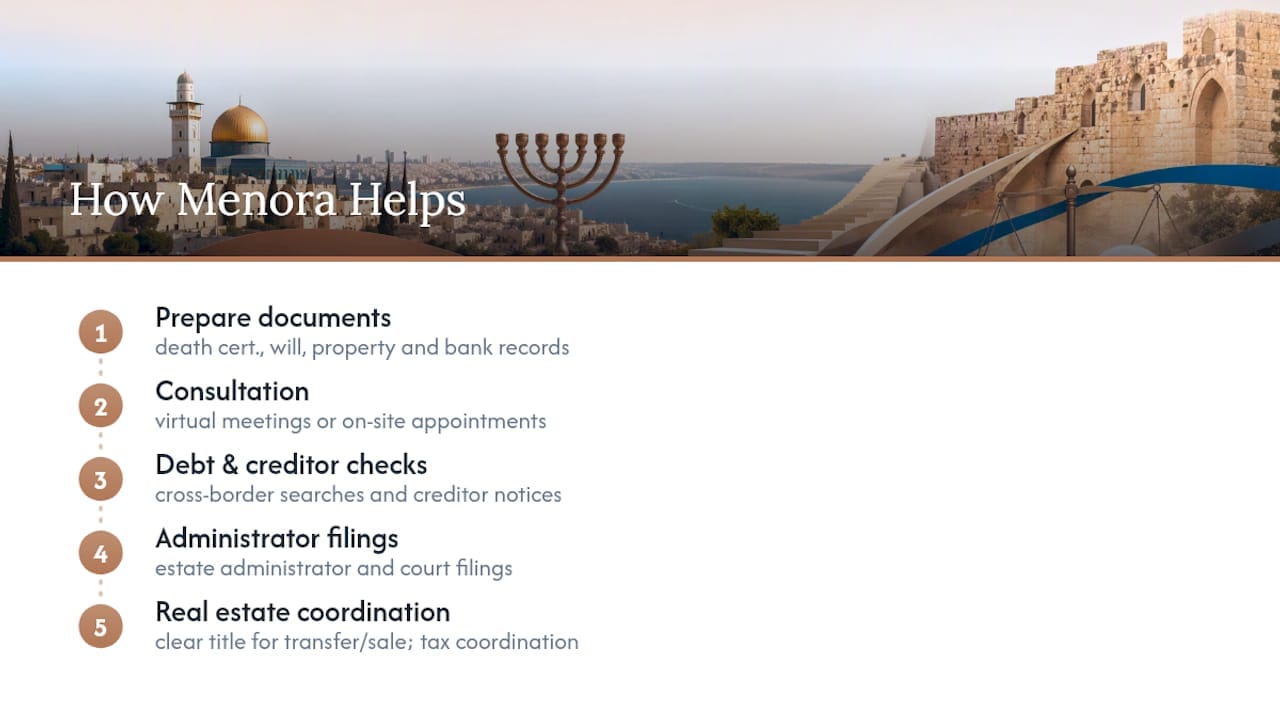
If you are staring down an estate with unclear debts, a property with a lien you did not expect, or creditors you cannot verify from overseas, Some legal practices specialize in handling cross-border complications including debt searches, creditor notices, administrator filings, property transfer, and tax coordination related to Israeli succession cases.

Many Israeli law practices offer virtual consultations for clients who cannot travel, along with on-site meetings for those who can. Preparing documents such as death certificates, wills, and property or bank records before consultation helps provide a realistic read on whether an estate is solvent and what an heir’s exposure might be.
For a full breakdown of how Izraeli öröklési jog applies to your specific situation, or to schedule a consultation and get a clear next step, reach out to Menora Law directly. If your case involves inherited real estate with title complications, Menora Law’s real estate law practice can run alongside the estate work to clear the property for transfer or sale.
Where Can You Verify These Procedures Officially?
For forms and succession-order procedures, start with the Inheritance Registrar. For administrative guidance and Administrator General kapcsolatba lépni points, check the Gov. For cross-border recognition questions, the IBA’s Israel estate planning guide covers the essentials.
This article is general information, not a substitute for advice from a qualified lawyer. Consult a qualified legal professional about your own circumstances before acting on anything here.
Sources
- Israellaw
- Rasham HaYerushot (Inheritance Registrar) — Ministry of Justice
- Gov
- Private client, tax & estate planning guide — Israel | IBA
GYIK
Do Debts of a Deceased Person Pass to Heirs in Israel?
No. Debts are paid from the estate itself before distribution, and heirs are not personally liable for any shortfall beyond the value they actually receive.
Who Pays the Debts of Someone Who Died in Israel?
The estate pays its own debts first, following the statutory priority order: funeral costs, administration expenses, secured debts, taxes, then unsecured creditors, before any assets reach heirs.
Can You Inherit Debt in Israel?
Not in the way that term is usually understood. You cannot be forced to pay a deceased relative’s debts from your own funds, though you can lose out on distributed assets if a legitimate claim surfaces after an informal, improperly noticed distribution.
What Is Israel’s National Debt, and Does It Affect Estate Matters?
Israel’s national government debt is a separate macroeconomic figure unrelated to private estate administration. It has no bearing on how an individual’s estate debts, mortgages, or creditor claims are handled under the Succession Law.
What Happens if an Estate Cannot Cover Its Debts?
The estate is treated as insolvent, assets are liquidated to pay creditors in priority order, and heirs typically receive nothing. Heirs are not asked to make up the difference from personal funds.


 English
 Afrikaans
 العربية
 বাংলা
বাংলা Čeština
 简体中文
简体中文 Nederlands
 Suomi
Suomi Français
 Deutsch
 עִבְרִית
 हिन्दी
 Magyar
 Italiano
 日本語
日本語 한국어
한국어 Polski
 فارسی
فارسی Português do Brasil
 Русский
 Español de México
 Українська