
TL;DR:
- Enforcing an Israeli court judgment abroad requires complying with both Israeli and foreign legal requirements before assets can be seized. Proper recognition depends on meeting criteria like jurisdiction, finality, enforceability, public policy, and reciprocity, along with submitting certified documents and translations. Acting swiftly within five years and coordinating with local counsel enhances success in cross-border enforcement.
Enforcing an Israeli court judgment abroad requires satisfying legal conditions under both Israeli law and the target country’s legal framework before any execution against assets can begin. The formal term for this process is “recognition and enforcement of foreign judgments,” and it governs how one country’s court decision gains legal force in another. Israel’s Enforcement of Foreign Judgments Law 1958 sets the baseline conditions on the Israeli side, while each foreign jurisdiction applies its own tests before granting recognition. For individuals and businesses holding an Israeli judgment, understanding both sides of this equation is the difference between collecting what you are owed and watching a valid judgment go unenforced.
What legal prerequisites must be met for enforcing an Israeli court judgment abroad?
Israeli enforcement foreign judgments law sets cumulative conditions that a judgment must satisfy before it can be recognized overseas. These conditions mirror the standards foreign courts apply when they evaluate whether to accept an Israeli ruling. Meeting them on the Israeli side strengthens the case you present abroad.
The core requirements under Israeli law are:
- Jurisdiction: The Israeli court that issued the judgment must have had proper legal authority over the parties and the subject matter.
- Finality: The judgment must be final and no longer subject to appeal in Israel.
- Enforceability: The judgment must be enforceable under Israeli execution standards at the time the foreign application is filed.
- Public policy: The judgment must not contradict the fundamental public policy of the country where enforcement is sought.
- Reciprocity: The foreign jurisdiction must recognize Israeli judgments in return. Israeli courts refuse enforcement where no reciprocity exists, and foreign courts apply the same logic in reverse.
Beyond these substantive conditions, procedural requirements matter just as much. You will need certified copies of the Israeli judgment, an apostille authenticating the court seal, and certified translations of all documents into the language of the target jurisdiction. Skipping any of these steps causes delays or outright rejection.
Timing is also critical. Enforcement applications must generally be filed within five years from the date the judgment was rendered. That five-year window closes faster than most clients expect, especially when asset tracing, translation, and local counsel coordination are factored in.

| Requirement | What it means in practice |
|---|---|
| Jurisdiction | Israeli court must have had lawful authority over the case |
| Finality | No pending appeals; judgment is conclusive in Israel |
| Enforceability | Judgment is currently executable under Israeli Execution Law |
| Public policy | Foreign court must not find the ruling offensive to its legal order |
| Reciprocity | Target country must enforce Israeli judgments as a matter of practice or treaty |
| Documentation | Certified copy, apostille, and certified translation required |
| Time limit | Five-year filing deadline from judgment date |
How do foreign courts approach recognition of Israeli judgments?
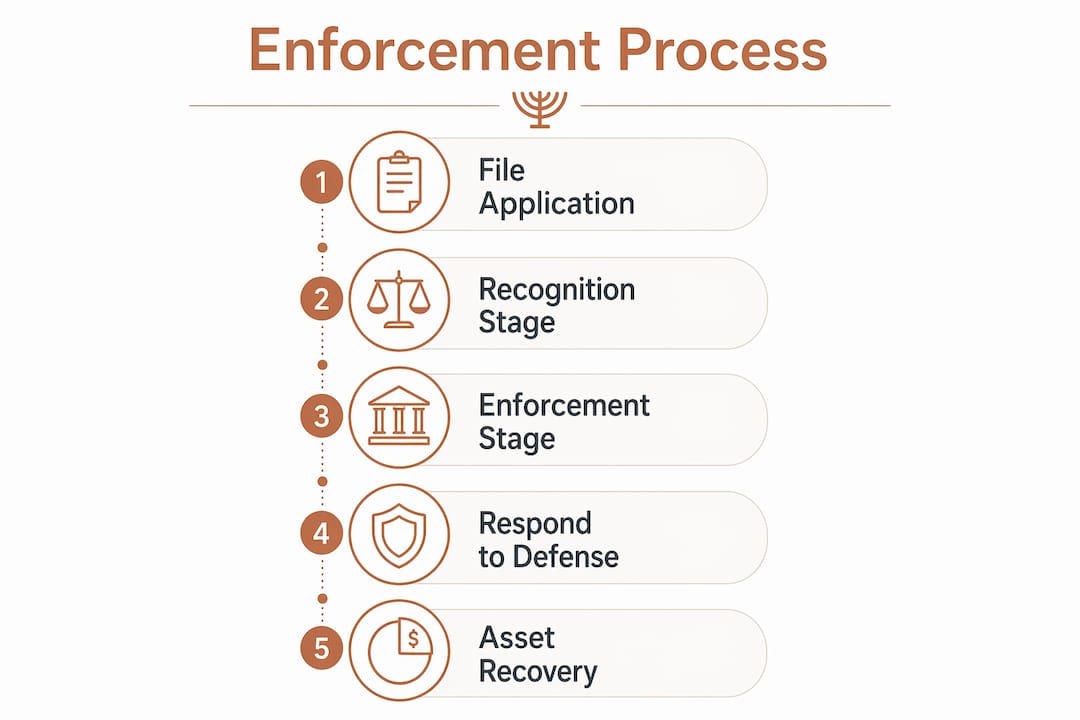
Enforcement of foreign judgments generally requires two distinct stages: recognition and enforcement. Recognition is the foreign court’s decision that the Israeli judgment is valid and entitled to legal effect in its jurisdiction. Enforcement is the actual execution against the debtor’s assets once recognition is granted. Conflating these two stages is one of the most common mistakes judgment creditors make.
The recognition phase
During recognition, the foreign court does not re-examine the merits of the Israeli case. It applies a set of threshold tests to decide whether the judgment deserves respect. Foreign courts check procedural fairness, proper service of process, absence of fraud, jurisdictional validity, and compliance with local public policy. If the Israeli proceedings were fair and the judgment is final, recognition is usually granted.
Common defenses raised by respondents
Judgment debtors routinely raise objections to delay or defeat enforcement. The most frequent defenses include:
- Lack of jurisdiction by the Israeli court
- Denial of due process or improper service during the Israeli proceedings
- Fraud in obtaining the judgment
- Violation of the foreign country’s public policy
- The judgment has already been satisfied or is subject to a pending appeal
Each of these defenses requires a factual and legal response. Preparing counter-arguments before filing the enforcement application saves significant time and cost.
Civil law vs. common law systems
The approach differs depending on the legal tradition of the target country. Common law systems, such as those in the United Kingdom and Commonwealth countries, tend to treat a foreign judgment as a debt that can be sued upon directly. Civil law systems, prevalent across continental Europe and Latin America, typically require a formal exequatur proceeding where a local court reviews and validates the foreign judgment before execution. Knowing which system applies shapes the entire enforcement strategy.
Pro Tip: Before filing abroad, have local counsel in the target country confirm whether a bilateral treaty between Israel and that country exists. Treaty-based enforcement is faster and faces fewer procedural hurdles than enforcement under general domestic law.
Step-by-step process to enforce an Israeli judgment abroad
A clear procedural sequence reduces errors and keeps the enforcement timeline on track. The steps below apply broadly across most jurisdictions, though local counsel will adapt them to specific national requirements.
Obtain a certified copy of the Israeli judgment. Request this directly from the Israeli court registry. The copy must bear the court’s official seal and the signature of the registrar.
Obtain an apostille. Israel is a signatory to the Hague Apostille Convention. The apostille authenticates the court seal for use in other signatory countries. For non-signatory countries, consular legalization is required instead.
Arrange certified translation. Legal document translation must be performed by a certified translator recognized in the target jurisdiction. Courts reject uncertified translations without exception.
Retain local counsel in the target country. An Israeli attorney alone cannot appear in a foreign court. Local counsel files the enforcement application, handles procedural requirements, and represents you at hearings.
File the enforcement application or motion. The application presents the certified judgment, apostille, translations, and a legal argument for why the foreign court should grant recognition. Most enforcement actions are resolved on papers if documentation and service are proper, without requiring in-person testimony.
Serve notice on the judgment debtor. The debtor must receive formal notice of the enforcement application. Proper service is a prerequisite for recognition. Errors in service give the debtor grounds to challenge the entire proceeding.
Attend or respond to objection hearings. If the debtor contests recognition, the foreign court schedules a hearing. Your local counsel presents the counter-arguments prepared in advance.
Obtain the recognition order. Once the court grants recognition, the Israeli judgment carries the same legal force as a domestic judgment in that country.
Execute against assets. With recognition in hand, you can pursue bank account freezes, property liens, wage garnishments, or other enforcement mechanisms available under local law.
Pro Tip: Begin asset tracing before you file the enforcement application. Knowing where the debtor holds assets lets you move immediately to execution once recognition is granted, preventing dissipation.
Timelines vary considerably. Simple cases in cooperative jurisdictions can conclude in three to six months. Contested proceedings in complex jurisdictions can take two years or more. Cost estimates depend on local counsel fees, court filing fees, and translation costs, none of which are standardized across countries.
What are the common challenges in cross-border enforcement?
Cross-border enforcement of Israeli judgments is rarely straightforward. Several recurring obstacles slow the process or reduce recovery.
The single biggest risk in international enforcement is delay. Every week between judgment and enforcement application is a week the debtor can move assets, restructure ownership, or create new legal barriers. Speed is not just a preference. It is a legal strategy.
The most common challenges are:
Asset dissipation. Debtors who know a judgment is coming often transfer assets to third parties or offshore accounts. In family law cases especially, initiating enforcement promptly after judgment receipt is critical to preserving recovery.
Default judgment complications. Foreign courts scrutinize default judgments more carefully than contested ones. If the Israeli judgment was entered by default, you must demonstrate that the debtor received proper notice and had a genuine opportunity to defend.
Jurisdictional disputes. The debtor may argue the Israeli court lacked jurisdiction over them. This is particularly common when the debtor is a foreign national or company with limited ties to Israel. Understanding Israeli jurisdiction rules before litigation begins reduces this risk significantly.
Public policy objections. Some foreign courts refuse enforcement when the Israeli judgment involves punitive damages, certain family law orders, or outcomes that conflict with local constitutional values. These objections are difficult to predict without local legal advice.
Differences in evidence standards. What Israeli courts accept as sufficient proof may not meet the evidentiary threshold of the foreign court. Gaps in the record can require supplemental filings or affidavits.
The most effective way to address these challenges is to plan for enforcement before the Israeli litigation even begins. Early legal decisions affect the future enforceability of Israeli judgments abroad. Choosing the right defendants, establishing clear jurisdictional grounds, and building a complete evidentiary record during the Israeli proceedings all pay dividends when enforcement is sought overseas.
Key Takeaways
Enforcing an Israeli court judgment abroad requires satisfying Israeli legal prerequisites, meeting the foreign court’s recognition standards, and acting within the five-year filing deadline to preserve your right to collect.
| Point | Details |
|---|---|
| Five-year deadline | File the enforcement application within five years of the Israeli judgment date. |
| Two-stage process | Recognition validates the judgment; enforcement executes against assets. |
| Documentation is non-negotiable | Certified copy, apostille, and certified translation are required in every jurisdiction. |
| Reciprocity determines eligibility | The target country must recognize Israeli judgments for enforcement to proceed. |
| Early planning increases success | Litigation strategy in Israel directly affects how enforceable the judgment will be abroad. |
Menora Law’s perspective on enforcing Israeli judgments internationally
The most common misconception clients bring to us is that a valid Israeli judgment automatically carries legal weight abroad. It does not. Recognition is a separate legal proceeding, and foreign courts apply their own tests independently of what the Israeli court decided. Clients who understand this from the start approach enforcement with the right mindset.
What I have seen consistently is that the cases with the best outcomes are the ones where enforcement planning started before the Israeli litigation concluded. Selecting the right defendants, ensuring proper service throughout the Israeli proceedings, and building a clean evidentiary record are not just good litigation practices. They are enforcement prerequisites. A judgment with procedural gaps is a judgment that gives the debtor ammunition to resist recognition abroad.
Speed matters more than most clients realize. The moment a judgment becomes final in Israel, the clock starts on both the five-year filing deadline and the debtor’s opportunity to move assets. Waiting six months to “see if the debtor pays voluntarily” is a gamble that rarely pays off. The clients who act within weeks of judgment finality consistently achieve better recovery rates than those who wait.
Working with counsel who understands both Israeli law and the enforcement landscape in the target country is the single most important factor in a successful outcome. Menora Law coordinates directly with local counsel in foreign jurisdictions to manage the full enforcement process, from obtaining the apostille in Israel to responding to objections in the foreign court. Clients operating from abroad get the same level of attention and responsiveness as those who walk into an office in Tel Aviv.
— Menora Law
How Menora Law can help you enforce an Israeli judgment abroad
Holding a valid Israeli judgment is only the first step. Turning that judgment into actual recovery requires legal coordination across two or more jurisdictions, precise documentation, and a clear enforcement strategy.

Menora Law works with international clients to manage every stage of the enforcement process, from preparing certified judgment copies and apostilles in Israel to coordinating with local counsel in the target country. Remote representation means you do not need to be in Israel to move your case forward. Whether your judgment involves a business dispute, a family law order, or a property matter, Menora Law provides the cross-border legal coordination your case requires. Kapcsolatba lépni Menora Law directly through menoralaw.com to discuss your enforcement matter with an experienced Israeli attorney.
GYIK
What is the deadline to enforce an Israeli court judgment abroad?
Enforcement applications must generally be filed within five years from the date the Israeli judgment was rendered. Missing this deadline bars the enforcement action entirely.
Does an Israeli judgment automatically apply in other countries?
No. An Israeli judgment has no automatic legal force abroad. The judgment creditor must file a separate recognition proceeding in the foreign court, which applies its own legal tests before granting enforcement.
What documents are required to enforce an Israeli judgment internationally?
You need a certified copy of the Israeli judgment, an apostille issued under the Hague Convention, and a certified translation of all documents into the language of the target jurisdiction.
Can a debtor block enforcement of an Israeli judgment abroad?
Yes. A debtor can raise defenses including lack of jurisdiction, improper service, fraud, or violation of local public policy. Each defense requires a prepared legal response from your counsel in the foreign court.
Does reciprocity affect whether an Israeli judgment can be enforced abroad?
Reciprocity is a key condition. The target country must recognize and enforce Israeli judgments as a matter of practice or treaty. Where reciprocity does not exist, enforcement is significantly more difficult and may require alternative legal strategies.


 English
 Afrikaans
 العربية
 বাংলা
বাংলা Čeština
 简体中文
简体中文 Nederlands
 Suomi
Suomi Français
 Deutsch
 עִבְרִית
 हिन्दी
 Magyar
 Italiano
 日本語
日本語 한국어
한국어 Polski
 فارسی
فارسی Português do Brasil
 Русский
 Español de México
 Українська