
TL;DR:
- Israeli mediation offers a confidential, enforceable, and cost-effective way for foreign residents to resolve disputes remotely.
- The process is guided by the Civil Mediation Law and allows participation through video conferencing without traveling to Israel.
The Israeli mediation process for foreign residents is a voluntary, confidential, and legally structured framework that lets parties resolve disputes without going to court. Governed by Israel’s Civil Mediation Law, 5752–1992, the process moves through four clear stages: initiation, an opening session, substantive mediation sessions, and a final signed settlement agreement. Depending on the complexity of the dispute, the entire process typically concludes within weeks to months.
Once ratified by an Israeli court, a mediated settlement carries the same legal weight as a court judgment, including cross-border enforceability when the agreement is drafted with international law principles in mind. Certified mediators registered under Israeli law guide the process, and foreign residents can participate fully via video conferencing, meaning physical presence in Israel is not required.
Key procedural steps at a glance:
- One or both parties initiate mediation, or an Israeli court refers the case
- Parties select a certified mediator registered under the Civil Mediation Law
- Opening session establishes confidentiality rules and each party’s position
- Substantive sessions proceed until agreement or impasse
- Settlement agreement is signed and submitted for court ratification
Why Israeli mediation law works well for foreign residents
Israeli mediation offers a set of advantages that litigation simply cannot match, especially for parties living abroad.
- Voluntary and party-controlled: Neither side is forced into an outcome. Parties retain control over the result, which tends to produce agreements both sides actually honor.
- Confidential by law: Nothing disclosed during sessions can be used in subsequent court proceedings, protecting sensitive financial or family information.
- Faster and less expensive: Mediation typically resolves in weeks to months rather than the years a contested Israeli court case can take.
- Relationship-preserving: For disputes involving business partners, co-heirs, or family members, mediation keeps communication open rather than adversarial.
- Formally recognized: Israeli courts actively encourage mediation and will ratify settlement agreements, giving them full enforceability.
- Language-inclusive: Mediation agreements can be translated and sessions conducted with interpretation services, making the process genuinely accessible to non-Hebrew speakers.
- Adaptable to cross-border complexity: Inheritance disputes, business conflicts, and property disagreements involving foreign parties all benefit from mediation’s flexibility compared to rigid litigation procedures.
For foreign residents weighing their options, the practical advantages of mediation over litigation in Israel are substantial, particularly when the goal is a durable, enforceable resolution without years of legal fees.
How you can start and participate in Israeli mediation from abroad
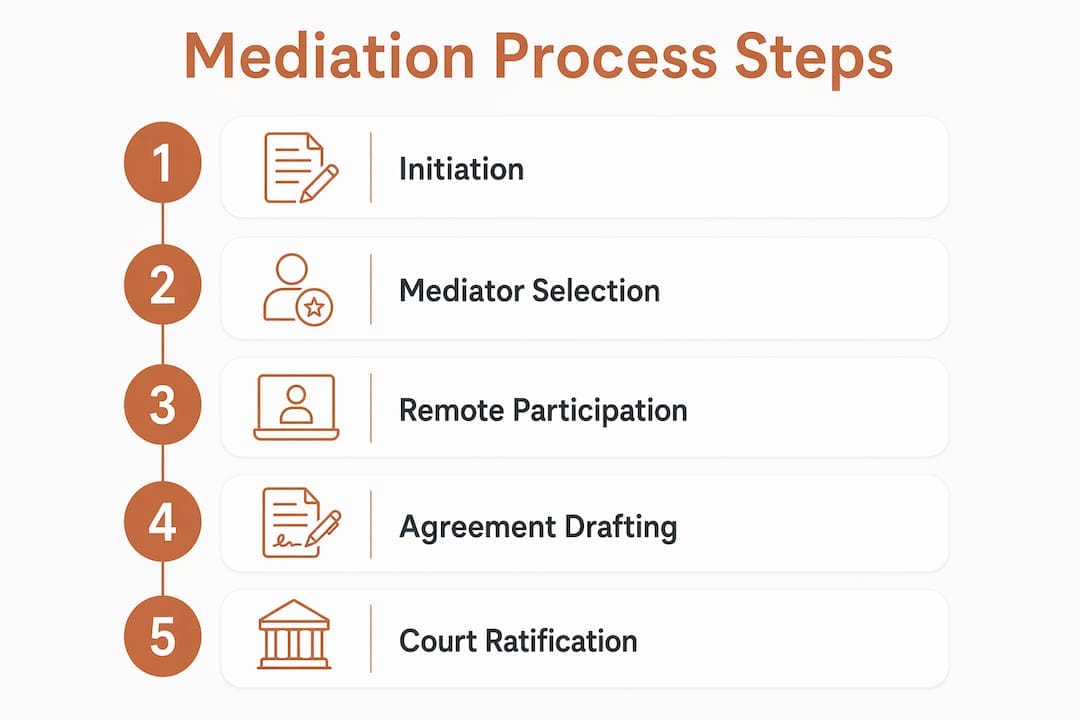
Foreign residents do not need to be in Israel to engage fully in the mediation process. Here is how it works in practice.
Initiation options:
- Joint referral: Both parties agree to mediate and jointly select a certified mediator.
- Unilateral initiation: One party proposes mediation; the other may accept or decline.
- Court referral: An Israeli court handling a related case may refer the matter to mediation before or during litigation.
Step-by-step guide for remote participation:
- Select a certified mediator. Choose a mediator registered under the Civil Mediation Law. Your legal counsel can recommend qualified professionals with experience in international disputes.
- Sign the mediation agreement. Before sessions begin, all parties sign a document confirming confidentiality obligations and procedural rules.
- Schedule sessions via video conference. Platforms such as Zoom or Microsoft Teams are widely used. Sessions are scheduled to accommodate international time zones.
- Exchange documents electronically. Evidence, financial records, and legal filings are submitted digitally, with your attorney managing the submission process.
- Participate in substantive sessions. Each party presents their position. The mediator facilitates dialogue, often meeting with parties separately (caucus sessions) to explore settlement options.
- Sign the settlement agreement. Once terms are agreed, the written agreement is signed by all parties.
- Submit for court ratification. Your attorney files the agreement with the relevant Israeli court, Family Court, or Rabbinical Court, converting it into an enforceable judgment.
Menora Law manages every one of these steps remotely for international clients, from mediator selection through court ratification. For a broader look at how Israeli legal proceedings work without presence in Israel, the firm’s 2026 guide covers the full picture.
Pro Tip: Request that your settlement agreement explicitly reference applicable international treaties and enforcement conventions from the outset. An agreement drafted with cross-border enforceability in mind is far easier to act on than one that needs to be re-litigated in a foreign jurisdiction.

What kinds of disputes do foreign residents resolve through Israeli mediation?
Mediation under Israeli law is well-suited to a wide range of disputes that commonly involve foreign parties. The confidential and flexible nature of the process makes it preferable to litigation in most of these contexts.
- Inheritance and estate disputes: Co-heirs living in different countries frequently use mediation to divide Israeli estates without prolonged probate litigation. Mediation allows families to reach agreements on asset distribution privately and efficiently.
- Business partnership conflicts: Disputes over profit-sharing, contract terms, or partnership dissolution between Israeli and foreign business partners are resolved without exposing sensitive commercial information in open court.
- Property disputes: Disagreements over Israeli real estate, including co-ownership conflicts or landlord-tenant matters involving foreign owners, are well-suited to mediation’s structured dialogue.
- Family law matters: Divorce, child custody arrangements, and spousal support issues involving one or more foreign parties benefit from mediation’s focus on mutual agreement rather than adversarial proceedings.
- Contractual disagreements: Cross-border commercial contracts that break down often involve jurisdictional complexity that mediation can address more efficiently than litigation.
Menora Law handles all of these dispute categories, with particular depth in inheritance, Israeli business law, and real estate matters involving foreign clients.
Common challenges in Israeli mediation for foreigners, and how to handle them
Foreign residents face a specific set of obstacles in Israeli mediation. Most are manageable with the right preparation and legal support.
- Language barriers: Hebrew is the primary language of Israeli legal proceedings. Solution: request a qualified interpreter for all sessions and have all documents translated before signing. Interpretation services are integral to effective mediation outcomes for international parties.
- Cultural differences: Communication styles, negotiation norms, and expectations around formality differ significantly across cultures. Solution: work with a mediator experienced in international disputes who can bridge these gaps without letting misunderstanding derail progress.
- Jurisdictional complexity: Foreign residents often worry about whether an Israeli agreement will hold up at home. Solution: draft the settlement with explicit reference to international enforcement frameworks, and have local counsel in your home country review enforceability before signing.
- Time zone and scheduling conflicts: Coordinating sessions across multiple time zones adds friction. Solution: establish a clear scheduling protocol at the outset, with agreed-upon windows that work for all parties.
- Trust-building remotely: Building rapport with a mediator and the opposing party via video is harder than in person. Solution: use the opening session deliberately, take time to establish ground rules, and keep communication consistent between sessions.
Pro Tip: Brief your legal representative thoroughly before every session. The more context Menora Law has about your priorities and concerns, the more effectively they can guide the process and anticipate the other side’s positions.
Menora Law’s perspective on Israeli mediation for foreign clients
Most foreign residents approach Israeli mediation with two misconceptions. The first is that distance makes the process unworkable. The second is that mediation is a soft option, less binding than a court judgment. Both are wrong, and conflating them leads people to either avoid mediation entirely or enter it without the preparation it deserves.
The enforceability of a ratified mediation agreement in Israel is not a technicality. It carries the same legal weight as a court judgment, and when drafted correctly, it can be acted upon across borders. The distance problem is equally overstated. Menora Law has guided foreign clients through complete mediation processes, from initiating kapcsolatba lépni with a certified mediator to filing the ratified agreement with an Israeli court, without those clients ever boarding a plane.
What actually determines outcomes in Israeli mediation is preparation and representation quality. A foreign resident who arrives at the opening session without a clear legal strategy, without translated documents, and without counsel who understands both Israeli procedure and international enforcement is at a real disadvantage. That gap is where Menora Law’s international focus makes a concrete difference.
Key Takeaways
The Israeli mediation process for foreign residents is a legally binding, confidential, and fully remote-capable framework that resolves disputes faster and at lower cost than Israeli court litigation.
| Point | Details |
|---|---|
| Governed by Israeli law | The Civil Mediation Law, 5752–1992, sets the rules for all certified mediation in Israel. |
| Fully enforceable | Agreements ratified by Israeli courts carry the same weight as court judgments, including cross-border effect when properly drafted. |
| Remote participation is standard | Foreign residents participate via video conferencing; physical presence in Israel is not required. |
| Common dispute types | Inheritance, business partnerships, property conflicts, and family law matters are the most frequent cases. |
| Menora Law’s role | Menora Law manages the full mediation process remotely for international clients, from mediator selection to court ratification. |
Menora Law handles Israeli mediation for international clients
Foreign residents dealing with an Israeli inheritance, a property dispute, or a business conflict need more than general legal advice. They need an attorney who knows Israeli procedure inside out and can manage the entire process from abroad.
Menora Law specializes in exactly this. The firm represents international clients across the full range of Israeli mediation matters, including inheritance disputes, real estate conflicts, and cross-border business disagreements. Every step, from selecting a certified mediator to filing the ratified agreement with an Israeli court, is handled remotely with clear, consistent communication.
If you have an Israeli legal matter that needs resolving, kapcsolatba lépni Menora Law for a consultation. The firm works with clients across time zones and provides strategic guidance tailored to your specific situation.
GYIK
What law governs mediation in Israel?
Israeli mediation is governed by the Civil Mediation Law, 5752–1992, which establishes the voluntary, confidential, and collaborative framework for all certified mediation proceedings.
Can a foreign resident participate in Israeli mediation without traveling to Israel?
Yes. Foreign residents can participate fully via video conferencing, with legal counsel managing document submission and communication on their behalf.
Is a mediation agreement reached in Israel legally binding?
Once ratified by an Israeli court, a mediation agreement carries the same enforceability as a court judgment and can have cross-border legal effect when drafted with international treaties in mind.
How long does the Israeli mediation process typically take?
The process typically concludes within weeks to months, depending on the complexity of the dispute and the parties’ willingness to engage constructively.
How does Menora Law help foreign residents in Israeli mediation?
Menora Law manages the entire mediation process remotely for international clients, including mediator selection, session coordination, document preparation, and court ratification of the final agreement.


 English
 Afrikaans
 العربية
 বাংলা
বাংলা Čeština
 简体中文
简体中文 Nederlands
 Suomi
Suomi Français
 Deutsch
 עִבְרִית
 हिन्दी
 Magyar
 Italiano
 日本語
日本語 한국어
한국어 Polski
 فارسی
فارسی Português do Brasil
 Русский
 Español de México
 Українська