
If your company is based abroad and does business with Israel, Israeli VAT (called Ma’am in Hebrew) can apply to you in three main ways. You may have to register and charge it. You may be able to charge 0% on services you provide to customers abroad. Or you may be hit with it when you sell to an Israeli buyer. Which one applies depends on what you sell, who buys it, and whether you have real activity in Israel.
This guide walks through each situation in everyday language. At Menora Law we work with international clients who need to deal with Israeli rules from overseas, and the same questions come up again and again. We cover the current rate, registration, the local representative, zero-rated services, reverse charge, and how VAT differs from income tax. Use it to get oriented, then confirm your own facts before you act.
TL;DR
- The standard Israeli VAT rate is 18%, raised from 17% on January 1, 2025.
- A foreign company that carries out taxable activity in Israel, for example through a permanent establishment, registers through a local VAT representative before it starts. Foreign digital-service suppliers selling to Israeli consumers have their own registration rules.
- Services supplied from Israel to customers abroad can sometimes be zero-rated, but there are three exceptions that take the zero rate away.
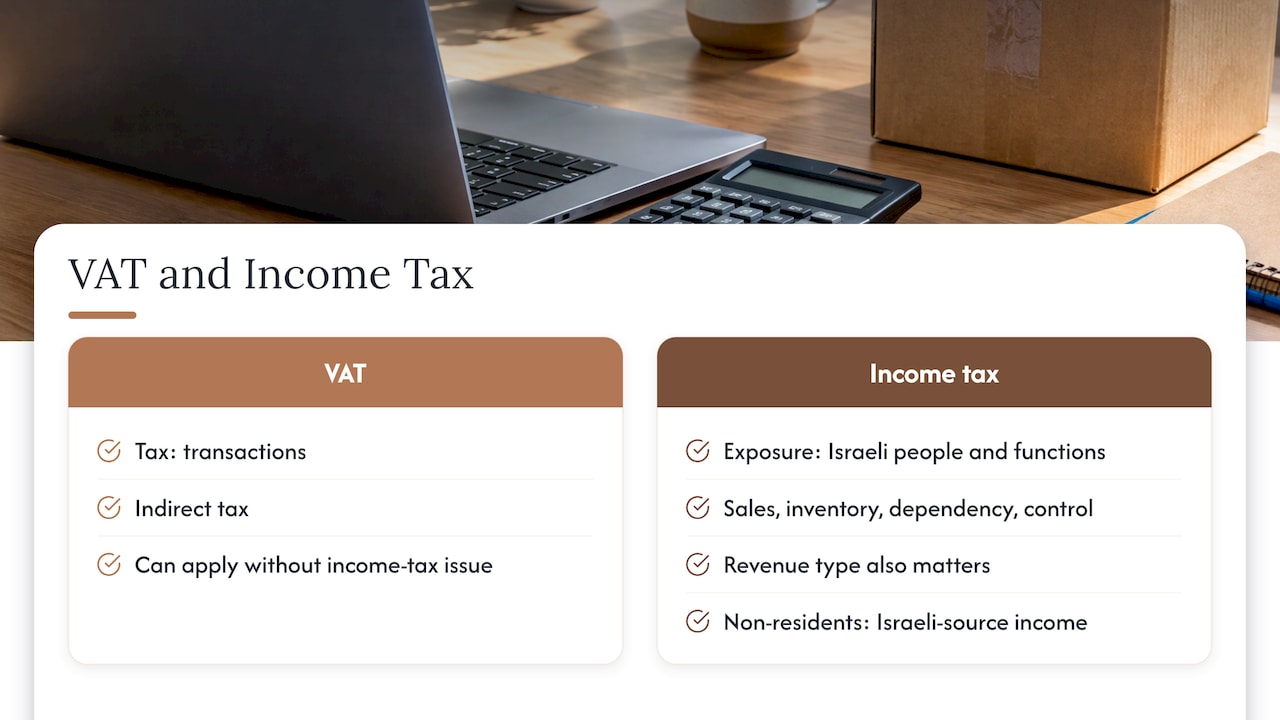
- VAT is a tax on transactions. Income tax is a separate question about where your profits are earned, and the answers can differ.
- If the classification of your deal is unclear, get advice or a VAT pre-ruling before you scale, not after.
The basics: what Israeli VAT is and what it costs
Israel charges VAT on most goods and services supplied in the country, and on certain imports. The business that makes the sale collects the tax from the customer and passes it on to the Israeli Tax Authority. In return, a registered business can generally deduct the VAT it paid on its own business expenses.
The standard rate is 18%. It was raised from 17% on January 1, 2025, so any contract, price list or invoice template you built before then should be checked. Older documents that still say 17% are a common and avoidable error.
A few terms you will see in Israel:
- Osek murshe (authorized dealer): a business registered for VAT that charges it and files returns.
- Osek patur (exempt dealer): a small business under the turnover threshold that does not charge VAT. For resident businesses, the threshold was NIS 120,000 in annual turnover for 2024 and 2025.
- Zero-rated: a sale that carries 0% VAT but is still reported, and still lets you reclaim input VAT.
- Exempt: a sale with no VAT that does not need to be reported the same way, but you can’t reclaim VAT on your expenses.
The last two get confused all the time. Auren Israel’s tax team explains that zero-rated and exempt are fundamentally different: a zero-rated transaction must still be reported and allows input VAT deduction, while an exempt one does not allow you to reclaim VAT on expenses. If you pick the wrong label, your cash flow and your filings both go wrong.
When does a foreign company have to register?
There is no single rule that fits every foreign company. Registration depends on what you are actually doing in Israel. Here are the situations we see most often.
You have a permanent establishment or real activity in Israel
If a foreign company has a permanent establishment in Israel, registration through a fiscal representative is required before taxable activity begins. That covers things like a local office, a team working here, or an ongoing business presence that makes taxable sales in Israel.
The small-business exemption will not rescue you here. Corporate entities and partnerships are not eligible for osek patur status, so a company that makes taxable sales in Israel registers as an osek murshe regardless of turnover.
You sell digital services to Israeli consumers
Israel has a special regime for foreign suppliers of electronic services to private consumers. Under what is known as the Specified Non-Resident Suppliers regime, such suppliers must register and collect VAT at 18% once annual sales pass defined thresholds, with returns filed through a dedicated portal. Other summaries describe it as applying from the first taxable sale, with no threshold at all. Because those two descriptions differ, do not guess: have your position checked against the current Israeli Tax Authority guidance before you launch to Israeli consumers.
This regime is about B2C sales (to individuals). A sale to an Israeli business is a different analysis, which we cover in the reverse-charge section below.
You only sell to customers abroad
If your company has no activity in Israel and sells to customers outside Israel, Israeli VAT generally isn’t part of the picture. The trouble starts when the line between “abroad” and “in Israel” blurs: a customer who is partly Israeli, a service connected to Israeli property, or a team that does more in Israel than the contract admits.
Auren Israel points out that for digital services, the outcome often turns on B2B versus B2C, the legal classification of the deal, and whether there is business activity in Israel. The same guide flags a typical mistake: commercial teams assume that no Israeli VAT invoice means no VAT issue. That assumption is often untested.
How registration works in practice
Registration for a foreign entity is more paperwork-heavy than most people expect. According to one compliance guide, a foreign entity submits a completed registration application, appoints a local VAT representative who lives in Israel, and provides corporate documents and a declaration of expected taxable activity. Another describes the process for foreign digital-service providers as manual filing through a local tax representative, with the representative’s ID card and the completed VAT form among the documents.
In plain terms, you should expect to prepare:
- Proof the company exists: a certificate of incorporation and articles of association, usually with the translations or authentication that Israeli authorities ask for.
- A local representative: an individual or firm in Israel who acts for you before the Tax Authority.
- A description of your expected activity in Israel: what you will sell, to whom, and roughly how much.
- The registration forms themselves, filled out in Hebrew.
Form numbers and exact document lists change, so treat the numbers in any blog, including ours, as a starting point and confirm with the Tax Authority or your Israeli counsel before filing.
Why the local representative matters
The representative is not a formality. Your Israeli VAT file is run through that person, so tax notices and correspondence land with them first. Pick someone you can reach quickly, who reads Hebrew tax letters the day they arrive, and who understands your business model well enough to explain it to an assessing officer. For overseas clients, fast communication is the whole game: a missed letter can become a penalty before you even hear about it.
Returns, deadlines and penalties
Once registered, you file periodic VAT returns, monthly or every two months depending on the business. The deadline is the 15th of the relevant month, and electronic filing is mandatory. Even a period with no sales needs a report. Late filing and late registration both cost money. One guide states that the penalty for late registration is 1% of the taxable turnover. Treat that figure as indicative and check it against current law with your adviser.
A practical tip: put the 15th in the calendar of both your finance team and your Israeli representative, and agree in writing who is responsible for sending the invoices and bank data needed for each return.
Services to customers abroad: when 0% VAT applies
This is the question that matters most to Israeli-based service companies with international clients, and to foreign companies that run a branch or subsidiary here. In general, a service supplied by an Israeli business to a customer who is a foreign resident can be zero-rated. But it isn’t automatic.
Grant Thornton Israel’s VAT specialist lays out three exceptions that remove the zero rate:
| Exception | What it means in plain English |
|---|---|
| The service is also provided to an Israeli resident in Israel (Section 30(a)(5)) | If the same service benefits someone in Israel, the zero rate falls away |
| The service relates to an asset located in Israel (Regulation 12A(a)) | For example, work tied to Israeli property or goods, unless the provider proves the consideration is part of the value of goods under the Customs Ordinance |
| The service serves another foreign resident during that person’s stay in Israel (Regulation 12A©) | Think of a visitor receiving a service while physically in Israel |
Some quick examples of how the exceptions play out:
- A consulting firm in Tel Aviv advises an overseas company on its global strategy. The customer is abroad and nothing relates to Israeli property. Zero-rating is the likely starting point.
- The same firm advises that overseas company on an apartment it owns in Israel. The service relates to an asset in Israel, so the zero rate is in doubt.
- A foreign client flies in and receives a service while staying here. The third exception is directly in play.
If you use zero-rating, remember the reporting duty. A zero-rated sale must still be reported to the Tax Authority. Keep the contract, proof of the customer’s foreign residence, and proof of payment in a file that you could hand to an assessor.
When an Israeli business buys from a foreign company
Now the other direction. An Israeli company pays a foreign supplier for a service or digital product. Who accounts for the VAT?
The rules on imported services and intangible products have been a point of friction. In 2022, Leon Harris reported in The Jerusalem Post that the Tax Authority had apparently interpreted Section 26(b) of the VAT Law to include email and downloads as “mail” for imported digital products, and that banks were withholding VAT from payments for those products. He also noted that a foreign supplier not registered for Israeli VAT may end up forfeiting that VAT altogether.
What does that mean for you as a foreign supplier?
- If you aren’t registered, an Israeli customer or its bank may deduct VAT from what they pay you. You can’t claim it back through the usual channel.
- If you are registered, you charge VAT on the invoice and file returns, and your own input VAT is deductible.
- If you are a non-resident who was charged VAT in Israel, you can only claim the input VAT as a refund if you are registered as a dealer for VAT purposes in Israel.
So the cost of staying unregistered can be higher than the cost of registering. This is exactly the type of trade-off to price out before you sign a large contract with an Israeli customer.
VAT versus income tax: two different questions
Foreign companies often treat these as one issue. They aren’t.
VAT is an indirect tax on transactions. Income tax exposure, as Auren Israel explains, is fact-driven and looks at people and functions in Israel, ongoing sales or business development, local inventory, dependency and control, and the nature of the revenue.
The corporate income tax rate is 23% for 2025 and 2026. A non-resident entity is taxed in Israel only on income accrued or derived in Israel, while an Israeli-resident entity is taxed on worldwide income, according to the same PwC summary.
You can have a VAT obligation without a corporate income tax problem, or the reverse. The two should still be planned together, because the facts that create one often hint at the other. If you stationed a salesperson in Israel to find customers, that same fact matters for both.
Common mistakes we see
- Assuming no invoice means no VAT. Tax can arise even if you never issued an Israeli VAT invoice.
- Mixing up zero-rated and exempt. The difference decides whether you can reclaim your expenses.
- Using the old 17% rate in templates and quotes after the move to 18%.
- Ignoring the exceptions to zero-rating, especially when a service touches Israeli property or an Israeli customer.
- Choosing a representative by price alone. Slow answers cost more than a higher fee.
- Registering late. A late registration penalty and back-filed returns are a headache nobody needs.
- Treating VAT and income tax as separate projects run by different people who never speak.
A practical checklist before you sell into Israel
Before you sign your first Israeli customer, work through these questions:
- Who is the customer: an Israeli business, an Israeli consumer, or a foreign resident?
- What exactly are you selling: goods, a service, or a digital product?
- Does any part of the service connect to an asset in Israel?
- Will anyone work for you in Israel, even part-time?
- Does your contract state whether prices include or exclude VAT, and at what rate?
- Who files returns, and who gets the Tax Authority’s letters?
- Is there real uncertainty about classification or place of supply? If so, Auren Israel suggests a VAT pre-ruling to get certainty before scaling.
Write the answers down. That one-page record is useful for your own board, and it’s the first thing your Israeli adviser will ask for.
Our perspective
Most foreign companies come to us after something has already happened: a bank withheld VAT from a payment, a letter arrived in Hebrew that nobody could read, or an Israeli customer asked for a VAT invoice and the finance team had no idea what to say.
Our view is simple. VAT for a foreign company in Israel is rarely hard once the facts are laid out clearly, and it is expensive when nobody lays them out. The right time to look at it is before the contract is signed, when the structure can still change.
At Menora Law we work with international clients who are dealing with Israeli law from abroad. We handle the legal side of entering the Israeli market: setting up a company, corporate structuring, real estate contracts, and representing international companies here. Because we work with clients remotely, you don’t need to fly in to get organized. We aim to answer fast, explain things in plain English, and give you a strategy rather than a list of risks.
VAT also touches deals that are really about something else, like a real estate purchase, a merger, or a startup investment. Having one Israeli legal team that sees the whole picture is how we think these matters are best handled.
Legge Menora
Getting help from Israeli counsel
If you are setting up in Israel, buying property, or selling to Israeli customers, we can help you build the legal structure around your VAT position. Our work for international clients includes starting a company in Israel, corporate structuring, representing international companies, real estate transactions and more, all handled remotely or on-site abroad when that’s easier for you.
Tell us what you plan to sell and to whom, and we will tell you what to look at first. Reach out through Legge Menora today and we will get back to you quickly.
FAQ
What is the VAT rate for foreign companies in Israel?
The standard rate is 18%, which applied from January 1, 2025, up from 17%, according to Shemesh CPA’s corporate tax guide. The same rate applies whether the seller is Israeli or foreign when the sale is taxable in Israel. Some transactions, such as qualifying services to foreign residents, can be zero-rated.
Does a foreign company need a local representative to register for VAT?
In most cases where a foreign entity registers for Israeli VAT, yes. Guides describe the appointment of a local VAT representative residing in Israel as part of the application. Confirm the requirement that applies to your type of activity before you file.
Can a company in Israel charge 0% VAT on services to customers abroad?
Often yes, but not always. The zero rate is removed if the service is also given to an Israeli resident in Israel, relates to an asset in Israel, or serves a foreign resident during a stay in Israel. These three exceptions come from Israeli VAT law and regulations. Zero-rated sales must still be reported.
Is Israeli VAT the same as corporate income tax?
No. VAT is a tax on transactions, while corporate income tax applies to profits. The corporate rate is 23% for 2025 and 2026, and a non-resident entity is taxed only on income accrued or derived in Israel. You can owe one without the other.
What if I’m not sure how my deal is classified?
Get it checked before you scale. Where classification or place of supply is uncertain, Auren Israel notes that a VAT pre-ruling can provide certainty in advance. An Avvocato israeliano can help you frame the facts and decide whether a ruling is worth requesting.
Sources
- Doing Business in Israel: Corporate Tax Guide 2026
- Doing Business in Israel 2024 (BDO)
- VAT in Israel for Foreign Companies: Top 7 Key Questions (Auren Israel)
- Selling Online into Israel? VAT, Import VAT, and Marketplace Tax Risks (Auren Israel)
- Permanent Establishment in Israel: Tax Rules and Compliance
- Israel Ma’am (VAT) for Foreign and Local Businesses, 2026
- Israel VAT registration threshold
- Israeli VAT registration guide
- Israel VAT guide (Lovat Compliance)
- SaaS Sales Tax in Israel
- Providing services to a foreign resident and zero VAT (Grant Thornton Israel)
- Israel has a new stealth tax on digital products (The Jerusalem Post)
- Israel: Taxes on corporate income (PwC Worldwide Tax Summaries)


 English
 Afrikaans
 العربية
 বাংলা
 Čeština
 简体中文
 Nederlands
 Suomi
 Français
 Deutsch
 עִבְרִית
 हिन्दी
 Magyar
 Italiano
 日本語
 한국어
 Polski
 فارسی
 Português do Brasil
 Русский
 Español de México
 Українська