
Governing law and jurisdiction are two separate decisions in a contract. Governing law decides which country’s rules interpret the agreement and settle the parties’ rights. Jurisdiction decides which court, or which arbitration forum, hears the dispute. They can point to the same country, and in a well-drafted contract usually do. But nothing forces them to match, and when they don’t, the dispute gets slower and more expensive. If your deal touches Israel, Menora Law drafts and reviews these clauses for overseas clients, remotely or on-site abroad, so the two decisions are made on purpose and not by default.
TL;DR
- Governing law answers “whose rules decide what this contract means and who owes what?” Jurisdiction answers “who gets to hear the case, and where?”
- Choosing a law does not choose a court. Choosing a court does not choose a law. Each needs its own clause.
- A court can apply one country’s law while sitting in another. That works, but it adds cost and risk, because foreign law has to be proven.
- A judgment is only as useful as your ability to enforce it where the other side’s assets are. In Israel, a foreign judgment has to go through a formal acceptance process first.
- For deals involving Israel, align both clauses, write “exclusive” and “shall” where you mean it, and decide early between court and arbitration.
The short version: two clauses, two questions
People mix these up because both clauses sit next to each other at the back of a contract, often under one heading like “Miscellaneous” or “Governing Law and Disputes.” Read them as two separate questions.
| Governing law (choice of law) | Jurisdiction (choice of forum) | |
|---|---|---|
| Question it answers | Which country’s substantive law applies? | Which court or tribunal decides the dispute? |
| What it controls | Interpretation of the contract, the parties’ rights and obligations, remedies | Where a case is filed, who has authority to hear it, often procedure |
| Typical wording | “This agreement shall be governed by the laws of the State of Israel.” | “The courts of Tel Aviv shall have exclusive jurisdiction.” |
| What happens if it’s missing | A court has to work out the applicable law using conflict-of-laws rules | The parties may fight over where to sue before they ever reach the merits |
The distinction is well established in international practice. One international law firm guide explains that a governing-law clause supplies the substantive law used to interpret the agreement and the parties’ rights and obligations, while a jurisdiction clause determines how disputes are resolved and may also govern procedure. The World Bank’s dispute-resolution checklist for public-private partnerships makes the same point in plain terms: do not conflate the two clauses, because the law of the agreement may differ from the country where disputes are heard.
What governing law actually does
The governing law is the rulebook. When two parties disagree about what a clause means, whether a payment was late, whether a termination was valid or what damages are available, the judge or arbitrator reaches for the governing law to answer.
A few practical consequences:
- It shapes the meaning of your words. The same sentence can be read differently under different legal systems. Concepts such as good faith, penalty clauses, limits on liability and implied terms are treated differently from country to country.
- It sets the remedies. What you can claim if the other side breaches depends on the rulebook, not only on what the contract says.
- It supports certainty. One practice guide on governing-law clauses notes that courts in countries with developed legal systems will usually uphold the parties’ choice of governing law, which is why the clause gives deals predictability.
What it does not do is name a decision maker. A governing-law clause on its own does not give any particular court the power to hear your case. A cross-border contract guide puts the point bluntly: selecting a law does not necessarily select a court, create jurisdiction, fix an arbitration seat or guarantee that a judgment will be recognized where assets sit.
When Israeli law is the right governing law
If your contract is performed in Israel, concerns an Israeli company, or involves Israeli real estate, intellectual property or employees, Israeli law is often the natural choice. The reason is simple: the people applying it, the registries it touches and the authorities that enforce the outcome are all in one place. If you are buying property, for instance, the contract will have to work with Israeli land registration practice no matter what the clause says, so an agreement governed by Israeli law and drafted for Israeli procedures causes fewer surprises. Our guide to making an English contract enforceable in Israel walks through what has to be in place when the paper is in English but the performance is local.
What jurisdiction does
Jurisdiction is the address. It tells everyone where a dispute goes. It can be:
- A court clause, naming the courts of a country, a district or a city.
- An arbitration clause, sending disputes to a private tribunal under agreed rules, in an agreed seat.
- A tiered clause, which requires negotiation or mediation first and then litigation or arbitration.
The word “jurisdiction” carries two meanings that are worth separating. In everyday contract language it means the forum the parties pick. In a courtroom it also means the court’s legal power to hear a case at all. A clause can pick a forum, but it cannot give a court powers the court’s own legal system doesn’t allow it to exercise. That’s why the second half of this article is about enforcement and not just wording.
Exclusive or non-exclusive
Un exclusive jurisdiction clause means disputes go to the named court and nowhere else. A non-exclusive clause means the named court is available, but either side may also sue somewhere else that has a legal basis to hear the case. Non-exclusive clauses sound flexible, but in practice they invite a race to the courthouse. If you want certainty, say “exclusive” and use the word “shall.” The World Bank checklist above also tells drafters to state whether the court choice is exclusive or non-exclusive, and whether disputes go to courts or to arbitration.
Venue and forum, the neighbors of jurisdiction
You will also see “venue” or “forum.” For most international contracts you can treat these as part of the same question: where, physically and institutionally, does the case get heard? What matters is that the contract names a place and a type of decision maker, and says whether that choice is exclusive.
Why the two can point in different directions
Because the clauses answer different questions, you can mix and match. A contract can be governed by the law of one country and send disputes to the courts of another. Lawyers do this on purpose in some financial transactions, because parties like the predictability of a particular legal system and the efficiency of a particular court system. A guide to international contract clauses describes this combination as common in international finance, with the court hearing the case treating the chosen law as foreign law supported by expert evidence.
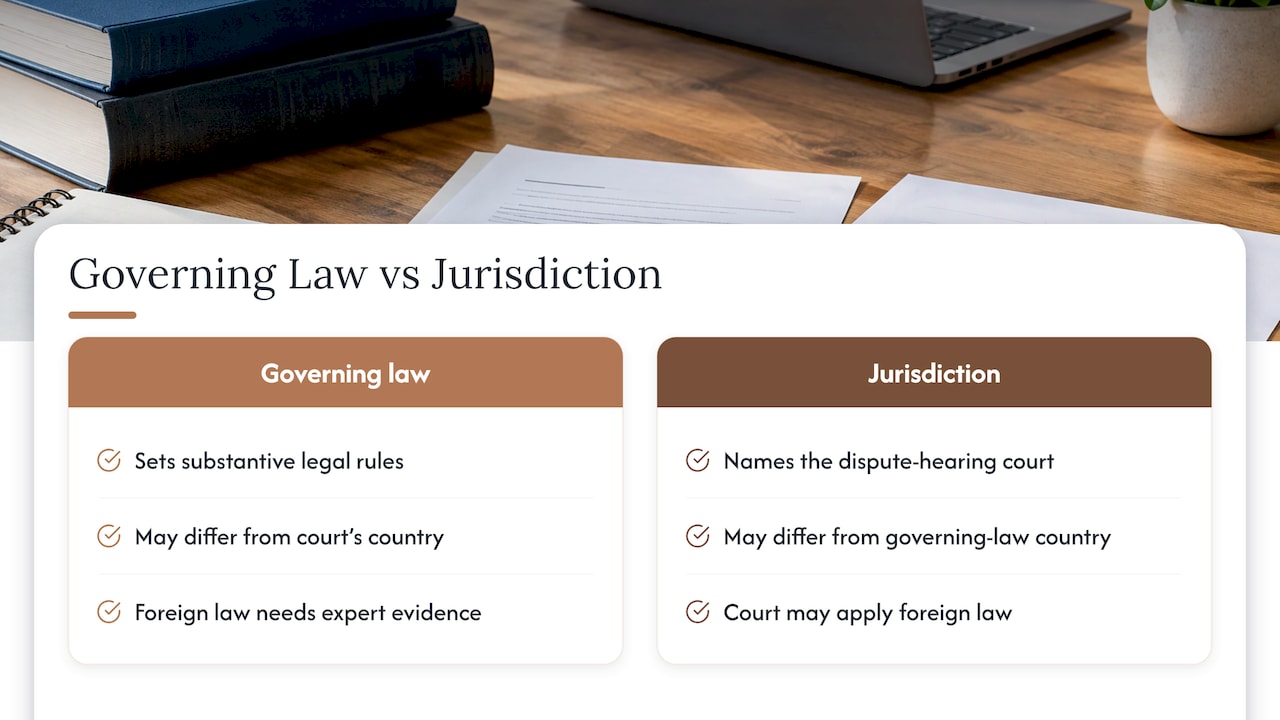
That last part is the cost. When a court applies a law that is not its own, someone has to explain that law to the judge. That usually means expert witnesses, translation of legislation and case law, and extra hearing time. Mismatched clauses are also a risk for accuracy: the same practice guide that praises governing-law certainty also says consistent governing-law and jurisdiction clauses help avoid cost and the risk of foreign law being applied incorrectly.
The accidental mismatch
The worse scenario is not a deliberate mismatch. It is the contract that picked a governing law and said nothing about where to sue. Now each side can argue for the courthouse that suits it, and the first fight is about the forum, not the facts. Or the reverse: a forum is named and the law is left silent, and the court has to decide which country’s rules apply using its own conflict rules.
A firm’s drafting note on joint ventures warns that failing to coordinate both clauses, or drafting them unclearly, can cause lengthy and costly disputes over which courts or tribunals decide and which substantive law applies.
What happens when the law is one country’s and the courts are another’s
Suppose your agreement is governed by Israeli law, but the jurisdiction clause names the courts of another country. Three things follow.
- The named court decides whether it will hear the case. It looks at its own rules on jurisdiction clauses. Many courts in commercial systems respect an exclusive forum clause that was freely agreed, but each system keeps the power to refuse in exceptional cases.
- If it hears the case, it applies Israeli law as foreign law. That means proof of what Israeli law says, usually by expert evidence, not by simply citing a statute.
- The judgment then has to be enforced. If the other side’s assets are in Israel, the winner has to ask an Israeli court to give the foreign judgment effect.
The interplay between a foreign law clause and a forum clause can also decide how far the forum clause reaches. Academic commentary on this question, such as a transnational litigation analysis of foreign forum selection clauses, argues that courts should look to the law named in the choice-of-law clause to understand the scope of the forum clause. In other words, the governing law can reach back and shape the jurisdiction clause. That is one more reason the two should be drafted together by someone who knows both systems.
The reverse arrangement is just as workable on paper: an Israeli court hearing a dispute governed by another country’s law. Israeli judges are then asked to apply foreign rules, and the parties carry the burden of proving them. Ask yourself whether that is really what you want, or whether it simply happened because the template came from somewhere else.
Court or arbitration: the jurisdiction choice inside the jurisdiction choice
A jurisdiction clause is also where you decide between court and arbitration. Arbitration sends disputes to a private tribunal. The Cambridge Law Journal describes this as a private system of adjudication, and notes that questions about the scope of the clause can depend on the law governing the jurisdiction term or the arbitration agreement. That is another place where governing law and jurisdiction interact.
Some things to settle when you choose arbitration:
- The seat. The place of arbitration affects which courts supervise the process.
- The rules and the institution that administer it.
- The number and selection of arbitrators.
- The language of the proceedings.
- Who decides whether a dispute is arbitrable at all. Broadly drafted clauses can hand that threshold question to the arbitrators themselves, as this discussion of an arbitration clause and court access illustrates.
If you are weighing arbitration for an Israeli deal, we explain how these clauses are typically built in our practical guide to arbitration clauses in Israeli contracts and why parties often choose that route in why Israeli arbitration is preferred for dispute resolution. Arbitration awards are generally easier to take across borders than court judgments, but you should confirm that for the specific countries involved before you rely on it.
Enforcement: where governing law and jurisdiction really get tested
Winning is one thing. Collecting is another. Enforcement is where a careless pair of clauses shows its cost.
Israel is a clear example. According to a summary from the Cardozo Israeli Supreme Court Project, a foreign judgment has to go through an acceptance process in Israel before it carries status for enforcement, recognition or res judicata. If it is not accepted, it is treated as though it never existed in Israel. So if your counterparty keeps its bank accounts, property or business in Israel, a judgment from a foreign court is not the end of the road. It is the start of a second proceeding in Israel.
The flip side is that an Israeli judgment has to be recognized elsewhere to reach assets abroad. We cover the practical side in enforcing an Israeli court judgment abroad.
That is why we ask one question at the start of every cross-border contract: where will the money be if we win? If the answer is Israel, a jurisdiction clause naming Israeli courts, or an arbitration clause with an enforcement path that works in Israel, usually saves a step.
Can a court ignore your clause?
Yes, in limited situations. Courts in most legal systems keep a safety valve for clauses that are the product of fraud or overreaching, or that are plainly unfair or contrary to public policy. A court may also decline to apply the chosen law where it has no real connection to the deal or conflicts with a fundamental local policy. The practical lesson is to pick a governing law and forum with a genuine link to the transaction. A choice that exists only because it was in the template is the first one to be challenged.
A worked example
Imagine an overseas company signs a distribution agreement with an Israeli distributor. The contract says it is governed by Israeli law. It says nothing about where disputes go.
A year later the distributor stops paying. The overseas company wants to sue at home, where its lawyers are. The distributor argues the case belongs in Israel, where the contract is performed and its assets are. The first six months are spent on a forum fight. If the overseas court takes the case, it must learn Israeli law through experts. If it wins, it must bring the judgment to Israel and have it accepted before any bank account can be touched.
Now rewrite the contract. Governed by Israeli law. Disputes to the competent courts in Tel Aviv, exclusive. Or: disputes to arbitration seated in Israel under named rules, in English. The same dispute now starts on the merits in the first week. The law, the judge and the place of enforcement are all in the same country. The drafting took an hour. The difference is months.
Drafting checklist for contracts involving Israel
Use this list when you read your own agreement or a draft someone sends you.
- Two clauses, two headings. Keep “Governing Law” and “Jurisdiction” separate so neither can be read to cover the other.
- Name the law precisely. “The laws of the State of Israel,” and say whether conflict-of-laws rules are excluded so the choice cannot be sent elsewhere.
- Name the forum precisely. A country is not enough. Name the courts or the arbitral institution, the seat and the language.
- Say exclusive and say shall. Drafting guidance for forum clauses recommends mandatory wording such as “shall” for a mandatory forum, because softer words like “may” or “will” can be read as optional, as a law firm drafting guide explains.
- Match the two where you can. Israeli law with Israeli courts or an Israeli seat is the lowest-friction pairing.
- Think about enforcement. Look at where the other side’s assets are and whether a judgment or award can be enforced there.
- Cover related documents. Side letters, purchase orders and annexes should not contradict the main clause.
- Check the language. If the signed version is in English but the proceedings will be in Hebrew, say which version controls and who pays for translation.
- Consider interim relief. A clause can allow urgent applications, such as freezing assets, in any court that can actually reach the assets.
- Review special rules. Consumer, employment and some real estate matters can carry their own rules on where and under which law a dispute is decided. Have them checked before you rely on a clause.
Mistakes we see in cross-border contracts
- Copying a template from another country. The clauses assume a legal system that isn’t the one the contract actually lives in.
- Naming a country but not a court. “Courts of Israel” does not say which one, and the question of which Israeli court can matter for cost and speed. Our overview of the Israeli civil litigation process shows why it’s worth deciding up front.
- Using one clause for everything. A single sentence that says “governed by and construed in accordance with the laws of Israel and subject to its courts” blurs two questions. Split it.
- Ignoring arbitration scope. An arbitration clause that covers only “disputes arising under this agreement” may not reach tort or statutory claims connected to the deal.
- Forgetting the exit. Many contracts say who decides disputes but not how a judgment will be enforced against assets in another country.
If you are a foreign party thinking about bringing or defending a claim in Israel, our guide to international commercial lawsuits in Israel explains what overseas parties should expect.
How we approach it at Menora Law
Menora Law works on Israeli law for international clients, so these clauses are everyday work for us. We prepare real estate contracts in Israel, represent international companies in Israel, help clients start companies and handle mergers. In each of those, we read the governing law and jurisdiction clauses as a pair and make sure they fit the deal and the place where any judgment or award would have to be enforced.
You don’t need to travel for this. We offer remote and on-site consultations abroad, so you can go through a draft with us from wherever you are.
Our view: pick the pair, not the clause
We see governing law and jurisdiction as one decision made in two parts. The question we put to every client is what happens on the day something goes wrong: which rulebook applies, who decides, and how does the result turn into money or performance in Israel.
For contracts that live in Israel, we recommend Israeli law and a forum that can actually reach the assets, whether that is a named Israeli court or arbitration with a clear seat. That keeps the law, the decision maker and the enforcement in one place, and it keeps the expert evidence and the second proceeding out of your budget.
We built Menora Law for overseas clients who need direct, strategic Israeli legal support without flying in. If a clause matters to your deal, it deserves a lawyer’s attention before you sign, not after the dispute starts.
Legge Menora
Get your clauses reviewed before you sign
If you have a contract that touches Israel, whether it is a real estate purchase, a company agreement, a license or a distribution deal, we can review the governing law and jurisdiction clauses and, where needed, draft them from scratch. Our work covers contracts, company formation, mergers and representation of international companies, and we communicate quickly and remotely. Start at Legge Menora and tell us what you are signing.
FAQ
What is the difference between governing law and jurisdiction?
Governing law is the set of legal rules that interprets the contract and decides the parties’ rights and remedies. Jurisdiction is the court or tribunal that hears a dispute. They are separate clauses answering separate questions, and a contract can name one country’s law and another country’s courts.
Does choosing a governing law choose the court?
No. A governing-law clause supplies the substantive rules, but it does not by itself select who decides the case or give a court the power to hear it. You need a separate jurisdiction or arbitration clause for that.
Should governing law and jurisdiction be the same country?
Usually it is better if they are. When one court applies another country’s law, it needs expert evidence to prove that law, which adds cost and the risk of error. For Israeli contracts, pairing Israeli law with Israeli courts or an Israeli arbitral seat is the simplest setup.
What is the relationship between jurisdiction and arbitration?
Arbitration is one way a jurisdiction clause can resolve disputes. Instead of naming a court, the clause sends disputes to a private tribunal with its own seat and rules. The law governing the arbitration agreement can also affect how far the clause reaches.
Can I enforce a foreign court judgment in Israel?
Not automatically. A foreign judgment has to go through an acceptance process in Israel before it has effect there. If you expect to collect in Israel, consider choosing Israeli courts or arbitration from the start, and speak to an Avvocato israeliano about your specific case.
Sources
- Joint ventures: choice of law and choosing the right dispute resolution forum
- World Bank PPP dispute resolution checklist
- Quickguide: Governing Law Clauses
- Cross-Border Contracts: Law, Forum, Enforcement
- Governing Law Clauses in International Contracts
- Interpreting Foreign Forum Selection Clauses
- Interpreting multiple dispute-resolution clauses in cross-border contracts, Cambridge Law Journal
- Arbitration clause and court access
- International Jurisdiction, Cardozo Israeli Supreme Court Project
- Drafting Choice of Law and Choice of Forum Provisions


 English
 Afrikaans
 العربية
 বাংলা
 Čeština
 简体中文
 Nederlands
 Suomi
 Français
 Deutsch
 עִבְרִית
 हिन्दी
 Magyar
 Italiano
 日本語
 한국어
 Polski
 فارسی
 Português do Brasil
 Русский
 Español de México
 Українська