
TL;DR:
- Israel’s legal system combines British traditions with specific statutes, creating a structured environment that rewards understanding and frustrates ignorance. Foreign heirs must follow Israeli probate procedures under the 1965 Succession Law, with delays often arising from missing documents or disputes. Business incorporation allows full foreign ownership but requires careful preparation, authentication, and local legal guidance to ensure compliance and efficiency.
Israel’s legal system catches a lot of people off guard. Whether you’re a foreign heir trying to claim an estate, an entrepreneur looking to register a company, or a buyer purchasing property in Tel Aviv, the legal israel process is more structured than most expect. The Israeli legal framework blends British common law traditions with specific statutes, creating a system that rewards those who understand it and frustrates those who don’t. This guide walks you through the four areas where Menora Law sees the most questions: inheritance, business incorporation, real estate, and compliance.
Key takeaways
| Point | Details |
|---|---|
| Inheritance follows the 1965 Succession Law | Foreign heirs must follow Israeli probate procedures to legally claim estate assets. |
| Foreign ownership of companies is fully permitted | Israel allows 100% foreign ownership of private companies, but document authentication is critical. |
| Real estate ownership is only final after Tabu registration | Property registration in the Land Registry takes 3 to 12 months after delivery. |
| Privacy compliance obligations expanded in 2025 | Amendment 13 to the Privacy Protection Law now requires many companies to appoint a Data Protection Officer. |
| Early legal counsel prevents costly delays | Engaging an 이스라엘 변호사 from the start reduces errors, missed deadlines, and procedural setbacks. |
Understanding inheritance law in Israel
When a person passes away in Israel, or leaves behind assets located in Israel, the Succession Law of 1965 governs how the estate is distributed. This applies whether the deceased was a resident of Israel or a foreign national who owned Israeli property. The law sets clear rules on who inherits, in what order, and through what process.
The first thing to understand is that Israeli inheritance does not happen automatically. Heirs must apply to the Registrar of Inheritance Affairs or the Family Court to receive either a probate order (if there is a will) or a succession order (if there is no will). Until that order is issued, no one can legally access or transfer the estate’s assets.
Here is what the process generally involves for foreign heirs:
- Locating and translating the will, if one exists, and having it authenticated for use in Israeli proceedings
- Filing an application with the appropriate Israeli authority, along with identification documents and proof of relationship to the deceased
- Publishing a notice in Israeli newspapers and the official gazette, giving other potential heirs the opportunity to contest the application
- Receiving the succession or probate order, which authorizes the appointed administrator to manage and distribute the estate
- Transferring assets, including bank accounts, real estate, and securities, to the rightful heirs
Cross-border inheritance adds layers of complexity. If the deceased held assets in multiple countries, each jurisdiction applies its own rules. In Israel, the Israeli probate process applies to all assets located within the country, regardless of where the deceased lived. This means a foreign heir may need to manage parallel legal proceedings in two countries at the same time.
Common delays include missing documentation, disputes between heirs, and creditor claims against the estate. Heirs who are not Israeli residents sometimes underestimate how long the process takes. A straightforward case can take several months. A contested estate can take years.
Pro Tip: Start gathering documentation as early as possible. Israeli authorities require certified translations of foreign documents, and obtaining apostilles from foreign governments can add weeks to your timeline if you wait until the last minute.
Business incorporation and legal requirements
Israel is a business-friendly country for foreign investors. The Israeli Companies Law permits full foreign ownership of private companies, and there is no requirement for directors to be Israeli citizens or residents. That said, the incorporation process has specific requirements that trip up many first-time founders.
Here is a step-by-step overview of what registering a company in Israel involves:
Choose a company structure. The most common choice for foreign investors is a private limited liability company (Ltd.). It offers liability protection, flexible ownership, and is well recognized by Israeli banks and regulators.
Prepare and authenticate your documents. You will need certified copies of passports, a notarized power of attorney if you are registering from abroad, and proof of address. Document authentication delays are the single most common reason incorporation timelines stretch beyond expectations.
Draft the Articles of Association. This document outlines the company’s governance structure, share capital, and operational rules. It must meet Israeli regulatory standards.
Establish a registered office address. Under the Israeli Companies Law 5759-1999, every company must maintain a physical registered office address in Israel. A P.O. Box does not qualify. The address is publicly listed and must be capable of receiving official correspondence.
File with the Registrar of Companies. Once all documents are in order, your lawyer files the incorporation application. The Registrar typically processes filings within a few weeks, assuming the paperwork is complete.
Register for tax purposes. After incorporation, the company must register with the Israeli Tax Authority for VAT and corporate income tax purposes. If the company employs staff, additional registrations with the National Insurance Institute are required.
Disclose beneficial ownership. Israel requires companies to report their ultimate beneficial owners to the Registrar. This is a compliance obligation that many foreign founders overlook until it causes problems.
One thing worth knowing: Israel determines a company’s tax residency based on where control and management actually take place, not just where the company is incorporated. If all decision-making happens outside Israel, the company may face questions about its tax status. Getting clear legal advice on this point before incorporation saves significant headaches later.
Pro Tip: Appoint a local Israeli representative before you start the incorporation process. Having someone who can receive official correspondence, attend to filings in person, and liaise with the Registrar on your behalf dramatically reduces delays when you are managing the process from abroad.
Real estate transactions and ownership registration
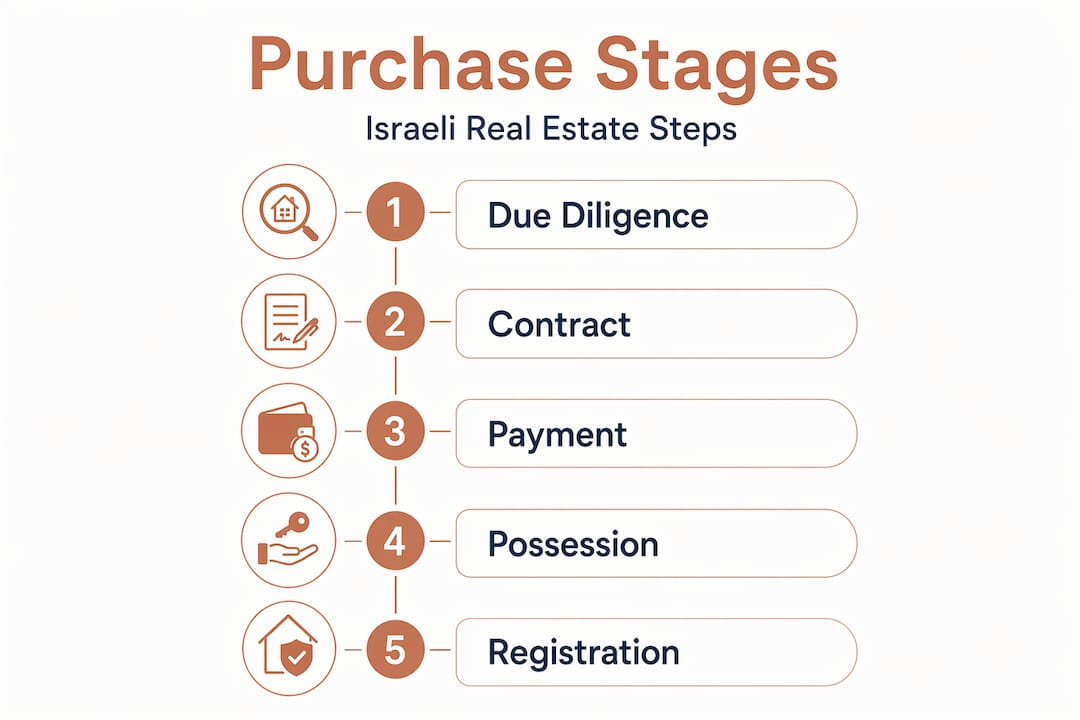
Buying property in Israel as a foreigner is entirely possible, and the legal protections built into the system are genuinely strong. However, the process has specific stages, and understanding each one protects your investment.

Key stages of an Israeli real estate purchase
| Stage | Description | Typical Timeline |
|---|---|---|
| Reservation and due diligence | Title search, permit verification, and review of sale contract | 2 to 4 weeks |
| Contract signing and payment schedule | Formal purchase agreement executed; payments tied to construction milestones | Ongoing through project |
| Property delivery and inspection | Buyer inspects property; defects are documented for contractor resolution | At delivery |
| Tabu registration | Ownership registered in the Land Registry | 3 to 12 months post-delivery |
The due diligence phase is where your lawyer earns their fee. A proper title search confirms that the seller has clear ownership, that there are no liens or encumbrances on the property, and that all building permits are in order. Skipping or rushing this step is one of the most expensive mistakes a buyer can make.
For off-plan purchases (buying before construction is complete), Israeli law provides meaningful protections:
- Bank guarantees or escrow arrangements cover all payments made before delivery. If the developer defaults or the project fails, buyers receive full refunds for amounts already paid.
- Defect liability periods require the contractor to fix construction defects reported within specified timeframes after delivery.
- Final inspections are a formal legal step. Document every defect in writing at the time of delivery.
The Tabu registration is the final and most important legal step. Until your ownership is registered in the Land Registry, you do not have full legal title to the property. Registration typically takes 3 to 12 months after delivery, depending on the complexity of the project and the developer’s cooperation. During this period, your rights are protected by contract and financial guarantees, but formal title remains incomplete.
If you are considering buying property in Israel as a foreigner, working with an Israeli real estate lawyer from the start is not optional. It is the difference between a smooth transaction and a prolonged dispute.
Compliance and evolving legal obligations
The compliance environment in Israel has become significantly more demanding over the past two years. Businesses operating in Israel, whether locally incorporated or serving Israeli customers from abroad, need to stay current with these changes.
The most significant recent development is Amendment 13 to the Privacy Protection Law, which took effect in 2025. This amendment requires many Israeli companies to appoint a qualified Data Protection Officer (DPO). The Israeli Privacy Protection Authority has been clear about what “qualified” means: the DPO must have genuine expertise in privacy law, must be adequately resourced, and must operate with independence from business operations. Appointing someone in name only, without real authority or knowledge, does not satisfy the requirement and can result in enforcement action.
Organizations that must appoint a DPO under the amended law include:
- Companies that process large volumes of personal data as a core business function
- Public bodies and government-adjacent organizations
- Entities that process sensitive categories of data, such as health, financial, or biometric information
- Businesses using automated profiling or AI-based data processing at scale
“The Israeli Privacy Protection Authority has signaled that enforcement under Amendment 13 will be active, not passive. Companies that treat DPO appointment as a checkbox exercise rather than a genuine governance commitment are taking a real risk.”
Beyond privacy law, businesses should be aware of Israel’s beneficial ownership disclosure requirements, anti-money laundering regulations, and sector-specific licensing rules. The legal framework in Israel is not static. It evolves, and the pace of change has accelerated.
For international companies with Israeli operations or customers, aligning with both Israeli requirements and international standards like GDPR is increasingly necessary. Menora Law helps clients map their obligations across jurisdictions and build compliance programs that actually hold up under scrutiny.
My honest take on Israeli legal matters
I’ve worked with clients across a wide range of Israeli legal situations, from heirs living overseas trying to claim estates they didn’t know existed, to entrepreneurs who assumed registering a company in Israel would take a week. What I’ve learned is that the Israeli legal system is not as intimidating as people fear, but it is far less forgiving of shortcuts than most people expect.
The biggest mistake I see repeatedly is waiting too long to get legal counsel involved. In inheritance cases, heirs sometimes spend months gathering documents on their own, only to discover they’ve been collecting the wrong ones. In real estate transactions, buyers sign reservation agreements without legal review, not realizing those agreements already contain binding terms. In business incorporation, founders submit incomplete documentation and then wonder why the Registrar of Companies hasn’t responded.
What I’ve found actually works is treating legal counsel as the starting point, not the safety net. When you engage an 이스라엘 변호사 before you take action, rather than after something goes wrong, the entire process moves faster and costs less. You get the right documents the first time. You understand the timeline before you’re surprised by it. You know your rights before someone else tries to limit them.
그만큼 Israeli legal system has real strengths: strong buyer protections in real estate, clear succession rules, and a business environment that genuinely welcomes foreign investment. The key is knowing how to work within the system rather than against it. That’s what Menora Law does every day for clients around the world.
— Menora Law
How Menora Law can help you
If you’ve read this far, you already understand that Israeli legal matters require more than a general understanding of the law. They require specific expertise, local presence, and the ability to communicate clearly across borders and time zones.
Menora Law works with foreign heirs, international investors, overseas entrepreneurs, and individuals who need trusted Israeli legal representation without being physically present in Israel. The firm handles inheritance and estate matters, real estate transactions, business incorporation, and regulatory compliance. Clients consistently highlight fast communication and personalized strategies as what sets Menora Law apart from other options.
Whether you need to work with an Israeli real estate lawyer on a property purchase, manage a cross-border estate, or get your company properly registered and compliant, Menora Law provides the local expertise and international reach to get it done right. 연락하다 Menora Law today to schedule a consultation and get clear answers to your specific situation.
자주하는 질문
1965년 이스라엘 승계법이란 무엇입니까?
The Israeli Succession Law of 1965 governs how estates are distributed in Israel, covering both residents and foreign nationals who own Israeli assets. It requires heirs to obtain a probate or succession order through Israeli legal proceedings before accessing or transferring estate assets.
Can a foreigner fully own a company in Israel?
Yes. The Israeli Companies Law permits 100% foreign ownership of private companies, and directors are not required to be Israeli citizens or residents. However, the company must maintain a physical registered address in Israel and comply with local tax and disclosure requirements.
How long does property registration in Israel take?
Final ownership registration in the Tabu (Land Registry) typically takes 3 to 12 months after property delivery, depending on the project’s complexity. Until registration is complete, ownership rights are protected by contract and financial guarantees rather than formal title.
Who needs to appoint a Data Protection Officer in Israel?
Under Amendment 13 to the Privacy Protection Law, which took effect in 2025, companies that process large volumes of personal data, handle sensitive data categories, or use AI-based data processing at scale are required to appoint a qualified DPO. Public bodies and government-adjacent organizations are also covered.
Do I need an Israeli lawyer to buy property in Israel from abroad?
Yes. Working with an Israeli real estate lawyer is strongly recommended and practically necessary for foreign buyers. A lawyer conducts title searches, reviews contracts, manages Tabu registration, and protects your interests throughout the transaction. Attempting to manage the process without local legal representation significantly increases your exposure to costly errors and delays.
Recommended
- Israeli Lawyer Tips: How To Easily Buy Land In Israel As A Foreigner According To Land Law In Israel? | Menora Law
- Real Estate In Israel – Tips To Successfully Invest In 2024
- Real Estate In Israel – Tips To Successfully Invest In 2024
- Buying Real Estate In Israel – 30 Tips To Navigate Better The Israeli Property Market


 English
 Afrikaans
 العربية
 বাংলা
বাংলা Čeština
 简体中文
简体中文 Nederlands
 Suomi
Suomi Français
 Deutsch
 עִבְרִית
 हिन्दी
 Magyar
 Italiano
 日本語
日本語 한국어
한국어 Polski
 فارسی
فارسی Português do Brasil
 Русский
 Español de México
 Українська