
TL;DR:
- The Israeli Hebrew legal system combines secular statutes with religious legal traditions, affecting inheritance, property, and civil disputes. Its hybrid structure involves civil courts and religious courts, with Hebrew law serving as a gap-filling interpretive source since 1980. The 2026 law expansion allows rabbinical courts to arbitrate certain civil disputes with explicit party consent, raising new legal considerations for foreign clients.
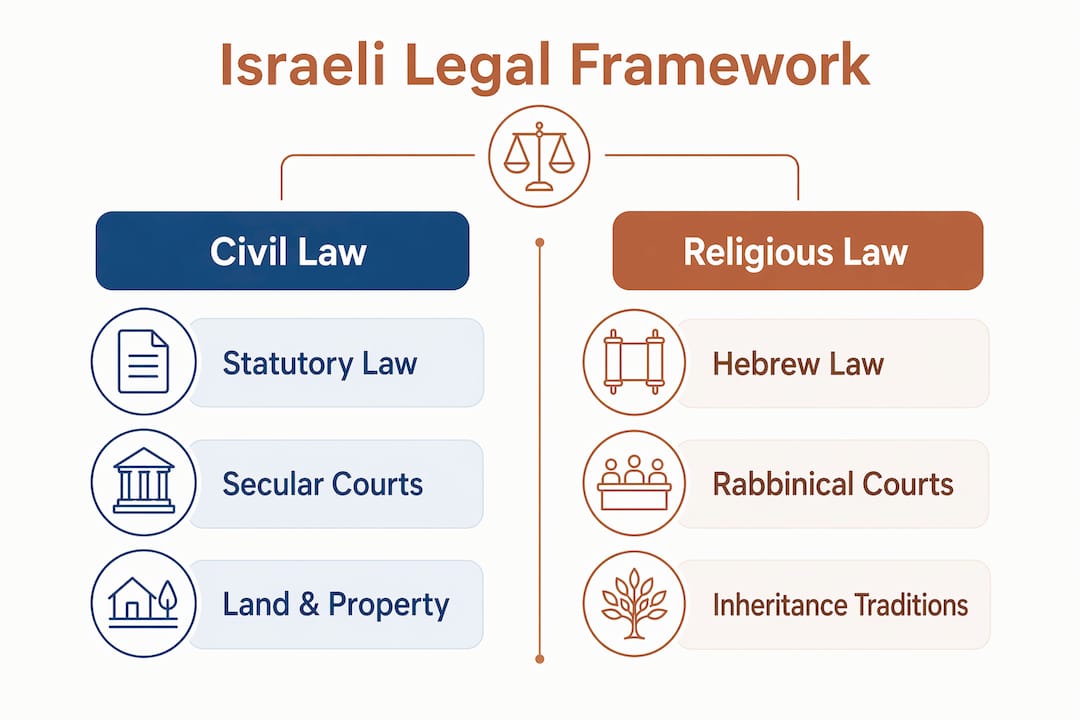
The Israeli Hebrew legal system is defined as a dual-framework structure that combines secular statutory law with religious legal traditions, governing matters from inheritance and real estate to civil disputes for individuals and businesses operating under Israeli jurisdiction. Understanding this system is not optional for foreign clients dealing with Israeli assets. It is the foundation for every legal decision you will make, whether you are claiming an inheritance, buying property, or managing compliance obligations in Israel. The 2026 expansion of rabbinical court powers has added new layers to this already complex structure, making informed legal guidance more critical than ever.
What is the role of the Israeli Hebrew legal system?
Israel’s legal system is one of the few in the world that formally integrates religious law into its civil framework. The role of the Israeli Hebrew legal system, more precisely called the Israeli mixed legal system, is to govern personal status, inheritance, family matters, and certain civil disputes through a combination of statutory codes, case law, and religious legal sources. Hebrew law, known in legal scholarship as Mishpat Ivri, does not function as a standalone legal code. It operates as a residual interpretive tool that courts apply when statutes and case law leave a gap.

This distinction matters enormously for foreign clients. When you inherit Israeli property or enter a real estate transaction in Israel, the governing law is primarily the relevant Israeli statute. Hebrew law enters the picture only when that statute is silent on a specific point. Knowing where the boundary falls between civil and religious authority determines which court has jurisdiction over your matter and what procedural rules apply.
The system’s hybrid nature also explains why Israeli legal terms differ internationally. Concepts like “probate order” in Israel carry specific procedural meanings that do not map directly onto equivalent processes in other jurisdictions. Foreign clients who assume Israeli law works like the legal system they know at home routinely encounter costly surprises.
How is the Israeli court system structured?
Israel’s court system is administered through the Judicial Authority, headed by the Supreme Court, and includes Labor courts, district courts, and magistrate courts. This three-tier structure handles the vast majority of civil, commercial, and criminal matters. The Supreme Court sits at the apex, functioning both as a court of final appeal and as the High Court of Justice for constitutional and administrative matters.
For individuals and businesses dealing with inheritance or real estate, the relevant courts are typically:
- Magistrate courts: Handle smaller civil claims and initial real estate disputes
- District courts: Handle larger civil and commercial matters, including significant inheritance disputes and property transactions
- Labor courts: Specialize in employment matters, which became more relevant after the 2026 arbitration expansion
- The Supreme Court: Reviews legal questions of national importance and constitutional challenges
Religious courts operate alongside this civil structure. Rabbinical courts are state judicial institutions with jurisdiction over marriage, divorce, inheritance, and, since 2026, certain civil disputes by consent. The Great Rabbinical Court in Jerusalem serves as the highest appellate authority within the rabbinical system. Sharia courts hold equivalent jurisdiction over Muslim citizens in personal status matters. Druze and Christian communities have their own recognized religious courts as well.
The critical point for foreign clients is that religious courts and civil courts are not interchangeable. A rabbinical court ruling on an inheritance dispute carries legal weight, but it is reached through a different procedural framework than a district court ruling on the same matter. Choosing the wrong forum, or failing to understand which forum has jurisdiction, can invalidate proceedings entirely.
What is the current role of Hebrew law in Israeli courts?
Hebrew law’s role in the Israeli legal system is formally defined by the Foundations of Law Act of 1980. Under that statute, when a judge faces a legal question that existing legislation and case law do not resolve, the judge must turn to Hebrew law as a gap-filling source before looking to foreign legal systems. This reversed a prior practice of defaulting to English common law for interpretive gaps, a legacy of the British Mandate period.
Hebrew law’s practical applications concentrate in four main areas:
- Personal status matters: Marriage, divorce, and related family law questions where religious tradition carries interpretive weight
- Inheritance disputes: Cases where the Succession Law 5725-1965 does not address a specific factual scenario
- Property and trust law: Situations where equitable principles drawn from Jewish legal tradition inform judicial reasoning
- Contract interpretation: Rare cases where good faith obligations are interpreted through a Hebrew law lens
Hebrew law is defined as Torah law as practiced and interpreted by the Chief Rabbinate, and judicial proficiency in Hebrew law is now a formal evaluation criterion for judges expected to apply it. This is not a theoretical requirement. A 2026 legislative proposal in the Knesset sought to formalize proficiency testing for judges, reflecting real concern that Hebrew law is being applied inconsistently across the court system.
Pro Tip: If your inheritance or property dispute involves a factual scenario not clearly addressed by the relevant Israeli statute, ask your Israeli attorney whether Hebrew law principles have been applied in comparable cases. This can affect both the outcome and the choice of forum.
Orthodox political factions have consistently pushed to expand Hebrew law’s role beyond its current gap-filling function, seeking to make it a primary rather than supplementary source. These efforts reflect tensions between secular and religious legal principles within Israeli society. For foreign clients, the practical implication is that the boundary between civil and religious legal authority in Israel is politically contested and subject to change. Staying current with legislative developments is not optional. It is part of sound legal planning.
How did the 2026 rabbinical arbitration law change things?
In 2026, the Knesset passed legislation formally expanding rabbinical courts’ arbitration authority to cover certain civil disputes, provided all parties give explicit consent. This was a significant structural change. Previously, rabbinical courts handled civil matters informally through a consent-based arrangement that lacked statutory backing. The 2026 law gave that arrangement formal legal standing.
The scope of the new law covers:
- Employment disputes between consenting parties
- Neighbor and property boundary disputes
- Certain commercial civil matters where all parties agree in writing
- Some family-adjacent financial disputes not classified as personal status matters
The law explicitly excludes criminal matters, state-related disputes, and certain personal status cases that remain within the exclusive jurisdiction of the civil or religious court system.
“The 2026 law reestablishes a consent-based arbitration status previously informal but raises concerns about equality, especially for women litigants.” — The Times of Israel, 2026
그만큼 Israel Democracy Institute raised pointed concerns about the law’s implications. Women have no representation in rabbinical court panels, and the application of religious law to civil disputes creates a risk that rulings will conflict with civil rights protections guaranteed under Israeli basic laws. Critics argue the law allows religious legal norms to displace democratic legal standards in areas where civil courts should hold exclusive authority.
Proponents counter that the law respects individual autonomy. If both parties freely consent to rabbinical arbitration, they argue, the state should honor that choice. The consent mechanics post-2026 are strict: consent must be explicit, written, and informed. Verbal agreement is insufficient. Any ambiguity in the consent document can void the rabbinical court’s authority entirely, leaving the matter to be relitigated in civil court.
For businesses and individuals, the practical risk is clear. If you are a party to a dispute and the other side proposes rabbinical arbitration, you need to understand exactly what rights you are agreeing to waive before you sign anything. This is precisely the kind of situation where experienced Israeli legal counsel is not a luxury. It is a necessity.
How do inheritance and real estate laws interact with Hebrew legal traditions?
Israeli inheritance law is governed primarily by the Succession Law 5725-1965, a civil statute that sets out the rules for intestate succession, will validity, and probate procedure. Hebrew law enters this framework as a secondary interpretive source, not as a competing code. The practical effect is that most inheritance matters in Israel are resolved through civil proceedings, but religious courts retain concurrent jurisdiction in certain disputes, particularly those involving Jewish citizens.
| Legal Framework | Primary Application | Hebrew Law Role |
|---|---|---|
| Succession Law 5725-1965 | Intestate succession and will validity | Gap-filling where statute is silent |
| Land Law 5729-1969 | Property ownership and transfer | Minimal; civil law governs |
| Trust Law 5739-1979 | Trust creation and administration | Interpretive in equitable disputes |
| Rabbinical court jurisdiction | Inheritance disputes among Jewish parties | Primary where parties consent |
Foreign wills are recognized under Israeli law if they are formally valid under at least one legal system. This means a will executed abroad can govern Israeli assets, but it must go through an Israeli probate process. Foreign probate orders are not recognized in Israel. A grant of probate issued by a court in another country has no legal effect on Israeli assets. Separate Israeli proceedings are mandatory, regardless of what documents you hold from another jurisdiction.
On the tax side, Israel has no inheritance or estate tax, which is a significant planning advantage for international families with Israeli assets. This does not mean there are no tax implications. Capital gains tax, real estate purchase tax, and trust-related income tax obligations can all arise depending on how assets are structured and transferred. The absence of an estate tax is a starting point for planning, not a conclusion.
Pro Tip: If you hold Israeli real estate and want it to pass to heirs without a contested probate process, a properly drafted Israeli will is far more reliable than relying on a foreign will or intestate succession rules. An Israeli attorney can draft a will that satisfies both the Succession Law and any applicable religious law requirements.
Real estate transactions in Israel are governed by the Land Law 5729-1969 and administered through the Israel Land Registry. For foreign investors buying property in Israel, the process involves purchase tax, registration requirements, and in some cases restrictions on land types that can be privately owned. Hebrew law has minimal direct application to real estate transactions, but rabbinical court rulings on inheritance can affect title to property if an estate dispute is resolved through religious arbitration. This is one reason why understanding the full legal framework matters even for what appears to be a straightforward property purchase.
Cross-border matters add another layer of complexity. Coordinating Israeli legal matters from abroad requires local representation that understands both the civil court process and the religious court system. An attorney who knows only one side of that equation will miss critical procedural steps.
Key takeaways
The Israeli Hebrew legal system requires foreign clients to understand both civil statutory law and the residual but real influence of Hebrew law, particularly in inheritance, real estate, and post-2026 civil arbitration matters.
| Point | Details |
|---|---|
| Hebrew law is supplementary | It fills statutory gaps under the 1980 Foundations of Law Act, not a primary legal code. |
| Court structure is tiered | Civil courts handle most matters; religious courts hold concurrent jurisdiction in personal status and, since 2026, some civil disputes. |
| 2026 arbitration law changes consent rules | Rabbinical arbitration of civil matters now requires explicit written consent from all parties to be enforceable. |
| Foreign probate orders are not recognized | Israeli assets require separate Israeli probate proceedings regardless of foreign court orders. |
| No inheritance tax in Israel | Strategic planning around capital gains, purchase tax, and trust structures still applies. |
Menora Law’s perspective on Hebrew law and religious arbitration
Working with international clients on Israeli inheritance and real estate matters, we at Menora Law see one consistent pattern: the clients who run into trouble are those who assumed Israeli law would behave like the legal system they already know. It does not. The integration of Hebrew law into the civil framework is not a historical footnote. It is an active feature of the system that affects real cases.
The 2026 arbitration expansion is a good example of why staying current matters. A foreign client who signs a consent document agreeing to rabbinical arbitration without understanding what that means has potentially waived civil court protections that would otherwise apply. We have seen situations where well-intentioned agreements created jurisdictional problems that took significant time and cost to untangle.
Our honest view is that the 2026 law, while legally valid, introduces risk for parties who are not fully informed. The consent requirement is strict on paper, but the practical reality is that pressure to agree to religious arbitration can exist in family and business contexts. Knowing your rights before you sign is the only reliable protection.
For foreign clients specifically, the combination of no inheritance tax, a clear statutory framework under the Succession Law, and the availability of civil court proceedings makes Israel a manageable jurisdiction. The complexity comes from the religious law overlay and the political dynamics that continue to shift the boundary between civil and religious authority. That is exactly where experienced local counsel earns its value.
— Menora Law
How Menora Law can help with Israeli inheritance and real estate matters
If you are dealing with an Israeli inheritance, a property transaction, or a compliance matter that touches on Hebrew legal traditions, Menora Law provides the kind of focused, experienced representation that international clients need.

Menora Law handles Israeli inheritance and estate matters for clients located anywhere in the world, including probate proceedings, will drafting, and estate administration. For real estate, the firm provides full representation from due diligence through registration, with a clear understanding of how religious court rulings can affect property title. If you need a trusted Israeli legal team that communicates clearly and moves efficiently, 메노라 로에 문의 to discuss your situation. Remote consultations are available, and the firm works with clients across time zones without delay.
자주하는 질문
What is the role of Hebrew law in Israel’s legal system?
Hebrew law serves as a residual interpretive source under the Foundations of Law Act of 1980, filling gaps when statutes and case law do not address a specific legal question. It is not a primary legal code and applies most often in inheritance, family, and personal status matters.
How does the 2026 rabbinical arbitration law affect civil disputes?
The 2026 Knesset law allows rabbinical courts to arbitrate certain civil disputes, including employment and neighbor matters, when all parties provide explicit written consent. Criminal matters and most personal status cases are excluded from this expanded authority.
Are foreign wills valid for Israeli assets?
A foreign will is recognized in Israel if it is formally valid under at least one legal system, but it must go through an Israeli probate process. Foreign probate orders issued by courts in other countries have no legal effect on assets located in Israel.
이스라엘에 상속세가 있습니까?
Israel has no inheritance or estate tax, making it a favorable jurisdiction for estate planning. Capital gains tax, real estate purchase tax, and trust-related income obligations may still apply depending on how assets are structured.
Why do Israeli legal terms differ from international equivalents?
Israeli law developed from a combination of Ottoman law, British Mandate common law, and post-independence statutory codes, with Hebrew law as an additional interpretive layer. This unique history means that terms like “probate order” or “succession” carry procedural meanings specific to Israeli courts that do not translate directly to other legal systems.


 English
 Afrikaans
 العربية
 বাংলা
বাংলা Čeština
 简体中文
简体中文 Nederlands
 Suomi
Suomi Français
 Deutsch
 עִבְרִית
 हिन्दी
 Magyar
 Italiano
 日本語
日本語 한국어
한국어 Polski
 فارسی
فارسی Português do Brasil
 Русский
 Español de México
 Українська