
The Israel-UK double taxation treaty splits taxing rights between the two countries so the same income doesn’t get taxed twice. If you’re an Israeli resident earning rental income, dividends, interest, or a pension from the UK, Israel generally gives you credit for the UK tax you already paid. The rules changed in a meaningful way when the 2019 protocol came into force, updating exchange-of-information provisions and adjusting how certain income types get taxed. Israeli residents and businesses with UK income need to understand both the original 1962 treaty and what the protocol changed.
TL;DR:
- The UK-Israel treaty caps UK withholding tax rates on dividends, interest, and royalties, but eligibility depends on beneficial ownership and shareholding thresholds.
- Israeli residents must comply with the treaty’s residency tie-breaker rules to avoid double taxation and use the mutual agreement procedure if disputes arise.
- For foreign tax credits, taxpayers must report UK income and proof of tax paid, ensuring they do not claim credits for overpaid or refunded UK taxes.
- The 2019 protocol introduced a most-favored-nation clause on information exchange, increasing transparency and anti-avoidance measures.
- Confirming treaty residency status and requesting reduced withholding rates before payment can prevent unnecessary overpayment and delays.
What Does the Israel-UK Tax Treaty Actually Cover?
그만큼 אמנת מס ישראל בריטניה (Israel-UK tax treaty) covers income tax and capital gains tax in both countries, along with corporation tax on the UK side. It applies to the main categories of cross-border income Israeli residents typically deal with: employment income, business profits, dividends, interest, royalties, pensions, and gains from selling property or shares.
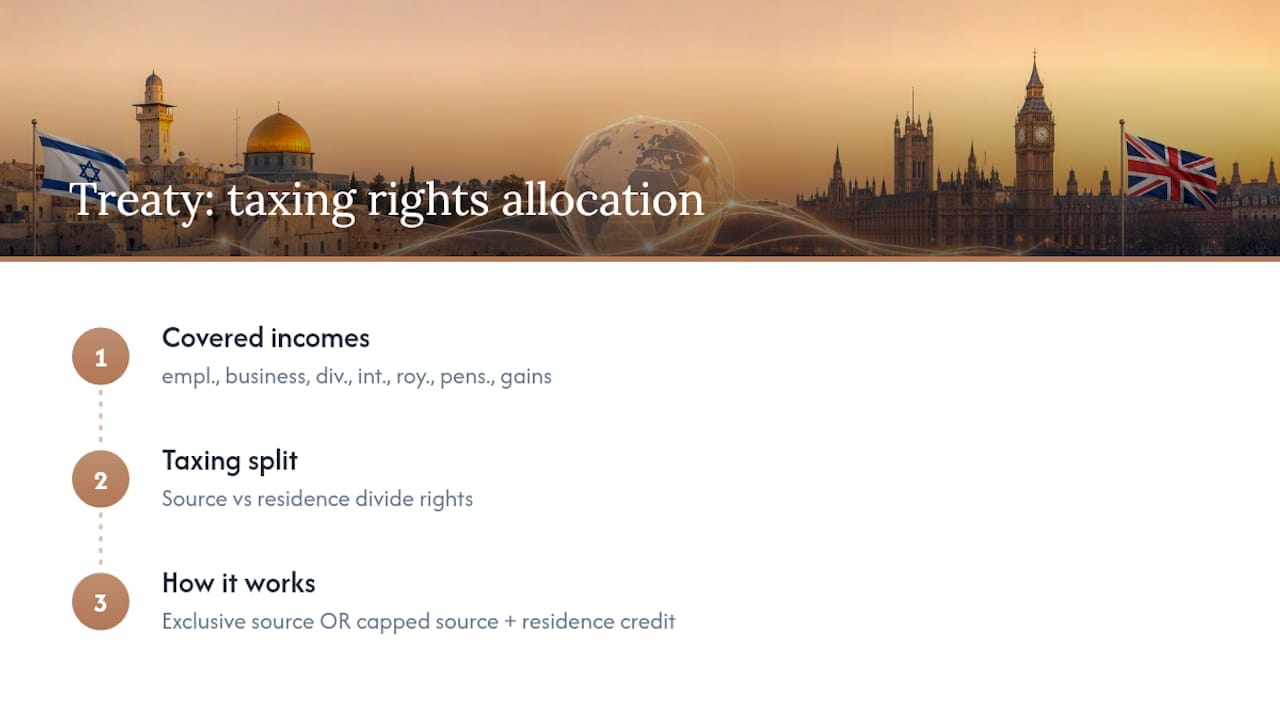
The treaty’s core job is dividing taxing rights between the “source” country (where income originates) and the “residence” country (where the taxpayer lives). Without this framework, an Israeli resident earning UK rental income could theoretically owe full tax in both jurisdictions. The treaty prevents that by either giving one country exclusive rights or by capping what the source country can charge and requiring the residence country to grant credit for the rest.
The 2019 protocol added a most-favored-nation clause tied to exchange of information, so if Israel later signs a treaty with broader information-sharing terms, similar terms can extend to the UK-Israel arrangement too. This matters because tax authorities on both sides increasingly share account and income data automatically, and the treaty’s anti-avoidance intent is baked into that structure. It’s not just about lower rates. It’s about making sure income doesn’t slip through the cracks of two different tax systems.
How Do You Determine Tax Residency Under the Treaty?
If you’re considered a tax resident of both Israel and the UK under each country’s domestic law, the treaty applies a tie-breaker sequence to settle which country wins for treaty purposes. The tests apply in strict order, and you stop as soon as one resolves the question.
- Permanent home: If you have a permanent home available in only one country, that’s your treaty residence.
- Center of vital interests: If you have homes in both, residence goes to wherever your personal and economic ties are stronger, family, business, social connections.
- Habitual abode: If that’s still unclear, it comes down to where you spend more time.
- Nationality: If habitual abode doesn’t settle it, nationality decides.
- Mutual agreement: If none of the above resolves it, the Israeli and UK tax authorities negotiate directly.
For companies, the traditional test looks at where effective management actually happens, not where the company is registered on paper. A UK-incorporated company run day-to-day by directors sitting in Tel Aviv can end up treated as an Israeli resident for treaty purposes, which changes everything about how its income gets taxed. Learn more about how Israeli tax residency rules apply to individuals with ties abroad.
When residency disputes don’t resolve easily, the treaty allows either government to invoke the mutual agreement procedure, a formal negotiation channel between tax authorities designed to prevent a taxpayer from being taxed twice due to a residency disagreement.
What Are the Treaty’s Withholding Rate Limits?
The treaty caps how much the source country can withhold on certain payments before the residence country’s credit even comes into play. These caps don’t eliminate tax. They put a ceiling on it.
A few conditions determine which rate actually applies. Beneficial ownership matters. If you’re a nominee or conduit receiving income on someone else’s behalf, treaty benefits usually don’t apply to you. Minimum shareholding thresholds also matter for dividends. The HMRC guidance on treaty rates lays out these thresholds in detail, and getting them wrong is one of the most common reasons Israeli taxpayers end up overpaying UK withholding tax.
Capital gains generally get taxed in Israel if you’re an Israeli resident, with a notable exception for gains on UK real estate, which the UK typically taxes regardless of your residence. Pensions follow their own logic too. Government service pensions often stay taxable only in the paying country, while private pensions usually shift to the residence country.
- For property sales in the UK, expect UK tax exposure regardless of where you live.
- For portfolio dividends, expect a reduced UK withholding rate rather than a full exemption.
- For royalties, expect the UK to generally step back and let Israel tax the income.
How Does Israel Give Credit for UK Tax Already Paid?
Israel’s foreign tax credit mechanism lets you offset UK tax paid against your Israeli tax liability on the same income, so you’re not paying full rates twice on one paycheck or one dividend.
- Report the UK-source income on your Israeli tax return in the year it’s earned.
- Calculate the credit, capped at the Israeli tax that would otherwise apply to that same income.
- Attach proof of UK tax paid: HMRC withholding certificates, self-assessment statements, or bank records showing tax deducted at source.
- Keep records in case the Israeli Tax Authority requests substantiation later.
Pro Tip: Don’t rely on a bank statement alone showing tax withheld. Request an actual HMRC certificate or self-assessment confirmation wherever possible. Israeli tax authorities frequently push back on credit claims that rely only on informal proof, and that delay can cost you months.
The most common mistake is claiming credit for tax that wasn’t actually the final UK liability. If you overpaid UK tax and later got a refund, you can’t credit the refunded portion in Israel.
What Changed Under the 2019 Protocol?
The 2019 protocol, signed January 17, 2019, and in force since October 28, 2019, updated several treaty provisions and phased in new effective dates for different Israeli taxes starting January 1, 2020.
The most practically important change was the most-favored-nation clause on exchange of information, which lets Israel extend broader information-sharing terms from other treaties into the UK relationship automatically. The protocol also refined language around several income categories to reduce ambiguity that had existed under the older 1962 and 1970 versions. The official Israeli publication of the protocol confirms the phased implementation timeline for Israeli taxpayers.
What Should You Do Right Now If You Have UK Income?
- Confirm your treaty residency status using the tie-breaker tests before assuming which country taxes what.
- Gather UK withholding proof (HMRC statements, dividend vouchers, bank confirmations) for every income source.
- Check whether you qualify for a reduced treaty withholding rate and request it from the UK payer directly, rather than paying full rate and reclaiming later.
- File your Israeli return with the foreign tax credit claim attached and documented.
- If residency or rate disputes arise, consider the mutual agreement procedure or bring in legal representation experienced in cross-border filings.
For property owners specifically, the practical filing guidance from PADSABROAD on UK tax obligations for overseas owners offers useful context on documentation habits that transfer well to the Israel-UK situation.
Where Menora Law Fits Into Israel-UK Tax Questions
Residency disputes, treaty rate claims, and mutual agreement procedure cases are exactly where a UK spreadsheet stops being enough. Menora Law regularly helps Israeli residents and businesses with UK income sort out residency status, assemble the documentation Israeli tax authorities actually accept, and represent clients when a dispute needs formal resolution. Straightforward dividend credits, you can often handle yourself. Residency conflicts or MAP cases call for a lawyer who knows both the treaty text and how the Israeli Tax Authority applies it in practice.
— Menora Law
Get Help With Cross-Border Israeli Tax Matters
Sorting out UK income against Israeli tax law isn’t something you want to guess your way through, especially when residency status or a foreign tax credit claim is on the line. Menora Law brings Israeli legal expertise directly to clients living abroad, with remote consultations, fast communication, and case handling built around international schedules rather than requiring you to fly to Israel.

Before reaching out, gather your UK income statements, any HMRC withholding certificates, and details on where you currently hold tax residency. Menora Law’s team can then map out whether you’re claiming the right credit, whether a reduced treaty rate applies, or whether a residency dispute needs formal representation. For readers whose UK ties involve cross-border estate or property questions, Menora Law’s coordinating cross-border Israeli legal matters page walks through how the firm handles multi-jurisdictional cases end to end. Ready to talk through your situation? Reach out to Menora Law today to schedule an initial remote consultation.
This article is general information, not a substitute for advice from a qualified financial advisor. Consult a qualified financial professional about your own circumstances before acting on anything here.
Sources
자주하는 질문
What Is the Tax Treaty Between Israel and the UK?
It’s a 1962 agreement, amended by protocols in 1970 and 2019, that allocates taxing rights between Israel and the United Kingdom to prevent the same income from being taxed twice in both countries.
Is There a Tax Treaty Between Israel and Cyprus?
Yes, Israel has a separate double taxation treaty with Cyprus, structured similarly to the UK treaty, allocating taxing rights on income and capital gains between the two countries.
Which Countries Have a Tax Treaty With Israel?
Israel maintains double taxation treaties with dozens of countries, including the UK, the United States, Cyprus, Portugal, and most major European and OECD economies, each with its own specific rates and provisions.
What Is the Tax Treaty Between Israel and Portugal?
Israel and Portugal have a double taxation agreement that allocates taxing rights on income and capital gains, following a structure similar to Israel’s other tax treaties, including residency tie-breaker rules.
How Do I Claim Treaty Relief on UK Income in Israel?
Report the UK income on your Israeli tax return, calculate the foreign tax credit up to your Israeli tax liability on that income, and attach documentation proving the UK tax was actually paid.


 English
 Afrikaans
 العربية
 বাংলা
বাংলা Čeština
 简体中文
简体中文 Nederlands
 Suomi
Suomi Français
 Deutsch
 עִבְרִית
 हिन्दी
 Magyar
 Italiano
 日本語
日本語 한국어
한국어 Polski
 فارسی
فارسی Português do Brasil
 Русский
 Español de México
 Українська