
TL;DR:
- Israeli inheritance law, governed by the Succession Law of 1965, requires a court order to transfer assets, whether through a will or intestate succession. International heirs must navigate Israeli procedural courts and possible foreign law conflicts, with no inheritance tax but potential capital gains liability. Early legal action and proper documentation are crucial to avoiding delays, disputes, and costly procedural backlogs in estate administration.
Israeli inheritance law is defined by the Succession Law, 5725-1965, which governs how property and assets are distributed after death, either through a valid will or through statutory intestate rules when no will exists. This law applies to assets located in Israel regardless of the deceased’s citizenship or country of residence, making it directly relevant to international heirs, expatriates, and foreign families who own Israeli property. Whether you are managing an estate from abroad or dealing with a local inheritance, understanding the two core paths under Israeli succession law, probate order and succession order, is the foundation of every step that follows.
What is Israeli inheritance law and how does it work?

Israeli inheritance law operates through two distinct legal tracks. The first applies when the deceased left a valid will. The second applies when no valid will exists, known as intestate succession. Both tracks require a formal court order before any assets can be transferred, and that requirement is non-negotiable regardless of how straightforward the estate appears.
그만큼 Succession Law of 1965 is the single statute that governs both tracks. It covers everything from the validity of wills to the hierarchy of heirs, the rights of spouses, and the procedures for distributing property. No other Israeli statute replaces or supersedes it for inheritance matters.
One point that surprises many international heirs is that a death certificate alone is not enough to release assets. Banks and real estate bodies release assets only after a Probate Order or Succession Order is obtained. This means the legal process must be completed before you can access a bank account, sell a property, or transfer any registered asset in Israel.
How does inheritance work with a will versus without one?
When a valid will exists: the probate order
A Probate Order is the court’s confirmation that a will is legally valid and that its terms should govern distribution of the estate. Once issued by the Israeli Family Court or the Inheritance Registrar, this order authorizes every institution holding assets to release them according to the will’s instructions.
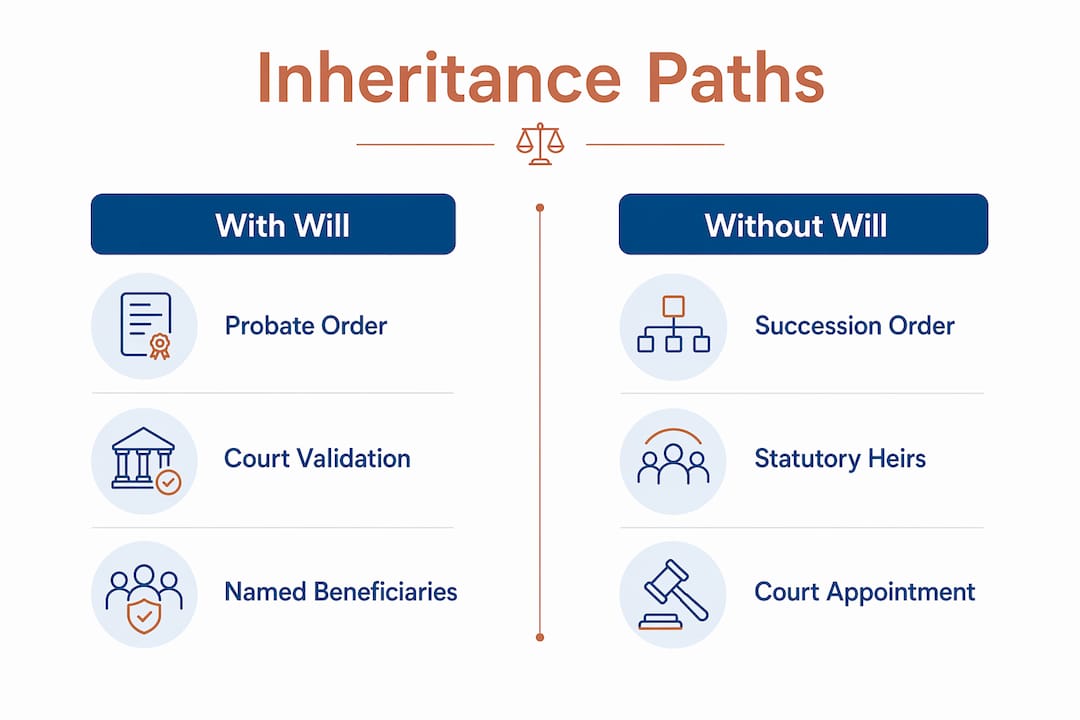
The process of obtaining a Probate Order involves filing the original will, a death certificate, and supporting identification documents. The court reviews the will for formal validity, checks for any objections from interested parties, and issues the order if no legal obstacles exist. The probate order process typically takes several months, though contested wills can extend that timeline significantly.
Pro Tip: If you are a beneficiary named in an Israeli will and you live abroad, you can appoint an Israeli attorney to represent you throughout the probate process. You do not need to travel to Israel for routine filings.
When no will exists: the succession order
A Succession Order applies when the deceased left no valid will, or when a will is declared void. In this case, the court applies the statutory intestate rules set out in the Succession Law to determine who inherits and in what proportions. The succession order procedure follows a similar filing process but relies on heir declarations and family documentation rather than a will document.
The numbered steps for either track are as follows:
- Gather the death certificate, identity documents of the deceased, and proof of relationship for all heirs.
- File a petition with the Israeli Family Court or the Inheritance Registrar.
- Publish a public notice allowing third parties to raise objections.
- Receive the court order after the objection period closes and the court is satisfied.
- Present the order to each institution holding assets, including banks, the Land Registry (Tabu), pension funds, and insurance companies.
What is the statutory order of heirs under Israeli intestate succession?
When no valid will exists, fixed heir categories and shares are applied strictly by Israeli courts unless all heirs unanimously agree to a different arrangement. This statutory hierarchy is precise and leaves little room for informal family arrangements.
The distribution rules work as follows:
- Spouse and children: The surviving spouse receives half of the estate. The children divide the remaining half equally among themselves. If there are no children, the spouse receives the entire estate.
- Parents and siblings: If there is no surviving spouse and no children, the deceased’s parents inherit. If the parents are also deceased, siblings inherit in their place.
- Extended relatives: If none of the above relatives survive, the estate passes to grandparents and their descendants, following the same descending logic.
The table below summarizes the primary distribution scenarios:
| Surviving relatives | Spouse’s share | Children’s share | Other relatives |
|---|---|---|---|
| Spouse and children | 50% | 50% divided equally | None |
| Spouse only (no children) | 100% | None | None |
| Children only (no spouse) | None | 100% divided equally | None |
| Parents only | None | None | 100% to parents |
| Siblings only | None | None | 100% to siblings |
One nuance worth knowing is that religious law, specifically Halacha, historically influenced inheritance customs in Israel, particularly regarding spousal rights. The Succession Law of 1965 largely replaced those religious rules for civil purposes, but religious courts can still have jurisdiction in certain family matters. For most practical inheritance proceedings, the civil Succession Law governs.
Testamentary freedom is protected under Israeli law, meaning a person can write a will that departs from the statutory distribution. However, heirs cannot waive inheritance rights before the testator’s death, and any agreement that restricts a person’s right to make or revoke a will is void. This protects individual autonomy in estate planning.
How are cross-border inheritance and foreign heirs handled?
Israeli courts distinguish between two separate questions in cross-border inheritance cases. The first is procedural jurisdiction: which court has authority to issue orders for Israeli assets. The second is substantive law: which country’s rules determine who inherits and in what shares. Israeli courts apply procedural jurisdiction over Israeli assets while sometimes deferring to the deceased’s domicile law on substantive inheritance shares.
This distinction has real consequences. If a French national owned an apartment in Tel Aviv and died without a will, an Israeli court would issue the Succession Order for that property. However, the court might apply French inheritance law to determine the shares each heir receives, depending on the circumstances and applicable conflict of laws rules. The Israeli procedural steps remain mandatory regardless of which country’s substantive law applies.
Key considerations for international heirs include:
- Mandatory Israeli process: Even if foreign law governs the shares, you must obtain an Israeli court order to transfer any Israeli asset. There is no shortcut through a foreign probate process.
- No inheritance tax: Israel abolished inheritance tax in 2004, which is a significant advantage for international heirs compared to many other jurisdictions.
- Capital gains tax on sale: Heirs who sell inherited Israeli real estate may owe capital gains tax. The tax is calculated based on the difference between the sale price and the property’s value at the time of inheritance, not the original purchase price. Timing the sale strategically can reduce this liability.
- Legal representation: Non-resident heirs are strongly advised to appoint an Israeli attorney with a power of attorney. This allows the attorney to file petitions, appear in court, and coordinate with institutions on the heir’s behalf without requiring travel to Israel.
Pro Tip: Despite no inheritance tax in Israel, capital gains tax on inherited property can generate a significant liability when you sell. Consult an Israeli tax advisor before deciding whether to sell immediately or hold the asset.
For families managing cross-border Israeli legal matters, the interaction between Israeli procedural requirements and foreign substantive law is one of the most technically complex areas of Israeli succession practice. Getting this wrong can delay the entire estate for years.
What are the procedural steps to inherit and register property in Israel?
Obtaining the court order is only the beginning. After the Probate Order or Succession Order is issued, heirs must present it to every institution that holds an asset. Each institution requires the appropriate order before releasing assets, and each has its own internal process for doing so.
The practical steps after receiving the court order are:
- Banks: Present the order to each bank branch holding accounts. The bank will transfer funds to the heirs according to the order’s terms. Some banks require additional heir declarations or indemnity forms.
- Land Registry (Tabu): File a registration application with the Tabu to transfer real estate title into the heirs’ names. This requires the court order, identity documents, and payment of registration fees.
- Israel Lands Authority: If the property is on Israel Lands Authority land (which covers a large portion of Israeli real estate), additional coordination is required to update lease or allocation rights.
- Pension funds and insurance companies: Each provider requires the court order plus beneficiary designation forms or heir declarations to release funds.
- Estate distribution agreement: If heirs agree to divide the estate differently from the will or statutory shares, they can sign a formal estate distribution agreement. This document must be filed with the court or registrar and is legally binding once approved.
Delays in obtaining court orders can freeze the estate, blocking bank accounts and preventing property transactions. A frozen estate means heirs cannot sell, refinance, or renovate the property until the legal process is complete. This is not a theoretical risk. It is one of the most common and costly problems families face in Israeli inheritance proceedings.
When registering inherited real estate, delays in synchronizing Tabu records and Israel Lands Authority records can further impede sales or renovations. Legal assistance is recommended to coordinate updates across both registries simultaneously rather than sequentially, which can save months of waiting.
Wills sometimes contain restrictions on inherited property, such as prohibiting sale for a set period or requiring the property to pass to a specific person upon the heir’s death. These restrictions are registered against the property title and must be respected. Buyers and lenders will see them in a title search, so understanding them before you inherit is far better than discovering them when you try to sell.
Key takeaways
Israeli inheritance law requires a formal court order for every asset transfer, making early legal action the single most important step any heir can take.
| Point | Details |
|---|---|
| Succession Law of 1965 governs all estates | This statute applies to all Israeli assets regardless of the deceased’s citizenship or country of residence. |
| Two tracks: probate order and succession order | A Probate Order confirms a will; a Succession Order applies the statutory heir hierarchy when no will exists. |
| Fixed statutory shares without a will | Spouses receive 50%, children share the remaining 50%, with parents and siblings inheriting only if neither survives. |
| No inheritance tax, but capital gains applies | Israel abolished inheritance tax in 2004, but heirs selling inherited property may owe capital gains tax on the proceeds. |
| Cross-border cases require Israeli process | Foreign heirs must still obtain Israeli court orders for Israeli assets, even when foreign substantive law governs the shares. |
Menora Law’s perspective on what families get wrong
After working with international heirs and local families on Israeli estate matters, the pattern we see most often is not a lack of legal knowledge. It is a lack of urgency. Families assume the process will be straightforward and wait months before engaging legal counsel. By that point, bank accounts are frozen, a property sale has fallen through, and the estate is tangled in procedural backlogs that could have been avoided entirely.
The second most common mistake is treating Israeli inheritance as a purely local matter when there are foreign elements involved. A deceased person who lived abroad but owned Israeli real estate creates a cross-border case the moment the estate is opened. The interaction between Israeli procedural law and the substantive law of the deceased’s domicile is genuinely complex. Families who try to manage this without Israeli legal representation consistently run into problems that cost more to fix than the original legal fees would have been.
One thing we find underappreciated is the estate distribution agreement. When heirs agree on a different division than the will or statutory rules provide, this agreement is a powerful tool. It resolves disputes before they become litigation, and it gives families flexibility that the statutory rules alone do not. But it must be drafted correctly and filed with the appropriate authority to be enforceable.
The absence of inheritance tax in Israel is a genuine advantage, but it creates a false sense of security around tax planning. Capital gains tax on inherited real estate can be substantial, and the timing of a sale matters enormously. We always recommend addressing the tax question before the estate is distributed, not after.
— Menora Law
How Menora Law can help you with Israeli inheritance matters
Menora Law specializes in Israeli inheritance and succession law for international clients, local families, and expats managing estates from abroad. Whether you need a Probate Order, a Succession Order, or guidance on cross-border estate coordination, the team at Menora Law handles every stage of the process with clear communication and practical legal strategy.
From coordinating with Israeli banks and the Land Registry to advising on capital gains tax timing and drafting estate distribution agreements, Menora Law provides the full scope of services heirs need to resolve an estate efficiently. Remote representation is available for overseas clients, meaning you do not need to travel to Israel to move your case forward. Explore Menora Law’s Israeli inheritance law guide or 연락하다 the firm directly to discuss your situation.
자주하는 질문
What is the Succession Law of 1965?
The Succession Law, 5725-1965 is the primary Israeli statute governing inheritance, covering both will-based and intestate succession for all assets located in Israel regardless of the deceased’s nationality.
What is an Israeli heirship order?
An Israeli heirship order, also called a Succession Order, is a court-issued document that identifies the legal heirs and their shares when a person dies without a valid will. Banks, the Land Registry, and other institutions require this order before releasing any assets.
Do foreign heirs need to travel to Israel to inherit?
No. Foreign heirs can appoint an Israeli attorney with a power of attorney to handle all filings, court appearances, and institutional coordination on their behalf without requiring travel to Israel.
Is there inheritance tax in Israel?
Israel abolished inheritance tax in 2004. However, heirs who sell inherited Israeli real estate may owe capital gains tax based on the property’s appreciation from the time of inheritance to the date of sale.
What happens if there is no will in Israel?
Without a valid will, Israeli courts apply the statutory intestate rules under the Succession Law. The surviving spouse receives half the estate, children share the other half equally, and more distant relatives inherit only if no spouse or children survive.


 English
 Afrikaans
 العربية
 বাংলা
বাংলা Čeština
 简体中文
简体中文 Nederlands
 Suomi
Suomi Français
 Deutsch
 עִבְרִית
 हिन्दी
 Magyar
 Italiano
 日本語
日本語 한국어
한국어 Polski
 فارسی
فارسی Português do Brasil
 Русский
 Español de México
 Українська