
TL;DR:
- Foreign heirs must obtain an Israeli Succession or Probate Order to transfer assets in Israel. Proper authentication, translation, and publication are essential steps in the process. Israeli law prioritizes mandatory protections for spouses and dependents over foreign will provisions.
An international heir pursuing an Israeli asset claim must obtain a local Succession Order or Probate decree from the Israeli Registrar. This is not optional. A foreign will or foreign probate order alone carries no legal weight for transferring property inside Israel. Israeli law governs all assets located within its borders, regardless of where the deceased lived or where the estate was probated. If you are abroad and trying to claim Israeli property, a bank account, or other assets left by a relative, you need to understand exactly how Israeli inheritance law works and what steps you must take to protect your rights. Menora Law guides international heirs through this process every day.
What are the key legal steps for an international heir to claim Israeli assets?
Every foreign inheritance claim in Israel follows a defined procedural path. The steps differ slightly depending on whether the deceased left a valid will. Knowing the full sequence before you start saves time and prevents costly mistakes.
Step 1: Identify the Israeli assets and confirm jurisdiction.
Before filing anything, you need to know exactly what assets exist in Israel and confirm they fall under Israeli jurisdiction. Real estate, Israeli bank accounts, and shares in Israeli companies all require local legal proceedings to transfer.
Step 2: Determine whether a will exists.
If the deceased left a valid will that covers Israeli assets, you apply for a Probate Order. If no will exists, you apply for a Succession Order. Both applications go to the Israeli Registrar of Inheritance Affairs or the Family Court, depending on the case.
Step 3: Prepare and authenticate all documents.
All foreign documents must carry an Apostille stamp under the Hague Convention and be accompanied by certified Hebrew translations. This applies to death certificates, wills, and any supporting identification.

Step 4: Submit the application to the Israeli Registrar.
The application includes the authenticated documents, a formal petition, and payment of the required filing fees. The Registrar reviews the submission and, if complete, issues a public notice.
Step 5: Publish a notice in Israeli newspapers.
Publication of heir notices in Israeli newspapers is mandatory. This alerts creditors and any unknown heirs before the final decree is issued. The notice costs 215 NIS in 2026 and is a non-negotiable procedural step.
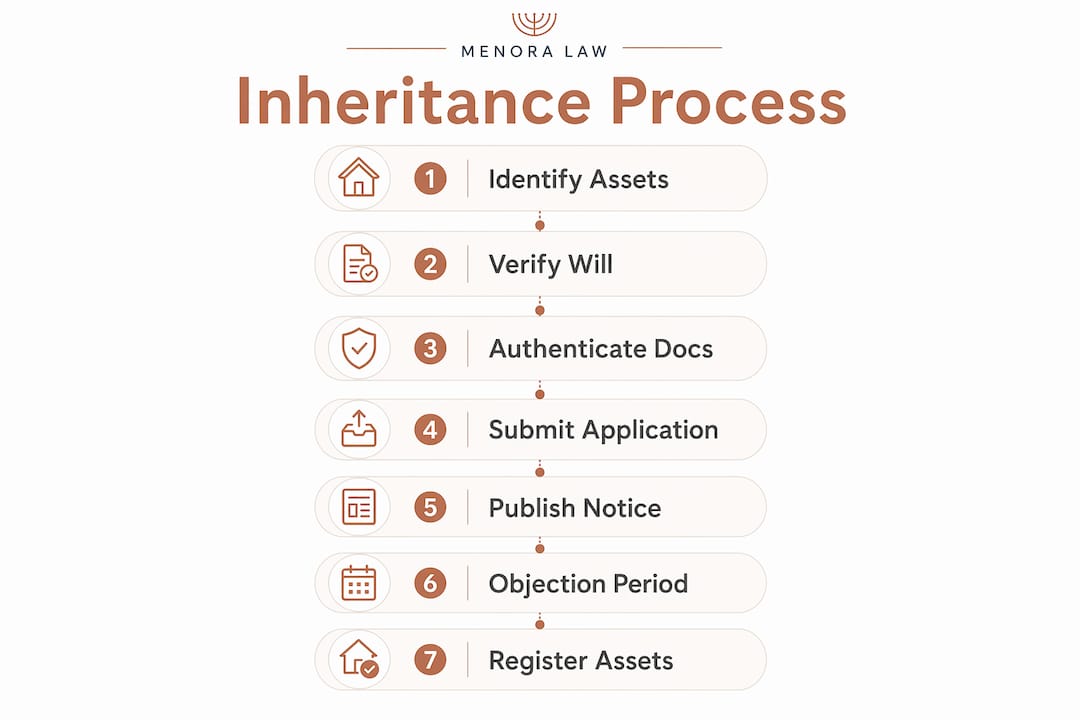
Step 6: Await the objection period and receive the order.
After publication, a waiting period allows any party to file an objection. If no valid objections arise, the Registrar issues the Succession Order or Probate Order. This order is the legal instrument that authorizes asset transfer.
Step 7: Register assets and complete the transfer.
Once the order is granted, you register the assets in your name through the relevant Israeli authority, such as the Land Registry for real estate.
Pro Tip: Start gathering documents the moment you learn of the inheritance. Authentication and translation take weeks, and delays in documentation are the single most common reason Israeli inheritance proceedings stall.
How does Israeli inheritance law affect asset distribution to foreign heirs?
Israeli inheritance law applies to all assets physically located in Israel, regardless of the deceased’s nationality or country of residence. This is the domicile principle in action. Even if a foreign court has already probated the estate, Israëlisch erfrecht controls what happens to Israeli assets.
One of the most significant rules involves the public policy exception. Israeli courts reject foreign testamentary provisions that violate public policy, such as clauses that discriminate by gender or religion. This means a will valid in another country may be partially or fully unenforceable in Israel if it conflicts with Israeli values of equitable distribution.
Mandatory protections for surviving spouses and dependents add another layer. Israeli inheritance law gives the surviving spouse the right to remain in the family home, and this right cannot be overridden by any foreign will. Dependents also hold maintenance claims against the estate, known in Hebrew as Mezonot min Ha’izavon. These claims take priority over testamentary distributions.
Israeli law treats the protection of surviving spouses and dependents as a baseline that no foreign will can remove. If a foreign will attempts to disinherit a spouse from the family home or cut off a dependent’s maintenance, Israeli courts will not enforce those provisions. The estate must first satisfy these mandatory obligations before any other distribution occurs.
These rules have real consequences for international estate planning. If you are an heir named in a foreign will and the estate includes Israeli property, you may receive less than the will specifies if mandatory protections consume part of the estate. Understanding this before filing saves you from surprises mid-process.
What documentation is required for foreign documents in Israeli probate?
Documentation is where most international heirs run into trouble. Israeli probate proceedings require a specific set of authenticated materials, and missing even one item causes delays.
The core documents required include:
- Death certificate. The original death certificate from the country where the deceased died, bearing an Apostille stamp from the relevant authority in that country.
- Will (if applicable). The original will or a certified copy, also apostilled and accompanied by a certified Hebrew translation.
- Foreign law expert opinion affidavit. When a foreign will is submitted, Israeli proceedings require a foreign law expert opinion to confirm the will is valid under the laws of the country where it was executed. This affidavit costs between 3,000 and 7,000 ILS in 2026 and is not optional.
- Certified Hebrew translations. Every foreign-language document must be translated into Hebrew by a certified translator. This includes the death certificate, the will, and any supporting identification documents.
- Proof of heir identity. Passports, birth certificates, and any documents establishing your relationship to the deceased must also be apostilled and translated where required.
The Apostille requirement stems from the Hague Convention, to which Israel is a signatory. Countries that are not Hague Convention members require a different authentication process through consular channels, which takes longer.
Pro Tip: Hire a certified Hebrew translator who has experience with legal documents specifically. A general translator may miss terminology that causes the Registrar to reject the submission.
One challenge heirs frequently face is obtaining an Apostille in countries where the process is slow or bureaucratic. Starting this step early, ideally before you even file in Israel, keeps the overall timeline on track.
How are Israeli assets registered and transferred after a succession order?
Receiving a Succession Order or Probate Order is not the finish line. The order grants you the legal right to the assets, but you still need to formally transfer and register them in your name.
| Asset Type | Governing Authority | Key Requirement | Common Issue |
|---|---|---|---|
| Real estate | Land Registry (Tabu) | Registration of ownership transfer | Delays if encumbrances exist |
| Bank accounts | Israeli bank branch | Presentation of court order | Branch may require additional ID |
| Company shares | Israeli Companies Registrar | Share transfer form and court order | Requires corporate resolution |
| Investment accounts | Israeli brokerage | Court order and heir identification | Varies by institution |
The Land Registry (Tabu) holds exclusive jurisdiction over immovable assets. Registration in the Tabu is the only way to establish full legal ownership of inherited Israeli real estate. Without it, you cannot sell, mortgage, or lease the property. Heirs who skip this step end up in legal limbo, sometimes for years.
For complex or large estates, the court may appoint an Estate Administrator, known in Hebrew as a Menahel Izavon. This person manages the estate’s assets during the administration period, pays debts, and oversees distribution. If you live abroad, an Estate Administrator can act on your behalf inside Israel, which is a practical solution for heirs who cannot travel.
Tax implications deserve attention here. Israel has no inheritance or estate tax, which is good news. However, capital gains tax applies when you sell inherited property. Israel does not provide a step-up in basis, so the tax is calculated on the gain from the original purchase price, not the value at the time of inheritance. Capital gains tax runs around 25% on the taxable gain. If you plan to sell inherited Israeli real estate, factor this into your financial planning before you complete the transfer.
For heirs living abroad, the practical risk is neglect. Property sitting unregistered and unmanaged loses value and can attract legal complications. Appointing a local representative or working with a firm like Menora Law to handle cross-border estate matters prevents this outcome.
Key Takeaways
Claiming Israeli assets as an international heir requires a local Succession Order or Probate decree, authenticated foreign documents, and formal registration through Israeli authorities before ownership is legally complete.
| Point | Details |
|---|---|
| Local court order is mandatory | A foreign probate order does not transfer Israeli assets; you need an Israeli Succession or Probate Order. |
| Documentation must be apostilled | All foreign documents require Apostille stamps and certified Hebrew translations before submission. |
| Israeli law overrides foreign wills | Mandatory protections for spouses and dependents apply regardless of what a foreign will states. |
| Tabu registration finalizes real estate | Inherited Israeli property is not legally yours until it is registered in the Land Registry. |
| Capital gains tax applies on sale | Israel charges approximately 25% capital gains tax on inherited property sales, calculated from the original purchase price. |
What Menora Law has learned from handling international heir cases
The most common mistake international heirs make is assuming their home country’s probate process covers Israeli assets. It does not. We see this repeatedly. A family completes a full probate in their home country, assumes the estate is settled, and then discovers months later that the Israeli bank account or apartment is still legally frozen in the deceased’s name. At that point, they have to start the Israeli process from scratch, often under time pressure.
The second major pitfall is underestimating the documentation burden. The Apostille process, the Hebrew translations, and the foreign law expert opinion affidavit are each their own project. Heirs who try to manage these independently, without knowing Israeli procedural requirements, frequently submit incomplete files. The Registrar returns incomplete files, and the clock resets.
De Renvoi doctrine is another area where international heirs get caught off guard. This is the principle that Israeli courts may apply the conflict-of-laws rules of a foreign jurisdiction when determining which country’s law governs a particular asset. In practice, it means the legal analysis is rarely straightforward, and an attorney who knows Israeli private international law is not a luxury. It is a necessity.
What actually works is early assessment. When a client contacts Menora Law as soon as they learn of an inheritance, we can identify the assets, assess the documentation needed, and build a realistic timeline before anything is filed. Remote representation means heirs never need to travel to Israel to complete the process. Fast, clear communication keeps clients informed at every stage without requiring them to understand every procedural detail themselves.
Protecting your inheritance rights in Israel is entirely achievable. The process is defined, the rules are clear, and the outcome is predictable when handled correctly from the start.
— Menora Law
Menora Law is ready to handle your Israeli inheritance case
International heirs dealing with Israeli assets face a process that is procedurally specific and legally unforgiving of shortcuts. Menora Law handles these cases for clients around the world, managing every step from document authentication to final Tabu registration, without requiring you to travel to Israel.
Menora Law’s attorneys understand both the procedural requirements of Israeli inheritance law and the practical realities of managing a case from abroad. Whether you are dealing with a straightforward bank account or a complex multi-asset estate, the firm provides clear guidance, fast responses, and representation that moves your case forward. Read the Israeli inheritance law guide to understand your rights in full, or contact Menora Law directly for a case assessment tailored to your specific situation.
FAQ
What is a Succession Order in Israeli inheritance law?
A Succession Order is a court decree issued by the Israeli Registrar that legally establishes who the heirs are when no valid will exists. It is the primary legal instrument for transferring assets from an intestate estate to the rightful heirs under Israeli law.
Can a foreign will transfer Israeli assets without an Israeli court order?
No. Foreign probate orders are not sufficient to transfer assets located in Israel. A local Probate Order or Succession Order from the Israeli Registrar is mandatory, regardless of what a foreign court has already decided.
How long does the Israeli inheritance process take for international heirs?
The timeline varies based on asset complexity and document readiness, but most straightforward cases take several months from initial filing to final order. Delays in apostilling documents or obtaining a foreign law expert opinion are the most common causes of extended timelines.
Does Israel tax inherited assets?
Israel does not impose an inheritance or estate tax. However, capital gains tax applies when inherited property is sold, calculated from the original purchase price rather than the value at the time of inheritance, which can result in a significant tax liability.
Can international heirs complete the Israeli inheritance process without traveling to Israel?
Yes. Israeli law permits remote representation through a licensed Israeli attorney. Menora Law regularly handles the full inheritance process for overseas clients without requiring them to appear in Israel at any stage.


 English
 Afrikaans
 العربية
 বাংলা
বাংলা Čeština
 简体中文
简体中文 Nederlands
 Suomi
Suomi Français
 Deutsch
 עִבְרִית
 हिन्दी
 Magyar
 Italiano
 日本語
日本語 한국어
한국어 Polski
 فارسی
فارسی Português do Brasil
 Русский
 Español de México
 Українська