
Start by finding the property’s גוש וחלקה (block and parcel number), not its street address, then search that identifier on RMI’s TabaSearch or MAVAT to pull the binding תשריט (plan map) and תקנון (plan regulations). Those two documents, not the listing agent’s description, define what can legally be built on the lot. If a purchase or permit depends on the answer, get it in writing from the municipality or RMI before you sign anything.
TL;DR:
- The property’s block and parcel number must be confirmed through official land registry documents before searching planning data, not just the street address.
- Cross-checking multiple databases like RMI TabaSearch, MAVAT, and GovMap provides a comprehensive and verifiable understanding of a parcel’s building rights and plan status.
- Obtain and save dated copies of the plan documents and official confirmations to ensure evidence matches subsequent municipal or legal disputes.
- Verbal assurances from municipalities are not legally binding; written confirmation is essential before signing any purchase agreement.
- Engaging a real estate lawyer, an appraiser, and an architect early in the process helps secure enforceable plan approvals, accurate valuation, and proper permit plans, especially for international buyers.
How Do You Check בדיקות תב״ע וזכויות בניה in Israel?
Every parcel in Israel sits under one or more תב"ע (Tochnit Binyan Ir, or city building plan), and that plan, not the seller’s word or the listing description, sets the actual זכויות בניה (building rights) for the lot. Checking בדיקות תב״ע וזכויות בניה properly means pulling the governing plan by its official parcel identifier and reading the regulation text that comes attached to it.
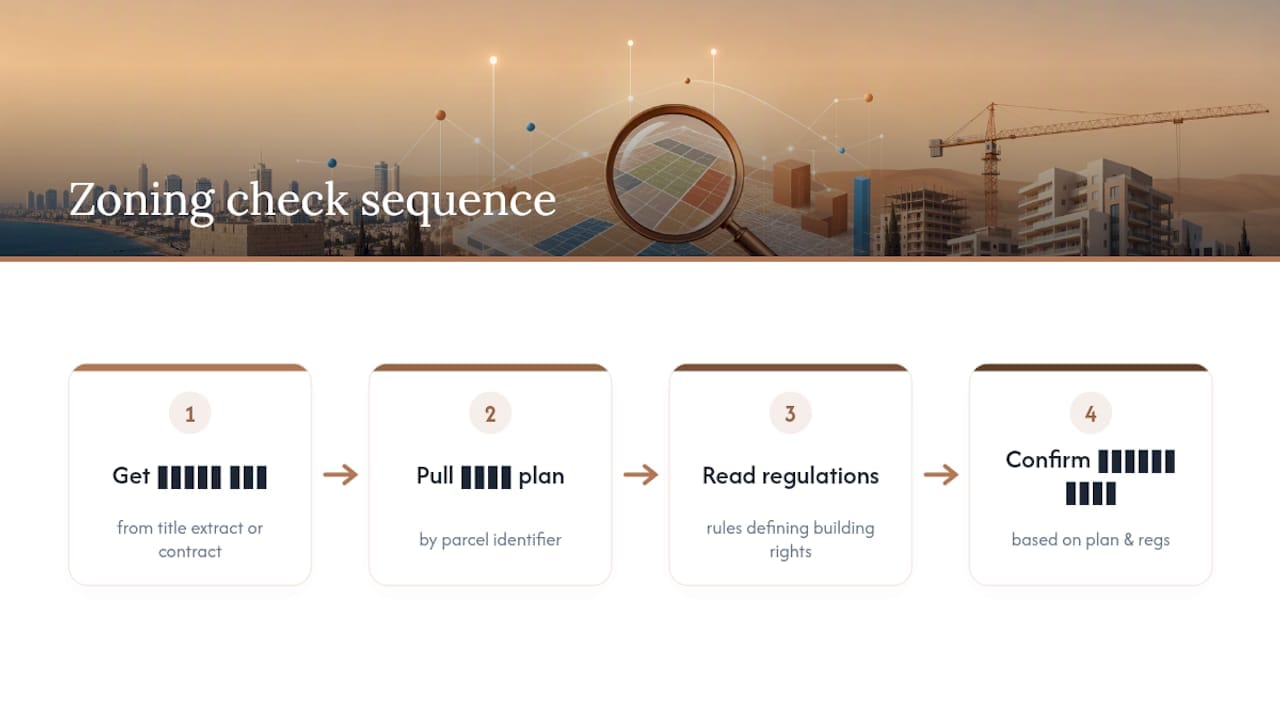
The identifier that matters is גוש וחלקה, the block and parcel number recorded in the Land Registry. A house number on a street can span two different plans, two different zoning designations, or even two different municipalities in edge cases. The Midrag guide to תב"ע checks makes this point directly: a reliable check starts with גוש וחלקה, not an address search, because address lookups routinely return incomplete or mismatched planning data. Get the גוש וחלקה from the נסח טאבו (title extract) or from the seller’s contract before you search anything else.
Where to Look: Official Israeli Planning and Land Databases
Israel runs several public systems for this, and each one gives you a different piece of the picture.
- gov.il’s TabaSearch page (Gov) offers the same underlying search in a more guided interface, useful if you’re new to the system.
- MAVAT (Mavat), run through the Ministry of Interior, and XPLAN (Ags) both show plan status and geometry, which planners use to confirm exactly where a plan’s boundaries fall.
- GovMap (Govmap) adds map context, showing infrastructure lines, conservation zones, and other overlays a plan document alone won’t flag.
Searching by גוש/חלקה across these systems, then cross-checking against the נסח טאבו, avoids the false positives that plague address-only searches. None of these portals replace a signed confirmation, but together they build the evidentiary trail your lawyer needs.
Step-by-Step Verification Checklist Before You Buy or Build
Work through this in order. Skipping steps is how people end up discovering a problem after the deposit is already paid.
- Confirm גוש וחלקה using the seller’s contract or a fresh נסח טאבו pulled from the Land Registry.
- Pull the governing plan files (תשריט, תקנון, נספחים) from RMI TabaSearch, MAVAT, or XPLAN, and save dated copies of everything.
- Read the permitted uses, height and floor limits, אחוזי בנייה (building percentage), and parking requirements in the תקנון text.
- Search for existing permits, enforcement records, demolition orders (צווי הריסה), pending appeals, and חריגות (recorded deviations) tied to the parcel.
- Compare planned works against what the plan actually allows. If they don’t match, you’re looking at a permit process, a הקלה (variance), or a full שינוי תב"ע (plan amendment).
- Request written confirmation from the municipality or RMI, and write conditional clauses into the purchase agreement that make the deal contingent on that confirmation matching expectations.
- Document every step. Screenshots, saved PDFs, filenames, and search dates matter if a dispute surfaces later.
Pro Tip: Save a PDF of every plan file the day you check it, not just a bookmark. Municipal plan portals get updated, and having a dated snapshot of what the file said when you searched is exactly the kind of evidence a lawyer needs if a discrepancy shows up down the line.
How to Read a תשריט and תקנון for Building Rights
The תשריט is the map. Find your parcel by its outline first, then check the color coding and building lines, since those tell you where structures are permitted to sit on the lot and how far back they must sit from boundaries. A parcel colored for residential use looks nothing like one zoned for public or commercial buildings, and the boundary lines on the map often carry more legal weight than anything written in a listing.
The תקנון is the text that actually governs the numbers. Look specifically for:
- Permitted land uses (residential, commercial, mixed, agricultural)
- Maximum floors and building height
- אחוזי בנייה, the building percentage that caps total floor area relative to lot size
- Minimum parking requirements per unit
- Special clauses covering setbacks, green space, or shared infrastructure
Definitions, annexes, and transitional provisions sit at the back of most plan documents, and they frequently narrow or modify rights stated earlier in the text. If a clause reads ambiguous, note the page and section number rather than guessing at its meaning; that’s exactly the kind of language a planning attorney resolves quickly but a buyer can misread badly.
Red Flags That Should Stop You Before You Sign
A few warning signs show up again and again in Israeli property disputes, and most of them are avoidable with the checklist above.
- Address-only searches. If a broker or seller hands you planning information based on the street address alone, treat it as incomplete until verified by גוש וחלקה.
- **Active enforcement files or demolition orders, attached to the parcel, which can transfer risk to a new owner.
- Verbal assurances that contradict the written תשריט or תקנון. Municipal service centers give preliminary answers over the counter, but Tel Aviv’s own municipal guidance states plainly that spoken answers are not legally binding, only signed written confirmations are.
- Hidden constraints like easements, conservation designations, or infrastructure reservations that a plan document might not show on the surface but GovMap’s overlay layers often catch.
- As-built construction that doesn’t match the permit file, meaning what’s physically standing on the lot was never legally approved.
Buyers who skip a written confirmation and rely solely on a verbal answer from a planning clerk are, by the municipality’s own standard, working with information that carries no legal weight in a dispute.
When to Hire Professionals and What Each One Does
Three specialists cover three different layers of a proper check, and skipping one usually means paying for the gap later. For international investors interested in emerging innovations, learning about Dubai Real Estate Tokenisation offers a comparative glimpse into modern property markets.
- A real estate lawyer (עו"ד מקרקעין) drafts the conditional clauses in your purchase contract, obtains the written planning confirmations that hold up as evidence, and files appeals if the municipality’s answer conflicts with what the plan documents show.
- An appraiser (שמאי מקרקעין) should get involved early, before you’re locked into a deal. The Midrag analysis of תב"ע checks notes that an early appraisal catches mismatches between what’s actually built and what’s permitted, and estimates whether the property has real upside or a hidden loss baked in.
- An architect or engineer translates the תשריט and תקנון into actual permit drawings, and scopes out exactly what changes would be needed to make your plans legal.
For clients abroad, coordinating three specialists across a legal system in a different language adds real friction. Experienced Israeli real estate lawyers can review plan documents remotely, draft conditional contract language, and represent clients before planning authorities to simplify management from another time zone.
Pro Tip: If you’re buying from overseas, ask your lawyer to request the written confirmation in parallel with your due diligence period, not after. Municipal response times vary, and waiting until the last week of a contract’s contingency period to request it is one of the most common ways deals fall apart.
Why Lawyer-Led Verification Actually Matters Here
Plan documents change, enforcement records get added, and municipal answers vary depending on who you ask and when. A verification process that stops at a portal search gives you information, not certainty, and the gap between the two is exactly where costly disputes start. International clients often face wider gaps managing planning processes from abroad. Fast, direct communication and strategic reading of plan documents before signing can turn a risky purchase into an informed one.
— Menora Law
How Menora Law Supports Your Property Check
Legal professionals can handle the legal side of a property purchase in Israel from start to finish, including pre-purchase planning checks, contract reviews, and remote representation when needed.
To get started, send over the property’s גוש וחלקה, a draft of the sale contract if one exists, and any plan files you’ve already pulled from RMI or MAVAT. Most initial reviews turn around quickly, and experienced firms working internationally provide direct answers by email or call rather than requiring visits to a local office. If you’re weighing a purchase and want the planning risk assessed before you commit, visit the Real Estate Law in Israel page to see how a pre-purchase legal review works, or head to the Menora Law homepage to reach the team directly.
This article is general information, not a substitute for advice from a qualified lawyer. Consult a qualified legal professional about your own circumstances before acting on anything here.
Sources
FAQ
What Is גוש וחלקה and Why Does It Matter?
Gush and chelek are the block and parcel numbers that identify land in Israel’s Land Registry. Plan boundaries and building rights attach to that identifier, not to a street address, so it’s the only reliable way to search for the correct תב"ע.
Can I Trust a Verbal Answer From the Municipality?
No. Municipal guidance from Tel Aviv states that answers given verbally at a planning service center are preliminary only; a written confirmation is the legally admissible version.
What’s the Difference Between MAVAT and XPLAN?
Both are official Ministry of Interior systems used to view plan status and geometry, but professionals often cross-check them together since each can surface details the other’s interface presents differently.
Do I Need a שמאי and a Lawyer, or Just One?
Both play different roles: the appraiser assesses value and flags mismatches between permitted rights and as-built conditions, while the lawyer secures written confirmations and drafts the contractual protections. Menora Law coordinates both for international clients handling a purchase remotely.
How Long Does a Written Planning Confirmation Take?
Timelines vary by municipality and how complex the plan history is, so it’s worth requesting the confirmation early in your due diligence period rather than waiting until the final week of a contract’s contingency window.


 English
 Afrikaans
 العربية
 বাংলা
বাংলা Čeština
 简体中文
简体中文 Nederlands
 Suomi
Suomi Français
 Deutsch
 עִבְרִית
 हिन्दी
 Magyar
 Italiano
 日本語
日本語 한국어
한국어 Polski
 فارسی
فارسی Português do Brasil
 Русский
 Español de México
 Українська