
Under Israeli law, a minor can be the legal owner of inherited assets but cannot manage them. A surviving parent usually steps in as natural guardian for daily matters, but selling property, withdrawing large sums, or making unusual investments requires approval from the General Guardian or a family court. Probate orders and estate-manager appointments are the norm, not the exception, whenever a child is named heir.
TL;DR:
- Minor’s assets are registered in their name immediately after inheritance, but they cannot sign legal documents or make financial decisions until turning 18.
- Court approval is required for any sale, mortgage, or large withdrawal involving property or funds with a minor co-owner to protect their interests.
- The estate manager’s role involves collecting assets, maintaining property, and submitting periodic court accountings, with outside managers appointed in conflicts or large estates.
- Families should consider drafting wills or trusts tailored to minors’ needs and set provisions to avoid delays or locked funds, especially for urgent expenses.
- Probate processes for minors often involve additional steps, including court approvals and valuations, with legal counsel recommended to navigate disputes and complex filings.
ירושה לקטינים בישראל: ownership without control
A minor who inherits under Israeli law becomes the registered owner of that asset the moment the estate transfers. A bank account gets opened or retitled in the child’s name. A plot of land gets a notation on the Land Registry tab reflecting the minor’s ownership share. On paper, the child owns the asset outright, the same as any adult heir.
Legal capacity is a separate question entirely. A minor cannot sign a lease, authorize a withdrawal, or approve a sale until turning 18. Someone else has to act on the child’s behalf for nearly every practical step, from opening the account to eventually spending the money on tuition or medical needs.
For routine matters, the natural guardian, typically the surviving parent, signs on the child’s behalf. That works fine for depositing a check or paying a school bill. It does not work for anything involving real property, large withdrawals, or long-term financial commitments.
Not every asset flows through this process the same way. Some accounts skip probate entirely:
- Life insurance payouts with a named beneficiary
- Pension death benefits designated directly to the child
- Certain provident fund balances
These instruments still fall under General Guardian oversight once a minor is named, even though they bypass the formal estate. That’s why aligning beneficiary forms with the will matters so much. A mismatch between what the policy says and what the will intends can send money straight to a child’s account with no trust structure, no release conditions, and no protective terms attached.
Who runs the estate: parent, guardian, or court-appointed manager
Guardianship and estate management are two different jobs, even when the same person holds both roles. Guardianship covers the child’s personal welfare, where they live, their schooling, their medical care. Estate management covers the money and property left behind. A surviving parent almost always keeps guardianship. Whether that same parent also gets to manage the estate’s finances is a separate call the court makes.
When a parent is appointed manager of the estate (מנהל עיזבון), the duties are specific and ongoing:
- Collecting and securing estate assets, including outstanding debts owed to the deceased
- Maintaining property in usable condition until final distribution
- Investing conservatively, since state practice discourages risky allocations of funds meant for a child’s future
- Filing periodic accountings with the court and, where required, the General Guardian
Courts sometimes bypass the parent altogether and appoint an outside manager instead. This tends to happen when the estate is large, when there’s a conflict of interest (say, the parent has debts of their own, or a business relationship with the deceased), or when relatives dispute who should hold the purse strings.
Pro Tip: If you expect friction with in-laws or extended family over how estate funds get handled, ask the court to appoint a neutral manager from the start. It costs more upfront but saves years of litigation later.
When you need permission from the General Guardian
The General Guardian exists specifically to prevent a minor’s inheritance from being mismanaged, spent down, or signed away before the child is old enough to object. Certain actions trigger mandatory review no matter how well-intentioned the guardian or manager might be.
Approval is typically required before you can:
- Sell or mortgage real estate the minor co-owns
- Transfer or withdraw large sums from a minor’s account
- Make investments outside conventional, low-risk instruments
- Take any action that could reduce the minor’s future inheritance or benefit someone else at the child’s expense
The court and General Guardian look for specific evidence before signing off. That includes a current property appraisal, a documented explanation of why the child actually needs the funds, and proof that no better alternative exists. Skipping any of these tends to stall the request, not kill it outright, but stall it long enough to matter if you’re facing a deadline.
Here’s the part families underestimate: funds tied to a minor’s inheritance are effectively locked once probate closes. Getting a release approved for tuition, medical treatment, or housing costs takes real time, sometimes weeks, sometimes longer if the paperwork is incomplete. Plan for that lag well before the money is actually needed.
How to file when minors are heirs
Filing for a probate order (צו ירושה) or probate of a will (צו קיום צוואה) with a minor heir named follows the standard process, with a few added layers.
Gather these documents before you start:
- Death certificate
- Identification for all heirs, including birth certificates for minors
- The original will, if one exists
- Bank statements and property records tied to the estate
- Any existing guardianship or custody orders
Then follow these steps:
- Mark the minor status clearly on the application. The Registrar of Inheritance Matters needs to know a child is among the heirs from the first filing, not discover it midway through review.
- Propose a manager of the estate. Name who you want managing the minor’s share, usually the surviving parent, and be ready to justify that choice.
- Pay the filing fee and submit through the Registrar’s office or the relevant family court, depending on whether the matter is contested.
- Expect at least one hearing if the estate includes real property, a business, or any dispute among heirs.
- Request valuations early. Property and business appraisals take weeks to arrange, and courts won’t approve distributions without current numbers.
If a child needs money before probate closes, ask the court for interim or emergency release. Courts do grant these for urgent needs like medical bills or school tuition, but you need documentation showing the need is real and immediate, not just convenient.
Selling property when a minor co-owns it
Courts treat a minor’s share in real estate as something to protect, not something to liquidate quickly. Any sale or mortgage involving property with a minor co-owner needs court approval, and that approval hinges on documentation: a current appraisal, sometimes an independent expert opinion, and a clear plan showing the sale actually serves the child’s best interest rather than just solving an adult’s cash flow problem.
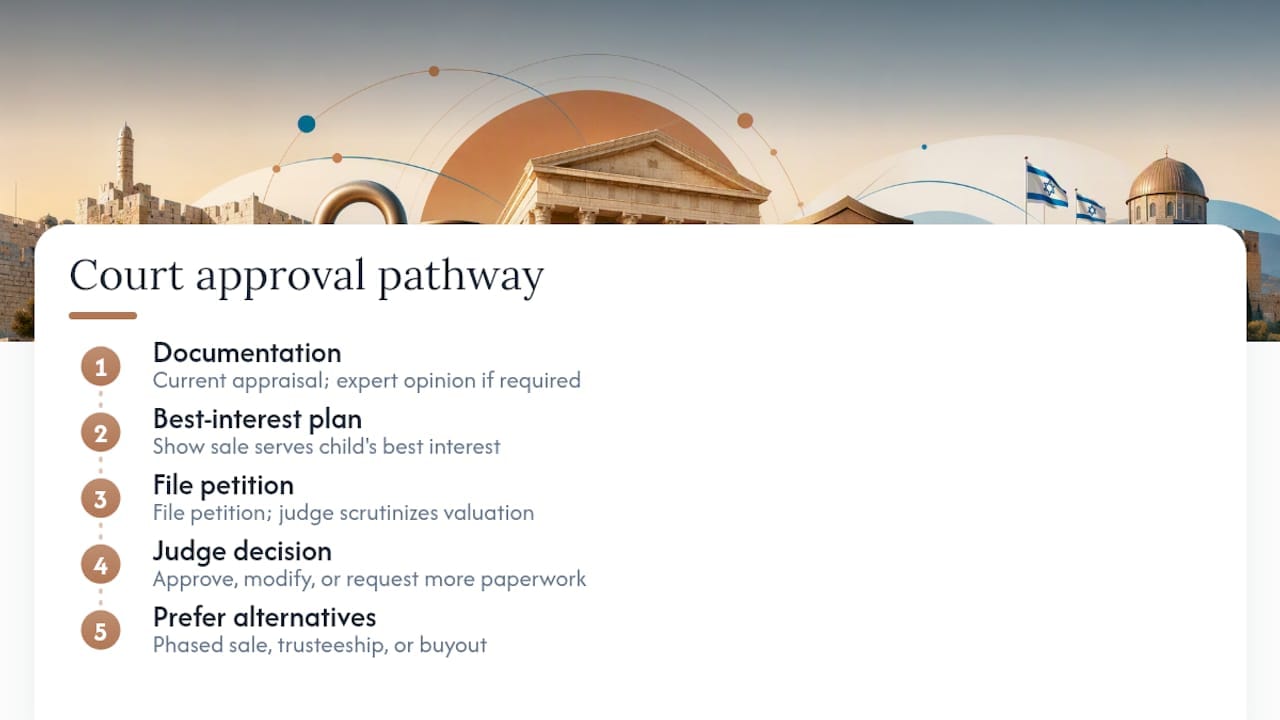
Family court decisions consistently show judges scrutinizing valuations closely before signing off on anything involving a minor’s real estate stake. A stale appraisal or a vague justification is one of the fastest ways to get a request bounced back for more paperwork.
Surviving spouses often want to stay in the family home rather than sell, and Israeli law generally supports that. A surviving parent can petition the court for the right to remain in the residence (זכות למדור), and courts typically grant it, balancing the parent’s housing stability against the minor’s ownership interest in the property.
Pro Tip: If an immediate sale isn’t necessary, propose a phased approach, a court-supervised trusteeship or a buyout arrangement between the surviving parent and the estate. Judges tend to favor solutions that avoid displacing a grieving family right away.
Planning ahead: wills, mutual wills, and conditional transfers
The best protection against locked funds and court delays is a will drafted with a minor’s inheritance specifically in mind, not a generic template.
Mutual wills (צוואה הדדית) let spouses coordinate their estate plans so the surviving partner keeps stability while the children’s eventual share stays protected. They come with a catch: Israeli statute and case law limit how and when one spouse can cancel or amend the will after the other dies, so drafting needs care from someone who actually understands those restrictions.
A testamentary trust or conditioned transfer gives you more control than a bare probate distribution allows:
- Set a release age higher than 18 if you don’t want a young adult receiving a lump sum at the earliest legal moment
- Specify permitted uses, education, housing, medical costs, rather than leaving it open-ended
- Name a trustee separate from the guardian if you want an extra layer of oversight
None of this works if your paperwork contradicts itself. Life insurance and pension beneficiary forms need to match what the will says. A policy naming a 10-year-old directly, with no trust language attached, overrides your careful estate plan the moment the insurer pays out.
Common complications that lead to disputes
A few recurring problems account for most of the fights that end up in family court:
- Estranged relatives or a former spouse attempting to claim control over a minor’s funds
- Debt-heavy estates where renunciation of the inheritance (הסתלקות) becomes worth considering to protect the child from inherited liabilities
- Beneficiary forms that don’t match the will, triggering automatic transfers the will never intended
- Missing appraisals, vague manager proposals, or incomplete documentation that stall General Guardian approval for months
Any one of these is a strong signal it’s time to bring in counsel rather than handle the filing solo.
Menora Law’s approach for families and overseas heirs
We handle probate filings and General Guardian approvals for families managing a minor’s inheritance, including heirs living outside Israel. Intake happens remotely: we collect death certificates, wills, and property records digitally, then file the probate application with minor status flagged from day one. Clients typically see the first hearing scheduled within weeks, not months, when documentation is complete. Our priority throughout stays fixed on protecting the child’s long-term share while still enabling reasonable, timely access to funds for urgent needs.
— Menora Law
Get help filing for a minor’s inheritance in Israel
If you’re managing an estate where a child stands to inherit, the paperwork alone can feel like a maze, appraisals, General Guardian filings, court hearings, all while you’re grieving. We work specifically with overseas heirs and international families navigating Israeli succession law, and that focus means faster turnaround than a general practice juggling unrelated cases.

We handle probate filings for minor heirs, draft mutual wills and testamentary trusts built to avoid locked funds, and represent clients directly before the General Guardian and family court. Consultations happen remotely by video for overseas clients, or in person if you’re in Israel, and we’ll ask for the same core documents outlined above: the will, death certificate, IDs, and property or account records. Start with our guide to Israeli inheritance law for a fuller picture of how succession works, or reach out directly to schedule a consultation and get your child’s inheritance moving through probate correctly the first time.
Sources
The Ministry of Justice’s probate order service publishes the official procedures and forms for filing, along with contact details for the Registrar of Inheritance Matters. For broader background on estate administration and succession procedures in Israel, Our guide to succession and probate covers the process step by step, and readers outside Israel may also find a useful comparative primer through Lydon Law’s estate planning resources.
This article is general information, not a substitute for advice from a qualified lawyer. Consult a qualified legal professional about your own circumstances before acting on anything here.
- מידע לאלמנים ואלמנות ביחס לנכסי ילדיהם הקטינים
- עזבונות עם יורשים קטינים: איך להגן על זכויות הילדים בחוק הירושה?
- צוואה הדדית: המדריך המשפטי המקיף לתכנון ירושה זוגי 2026
FAQ
What happens to an inheritance split between a spouse and children?
Under Israeli succession law, a surviving spouse and children divide the estate according to statutory shares unless a valid will states otherwise, and any portion going to minor children gets held under guardian or estate-manager control until they turn 18.
Does a will need to divide an inheritance between spouses during marriage?
No. Inheritance only becomes relevant after death; during marriage, property division follows Israel’s marital property rules, not succession law, so a will has no bearing on assets while both spouses are alive.
What are the basic inheritance laws in Israel?
Israel’s Succession Law sets statutory shares for spouses, children, and other relatives when no valid will exists, and requires a probate order or probate of a will before an estate can be distributed, with added General Guardian oversight whenever a minor is among the heirs.
Do inherited funds get divided in a divorce?
Generally, inheritance is treated as separate property in an Israeli divorce and isn’t automatically split between spouses, though this can shift if inherited funds were mixed into joint marital assets. Speak with an attorney about your specific situation to understand how your case is likely to be treated.


 English
 Afrikaans
 العربية
 বাংলা
বাংলা Čeština
 简体中文
简体中文 Nederlands
 Suomi
Suomi Français
 Deutsch
 עִבְרִית
 हिन्दी
 Magyar
 Italiano
 日本語
日本語 한국어
한국어 Polski
 فارسی
فارسی Português do Brasil
 Русский
 Español de México
 Українська