
TL;DR:
- Israeli family law disputes involving foreign residents depend on meaningful connections to Israel, not just citizenship or visits. Courts require residence, domicile, or substantial ties, and recent rulings limit jurisdiction based on brief presence, such as airport transits. Effective legal strategy includes early documentation of ties, proper court selection, and specialized counsel to navigate cross-border evidence and property issues.
An Israeli family law dispute involving a foreign resident is defined as any legal proceeding before Israeli courts concerning divorce, child custody, child support, or property division where at least one party holds primary residence outside Israel. Israeli family law for foreigners is governed by a dual-court system: civil family courts under the Israeli Judicial Authority and rabbinical courts with authority over Jewish marriage and divorce. Recent 2025 Supreme Court rulings have fundamentally reshaped how Israeli courts claim jurisdiction over foreign residents, making it more critical than ever to understand your rights before any proceedings begin. Menora Law works with foreign residents facing exactly these situations, providing clear legal strategy from the first step forward.
How does Israeli jurisdiction apply to family law disputes involving foreign residents?
Israeli courts do not automatically have authority over every family dispute simply because one party holds Israeli citizenship or briefly visited the country. Jurisdiction in Israeli family law disputes requires a substantive connection to Israel, a legal standard that goes well beyond passport status or a short trip.
The criteria Israeli courts use to establish jurisdiction include:
- Habitual residence: At least one party must have their primary center of life in Israel, not merely a registered address.
- Domicile: A party’s long-term legal home, distinct from temporary stays, carries significant weight.
- Substantive connection: Courts examine employment, property ownership, children enrolled in Israeli schools, and the duration of actual life in Israel.
- Marriage or divorce registration: Marriages registered in Israel create a stronger jurisdictional basis for related disputes.
The distinction between civil family courts and rabbinical courts matters here. Civil family courts apply the substantive connection test broadly to all parties regardless of religion. Rabbinical courts hold exclusive authority over Jewish marriage and divorce but are equally bound by the requirement for meaningful ties to Israel. A foreign Jewish couple passing through Israel cannot be pulled into rabbinical court proceedings simply because they landed at Ben Gurion Airport.
The 2025 Supreme Court ruling that ended airport-based jurisdiction is the most significant recent development for foreign residents. The court rejected the practice of initiating divorce proceedings against a spouse who was merely transiting through Israel, ruling that brief physical presence creates no valid jurisdictional basis. This ruling aligns Israeli law with broader international legal standards requiring genuine, meaningful connections before courts proceed with family matters.

For foreign residents, this ruling cuts both ways. If you are a foreign resident being served with proceedings in Israel based on a brief visit, you have strong grounds to contest jurisdiction. If you are the party seeking to initiate proceedings in Israel, you need to demonstrate your substantive connection clearly and early.
Pro Tip: If you fear proceedings being initiated against you in Israel based on a short visit, document your primary center of life abroad thoroughly. Bank records, lease agreements, employment contracts, and school enrollment records for your children all serve as evidence that Israel lacks jurisdiction over your case.
What are the step-by-step procedures for filing a family law dispute in Israel as a foreign resident?
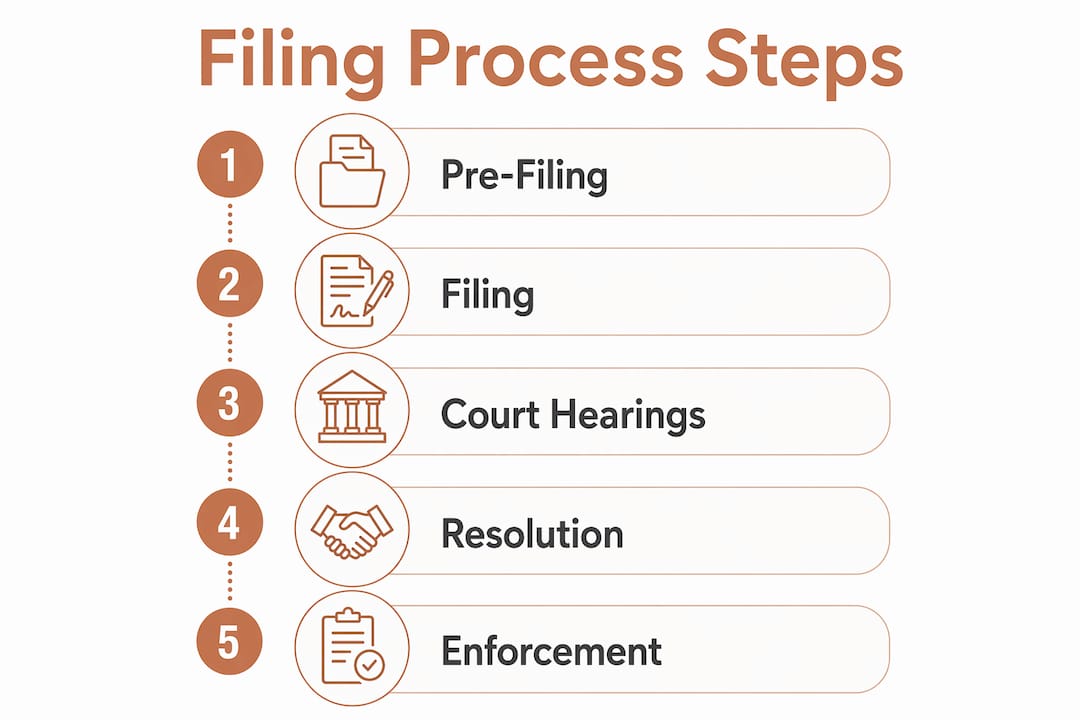
Filing a family law claim in Israel follows a defined procedural path regardless of whether you are inside the country or abroad. Understanding each stage prevents costly delays and procedural errors.
- Attempt resolution first. De gov.il filing service requires that parties demonstrate attempts to resolve the dispute before a formal claim is accepted. This typically means documented communication or a failed mediation attempt.
- Choose the correct court. Jewish parties dealing with divorce must file with the rabbinical court for the divorce itself, while property and custody matters can be filed in civil family court. Non-Jewish parties file all matters in civil family court.
- Prepare your documentation. Required documents generally include marriage certificates (apostilled if issued abroad), proof of residence or substantive connection, financial disclosure statements, and any existing custody or support agreements.
- Submit the claim through the Judicial Authority portal. The Israeli Judicial Authority operates an online filing system accessible from abroad, which is particularly useful for foreign residents who cannot appear in person.
- Serve the opposing party. Cross-border service of process follows the Hague Service Convention when the other party resides in a signatory country. Your attorney coordinates this process.
- Attend preliminary hearings. Israeli family courts schedule a preliminary hearing within weeks of filing. Remote participation via video link is available for foreign residents with prior court approval.
- Proceed to mediation or trial. Courts actively encourage mediation before formal litigation. Many disputes, particularly those involving property division, resolve at this stage.
The timeline from filing to resolution varies significantly. Uncontested divorces with agreed terms can conclude in three to six months. Contested custody or property disputes routinely take one to three years, particularly when cross-border evidence gathering is required.
| Stage | Typical Timeframe | Key Requirement |
|---|---|---|
| Pre-filing resolution attempt | 1 to 4 weeks | Documented communication or mediation |
| Court filing and acceptance | 1 to 2 weeks | Complete documentation package |
| Preliminary hearing | 4 to 8 weeks after filing | Appearance or approved remote participation |
| Mediation process | 2 to 6 months | Both parties’ cooperation |
| Trial (if contested) | 12 to 36 months | Full evidence and witness preparation |
Pro Tip: Foreign residents should retain Israeli legal counsel before filing, not after. Procedural errors made at the filing stage, such as submitting to the wrong court or failing to apostille foreign documents, can delay your case by months and give the opposing party grounds to challenge jurisdiction.
How are child custody and child support matters handled under Israeli law for foreign residents?
Child custody decisions in Israeli family courts are governed by the best interests of the child standard, the same principle applied in most jurisdictions worldwide. What makes Israeli proceedings distinctive for foreign residents is how courts weigh international factors alongside domestic ones.
Israeli courts consider the following when determining custody arrangements:
- Primary caregiver history: Which parent has been the primary day-to-day caregiver during the marriage carries substantial weight.
- Stability and continuity: Courts favor arrangements that minimize disruption to the child’s schooling, friendships, and cultural environment.
- Each parent’s ability to facilitate the other’s relationship with the child: A parent who actively undermines the other’s contact is viewed unfavorably.
- The child’s own preferences: For children above approximately age 10, courts give increasing weight to the child’s expressed wishes.
- Safety considerations: Allegations of domestic violence, substance abuse, or neglect trigger separate protective proceedings.
Joint custody is recognized under Israeli law and is increasingly common in cases where both parents demonstrate cooperation and geographic proximity. Sole custody is granted when one parent is absent, unfit, or poses a risk to the child’s welfare.
Relocation cases are among the most contested matters in foreign resident custody issues. A May 2026 court decision reinforced that relocation requests require detailed judicial findings weighing the realistic impact on the non-relocating parent’s visitation, the child’s cultural ties, and the practical enforceability of any new custody arrangement across borders. This means a parent seeking to relocate abroad with a child faces a high evidentiary burden.
Child custody orders involving relocation must be carefully evaluated based on the child’s best interests, with courts required to produce detailed findings that consider cultural, safety, and travel complexities before approving any cross-border move.
Child support in Israel is calculated based on the non-custodial parent’s income, the child’s established standard of living, and the direct costs of the child’s needs. Israeli courts can enforce support orders against assets held in Israel even when the paying parent lives abroad. Cross-border enforcement against assets held entirely outside Israel requires coordination through bilateral treaties or foreign court recognition of the Israeli order, which is why early legal advice on enforcement strategy is critical.
What are the key rules and processes for property division in family disputes involving foreign residents in Israel?
Property division in Israeli divorce proceedings follows the Property Relations Law, which establishes the principle of resource equalization. Under this law, each spouse is entitled to half the value of all assets accumulated during the marriage, regardless of whose name those assets are registered in.
The following comparison illustrates how different asset categories are treated:
| Asset Type | Treatment Under Israeli Law | Notes |
|---|---|---|
| Assets acquired during marriage | Split equally between spouses | Applies to property, savings, and business interests |
| Assets owned before marriage | Remain with original owner | Must be clearly documented |
| Inherited assets | Excluded from equalization | Even if received during marriage |
| Gifts from third parties | Excluded from equalization | Requires proof of gift origin |
| Appreciation of pre-marital assets | Subject to dispute and court discretion | Often contested in litigation |
For foreign residents, the critical question is which assets fall within Israeli court jurisdiction. Israeli courts can order equalization of assets located in Israel regardless of the parties’ nationality. Assets held abroad are more complex. Courts may include them in the equalization calculation but enforcing an order against foreign-held assets requires separate legal proceedings in the relevant jurisdiction.
Prenuptial agreements are legally binding in Israel only when voluntarily signed and approved by either a family court or a rabbinical court before or at the time of marriage. An agreement signed privately between spouses without court approval carries no legal force under Israeli law. This surprises many foreign residents who assume that a prenuptial agreement valid in their home country will be recognized automatically in Israel. It will not be, unless it meets Israeli approval requirements.
Pro Tip: If you entered your marriage with significant pre-marital assets or expect to inherit property, a court-approved prenuptial agreement under Israeli law is one of the most effective tools available to protect those assets. Negotiating and approving such an agreement also tends to produce clearer financial expectations within the marriage itself.
The difference between family court and rabbinical court approaches to property matters is worth noting. Rabbinical courts apply religious law principles alongside civil law, which can produce different outcomes on questions of financial obligations between spouses. Foreign residents who are Jewish should understand that rabbinical court proceedings on divorce can directly affect property division outcomes, making coordinated legal strategy across both court systems necessary.
Key takeaways
Foreign residents facing an Israeli family law dispute must establish jurisdictional standing, follow formal filing procedures, and engage specialized legal counsel to protect custody, support, and property rights effectively.
| Point | Details |
|---|---|
| Jurisdiction requires substance | Israeli courts need a genuine, meaningful connection to Israel, not just citizenship or a brief visit. |
| File through the correct court | Jewish divorce matters go to rabbinical court; all other family disputes belong in civil family court. |
| Relocation orders face high scrutiny | Courts require detailed findings on child welfare before approving any cross-border relocation. |
| Prenuptial agreements need court approval | A privately signed prenuptial agreement has no legal force in Israel without family or rabbinical court approval. |
| Property equalization covers marital assets | Assets accumulated during marriage are split equally, while pre-marital and inherited assets are generally excluded. |
What we have learned from handling these cases
At Menora Law, the cases that concern us most are the ones where a foreign resident first learns about Israeli proceedings against them when papers arrive at their door abroad. The 2025 Supreme Court ruling on airport-based jurisdiction was a genuine turning point, but it does not mean foreign residents are automatically protected. Courts still look hard at the facts, and a party who can demonstrate even modest ties to Israel, property ownership, a bank account, family members, will argue for jurisdiction.
What we tell every foreign resident who comes to us is this: do not wait for proceedings to begin before you think about jurisdiction. If you have any connection to Israel, whether through property, business, or family, and your marriage is under strain, get legal advice now. The cost of a consultation is a fraction of the cost of contesting jurisdiction after the fact.
Cross-border evidence collection is another area where cases stall unnecessarily. Documents issued abroad need apostilles. Financial records from foreign banks require formal requests. Witnesses living outside Israel need to be prepared for remote testimony. None of this is impossible, but all of it takes time. The foreign residents who fare best in Israeli family proceedings are the ones who start gathering documentation early, before the other side has filed anything.
We have also seen how property disputes become significantly more complicated when one spouse holds assets in multiple countries. Israeli courts can and do include foreign assets in equalization calculations. Enforcing those orders abroad is a separate challenge, but the calculation itself happens in the Israeli proceeding. Understanding this from the outset shapes the entire litigation strategy.
The practical advice we give most often is straightforward: get specialized legal representation early, document your connections to Israel or your lack of them, and treat mediation seriously. Most family disputes that resolve through mediation produce better outcomes for both parties than those that go to full trial, and they do so in a fraction of the time.
— Menora Law
How Menora Law helps foreign residents with Israeli family law matters
Menora Law specializes in Israeli family law for international clients, including foreign residents dealing with divorce, custody disputes, child support enforcement, and property division. The firm handles cross-border cases with a practical, results-focused approach, coordinating evidence gathering, court filings, and remote participation so clients do not need to be physically present in Israel for every stage of proceedings.

Whether you are facing proceedings initiated against you in Israel or need to protect your parental and financial rights as a foreign resident, Menora Law provides the legal strategy and direct communication that complex cross-border cases demand. The firm’s Israeli legal services for foreigners cover the full range of family law matters, from initial jurisdiction analysis to final enforcement of court orders. Contact Menora Law today to discuss your situation with an attorney who understands both Israeli law and the realities of living abroad.
FAQ
What is the substantive connection test in Israeli family law?
The substantive connection test requires that at least one party have genuine, meaningful ties to Israel, such as habitual residence, property ownership, or children enrolled in Israeli schools, before Israeli courts can claim jurisdiction over a family dispute. A brief visit or transit through Israel does not satisfy this standard under the 2025 Supreme Court ruling.
Can a foreign resident file for divorce in Israel from abroad?
Yes. The Israeli Judicial Authority provides an online filing service accessible from outside Israel, and courts can approve remote participation via video link for foreign residents who cannot attend hearings in person.
How does Israel calculate child support for foreign resident parents?
Israeli courts calculate child support based on the non-custodial parent’s income, the child’s established standard of living, and the direct costs of the child’s needs. Enforcement against assets held in Israel is straightforward; enforcement against assets held entirely abroad requires treaty-based cooperation or foreign court recognition of the Israeli order.
Are prenuptial agreements from other countries valid in Israel?
A prenuptial agreement signed abroad is not automatically recognized in Israel. For a prenuptial agreement to be legally binding under Israeli law, it must be approved by an Israeli family court or rabbinical court. Foreign residents with existing agreements should have them reviewed by Israeli counsel to determine whether they carry any legal weight in Israeli proceedings.
What happens to property held abroad in an Israeli divorce?
Israeli courts can include foreign-held assets in the equalization calculation under the Property Relations Law, meaning they count toward the total marital estate to be divided. However, actually enforcing an Israeli property order against assets located in another country requires separate legal proceedings in that jurisdiction, which is why cross-border legal coordination is critical from the start of any property dispute.
Recommended
- Legal Israel: What Foreigners And Investors Must Know
- Inheritance And Succession Law In Israel: A Comprehensive Guide For Foreign Residents And Heirs | Menora Law
- Israeli Legal Aid Eligibility Explained For Families
- Tips van Israëlische advocaten: Hoe kunt u als buitenlander eenvoudig land kopen in Israël volgens de landwetgeving in Israël? | Menora Law


 English
 Afrikaans
 العربية
 বাংলা
বাংলা Čeština
 简体中文
简体中文 Nederlands
 Suomi
Suomi Français
 Deutsch
 עִבְרִית
 हिन्दी
 Magyar
 Italiano
 日本語
日本語 한국어
한국어 Polski
 فارسی
فارسی Português do Brasil
 Русский
 Español de México
 Українська