
To import goods into Israel, you must do three things before your shipment leaves the dock: classify your goods by Harmonized System (HS) code, prepare a signed commercial invoice (or a signed FTA invoice declaration if you’re shipping from the U.S.), and confirm whether your product appears on Israel’s non-automatic licensing schedules under the Free Import Order 2014. Get those three steps right, and customs clearance through Israel’s Sha’ar Olami system moves predictably. Miss any one of them, and you face storage fees, re-inspection costs, or worse, shipment seizure.
Here is what to confirm before you ship:
- HS classification: Verify the correct code using Israel Customs’ pre-ruling service before departure, not after arrival.
- Signed commercial invoice: The invoice must be signed by the manufacturer, consignor, owner, or authorized agent and include the tariff heading number, composition details, and all shipping cost elements.
- FTA invoice declaration: U.S. exporters must print and sign an invoice declaration confirming rules of origin. No separate green form is required since January 10, 2018.
- Non-automatic license check: Confirm whether your HS code triggers a permit under Schedules 1 or 2 of the Free Import Order 2014, administered through the relevant Israeli ministry.
- Agency pre-approvals: Food, pharmaceuticals, electronics, and several other categories require advance permits from the Israel Standards Institution (SII), Ministry of Health, or Ministry of Agriculture before the goods arrive.
If your product sits in a gray area, request a pre-ruling from Israel Customs or контакт Menora Law for a quick legal check before you commit to a shipment.
Key Takeaways
Israeli import licensing requirements hinge on three non-negotiable steps: correct HS classification, a complete signed commercial invoice (with FTA declaration for U.S. goods), and advance confirmation of any ministry permits required under Israel’s Free Import Order 2014.
| Point | Details |
|---|---|
| HS classification is the legal foundation | The HS code determines duty rates, VAT, purchase tax, and whether a non-automatic import license is required. |
| FTA invoice declaration replaces the green form | U.S. exporters must print and sign an invoice declaration on the commercial invoice; the hard-copy Certificate of Origin has not been required since January 10, 2018. |
| Non-automatic licensing takes 7–21 working days | Once documentation is complete, ministry processing under the Free Import Order 2014 typically falls within this window; start early. |
| SII and ministry pre-approvals must precede arrival | Goods subject to mandatory Israeli standards or ministry permits cannot be released without those approvals in hand. |
| Menora Law provides remote legal review | For classification disputes, permit challenges, or pre-shipment compliance checks, Menora Law works remotely with overseas clients from initial inquiry through resolution. |
Which goods commonly require licenses, permits, or mandatory approvals in Israel
Not every product needs a special permit, but a significant number of categories do. Knowing which Israeli authority handles your product type saves weeks of back-and-forth after arrival.
Product categories that typically require permits or approvals
- Food and agricultural products: Ministry of Health (processed food, food additives, dietary supplements) and Ministry of Agriculture (fresh produce, plants, seeds, live animals). Phytosanitary certificates are standard for plant-based goods.
- Pharmaceuticals and medical devices: Ministry of Health registration is mandatory; importers must hold an approved importer license and, in many cases, warehouse approval.
- Electronics and telecommunications equipment: SII certification and/or Ministry of Communications type approval, depending on the device category.
- Vehicles and vehicle parts: Ministry of Transport approval and, for some components, SII conformity.
- Pets and live animals: Specific gov.il permits apply; pet import rules cover health certificates, quarantine conditions, and quantity limits.
- Weapons, dual-use goods, and certain chemicals: Ministry of Defense or Ministry of Economy licensing; export control classifications from the country of origin must also be reviewed.
- Hazardous materials: Environmental Protection Ministry oversight, with specific packaging and labeling requirements.
Primary authority by product category
| Product Category | Primary Israeli Authority |
|---|---|
| Food and food additives | Ministry of Health |
| Fresh produce, plants, seeds | Ministry of Agriculture |
| Pharmaceuticals and medical devices | Ministry of Health |
| Electronics and electrical appliances | SII / Ministry of Communications |
| Vehicles and automotive parts | Ministry of Transport |
| Weapons and dual-use goods | Ministry of Economy / Ministry of Defense |
| General customs and tariff questions | Israel Customs (Israel Tax Authority) |
| Pets and live animals | Ministry of Agriculture / gov.il |
Understanding Israel’s non-automatic licensing system
Israel applies non-automatic licensing under the Free Import Order 2014 for reasons of safety, health, environment, and national security. Schedules 1 and 2 of that Order list the specific HS codes subject to licensing. Schedule 1 goods require a permit before importation; Schedule 2 goods may require post-arrival approval or monitoring. Processing is typically handled by the relevant ministry and is usually completed within roughly 7–21 working days once documentation is complete.
Pro Tip: Before finalizing your shipment, run your HS code against the Free Import Order schedules and submit a pre-ruling request through the gov.il Customs portal if there is any doubt about classification or permit requirements. A binding pre-ruling eliminates the risk of a surprise hold at the port.
Essential documents to prepare before shipment for Israeli import clearance
Israel Customs expects a complete, consistent document package at the time of declaration. Missing or incomplete documents are the single most common cause of delays and demurrage charges.
Core document checklist
- Commercial invoice (signed): Must include supplier and buyer details, full goods description, HS tariff heading number, composition details, weight, unit price, total value, and all shipping cost elements (packing, freight, insurance). The signature must come from the manufacturer, consignor, owner, or authorized agent.
- Packing list: Itemized list matching the invoice, with gross and net weights and package counts.
- Bill of lading or airway bill: Original or telex release accepted; must match the invoice description.
- Certificate of origin or FTA invoice declaration: For U.S. goods claiming preferential duty treatment, a signed invoice declaration replaces the old green form Certificate of Origin.
- Import license or ministry approval: Required when the HS code appears on the Free Import Order schedules; must be obtained before arrival.
- Lab or test reports: Required for SII-regulated goods (electronics, toys, baby products, plumbing fixtures, and others); goods cannot be released without the SII permit.
- SII or Ministry of Economy conformity certificate: For goods subject to mandatory Israeli standards.
- Phytosanitary or sanitary certificate: Required for plant-based goods, fresh produce, and certain animal products.
U.S.-Israel FTA invoice declaration wording
Common errors that cause clearance delays
- Missing or illegible signature on the commercial invoice
- Incomplete product description (no composition percentages, no technical specs)
- Incorrect or overly broad HS code that triggers a permit the exporter did not anticipate
- Missing lab test reports or product samples for SII review
- No import license number on the invoice when a license was issued
- FTA invoice declaration absent or unsigned for U.S.-origin goods
The commercial invoice should carry the import license number in a clearly labeled field when a license has been issued. The signatory on the invoice and the signatory on the FTA declaration can be the same person, but both signatures must be present and legible.
Key Israeli agencies, typical permits, and certification programs you may need
Understanding which agency handles your product, and what they will ask for, lets you build a realistic pre-shipment timeline instead of discovering requirements at the port.
Agency roles at a glance
- Israel Customs / Israel Tax Authority: Administers tariff classification, customs duties, VAT, and purchase tax; issues pre-rulings; manages the Sha’ar Olami clearance system.
- Israel Standards Institution (SII): Issues mandatory conformity certificates for regulated product categories (electrical appliances, toys, baby products, taps, plumbing fixtures, and others); requires sample submission and may conduct on-site examinations.
- Ministry of Health: Registers pharmaceutical importers and products; approves food importers and warehouses; issues permits for food additives and dietary supplements.
- Ministry of Agriculture: Issues phytosanitary permits for plants, seeds, and fresh produce; oversees live animal imports.
- Ministry of Economy and Industry (MoC): Administers the Free Import Order licensing schedules; issues permits for dual-use goods and certain industrial products.
- Ministry of Communications: Issues type approvals for telecommunications and radio-frequency equipment.
- Ministry of Transport: Approves vehicle imports and certain automotive components.
- Environmental Protection Ministry: Oversees hazardous materials, chemicals, and waste-related imports.
Typical processing timelines
- Israel Customs pre-ruling: No fixed statutory deadline; allow 4–8 weeks for a complete response when samples and technical documentation are submitted.
- SII conformity certification: Varies by product complexity; sample testing alone can take several weeks, and the full process may extend to 2–4 months for new product categories.
- Ministry of Health (food/pharma): Importer registration can take several months; individual product permits typically require 4–8 weeks once the importer is registered.
- Ministry of Agriculture (phytosanitary): Advance permit applications for fresh produce should be submitted well ahead of shipment; USDA/FAS guidance notes that some fresh produce categories require significant advance notice.
- Free Import Order licensing (general): Processing is typically completed within 7–21 working days once documentation is complete, and licensing fees are generally not charged.
Documents commonly requested by agency
- SII: Product samples, technical specifications, lab test reports from accredited laboratories, and manufacturer declarations.
- Ministry of Health (food): Importer registration certificate, warehouse approval, product composition and labeling details, and country-of-origin documentation.
- Ministry of Health (pharma/medical devices): Product registration dossier, importer license, storage facility approval, and sometimes clinical or safety data.
- Ministry of Agriculture: Phytosanitary certificate from the country of export, import permit application, and sometimes quarantine inspection results.
A critical practical point: many import permits are issued only to entities registered in Israel. If you are a foreign exporter without an Israeli subsidiary, you will need a registered Israeli importer of record to hold the permit on your behalf. Coordinating this relationship before shipment, not after, is one of the clearest differentiators between smooth clearance and costly delays.
How HS classification determines your duties, taxes, and permit obligations
HS classification is the legal starting point for every import into Israel. The code you assign to your goods determines the applicable customs duty rate, VAT, purchase tax, and whether your product appears on the non-automatic licensing schedules. Getting it wrong is not a paperwork error; it creates retroactive customs liability.
How to request a pre-ruling from Israel Customs
- Prepare a detailed product description: Include the commercial name, technical name, function, composition (with percentages), manufacturing process, and intended use.
- Gather technical documentation: Product catalogs, technical data sheets, safety data sheets, and any existing foreign customs classifications.
- Collect samples or lab reports: Israel Customs may request physical samples or accredited lab test results to confirm composition.
- Submit via the gov.il portal: Use the official pre-ruling service to file the request; the submission should reference the candidate HS heading you believe applies and explain your reasoning.
- Await binding guidance: The pre-ruling, once issued, is binding on Israel Customs for the described goods and provides certainty for duty rates and permit requirements.
Landed cost components to estimate
When budgeting an import, the total landed cost in Israel typically includes:
- Customs duty: Rate determined by HS code; reduced or zero under the U.S.-Israel FTA for qualifying goods.
- Purchase tax: Applies to certain goods (vehicles, electronics, luxury items) at rates set by HS code.
- VAT: Currently 17% on the CIF value plus duty plus purchase tax.
- Customs processing fees: Administrative fees charged by Israel Customs.
- Port and storage costs: Demurrage and storage fees accrue quickly if clearance is delayed.
- Customs broker fees: Broker commissions for filing the Reshimon (customs declaration) and managing the clearance process.
Pro Tip: Document your technical specifications with photographs, component percentage breakdowns, and any existing EU or U.S. customs classification rulings. Israel Customs gives significant weight to well-organized technical dossiers, and a pre-ruling supported by strong documentation is resolved faster and with less risk of reclassification.
U.S.-Israel Free Trade Agreement essentials and how U.S. exporters claim preferential duty treatment
U.S. exporters must provide a signed invoice declaration and confirm that their goods meet the FTA’s rules of origin. No separate green form Certificate of Origin is required. Effective January 10, 2018, the invoice declaration replaced the old hard-copy certificate, and Israeli Customs enforces the declaration requirement strictly. A missing or unsigned declaration means the shipment is assessed at the standard (MFN) duty rate, not the preferential FTA rate.
Sample invoice declaration wording
Checklist for claiming FTA preferential treatment
- Confirm that your goods meet the FTA’s rules of origin (substantial transformation or tariff shift criteria, depending on the product).
- Maintain production records, supplier declarations, and bill-of-materials documentation to support origin claims.
- Print the signed invoice declaration on the commercial invoice itself (not on a separate sheet).
- For large-volume exporters, investigate the Approved Exporter scheme, which allows pre-authorized exporters to self-certify origin without individual shipment-by-shipment review.
- Coordinate with the Israeli importer and customs broker before departure to confirm the declaration wording is acceptable and the HS code matches what the broker will declare.
Transshipment and the Certificate of Non-Manipulation
When U.S. goods move through a third country before reaching Israel, preferential FTA status can be lost if customs authorities cannot confirm the goods were not processed or transformed in transit. To preserve preferential treatment, obtain a Certificate of Non-Manipulation from the customs authority of the transshipment country. This document confirms the goods remained under customs control and were not altered during transit. Without it, Israeli Customs may deny the FTA rate even if the invoice declaration is present.
Who is the importer of record and how does clearance work through Sha’ar Olami
The importer of record is the entity legally responsible for the goods from the moment they enter Israeli territory. That entity files the customs declaration, pays duties and taxes, holds any required import licenses, and bears liability for retroactive customs assessments (known as gira’on) if a classification error is discovered later.
The clearance workflow
- Shipment arrival: Goods arrive at the port of entry (Ashdod, Haifa, or Ben Gurion Airport) and are registered in the Sha’ar Olami national customs database.
- Reshimon submission: The customs broker transmits the customs declaration (Reshimon) electronically through Sha’ar Olami, attaching all required documents.
- Selection for examination: Customs appraisers select the declaration for documentary review (desk review of documents) or physical inspection (examination of the actual goods). The selection is risk-based.
- Release or hold: If documents are complete and the classification is accepted, the goods are released upon payment of duties and taxes. If there is a discrepancy, a hold is issued and additional documentation or physical inspection is required.
- Post-clearance audit: Israel Customs retains the right to audit classifications and valuations for several years after clearance; retroactive deficits can be assessed if errors are found.
Importer of record responsibilities
- Hold a valid Israeli business registration or appoint a registered Israeli entity as importer of record.
- Maintain all import documents for the statutory retention period.
- Ensure any required ministry permits are obtained and their numbers appear on the Reshimon.
- Where Ministry of Health requires specialized storage (cold chain, pharmaceutical-grade warehouses), have a signed warehouse agreement in place before the goods arrive.
- Pay all duties, taxes, and fees at the time of release; provide a customs bond or guarantee where required for deferred payment.
Typical timing and cost checkpoints
- Routine clearance (complete documents, no exam): 1–3 business days from Reshimon submission.
- Documentary review: Add 2–5 business days.
- Physical inspection: Add 3–7 business days; goods remain in port storage during this period.
- Storage and demurrage: Fees begin accruing after a short free-storage window (typically 3–5 days at most Israeli ports); costs escalate quickly for bulky or refrigerated cargo.
- Re-inspection or additional testing: If SII or another ministry requires further testing, clearance can extend to several weeks, with storage costs accumulating throughout.
Coordinating with your customs broker before the shipment departs is not optional; it is the practical mechanism that prevents most of these delays and highlights why early consultation with business legal counsel is crucial for importers. When a classification dispute or ministry hold arises, escalating to legal counsel early reduces both the timeline and the financial exposure.
Top mistakes importers make in Israel and concrete compliance steps to avoid delays and penalties
Most clearance problems are predictable. The following pitfalls appear repeatedly across product categories and can be avoided with straightforward pre-shipment checks.
Ranked list of common mistakes
- Incorrect HS code: The most consequential error. A wrong code can trigger an unexpected permit requirement, apply the wrong duty rate, or create retroactive liability. Always verify with a pre-ruling for new products.
- Missing or unsigned FTA invoice declaration: For U.S.-origin goods, an absent or unsigned declaration means the FTA rate is denied and the shipment is assessed at the full MFN duty rate.
- Absent lab/test reports or samples for SII: Goods subject to mandatory Israeli standards cannot be released without the SII conformity certificate. Submitting samples after arrival is far more expensive than doing so before shipment.
- Unregistered importer of record: Many permits and licenses are issued only to registered Israeli entities. A foreign exporter without an Israeli importer in place cannot legally clear the goods.
- Improper storage arrangements for food or medical goods: Ministry of Health requires approved warehouses for certain categories. Arriving without a signed warehouse agreement creates an immediate hold.
- Failure to check the non-automatic licensing lists: Exporters sometimes discover at the port that their HS code is on Schedule 1 of the Free Import Order, requiring a permit that takes weeks to obtain.
Pre-shipment compliance checklist
- Confirm HS classification and request a pre-ruling if there is any uncertainty.
- Verify whether the HS code appears on the Free Import Order schedules.
- Obtain all required ministry permits before the shipment departs.
- Prepare a complete, signed commercial invoice with all required fields.
- Include the signed FTA invoice declaration for U.S.-origin goods.
- Confirm SII requirements and submit samples or technical dossiers in advance.
- Verify importer of record registration and warehouse agreements where required.
- Brief your customs broker on the full document package before departure.
Consequences of non-compliance
Delays are the most immediate consequence, but the financial exposure goes further. Storage and demurrage fees accumulate daily. Retroactive customs deficits (gira’on) can be assessed years after clearance if a classification error is discovered. In serious cases, goods may be seized or ordered destroyed, particularly for food or pharmaceutical products that do not meet Israeli standards. Contracts with Israeli buyers can be voided or penalized when shipments arrive late or incomplete.
Pro Tip: Before your shipment departs, send the draft commercial invoice and FTA declaration to your Israeli customs broker for a final review. A 30-minute check at that stage costs far less than a week of port storage and a retroactive duty assessment.
How Menora Law supports importers and U.S. exporters with licensing, classification, and disputes
Menora Law works with international businesses and U.S. exporters who need Israeli legal expertise at the intersection of customs law, regulatory compliance, and commercial transactions. The firm’s services in this area cover the full import compliance cycle.
Services for importers and exporters
- Legal review of HS classification and supporting technical documentation before submission to Israel Customs.
- Drafting and reviewing FTA invoice declarations and origin evidence packages.
- Liaison with Israel Customs, SII, Ministry of Health, Ministry of Agriculture, and other relevant authorities on permit applications and classification disputes.
- Advising on importer registration requirements and warehouse or storage legal obligations.
- Representation in customs disputes, retroactive assessment challenges, and ministry appeals.
- Reviewing cross-border distribution and supply chain structures for Israeli legal compliance.
What early legal involvement actually prevents
Consider a scenario where an electronics importer classifies a product under a broad consumer electronics heading, only to discover after arrival that the specific device falls under a telecom equipment heading requiring Ministry of Communications type approval. The goods sit in port storage while the approval is sought, and a retroactive duty deficit is assessed on prior shipments. A pre-ruling request and a legal review of the classification before the first shipment would have resolved both issues at a fraction of the cost.
Starting an engagement with Menora Law
To prepare for a first legal check, gather your product specifications, draft commercial invoice, proposed HS code, and any existing foreign customs classifications. Menora Law operates remotely for overseas clients, meaning a virtual consultation can be scheduled without travel. The firm’s international service model is built for exactly this type of cross-border situation, where the client is abroad and the legal action is in Israel.
For a broader understanding of how Israeli law applies to foreign investors and businesses, Menora Law’s published resources provide a practical starting point.
A practical perspective on risk management for importers
The most consistent mistake international importers make is treating Israeli customs compliance as an administrative task rather than a legal one. Classification errors, missing permits, and incomplete invoice declarations are not just paperwork problems; they create legal liability that can surface years after the shipment clears. Israel Customs retains audit rights for an extended period, and retroactive assessments are a real operational risk for businesses that import regularly.
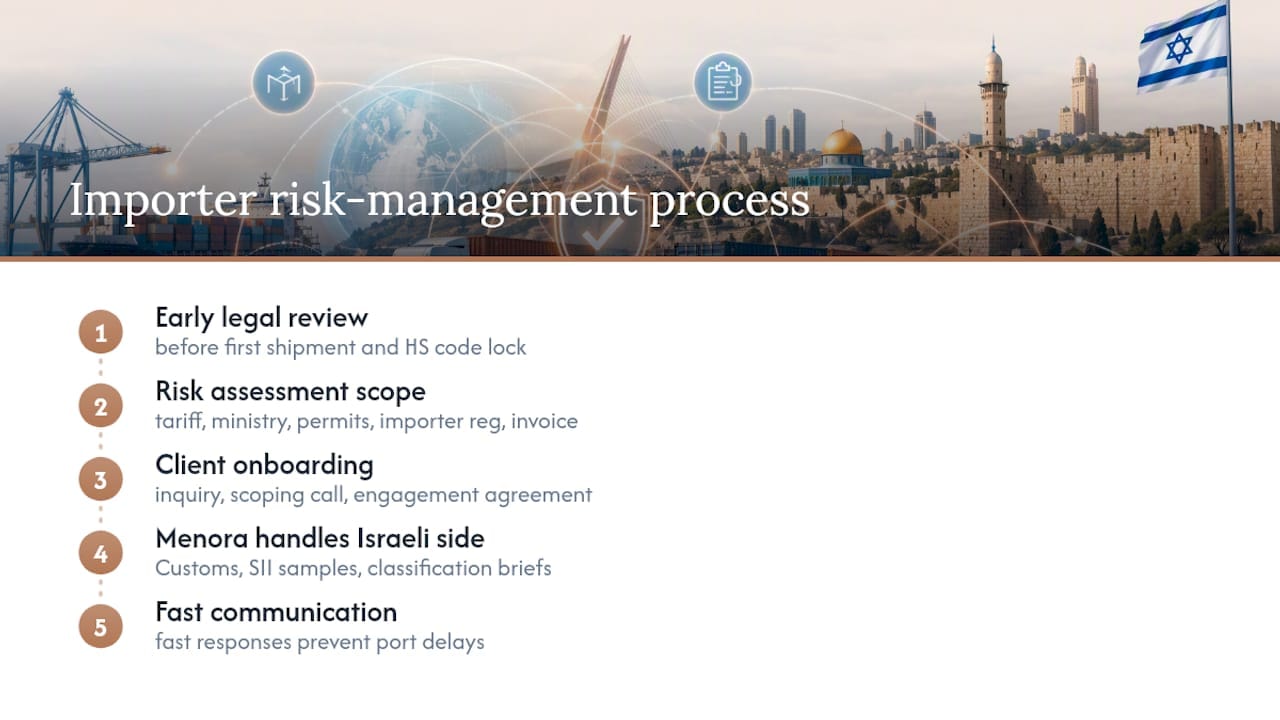
Early legal review, before the first shipment and before the HS code is locked in, changes the risk profile entirely. When Menora Law reviews a classification, the analysis covers not just the tariff rate but the full regulatory path: which ministry will be involved, what permits are needed, what the importer registration requirements are, and whether the proposed invoice declaration language will hold up under scrutiny. That scope of review is what separates a compliant import program from one that accumulates liability quietly.
For overseas clients, the practical reality is that most of this work can be done remotely. An initial inquiry, a scoping call to define the product categories and shipment volumes involved, and a clear engagement agreement are typically the first three steps. From there, Menora Law handles the Israeli-side interactions, whether that means corresponding with Israel Customs, coordinating with SII on sample submissions, or drafting the legal arguments for a classification dispute. Fast, direct communication is a core part of how the firm works with international clients, because delays in legal response translate directly into delays at the port.
When to hire Menora Law for Israeli import compliance and how to get started
Israeli import compliance becomes a legal matter, not just a logistics one, in several specific situations: when your HS classification is disputed or unclear, when a ministry permit is denied or delayed, when you are importing food or pharmaceutical products that require registered importer status and warehouse approvals, or when a transshipment arrangement puts your FTA preferential rate at risk.

Menora Law provides remote legal representation for international businesses and U.S. exporters dealing with exactly these situations. The firm’s business law practice covers the full range of Israeli commercial and regulatory matters, and the import compliance work sits within that broader capability. For a first consultation, prepare your product specifications, proposed HS code, draft commercial invoice, and any correspondence you have already received from Israel Customs or a relevant ministry. A virtual consultation can be arranged quickly, and the firm’s remote service model means geography is not a barrier. Reach out to Menora Law at Menoralaw to schedule your initial legal check and get a clear picture of your compliance obligations before your next shipment departs.
Sources
The sources below are the primary official references for Israeli import compliance. Consulting them directly, rather than relying on secondary summaries, is the safest approach for current requirements.
- Israel – Customs Laws and Regulations
- Import Licensing Notification Portal (Free Import Order 2014 – Israel)
- Israel Food and Agricultural Import Regulations and Standards (USDA/FAS)
- Gov
FAQ
What are Israel’s import licensing requirements in plain terms?
Israel requires importers to classify goods by HS code, prepare a signed commercial invoice, and obtain any ministry permits listed under the Free Import Order 2014 before goods arrive. Certain categories, including food, pharmaceuticals, electronics, and vehicles, require advance approval from the relevant Israeli ministry.
What documents do U.S. exporters need to claim FTA duty benefits?
U.S. exporters must include a signed invoice declaration on the commercial invoice confirming the goods meet the U.S.-Israel FTA rules of origin. The hard-copy Certificate of Origin (green form) has not been required since January 10, 2018.
What is the international import certificate, and when does Israel require it?
Israel does not use a single universal “international import certificate” for all goods. Instead, specific product categories require permits or conformity certificates from the relevant ministry (SII, Ministry of Health, Ministry of Agriculture, etc.) before clearance is granted.
What are the two types of import permits in Israel?
Israel’s Free Import Order 2014 distinguishes between Schedule 1 permits (required before importation) and Schedule 2 permits (subject to monitoring or post-arrival conditions). The applicable schedule is determined by the product’s HS code and the reason for licensing (safety, health, environment, or security).
When should an importer hire a lawyer instead of just a customs broker?
Legal counsel is advisable when a classification is disputed by Israel Customs, when a ministry permit is denied or delayed, when retroactive duty assessments (gira’on) are issued, or when the import involves complex regulatory requirements such as pharmaceutical registration or dual-use goods. Menora Law handles these matters remotely for overseas clients.
This article provides general information about Israeli import regulations and is not a substitute for professional legal advice. Requirements change; confirm current rules with Israel Customs, the relevant Israeli ministry, or a qualified Israeli legal professional before shipping.


 English
 Afrikaans
 العربية
 বাংলা
বাংলা Čeština
 简体中文
简体中文 Nederlands
 Suomi
Suomi Français
 Deutsch
 עִבְרִית
 हिन्दी
 Magyar
 Italiano
 日本語
日本語 한국어
한국어 Polski
 فارسی
فارسی Português do Brasil
 Русский
 Español de México
 Українська