
If you buy property in Israel from overseas, expect to prove who you are, who really owns the money, and where the money came from. Israeli banks and the professionals who handle the deal must do this by law. The buyers who close smoothly are the ones who bring the paperwork early and have an Ізраїльський юрист who knows how the checks run. At Menora Law, we represent overseas clients in Israeli real estate matters remotely, so this guide walks you through the checks the way we would explain them to a friend who is about to wire money to Israel.
TL;DR
- Anti-money-laundering (AML) checks in Israel happen at two points: when a professional (such as a lawyer) takes you on as a client, and when your bank opens an account or receives your funds.
- Expect three questions: Who are you, are you buying for yourself or for someone else, and where did this money come from?
- Source-of-funds proof is the item that most often slows a deal. Gather statements, sale contracts and tax records before you sign anything.
- Carrying large amounts of cash across the Israeli border without reporting it can lead to seizure and penalties. A bank wire is the cleaner route.
- Starting the file early, with an Ізраїльський юрист coordinating it, is the best way to protect your closing date.
Why Israel runs AML checks on property deals
Real estate is a classic place to park money, so Israel treats it as a sector where identity and source of funds need to be documented. The core rules sit in Israel’s Prohibition on Money Laundering Law of 2000 and in orders issued under it. Banks answer to the Bank of Israel’s supervision rules, and certain professionals answer to a separate order. You will meet both.
For you as a buyer, the practical result is simple. Nobody in the chain can just take your money and hand over a deed on a handshake. Each party that touches the deal has to know who you are, and some have to keep records for years.
This is not a sign anyone suspects you. The rules are risk-based: the more unusual the profile, the more questions. A foreign buyer who funds a purchase from an overseas account is a profile that gets a closer look than a local salaried employee, so a complete file matters.
Who actually carries out the checks
Three groups usually run checks on a foreign buyer.
The Israeli bank
When you open an account or receive a large transfer, the bank does its own due diligence. Bank Hapoalim’s published AML policy gives a good picture of what an Israeli bank does at account opening: customer identification and verification, a mandatory KYC questionnaire, a declaration of beneficiaries and controlling persons for entities, and screening of the customer’s name against sanctions lists. The same page says the bank may ask for supporting references about the source of funds in some situations, and that high-risk accounts get enhanced due diligence with corroborating documents.
“KYC” means “know your customer”: the bank’s questionnaire about your identity, activity and the purpose of the account.
A UN-hosted summary of Israel’s system adds that financial institutions must set due diligence procedures before opening accounts, classify customers by risk, and run continuous enhanced due diligence on high-risk accounts, including a look at the customer’s background and the country the funds come from.
The professionals in your transaction
Israel also has an order that applies to “business service providers”, a category that covers lawyers and accountants when they provide certain services. Under the Prohibition of Money Laundering (Business Service Providers) Order of 2014, the provider must identify the customer and complete customer due diligence before providing the service. A foreign resident is identified by a foreign passport or a laissez-passer (a travel document issued in place of a passport). The risk evaluation looks at who the customer is, what the service is, and where the money for the service comes from.
This matters because your Ізраїльський юрист is not just a helper in the background. Your lawyer has duties of their own, and a lawyer who skips the identification step puts the whole transaction at risk.
The wider chain
Developers, brokers, mortgage lenders and the Tax Authority each have their own reasons to ask questions. A developer’s sales office may ask for ID and proof of payment source before accepting a deposit. A tax office reviewing a purchase tax filing may ask about the funds as well. You do not need to memorize the full list. You need one organized file that answers all of them.
What you will be asked to provide
The exact list changes by bank and by deal, but the same building blocks appear again and again.
| Item | Why it is asked | What to prepare |
|---|---|---|
| Identity | To confirm who you are | Valid foreign passport; a second ID if the bank or provider requests one |
| Proof of address | To place you in a country and risk category | Recent utility bill or bank statement |
| Acting for yourself or others | To find the real owner | Written declaration; if buying through an entity, ownership chart and details of controlling persons |
| Source of funds | To see where the money came from | Bank statements, sale contract of a prior property, payslips or business accounts, tax returns, inheritance or gift documents |
| Purpose of the purchase | To understand the profile | Short explanation: home, investment, family property |
| Tax residency information | Banks collect tax-status self-certifications | Details of where you are tax resident |
A few details are worth knowing.
Identification can be done abroad. The 2014 Order says identification is carried out in person by the service provider or its staff, by another Israeli-licensed lawyer, by an Israeli diplomatic or consular representative abroad, or by an authority that issues apostilles. An apostille is the official certificate that makes a document valid in countries that joined the Hague convention. That is why a buyer in Florida or New York does not always need to fly to Israel just to be identified.
The “on whose behalf” question is mandatory. The same Order requires the customer to declare whether they act for themselves or to provide details of the beneficiaries and controlling interest holders. If you are buying through a company or a family trust, bring the structure documents with you.
Records are kept. The provider has to keep identification documents for at least five years after providing the service. Assume the paperwork you hand over will be stored.
Bank Hapoalim’s policy also notes that for walk-in customers a foreign resident is identified using two identifying documents, that a copy of identification is retained for cash transactions above NIS 5,000 or any transaction above NIS 50,000, and that for transactions over NIS 50,000 the bank takes a written declaration about beneficiaries and controlling holders of corporations. Other banks set their own procedures, but you can see the pattern: bigger sums, more paper.
Source of funds: the check that decides the timeline
Identity checks are quick if your passport is valid. Source-of-funds checks are where deals slow down, because they require a story that your documents can prove.
Think of it as a chain. Every dollar going into the purchase should trace back to something a clerk can recognize: salary, business profit, the sale of another property, an inheritance, a loan. Then each link needs a document.
Here are examples of how that looks in practice.
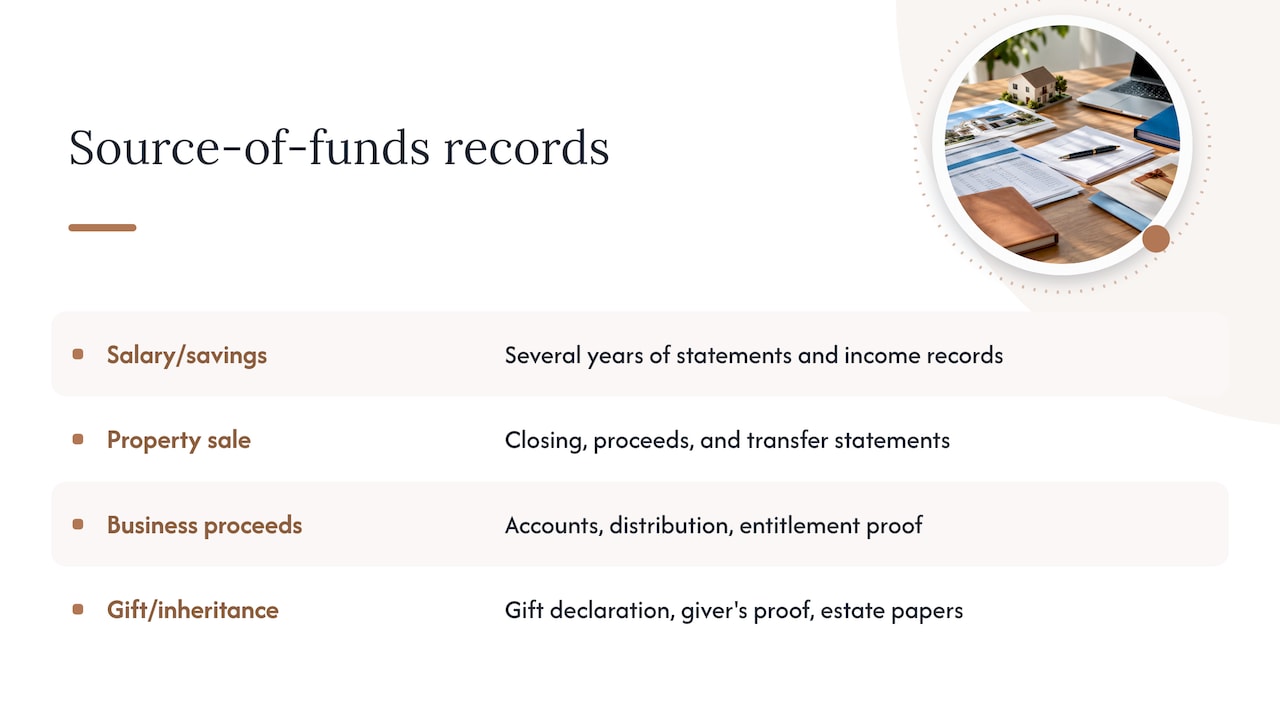
Sale of a home abroad. The closing statement of the sale, plus the bank statement showing the proceeds arriving, plus the statement showing the transfer toward Israel.
Savings built over years. Several years of statements and income records. A single lump sum that appears with no history is exactly what draws questions.
Business proceeds. Company financial statements, a distribution record, and evidence that the owner was entitled to take the money out.
Gift or inheritance. The inheritance paperwork or a signed gift declaration from the giver, with their own proof of how they obtained the funds. If the money is coming to you from an estate, our guide to how heirs abroad unlock Israeli assets explains the documents involved on the estate side.
The Bank of Israel’s Directive 411 adds another layer for people who hold or have held prominent public roles. Under the 2026 edition of the directive, banks must check, before opening an account, whether the customer or beneficiary is a politically exposed person (a PEP, meaning someone with a senior public function), ask about the source of funds and wealth, and have a senior manager approve an account for a foreign PEP. If you or a close family member has held such a role, tell your lawyer on day one so the file is built for it.
How the money moves, and what banks look at
Most foreign buyers pay by international wire, either into an Israeli bank account in their own name or into a lawyer’s trust account. Either way, the receiving side will see where the wire started, whose name is on it and what it is for.
A few habits keep wires clean:
- Send from an account in your own name, or the name of the buyer entity. Payments from third parties raise the “on whose behalf” question again.
- Use the same name on the wire as on the purchase contract.
- Do not split one purchase payment into several small transfers from different sources. It looks like an attempt to avoid scrutiny, even when your reason is innocent.
- Keep the wire confirmations. They are part of your source-of-funds file.
For a plain-language overview of what banks review when a customer is higher risk, this explanation of offshore account due diligence lists the typical checks and how to prepare for them. It is useful if your funds sit in more than one country.
If you also need an Israeli account to receive funds and pay taxes, see how Israeli banks approach foreign applicants in our guide on building a bank-ready file. It is written for foreign companies, but the logic of the file is the same.
Cash and border reporting
Bringing physical cash into Israel for a property purchase is a bad idea. Section 9 of Israel’s Prohibition on Money Laundering Law requires anyone entering or leaving Israel to report money at or above set amounts. Failing to report can bring six months in prison or a fine, the greater of a fixed rate or ten times the unreported amount. A police or customs officer may also seize unreported money without a court order.
The reporting thresholds are set in a schedule to the law and can be updated, so check the current figure with your lawyer before you travel with anything beyond ordinary travel money. For a purchase, the sensible route is a bank transfer. You get a paper trail, which is exactly what the checks want. If you are comparing ways to convert and move dollars, a live USD to ILS rate converter shows where the exchange rate stands on the day you check, and the rate moves constantly, so always confirm the rate your bank applies on the day of the transfer.
What causes delays or refusals
Most delays are not dramatic. They are an unanswered question sitting in somebody’s inbox. These are the usual causes.
- A source-of-funds gap. The money arrived recently and there is no paper trail behind it.
- A mismatch of names. The account holder, the contract buyer and the person who signed do not line up.
- A missing beneficial owner. The buyer is a company or trust and nobody has listed the people behind it.
- An expired or unclear ID. An apostille issue, an expired passport, or a document that is not legible.
- A high-risk flag. A PEP link, a high-risk country in the funding chain, or a sanctions-list name match that needs manual clearing.
- A late start. The buyer starts gathering documents after the contract is signed, and the payment deadlines in the contract keep running.
That last point deserves emphasis. Israeli purchase contracts carry payment dates, and a delay in releasing funds can put you in breach. Our article on what foreign buyers face on timing explains how delays of 45 to 60 days can happen in practice, and our overview of Israeli real estate law for buyers and investors shows where payment deadlines usually sit in the contract.
In a worst case a bank can decline to proceed or close an account when it cannot complete due diligence. That is a reason to make the file complete, not a reason to worry. Complete files rarely get that far.
A preparation checklist for overseas buyers
Here is the routine we would follow if we were buying from abroad.
- Decide how you will hold the property. In your own name, jointly, or through an entity. This decides whose documents are needed. Our guide on property rights for non-residents covers the basics of holding Israeli property from abroad.
- Build the identity set. Valid passport, proof of address, and any apostilled or witnessed copies your Ізраїльський юрист asks for. Check expiry dates now.
- Write the funds story in two paragraphs. Where the money comes from and how it reached the account it will be sent from. Then attach documents to each sentence.
- Collect the paper. Statements, sale contracts, tax filings, business records, gift or inheritance papers. Aim for a clean PDF folder, named clearly.
- Put every holder on the table. If more than one person or entity is involved, list them with their ownership shares.
- Raise flags early. PEP connections, earlier disputes with banks, or funds that cross several countries. Telling your lawyer before the bank asks is far easier than explaining afterward.
- Get your lawyer involved before you sign a contract. Not after. The lawyer should know the funding plan before the payment schedule is agreed, so deadlines match what your bank can actually do.
- Send funds in one traceable route. Wire from an account in the buyer’s name, keep the confirmations and send copies to your lawyer.
- Plan for the tax side. Purchase tax is due in addition to the price, and the Tax Authority can ask about funds as well. See our Israeli real estate tax FAQ for the common questions.
If you are buying land rather than an apartment, our page on buying land in Israel with a foreign passport covers what changes.
Where Menora Law fits in
Our work is Israeli real estate transactions and real estate contracts for international clients, and we represent clients remotely, with on-site consultations abroad available, so you do not have to travel to Israel to get the file moving. We work only under Israeli law, which means the checks described here are the ones we prepare you for.
If you are planning a purchase, our team can review your funding plan and your contract before you commit. You can start on the Menora Law website and tell us what you are buying and where the money is coming from.
If the property comes to you through an estate rather than a purchase, we also handle inheritance orders and estate administration in Israel, and our guide to Israeli probate is a good place to begin.
Our perspective
Most AML problems we see described in cross-border purchases are not about suspicious money. They are about incomplete stories. A buyer has honest savings, but the proof is scattered across three accounts, two countries and a drawer full of paper.
That is why we think of the AML file as part of the legal work, not a hurdle in front of it. Israeli law asks the professional to identify the client and understand where the funds come from. When your lawyer builds that picture with you at the start, the bank’s questions become a formality rather than a roadblock.
We focus on Israeli law and on overseas clients, so we build the file the way Israeli banks and professionals expect to read it. Fast communication matters here. A question from the bank that gets answered the same day keeps a closing on schedule, and remote representation means distance is not the reason for a delay.
Our advice is simple: speak to an Ізраїльський юрист before you sign, tell them the whole funding story, and let them shape the payment schedule around it.
Закон Менори
FAQ
Do I need an Israeli bank account to buy property in Israel?
Many foreign buyers open one because it makes paying the price, taxes and fees simpler, but the route depends on the deal and on your lawyer’s setup. Opening an account triggers the bank’s own due diligence, so prepare identity and source-of-funds documents first. Your Ізраїльський юрист can tell you which route fits your purchase.
Can I be identified for AML purposes without traveling to Israel?
Often yes. The 2014 Business Service Providers Order lets identification be carried out by an Israeli-licensed lawyer, an Israeli diplomatic or consular representative abroad, or an apostille-issuing authority, besides the provider itself. Your Ізраїльський юрист will tell you which option suits your case.
What documents prove the source of my funds?
Bank statements showing the money’s history, a sale contract for a previous property, tax returns, business accounts, or inheritance and gift papers. The rule of thumb is that each part of the money should link back to a document. A single unexplained lump sum is what draws questions.
Can I bring cash to pay for a property in Israel?
We do not recommend it. Israeli law requires you to report money above set amounts when you enter or leave the country, and unreported money can be seized and penalized. A bank transfer gives you the paper trail the checks need.
What if I am buying through a company?
You will be asked to identify the people who own and control the company, and to declare on whose behalf the purchase is made. Bring the corporate documents and an ownership chart so the bank and your lawyer can complete the file quickly.
Sources
- Bank Hapoalim: Anti Money Laundering
- UNODC: Israel, prevention of money-laundering compilation
- Israel: Prohibition of Money Laundering (Business Service Providers) Order, 2014
- Bank of Israel: Directive 411 (2026 edition)
- Israel: Prohibition on Money Laundering Law, 5760-2000
- Offshore account due diligence: what banks check
- USD to ILS exchange rate converter
Recommended
- Israeli Real Estate Law: What Buyers and Investors Must Know
- Israeli Lawyer Tips: How to Easily Buy Land in Israel as a Foreigner According to Land Law in Israel?
- Buying Real Estate in Israel: 30 Tips to Navigate the Israeli Property Market
- Avoid Audit Traps: Trusts for International Buyers of Israeli Property


 English
 Afrikaans
 العربية
 বাংলা
 Čeština
 简体中文
 Nederlands
 Suomi
 Français
 Deutsch
 עִבְרִית
 हिन्दी
 Magyar
 Italiano
 日本語
 한국어
 Polski
 فارسی
 Português do Brasil
 Русский
 Español de México
 Українська