
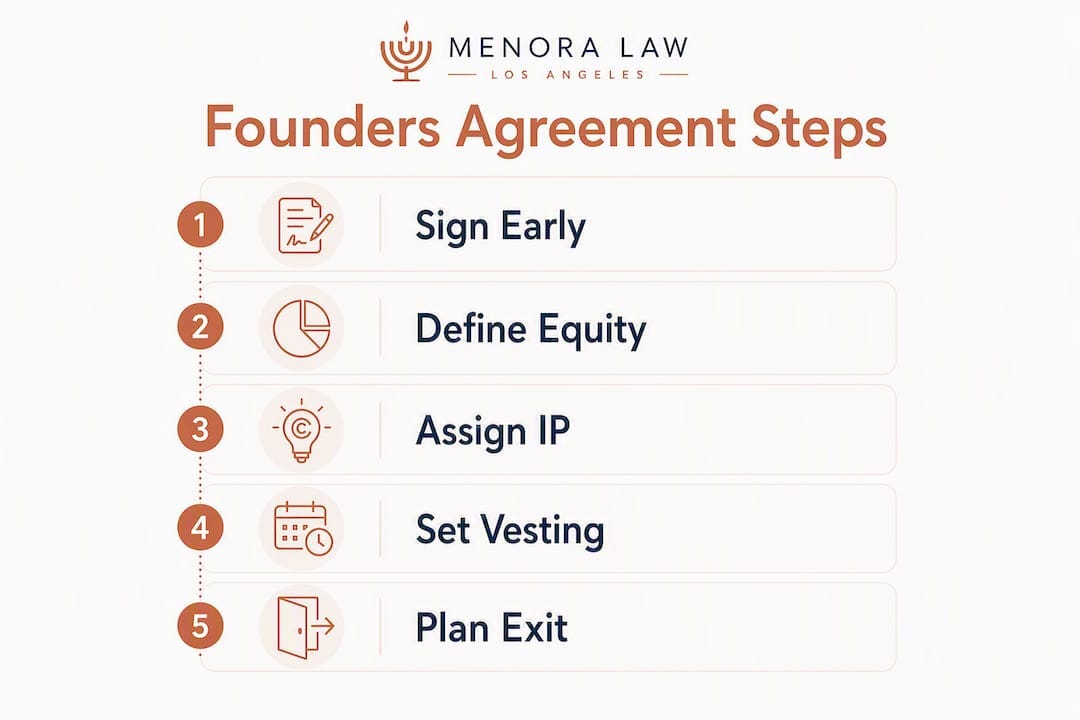
An Israeli founders agreement (הסכם מייסדים, also called חוזה מייסדים) is a legally binding contract between co-founders that governs equity, roles, IP ownership, and exit rights from day one. If you’re building a startup in Israel, sign a tailored agreement before incorporation or before any investor conversation begins. Research links co-founder conflict to startup failure or serious disruption, and a well-drafted agreement is the clearest way to prevent that.
Here’s what you need to have in place before you move forward:
- A clear equity split with a vesting schedule investors can verify
- An explicit IP assignment covering work done before and after incorporation
- Defined roles, decision-making authority, and voting thresholds
- Share-transfer mechanics (ROFR, tag-along, drag-along) and departure procedures
- A governing-law clause that anchors the agreement to Israeli law
The agreement sits alongside your articles of association but covers operational realities those public documents never address. Think of it as the partnership’s private constitution. Get it signed early, and get it drafted by counsel who knows Israeli corporate law.
What clauses does every Israeli founders agreement need?
A founders agreement in Israel covers more ground than a standard shareholders’ agreement. It blends corporate governance with personal commitments, and each clause connects to the others in ways that matter when things get complicated.
Core mandatory clauses:
- Equity allocation and vesting — who owns what percentage, and how shares vest over time (or reverse-vest back to the company on departure)
- IP assignment — explicit transfer of all founder-created intellectual property to the company, including work done before the company was formally incorporated
- Roles and responsibilities — titles, day-to-day duties, time commitments, and performance expectations for each founder
- Decision-making and governance — board composition, voting thresholds for ordinary and extraordinary resolutions, and deadlock-breaking mechanisms
- Share-transfer restrictions — right of first refusal (ROFR), right of first offer (ROFO), tag-along and drag-along rights
- Founder departure clauses — good-leaver and bad-leaver definitions, repurchase mechanics, and what happens on death or permanent disability
- Confidentiality and non-compete — obligations that survive departure, calibrated to what Israeli courts will actually enforce
- Dispute resolution and governing law — arbitration or mediation procedures, and a clear statement that Israeli law governs
Commonly negotiated additions:
- Founder contribution schedules (cash, IP, sweat equity, and how each is valued)
- Anti-dilution protections for founders in early funding rounds
- Clauses addressing military reserve duty (miluim) and part-time commitments
- Cross-border expansion provisions for international founders
تحت Companies Law, 5759-1999, many governance defaults apply unless the founders contract around them. The founders agreement is where you do that contracting. Vesting and repurchase clauses interlock directly: if a founder departs before their shares fully vest, the repurchase clause determines the price and process. Draft them together, not in isolation.

How do equity splits, vesting, and reverse-vesting work in Israel?
Equity allocation in Israeli startups rarely follows a rigid formula. Most founding teams negotiate splits based on each founder’s contribution: the originating idea, technical execution, business development capacity, and capital invested. Sweat equity is recognized under Israeli law, but it needs to be documented clearly in the agreement to hold up during due diligence.
Standard Israeli vesting patterns:
- A multi-year vesting period with an initial cliff is the standard structure investors expect
- After the cliff, shares typically vest monthly or quarterly for the remaining three years
- Acceleration provisions (single-trigger or double-trigger) are negotiated separately and are increasingly standard in term sheets
Reverse vesting is the mechanism investors actually care about. Rather than issuing shares that vest forward, the company issues all shares upfront and retains a contractual right to repurchase unvested shares if a founder leaves. This is the Israeli market norm.
- All founder shares are issued at incorporation
- A repurchase right attaches to unvested shares
- The repurchase price is typically nominal (par value or a small fixed amount)
- The right lapses as shares vest over the agreed schedule
- On departure, the company exercises the repurchase right for unvested shares only
Israeli startup guides confirm that explicit reverse-vesting language is one of the first things investors check. A vague or missing schedule can stall a funding round.
Drafting notes for vesting clauses:
- Specify the vesting commencement date (often backdated to when founders began working, not the incorporation date)
- Address what happens to unvested shares if the company is acquired before the cliff
- Include a clause for military reserve duty: Israeli founders called up for miluim should not have their vesting clock paused without agreement, and most Israeli counsel recommend treating reserve duty as continuous service
Pro Tip: If one founder contributed significant pre-incorporation work, consider backdating the vesting start date to reflect that contribution. This prevents a situation where a founding engineer who built the MVP for a year is treated as if they started on day one of incorporation.
How should you handle IP assignment under Israeli law?
IP assignment is where Israeli founders agreements most often fail. The default rules under Israeli law do not automatically transfer founder-created IP to the company, particularly for work done before incorporation or by founders who are not formal employees. That gap creates real risk.
Why this matters in Israel specifically:
- Israeli patent law and tax rules treat IP transfers as potentially taxable events, so the assignment must be structured carefully
- Moral rights under Israeli copyright law can survive an assignment unless explicitly waived
- Joint inventions by multiple founders require each contributor to assign their share independently
Steps to properly assign IP in an Israeli founders agreement:
- Identify all pre-incorporation IP: code, designs, patents, trade secrets, and know-how each founder created
- Include an explicit assignment clause transferring all such IP to the company upon incorporation (or upon execution of the agreement)
- Add a moral-rights waiver where relevant, particularly for software and creative works
- List each contributor by name and describe their contribution in a schedule attached to the agreement
- Confirm the assignment with a separate IP assignment deed if the company later files for patents
Sample IP assignment clause (adapt with counsel):
- “Each Founder hereby irrevocably assigns to the Company all right, title, and interest in and to any Intellectual Property created, developed, or conceived by such Founder in connection with the Company’s business, whether before or after the date of this Agreement, including all patents, copyrights, trade secrets, and know-how, together with any moral rights to the extent permitted by applicable law.”
For a deeper look at how Israeli copyright and moral rights interact with IP assignments, Israeli copyright law basics is a useful reference.
Pro Tip: Keep a dated development log from the earliest stage of the project. Commit histories, design files with timestamps, and email threads all serve as evidence of who created what and when. This documentation becomes critical if a former contributor later claims ownership.
How do you define roles, governance, and decision-making authority?
Founders agreements that skip governance details tend to produce the most expensive disputes. Titles like “CEO” or “CTO” describe a hierarchy, but the agreement needs to go further and specify what each founder actually controls, what requires unanimous consent, and what happens when the team deadlocks.
Key governance elements to define:
- Titles vs. duties: List each founder’s operational responsibilities explicitly. “CTO” means different things in a five-person team than in a fifty-person company; the agreement should describe the actual scope.
- Time commitment: Specify whether each founder is full-time, and include a mechanism to address a founder who reduces their involvement without formally departing.
- Board composition: Define how many seats the founders control, how directors are appointed, and what happens to board representation if a founder’s equity drops below a threshold.
- Voting thresholds: Ordinary resolutions (simple majority) vs. extraordinary resolutions (supermajority or unanimity) for decisions like issuing new shares, taking on debt, or changing the business model.
- Deadlock mechanisms: A chair casting vote, a pre-agreed escalation to mediation, or a buy-sell (shotgun) clause are the most common Israeli approaches.
Balancing operational flexibility with investor-preferred governance is a real tension. Investors will often push for board seats and protective provisions at Series A. The founders agreement should anticipate this by reserving specific founder rights that survive the first institutional round, rather than leaving everything open to negotiation under time pressure.

What share-transfer and exit clauses do founders need?
Share-transfer clauses control what happens when a founder wants to sell, a third party makes an offer, or the company is acquired. Without them, a co-founder can sell their stake to an unwanted third party, or a majority shareholder can drag the minority into a sale on unfavorable terms.
Core transfer mechanics:
- Right of first refusal (ROFR): Before selling to a third party, a founder must offer their shares to the company and/or other founders at the same price and terms.
- Right of first offer (ROFO): A softer version where the selling founder must first offer shares to existing holders before soliciting outside buyers.
- Tag-along rights: Minority founders can join a sale on the same terms if a majority founder sells to a third party.
- Drag-along rights: A majority of founders (or shareholders) can compel the minority to sell on the same terms in an approved exit transaction.
Good-leaver and bad-leaver rules:
- Define “good leaver” (resignation for cause, disability, death, or mutual agreement) and “bad leaver” (voluntary resignation without cause, breach of agreement, or termination for misconduct)
- Good leavers typically retain vested shares and receive fair market value for any repurchased unvested shares
- Bad leavers typically forfeit unvested shares at nominal value and may face additional restrictions on vested shares
- Set the valuation method for repurchases: pre-money valuation from the last funding round, an independent appraiser, or a formula-based approach
For context on how liquidation preferences interact with these exit mechanics, Israeli liquidation preference explained covers the downstream equity implications.
Israeli practice resources confirm that repurchase on termination, preemptive rights, and drag/tag protections are standard in Israeli founders agreements and are reviewed closely by investors.
Which dispute resolution approach works best under Israeli law?
Israeli law gives founders real flexibility in how they resolve disputes, but the choice has practical consequences. Courts are available but slow; arbitration is faster and private; mediation is non-binding but often effective for preserving relationships.
Key considerations:
- Israeli law as governing law: — The Companies Law, 5759-1999 sets default corporate governance rules, and private contracts operate within that framework. Choosing Israeli law avoids conflicts between the agreement and mandatory statutory provisions.
For international founders who need to understand how Israeli jurisdiction rules interact with cross-border agreements, Israeli legal jurisdiction rules provides a practical overview.
What do investors look for in a founders agreement?
Investors increasingly expect detailed founders agreements as a baseline condition of due diligence, not a nice-to-have. The absence of a signed agreement, or an agreement with obvious gaps, signals that the founding team has not thought carefully about governance, and that creates hesitation.
What due diligence teams typically review:
- Reverse-vesting schedule: Is it in place? Does it cover all founders? Is the commencement date accurate?
- IP assignment: Is every piece of technology assigned to the company? Are pre-incorporation contributions covered?
- Shareholder mechanics: Are ROFR, tag-along, and drag-along rights documented?
- Founder departure clauses: Are good-leaver and bad-leaver definitions clear?
- Side agreements: Are there any undisclosed arrangements between founders or with third parties?
Common red flags that slow or stop investment:
- A founder holding a large equity stake with no vesting schedule
- IP created before incorporation that was never formally assigned
- Verbal agreements about roles or compensation that contradict the written agreement
- Missing or ambiguous non-compete clauses
- No clear process for resolving deadlocks
Pro Tip: Before a term sheet arrives, run a quick internal audit: pull the founders agreement, the IP assignment records, and the cap table. If anything is missing or inconsistent, fix it before the investor’s lawyers find it. A gap discovered during due diligence is far more disruptive than one corrected proactively.
Investor-readiness checklist:
- Signed founders agreement with all founders as parties
- Reverse-vesting schedule attached and dated
- IP assignment deed or clause covering pre-incorporation work
- Cap table consistent with the agreement
- No undisclosed side letters or oral commitments
- Governing-law and dispute-resolution clauses present
- Non-compete and confidentiality clauses reviewed by Israeli counsel
For a broader look at what Israeli securities law requires from startups raising capital, Israeli securities law for startups covers the regulatory layer above the founders agreement.
What is the realistic process and timeline for drafting a founders agreement in Israel?
Most founders underestimate how long a properly drafted agreement takes. Rushing the process to meet a deadline usually means missing clauses that matter later.
Recommended sequencing:
- Founders alignment meeting (Days 1–3): Agree on equity split, roles, and vesting parameters before engaging counsel. Arriving at a lawyer’s office without consensus on the basics wastes time and money.
- Engage Israeli counsel (Days 3–5): Share your agreed parameters and any existing term sheets or investor letters of intent.
- First draft review (Days 7–14): Counsel produces a draft; founders review and negotiate internally before responding.
- Negotiation and revision (Days 14–21): Typically one to two rounds of revisions for a straightforward founding team.
- Incorporation alignment (Days 21–28): Coordinate the founders agreement with the articles of association and any shareholders’ agreement required by the registrar.
- Execution and filing (Days 28–35): All founders sign; relevant documents are filed with the Israeli Companies Registrar.
For international and remote founders:
- The entire process can be handled remotely with a firm experienced in cross-border Israeli matters
- Notarization requirements for foreign-executed documents vary; Israeli counsel can advise on apostille requirements for your jurisdiction
- Allow additional time if any founder is in a significantly different time zone
Documents to prepare for your first counsel meeting:
- Agreed equity split and vesting parameters (even a rough term sheet)
- List of all IP each founder has created that relates to the business
- Any existing agreements between founders (even informal emails)
- Corporate structure preferences (private company limited by shares is standard in Israel)
- Any investor letters of intent or preliminary term sheets
University and practice guides confirm that model agreements are a useful starting point, but they require counsel to adapt clauses to local law and tax implications. For Israeli founders, that adaptation is not optional.
What mistakes do Israeli founders most commonly make?
Most drafting errors are predictable. They fall into a short list of categories, and each one has a straightforward fix.
- No founder-departure provisions: — What happens if a founder becomes permanently disabled or dies? Israeli law has default succession rules, but they may not reflect what the founding team actually wants. Fix: include explicit provisions for death, disability, and long-term incapacity.
Pro Tip: If your current founders agreement is missing any of the above, do not wait for a funding round to fix it. An amendment is far simpler to execute when everyone is still aligned than when a term sheet is on the table and one founder is using the gap as leverage.
Sample clauses and a practical checklist for your counsel meeting
These sample clauses are short, editable starting points. They are not substitutes for legal advice and must be adapted by Israeli counsel to your specific structure, tax position, and investor requirements.
Three sample clauses:
Reverse-vesting clause:
“The Company shall have the right to repurchase, at nominal value (par value per share), any Unvested Shares held by a Founder upon the termination of such Founder’s engagement with the Company for any reason. ‘Unvested Shares’ means shares subject to the vesting schedule set out in Schedule A, which have not yet vested as of the date of termination.”IP assignment and waiver clause:
“Each Founder irrevocably assigns to the Company all Intellectual Property created in connection with the Company’s business, whether before or after the date of this Agreement. To the extent permitted by Israeli law, each Founder waives any moral rights in such Intellectual Property.”Repurchase on departure clause:
“Upon a Founder’s departure as a Bad Leaver, the Company may repurchase all Unvested Shares at nominal value within 30 days of the departure date. Upon departure as a Good Leaver, unvested shares shall be repurchased at Fair Market Value as determined by an independent appraiser agreed by the parties.”
Checklist for your counsel meeting:
- Agreed equity percentages and vesting start dates for each founder
- List of pre-incorporation IP with creator names and creation dates
- Preferred board structure and voting thresholds
- Good-leaver and bad-leaver definitions the team has agreed on
- Preferred dispute resolution method (arbitration vs. mediation)
- Any existing investor commitments or term sheets
- Questions about tax implications of IP transfer or equity structure
- Preferred governing law and arbitration seat (Tel Aviv is standard)
Model founders agreements from legal clinics cover ownership, vesting, IP, confidentiality, and dispute resolution as a starting point, but Israeli-specific drafting requires counsel who understands local corporate and tax law.
Pro Tip: Bring a one-page summary of each founder’s contributions to the first counsel meeting: what they built, when they started, and what they are committing going forward. This speeds drafting significantly and reduces the risk of omitting a contribution that should be documented.
| Point | Details |
|---|---|
| Sign early | Execute the founders agreement before incorporation or any investor conversation. |
| Assign all IP | Cover pre-incorporation work explicitly; do not rely on employment defaults. |
| Use reverse vesting | Investors expect a four-year schedule with a one-year cliff as a baseline. |
| Include exit mechanics | ROFR, tag-along, drag-along, and good/bad-leaver rules prevent costly disputes. |
| Consult Israeli counsel | Israeli law has specific defaults and tax implications that generic templates miss. |
Key Takeaways
A properly drafted Israeli founders agreement assigns IP, establishes reverse vesting, and defines exit mechanics before investors arrive, making it the single most important document a founding team signs.
| Point | Details |
|---|---|
| Define equity and vesting early | Four-year reverse vesting with a one-year cliff is the Israeli investor standard. |
| Assign IP explicitly | Pre-incorporation IP does not transfer automatically under Israeli law. |
| Govern with clear thresholds | Voting rules and deadlock mechanisms prevent operational paralysis as teams grow. |
| Include transfer restrictions | ROFR, tag-along, and drag-along rights protect all founders in a sale or exit. |
| Menora Law for Israeli founders | Menora Law drafts investor-ready founders agreements under Israeli law for international founding teams. |
Why the founders agreement is the document most founders underestimate
Most founding teams treat the founders agreement as a formality to check off before the real work begins. That framing gets the priority backwards. The agreement is not administrative paperwork; it is the document that determines what happens to your equity, your IP, and your company when the relationship between founders changes under pressure.
The clauses that matter most are rarely the ones founders spend the most time on. Equity splits get debated at length. Vesting schedules get negotiated carefully. But IP assignment, departure mechanics, and dispute resolution often get a single paragraph each, or get deferred entirely. Those are precisely the clauses that determine outcomes in a dispute or a due diligence process.
There is also a specific Israeli dimension that international founders often miss. Israeli law has defaults around IP, non-competes, and corporate governance that differ from what founders may be used to in other jurisdictions. A clause that is standard and enforceable elsewhere may be unenforceable in Israel, or may interact with the Companies Law in ways that produce unintended results. That is not a reason to avoid Israeli law; it is a reason to work with counsel who knows it well.
The founders agreement should be drafted when everyone is aligned and optimistic, because that is when the terms will be fair to all parties. Waiting until a dispute arises, or until an investor flags a gap, means negotiating under pressure. Sign it early, get it right, and treat it as the foundation it actually is.
How Menora Law helps international founders get this right
International founders building Israeli companies face a specific challenge: they need an agreement that satisfies Israeli investors, complies with Israeli corporate and IP law, and works for a team that may be spread across multiple countries.
Menora Law works with founding teams at exactly this stage. The firm drafts founders agreements that are structured for Israeli investor due diligence, with reverse-vesting schedules, IP assignment deeds, and share-transfer mechanics that reflect current Israeli market practice. For founders who cannot be in Israel, the entire process runs remotely, with fast communication and clear timelines.
Services relevant to founders include:
- Founders agreement drafting and negotiation under Israeli law
- IP assignment deeds and pre-incorporation IP documentation
- Incorporation alignment and Companies Registrar filings
- Dispute prevention clauses tailored to Israeli courts and arbitration practice
- Ongoing corporate counsel for international founding teams
If you are an international founder building in Israel, or an Israeli founder with co-founders based abroad, the right time to get this in place is before your next investor conversation. Schedule a virtual consultation with Menora Law to get a founders agreement that is built for Israel and ready for investment.
Useful sources and further reading
For founders who want to go deeper on the legal framework or prepare for a counsel meeting, the following sources are worth reviewing:
- Companies Law, 5759-1999 — the primary Israeli statute governing corporate structure, shareholder rights, and governance defaults that interact with private founders agreements
- Founders agreement guide for Israeli startups — LegalKal — practical guidance on reverse vesting, IP assignment, and investor expectations in the Israeli market
- Why a founders agreement matters for startups — CTech/Calcalist — attorney commentary on how inadequate agreements put ventures at risk
- University of Pennsylvania Entrepreneurship Clinic — model founders agreement — a useful template covering ownership, vesting, IP, and dispute resolution, to be adapted with Israeli counsel
- Israeli securities law for startups — Menora Law’s guide to the regulatory layer founders encounter when raising capital in Israel
- Legal Israel: what foreigners and investors must know — Menora Law’s overview for international founders navigating Israeli law
- Non-dilutive financing options for founders — a partner guide on alternative funding structures that affect how equity and dilution are managed
| Resource | Best used for |
|---|---|
| Companies Law, 5759-1999 | Understanding statutory defaults that govern Israeli corporate structure |
| LegalKal founders agreement guide | Practical Israeli-specific drafting guidance on vesting and IP |
| UPenn model founders agreement | Template starting point for clause structure before Israeli counsel adapts it |
| Menora Law virtual consultation | Tailored drafting and advice for international founders under Israeli law |
التعليمات
What is an Israeli founders agreement?
An Israeli founders agreement (הסכם מייסדים) is a binding private contract between co-founders that governs equity, IP ownership, roles, and exit rights under Israeli law. It operates alongside the company’s articles of association and covers operational matters those public documents do not address.
When should founders sign a founders agreement in Israel?
Israeli practice guides recommend signing before significant business activities begin and before any investor conversations. Early execution prevents disputes and signals professionalism during due diligence.
Does Israeli law automatically assign a founder’s IP to the company?
No. Israeli law does not automatically transfer IP created by a founder before incorporation or outside a formal employment relationship. An explicit IP assignment clause in the founders agreement, and often a separate assignment deed, is required to close that gap.
What is reverse vesting and why do Israeli investors expect it?
Reverse vesting is a mechanism where all founder shares are issued upfront, but the company retains a right to repurchase unvested shares at nominal value if a founder departs. Israeli investors treat a four-year schedule with a one-year cliff as a baseline expectation during due diligence.
Can Menora Law help international founders draft an Israeli founders agreement remotely?
Yes. Menora Law works with international founding teams entirely remotely, handling founders agreement drafting, IP assignment, and incorporation alignment under Israeli law. You can start with a virtual consultation to discuss your specific structure and timeline.
This article provides general legal information about Israeli founders agreements and is not a substitute for professional legal advice. Founders should consult qualified Israeli counsel to confirm how current law applies to their specific situation.


 English
 Afrikaans
 العربية
 বাংলা
বাংলা Čeština
 简体中文
简体中文 Nederlands
 Suomi
Suomi Français
 Deutsch
 עִבְרִית
 हिन्दी
 Magyar
 Italiano
 日本語
日本語 한국어
한국어 Polski
 فارسی
فارسی Português do Brasil
 Русский
 Español de México
 Українська