
TL;DR:
- Israeli tort liability law is primarily governed by the Civil Wrongs Ordinance of 1968, drawing from English common law principles. It requires proving four elements—duty of care, breach, damage, and causation—while considering contributory negligence that proportionally reduces damages. The law encompasses various liability types, including strict liability, injurious falsehood, and state liability, enforced through Israeli civil courts without juries.
Israeli tort liability law is defined as the body of civil law governing how individuals, corporations, and the state are held legally responsible for harm caused to others, primarily codified in the Civil Wrongs Ordinance (New Version), 1968. This statute, known in Hebrew as Pekudat Nezikin (Nusach Hadash), draws heavily from English common law while incorporating Israeli judicial interpretation and statutory amendments that address modern civil liability challenges. The framework covers negligence, strict liability, injurious falsehood, and state liability, making it one of the most layered civil liability systems in the Middle East. For legal professionals, scholars, and foreign individuals with claims or exposure in Israel, understanding this law means examining both the statutory text and the judicial reasoning that has shaped its application over decades. Israeli tort law functions as a hybrid legal regime where codified statutes and English common-law principles jointly inform practical outcomes.
What is Israeli tort liability law and its foundational sources?
The Civil Wrongs Ordinance (New Version), 1968 is the primary statute governing tort claims in Israel. It codifies core tort principles including negligence, breach of statutory duty, and strict liability, and was modeled on English common law before being supplemented by amendments addressing contemporary legal challenges. This origin matters practically: Israeli courts regularly draw on English and Commonwealth precedents when interpreting ambiguous provisions, giving the law a dynamic quality that pure civil-law systems lack.
Beyond the Ordinance, several supplementary statutes shape the full picture of civil liability in Israel. The Torts (State Liability) Law, 5712-1952 governs when the State of Israel can be sued for tortious conduct. The Road Accident Victims Compensation Law, 5735-1975 creates a no-fault compensation regime for traffic injuries. The Patient Rights Law and various consumer protection statutes add further layers of liability exposure for specific sectors. Together, these sources create a multi-statute framework that practitioners must read in coordination, not isolation.
দ Israeli legal system also incorporates principles from Jewish law and continental European traditions in limited areas, but tort law remains predominantly common-law in character. This means judicial precedent carries significant weight, and Supreme Court decisions on duty of care or causation effectively set binding standards for lower courts. For foreign practitioners advising clients with Israeli tort exposure, this precedent-driven approach is the most important structural feature to internalize.
What are the essential elements of negligence under Israeli tort law?
Negligence is the most frequently litigated tort in Israel, and four cumulative elements must be proven for a claim to succeed: duty of care, breach of that duty, actual damage, and causation. Each element is independently necessary. Failing to establish any one of them defeats the entire claim, regardless of how compelling the other three may be.
Here is how each element operates in practice:
Duty of care. Israeli courts apply a two-stage test derived from the English Anns v. Merton framework, asking first whether a duty exists in principle and second whether policy considerations justify imposing it. A physician treating a patient, a driver on a public road, and a manufacturer distributing a product all owe recognized duties. Novel duty questions, such as whether a government regulator owes a duty to a private investor, are resolved through this two-stage analysis.
Breach. The standard is the reasonable person under similar circumstances. Courts assess whether the defendant’s conduct fell below the level of care that a prudent, cautious person would have exercised. In professional contexts, such as medical malpractice or engineering liability, the standard rises to that of a reasonably competent professional in the relevant field.
Actual damage. Unlike some tort systems, Israeli negligence law requires proof of concrete harm. Pure economic loss without accompanying physical injury or property damage is recoverable in limited circumstances, and courts scrutinize such claims carefully. Personal injury, property damage, and financial loss tied to a physical event are the most straightforward categories.
Causation. This is often the most contested element in litigation. Proving causation requires linking the breach to the precise harm through contemporaneous, expert-validated evidence. Courts apply both factual causation (the “but for” test) and legal causation (foreseeability and remoteness) to determine whether the defendant’s breach is the operative cause of the plaintiff’s loss.
Pro Tip: In Israeli negligence cases, causation evidence is frequently dispositive. Retain medical experts, engineers, or financial analysts at the earliest stage of a claim. Courts give substantial weight to expert reports, and a well-documented causation chain can be the difference between full recovery and no recovery at all.
Pleadings in Israeli negligence cases must address all four elements explicitly. A statement of claim that establishes duty and breach but is vague on causation or damage will face procedural challenges and may be struck out or amended at the court’s direction.
How does contributory negligence affect tort liability in Israel?
Contributory negligence, known in Hebrew as ashm toram (אשם תורם), is the doctrine under which a plaintiff’s own fault reduces the compensation they receive. It does not bar recovery entirely but operates as a proportional reduction mechanism. Courts reduce compensation based on the claimant’s fault percentage, making fault apportionment one of the central battlegrounds in Israeli tort litigation.
The practical effect is direct and significant. If a court finds total damages of ₪500,000 but assigns 20% contributory negligence to the plaintiff, the award is reduced to ₪400,000. That 20% reduction represents a ₪100,000 loss to the claimant. Because small shifts in fault percentage have a nonlinear monetary effect, even a 5% or 10% swing in the contributory negligence finding can substantially alter the final award.
Israeli courts use two primary judicial tests when assessing a plaintiff’s contributory fault:
- The reasonable person test. Courts ask whether the plaintiff acted as a cautious, reasonable person would have under the same circumstances. A pedestrian who crosses against a red light and is struck by a vehicle will typically face a contributory negligence finding.
- The moral blame test. Beyond objective reasonableness, courts consider whether the plaintiff’s conduct warrants moral censure. This test allows for nuanced findings where a plaintiff’s behavior was technically unreasonable but understandable given their circumstances, such as a patient who delayed seeking treatment due to financial hardship.
Courts also recognize voluntary assumption of risk as a related defense. Where a plaintiff knowingly exposed themselves to risk, courts may reduce or negate liability entirely. This defense is distinct from contributory negligence but often pleaded alongside it.
Pro Tip: When representing a defendant in an Israeli tort claim, building a detailed contributory negligence narrative is as important as challenging the primary liability elements. Document the plaintiff’s conduct thoroughly, including any warnings given, safety instructions ignored, or voluntary risk-taking behavior. Even a 15% to 20% contributory negligence finding can meaningfully reduce the damages exposure.
Fault allocation narratives involving contributory negligence dramatically influence compensation outcomes, which is why experienced Israeli litigators treat this doctrine as a primary strategic tool rather than a secondary defense.
What are the key types of tort liability recognized in Israel beyond negligence?
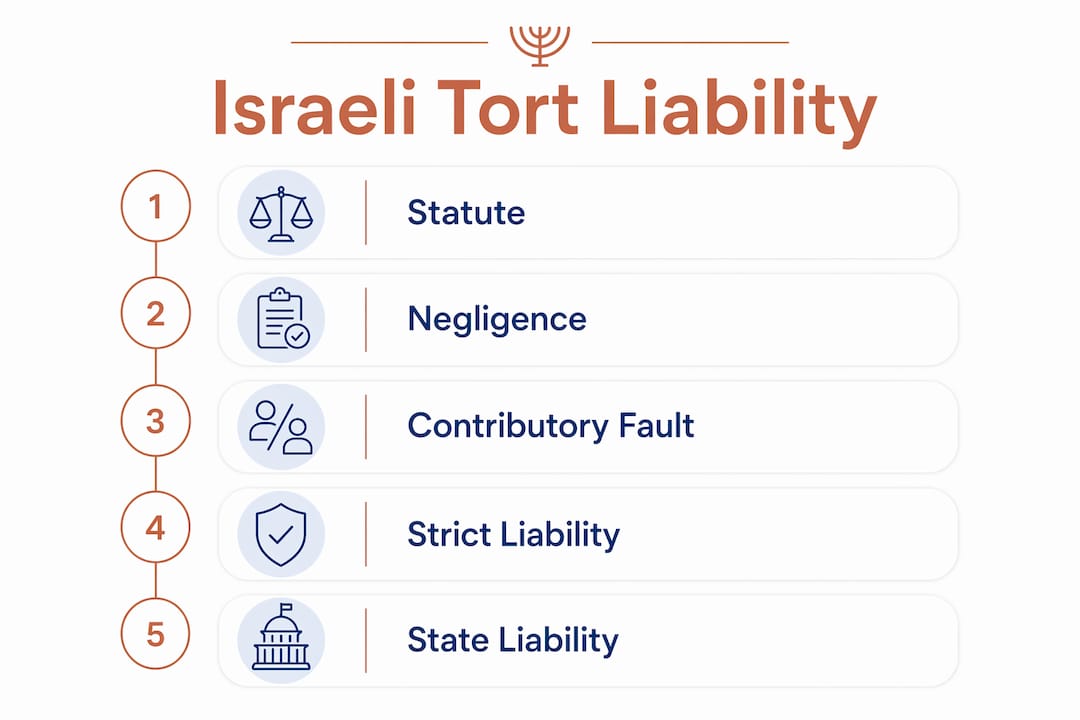
Israeli tort law recognizes several distinct liability theories beyond standard negligence. Each has its own statutory basis, elements, and practical application. The table below summarizes the primary categories:
| Tort type | Legal basis | Core requirement | Key application |
|---|---|---|---|
| Strict liability | Civil Wrongs Ordinance | Harm caused by inherently dangerous activity, no fault required | Industrial accidents, hazardous substances |
| Injurious falsehood | Section 58, Civil Wrongs Ordinance | False statement causing economic harm to reputation or business | Professional defamation, trade disparagement |
| State liability | Torts (State Liability) Law, 5712-1952 | State act or omission causing harm, subject to immunity exceptions | Government negligence, public authority failures |
| Corporate liability | Civil Wrongs Ordinance, employment law | Employee tortious act within scope of employment | Workplace injuries, product liability |
| Minor liability | Civil Wrongs Ordinance | Age 12 to 18: proportionate to maturity; under 12: generally no liability | School incidents, juvenile conduct |
Strict liability applies where the defendant engaged in an activity recognized as inherently dangerous, regardless of whether they exercised reasonable care. The plaintiff does not need to prove fault. This is particularly relevant in industrial settings, construction, and cases involving hazardous materials.

Injurious falsehood under Section 58 of the Civil Wrongs Ordinance covers professional reputation and economic interest injuries beyond classic negligence. A false statement about a competitor’s products, a professional’s qualifications, or a business’s financial standing can give rise to a claim if it causes measurable economic harm. This tort is distinct from defamation and focuses on economic rather than reputational injury in the personal sense.
State liability deserves particular attention. The Torts (State Liability) Law, 5712-1952 allows individuals to sue the State of Israel for tortious conduct, but the law contains significant immunity provisions. Acts of war, certain policy decisions, and legislative functions are generally immune. The boundaries of state immunity have been tested repeatedly before the Israeli Supreme Court, which has gradually narrowed immunity in cases involving administrative negligence and public authority failures.
Corporate liability in Israel follows the principle that corporations bear liability for tortious acts committed by employees within the scope of their employment. This ensures that injured parties can seek redress from entities with the financial capacity to satisfy judgments, rather than being limited to claims against individual employees.
Minor liability reflects a nuanced approach. Minors aged 12 to 18 can be held liable in tort with courts considering age and maturity. Children under 12 are generally not held liable. This graduated approach recognizes developmental differences while preserving some accountability for older minors.
How is Israeli tort liability law enforced through civil litigation?
Israeli civil litigation is conducted via bench trials without juries, with judges weighing evidence under a system influenced by both common law and continental legal traditions. This structure has direct implications for tort practitioners: persuasive legal writing, well-organized pleadings, and credible expert testimony carry more weight than courtroom theatrics.
The court hierarchy for tort claims operates as follows:
- Magistrates’ Courts handle claims up to ₪2.5 million. Most personal injury and property damage claims fall within this threshold.
- District Courts handle claims exceeding ₪2.5 million and serve as the appellate court for Magistrates’ Court decisions.
- The Supreme Court of Israel hears further appeals on questions of law and issues binding precedents that shape tort doctrine across all lower courts.
The statute of limitations for most tort claims is seven years from the date the cause of action arose. This period can extend where the injury or the identity of the defendant was unknown at the time of the harm, with some cases allowing up to ten years. Foreign claimants and defendants should note that these limitation periods are strictly enforced, and missing the filing deadline typically bars the claim entirely.
Key procedural features of Israeli tort litigation include:
- Pleadings. The statement of claim must set out all four negligence elements (or the relevant elements for other tort theories) with sufficient particularity. Vague or conclusory pleadings are vulnerable to procedural challenges.
- Expert testimony. Medical experts, engineers, economists, and other specialists play a central role. Courts rely heavily on written expert reports, and cross-examination of experts is a standard feature of contested tort trials.
- Documentary evidence. Medical records, accident reports, employment records, and financial statements are foundational. Israeli courts expect documentary evidence to be organized, translated where necessary, and submitted in accordance with procedural rules.
- Extraterritorial service. Foreign defendants can be served outside Israel under the Civil Procedure Regulations, though the process requires court approval and compliance with applicable international conventions.
For international clients and foreign practitioners, the Israeli civil litigation process has specific requirements around document translation, apostille certification, and jurisdictional thresholds that differ from common-law systems in Europe or North America. Engaging Israeli counsel early is the most reliable way to avoid procedural missteps that can delay or derail a legitimate claim.
Pro Tip: If you are advising a foreign client with a tort claim in Israel, address the statute of limitations question on day one. The seven-year period sounds generous, but delays in gathering foreign documents, obtaining translations, and identifying the correct defendant can consume that window faster than expected.
Key takeaways
Israeli tort liability law rests on the Civil Wrongs Ordinance (New Version), 1968, and requires practitioners to master negligence elements, contributory fault apportionment, and procedural rules specific to Israeli bench trial courts.
| Point | Details |
|---|---|
| Foundational statute | The Civil Wrongs Ordinance (New Version), 1968 governs all core tort theories in Israel. |
| Four negligence elements | Duty of care, breach, actual damage, and causation must all be proven for a negligence claim to succeed. |
| Contributory negligence impact | A plaintiff’s fault percentage directly reduces the damages awarded, making fault apportionment a primary litigation strategy. |
| Liability beyond negligence | Strict liability, injurious falsehood, state liability, and corporate liability each operate under distinct statutory rules. |
| Statute of limitations | Most tort claims must be filed within seven years, with limited extensions where injury or defendant identity was unknown. |
Menora Law’s perspective on Israeli tort liability
Having worked with international clients on Israeli civil claims for years, the most consistent mistake we see is treating Israeli tort law as interchangeable with the civil liability systems clients know from their home jurisdictions. It is not. The hybrid nature of Israeli tort law, drawing simultaneously from English common law precedent and Israeli statutory text, means that a legal argument that works in London or Sydney may land very differently before a Tel Aviv District Court judge.
Causation is where cases are most often won or lost. Clients frequently arrive with strong liability narratives but thin causation evidence. Israeli courts expect expert-validated, contemporaneous documentation linking the defendant’s breach to the specific harm suffered. Reconstructed evidence assembled years after the fact rarely satisfies this standard. The practical lesson is to preserve evidence immediately, retain qualified Israeli experts early, and build the causation chain before filing, not during discovery.
On contributory negligence, the strategic reality is that both sides have strong incentives to fight hard over fault percentages. A defendant who shifts 20% of fault to the plaintiff on a ₪1 million claim saves ₪200,000. That math drives aggressive contributory negligence pleading, and plaintiffs who ignore this dynamic often receive less than their cases are worth. Addressing the plaintiff’s conduct proactively, explaining it in context, and framing it against the moral blame standard gives claimants the best chance of minimizing reductions.
State liability cases require particular patience. The immunity provisions in the Torts (State Liability) Law, 5712-1952 are broad, and the Supreme Court’s gradual narrowing of those immunities has been incremental rather than transformative. Clients expecting swift accountability from government bodies need to understand that these cases are complex, often lengthy, and require a clear theory of why the specific state act falls outside the immunity provisions.
— Menora Law
Work with Menora Law on your Israeli tort claim
If you are dealing with a tort liability matter in Israel, whether as a claimant, a defendant, or an advisor to an international client, Menora Law provides experienced Israeli legal representation with a specific focus on international clients.

Menora Law handles civil claims across the full range of Israeli tort theories, from personal injury negligence to corporate liability and state accountability disputes. The firm offers remote representation for overseas clients, meaning you do not need to be in Israel to receive thorough, strategic legal advice. Communication is direct, response times are fast, and every case receives a tailored legal strategy grounded in Israeli statute and case law. To discuss your matter with an experienced Israeli civil litigator, visit মেনোরা আইন or review the firm’s detailed guide to the Israeli civil litigation process to understand exactly what to expect before your first consultation.
FAQ
What is the main statute governing tort liability in Israel?
The Civil Wrongs Ordinance (New Version), 1968 is the primary statute. It codifies negligence, strict liability, breach of statutory duty, and other tort theories, drawing on English common law principles.
How long do you have to file a tort claim in Israel?
The general statute of limitations for tort claims in Israel is seven years from the date the cause of action arose. Extensions of up to ten years apply where the injury or the defendant’s identity was not known at the time of the harm.
Can the Israeli government be sued for tortious conduct?
Yes. The Torts (State Liability) Law, 5712-1952 permits suits against the State of Israel for tortious acts, but broad immunity provisions apply to acts of war, legislative functions, and certain policy decisions.
What does contributory negligence mean in Israeli tort law?
Contributory negligence (ashm toram) means that a plaintiff’s own fault reduces their compensation proportionally. A 20% contributory negligence finding on a ₪500,000 award reduces the recovery to ₪400,000.
Are Israeli tort trials decided by a jury?
No. Israeli civil litigation is conducted exclusively through bench trials, with judges evaluating evidence and applying the law. There is no jury system in Israeli civil courts.


 English
 Afrikaans
 العربية
 বাংলা
বাংলা Čeština
 简体中文
简体中文 Nederlands
 Suomi
Suomi Français
 Deutsch
 עִבְרִית
 हिन्दी
 Magyar
 Italiano
 日本語
日本語 한국어
한국어 Polski
 فارسی
فارسی Português do Brasil
 Русский
 Español de México
 Українська