
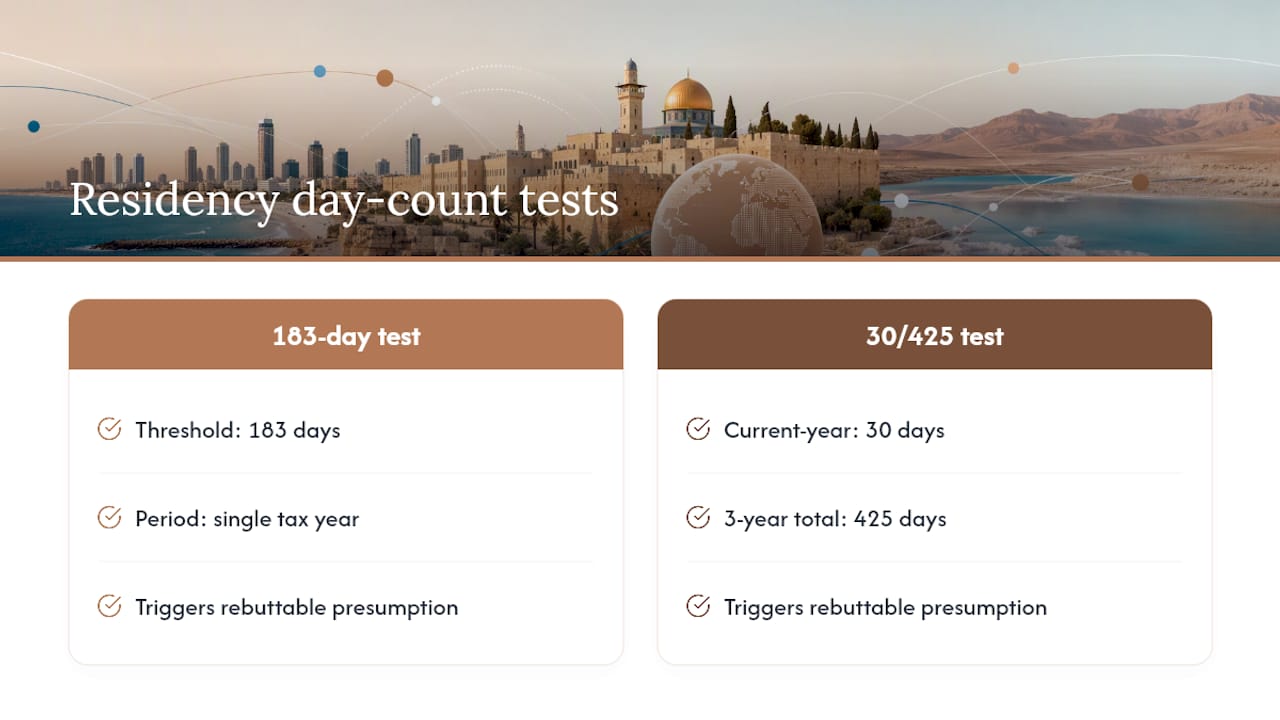
Whether you owe Israeli tax on your worldwide income comes down to one legal test and two numeric shortcuts. The “centre of life” test under Section 1 of the Income Tax Ordinance is the primary rule the Israel Tax Authority (רשות המיסים) applies, backed by two rebuttable day-count presumptions: 183 days in Israel during a tax year, or 30 days in the current year plus 425 days across the prior three years.
- Cross either threshold and the ITA presumes you’re a resident, taxed on income earned anywhere in the world.
- Stay under both, and the qualitative facts of your life (family, home, work) still control the outcome.
If you’ve spent significant time in Israel this year, or you moved family or business ties here, don’t assume your visa status settles the question. Tax residency is decided separately, and getting it wrong can mean a default withholding on Israeli-source passive income, generally considered to be high without specific treaty relief.
Start preserving your travel records, lease agreements, and family documents now. If your situation is anything but clean, Menora Law can assess the evidence with you before the ITA does it for you.
Key Takeaways
Israeli tax residency for foreigners hinges on the “centre of life” test first, with day-count presumptions serving only as rebuttable starting points, not final answers.
| Point | Details |
|---|---|
| Centre of life controls | Family location, permanent home, and main workplace usually outweigh a simple day count. |
| Day-count presumptions | 183 days in a year, or 30 days plus 425 days over three years, trigger a rebuttable presumption of residency. |
| Visa status isn’t tax status | Immigration category never automatically decides your Israeli tax residency. |
| Withholding and treaty relief | Foreign-source passive income can face 25% withholding, often reducible to 10% to 15% under a treaty. |
| Get evidence-based counsel | Menora Law reviews documentation, files ITA submissions, and represents foreign clients remotely on residency questions. |
This article is general information, not a substitute for advice from a qualified lawyer. Consult a qualified legal professional about your own circumstances before acting on anything here.
Tax Residency in Israel for Foreigners: The Statutory Test
The Income Tax Ordinance doesn’t hand out a checklist. It asks one core question: where is your “centre of life”? That phrase is the statutory anchor, and everything else, including the day-count rules, exists to support or rebut it.
Two presumptions do most of the practical work. Spend 183 days or more in Israel in a calendar year, and the ITA presumes residency. Fall short of that but hit 30 days in the current year combined with 425 days across the current and prior two years combined, and the same presumption kicks in. Both are described in the PwC tax summary of Israeli individual residence rules.
Neither presumption is absolute. Courts and the ITA’s own professional policy guidance look at the whole factual record before finalizing a determination. Day counts open the inquiry; they rarely close it.
What Counts as “Centre of Life”? The Evidence That Actually Matters
The ITA doesn’t weigh your calendar alone. Reviewers and courts look at where your real life is anchored, and some ties carry far more weight than others.
- Where your permanent home is, and whether it’s owned or rented long-term
- Where your spouse and children live and go to school
- Your main place of work, business activity, or professional practice
- Where your bank accounts, investment accounts, and vehicle registration sit
- Club memberships, professional subscriptions, and community ties
Family location and your permanent residence tend to dominate the analysis. A workspace in Tel Aviv means less if your spouse and kids are settled in London.
Pro Tip: Collect and date-stamp everything as you go, lease agreements, school enrollment letters, bank statements, even utility bills. A folder built in real time is worth far more to an ITA reviewer than documents assembled after the fact.

How the 183 and 30/425 Day-Count Rules Actually Work
The two presumptions are mechanical, but the math behind them isn’t always intuitive.
- The 183-day test. Spend 183 days or more physically present in Israel during a single tax year, and residency is presumed for that year.
- The 30/425 test. Spend at least 30 days in Israel during the current year, and at least 425 days total across that year and the two preceding years, and the same presumption applies.
Both tests are rebuttable. Fall under the thresholds and the ITA can still argue “centre of life” points to Israel; clear the thresholds and you can still argue your real life is elsewhere. The day count is a starting position, not a verdict, per PwC’s summary of the residence rules.
Keep passport stamps, boarding passes, and even mobile-location or employer attendance records. If your day count sits near either threshold, this paperwork often decides the case.
Does Your Visa Type Determine Your Tax Status?
No, and this is where a lot of foreigners get tripped up. Your immigration category (a work visa, an A/5 or B/1 permit, an investor visa) governs your right to live and work in Israel. It says nothing, on its own, about your tax obligations.
- A long-term visa holder who keeps a spouse, home, and business abroad can still be a non-resident for tax purposes.
- Conversely, someone on a short-term or tourist-adjacent visa who relocates family and finances to Israel can trip the “centre of life” test despite having no permanent status.
Visa category and tax residency are evaluated on entirely separate legal tracks, according to PwC’s Israel residence guidance. Treat them as two different questions, and build evidence for each.
The practical move is to line up documentation for your tax position independently of whatever your visa application already says.
Resident vs. Non-Resident: What It Actually Costs You
This is where the distinction stops being academic. A resident is taxed on worldwide income, everything from a Tel Aviv salary to dividends from a New York brokerage account. A non-resident is taxed only on Israeli-source income.
For foreigners, the pain usually shows up in a few predictable places:
- Foreign dividends and investment income that suddenly become taxable once Israeli residency attaches.
- Rental income from property abroad, which is generally outside Israel’s reach for non-residents but taxable worldwide for residents.
- Exit tax exposure when residency terminates, since Israel can tax unrealized gains on certain assets as if they were sold on the day you leave.
Foreigners commonly face a default 25% withholding on Israeli-source passive income like dividends, interest, or certain royalty payments, according to IsraelTax’s guide for foreign residents. A relevant bilateral tax treaty can often reduce that rate to a lower range, often roughly 10% to 15%, depending on the specific treaty and income type.
The treaty relief isn’t automatic. It depends on the exact agreement between Israel and your home country, and on filing the right forms with the withholding agent before payment. If you own rental property, whether in Israel or generating income for you elsewhere, the deductible expense rules can materially change your net exposure; RentrIQ’s guide to landlord tax deductions is a useful primer on what’s typically deductible against rental income. Verify which treaty applies to you specifically before assuming a rate.
Proving or Changing Your Residency Status: A Practical Checklist
Whether you’re establishing residency, rebutting a presumption, or trying to terminate Israeli tax residency altogether, the process runs on documentation and timing.
- Gather your supporting evidence: leases, school records, employment contracts, bank statements.
- Build a clear timeline of where you physically were, day by day, for the relevant years.
- File the appropriate ITA forms disclosing your residency position.
- In complex or high-stakes cases, request an advanced ruling from the ITA rather than waiting for an audit to force the question.
Your document checklist should include lease or property sale agreements, marriage and family records, bank and investment statements, employer contracts, utility bills, and detailed travel logs.
Ask for a formal ruling, or bring in counsel early, when you have cross-border income streams, potential exit tax exposure, or conflicting claims under a tax treaty. Ending Israeli residency requires affirmative proof that your centre of life moved abroad. Simply boarding a flight out of Ben Gurion doesn’t do it.
National Insurance, Property, and Pensions: The Ripple Effects
Tax residency doesn’t just touch income tax. It reaches into National Insurance coverage, property tax exposure, and pension treatment too.
- Your residency status affects both your Bituach Leumi contribution obligations and your entitlement to benefits, particularly if you’re living or working abroad for extended periods.
- Exit tax can apply to certain assets when residency terminates, and foreign pensions may face different treatment depending on your resident status and any applicable treaty.
- You’ll likely deal with both רשות המיסים and המוסד לביטוח לאומי separately, since they administer different obligations under different rules.
Anyone relocating for an extended stay should review their status directly with Bituach Leumi’s guidance for people living abroad rather than assuming income tax and National Insurance rules move together. They often don’t.
If you hold Israeli real estate, residency changes can also affect how gains and rental income are taxed; see Menora Law’s overview of property rights for non-residents for the property-specific angle.
The 2025 Draft Law: What’s Changing and Why It Matters Now
The government published a 2025 draft notice (תזכיר חוק) aimed at defining clear-cut cases where residency can be determined more conclusively, reducing the disputes that currently clog the system.
The likely effect is a tightening of how certain day-count and factual scenarios get classified, giving both taxpayers and the ITA less room for argument in straightforward cases. That’s good news if your facts are clean. It’s a warning sign if your situation involves mixed ties, since administrative practice can shift even before the draft becomes final law.
If you’re mid-relocation or your ties are split between Israel and another country, get a legal review now rather than after the rules solidify.
When to Bring In an Israeli Tax Lawyer: How Menora Law Helps
Some residency questions resolve themselves on the facts. Others don’t, and waiting for an ITA audit to force clarity is the expensive way to find out which kind you have.
- Menora Law prepares documentation for ITA submissions, pursues advanced rulings, and coordinates cross-border tax and immigration planning for foreign clients.
- Engagement makes sense when you have conflicting day counts, meaningful foreign passive income, property or pension exposure, or signs an ITA inquiry may be coming.
Foreign clients often don’t realize how their passive income streams interact with Israeli residency rules until it’s already a problem. Building the tax picture alongside the immigration plan from day one avoids that surprise.
Menora Law represents clients remotely with fast, direct communication, so distance from Israel is never a reason to go without proper counsel.
A Menora Law View: What Leaving Israel Doesn’t Automatically Fix
One recurring mistake: a client assumes that moving abroad ends Israeli tax residency the moment they leave. It doesn’t work that way. In one matter, only after assembling a clear timeline, family relocation records, and proof of closed Israeli business ties did the termination hold up. The paperwork, not the departure date, made the difference.
Get Your Israeli Tax Residency Reviewed Before the ITA Does
Menora Law is the practical alternative to guessing your way through a residency question or hiring a generalist firm with no Israeli tax focus. We specialize exclusively in Israeli law for international clients, which means we know exactly which documents the ITA weighs and how the 2025 draft rules are likely to shape upcoming determinations.

Our services for foreigners cover residency assessments, ITA submissions, bilateral treaty checks, exit tax planning, and representation if a dispute arises. If you own Israeli property alongside a residency question, our real estate law team handles that overlap directly. Consultations happen remotely by video, so you don’t need to be in Israel to get a straight answer. Book a consultation through মেনোরা আইন to get your evidence reviewed and your risk estimated before the ITA raises the question for you.
Sources
- תושב חוץ — IsraelTax (Hebrew)
- Israel – Individual – Residence | PwC Tax Summaries
- Living abroad — Bituach Leumi
- Gov
FAQ
How many days trigger Israeli tax residency?
Either 183 days in a single tax year, or 30 days in the current year combined with 425 days across the current and prior two years, triggers a rebuttable presumption of residency.
Can I be a tax resident even if I spend fewer than 183 days in Israel?
Yes. The “centre of life” test can still classify you as a resident based on family, home, and economic ties, regardless of day counts.
Does a work visa make me an Israeli tax resident?
No. Visa category and tax residency are assessed separately under Israeli law, and one doesn’t determine the other.
What tax rate applies to foreign-source passive income once I’m a resident?
When should I contact an Israeli tax lawyer about residency?
Reach out when day counts are borderline, you have significant foreign passive income, or you’re trying to formally terminate residency. Menora Law handles these assessments remotely for clients abroad.


 English
 Afrikaans
 العربية
 বাংলা
বাংলা Čeština
 简体中文
简体中文 Nederlands
 Suomi
Suomi Français
 Deutsch
 עִבְרִית
 हिन्दी
 Magyar
 Italiano
 日本語
日本語 한국어
한국어 Polski
 فارسی
فارسی Português do Brasil
 Русский
 Español de México
 Українська