
Under Israeli law, the line between liquidated damages and a penalty is not drawn the way many foreign contracts assume. Israel’s Contracts (Remedies for Breach of Contract) Law, 1970 calls the concept “agreed compensation.” It lets the parties fix the amount in advance, and it lets a court reduce that amount if it is unreasonable. So an Israeli court usually doesn’t throw out a clause for being a “penalty.” It asks whether the number is reasonable, and it can trim it.
This guide explains that in plain terms. It is for people signing or enforcing a contract governed by Israeli law from abroad: investors, founders, landlords, buyers, and companies working with Israeli partners. We are Menora Law, an Israeli law practice that represents international clients remotely and on site, and this is how we explain the topic to them.
TL;DR
- In Israeli contract law, the term to know is “agreed compensation” (in Hebrew, pitzui meuchad). It is a sum the parties fix in the contract to be paid on breach.
- The statute lets the injured party claim the agreed sum without proving how much it actually lost.
- A court can reduce an agreed sum that is unreasonable compared with the damage that could be foreseen when the contract was signed.
- The practical goal is a number you can explain: tie it to real, foreseeable losses, and write down how you arrived at it.
- If your contract is in English but governed by Israeli law, have an ইসরায়েলি আইনজীবী review the clause before signing, not after a dispute starts.
What liquidated damages mean in an Israeli contract
Liquidated damages are a pre-agreed sum of money, or a formula, that one side pays if it breaches the contract. The idea is simple. Some losses are hard to prove later. If a developer is late handing over an apartment, or a supplier misses a delivery window, calculating the exact loss can take months and expert reports. The parties avoid that by agreeing on a figure at the start.
Israeli law gives this a statutory home. The Remedies Law allows the parties to set agreed compensation in the contract itself. If one side breaches, the other can claim that sum without having to prove the damage it suffered. That is the main commercial benefit: speed and certainty.
You will see the concept under many names in real documents:
- Agreed compensation
- Liquidated damages
- Predetermined damages
- Late-delivery or delay charges
- A fixed sum payable on cancellation
The label matters less than what the clause does. A court looks at the substance of the clause, not at what the drafter called it.
What a penalty is, and why the Israeli approach looks different
In many legal systems, a penalty clause is one that punishes breach rather than estimating loss, and a court refuses to enforce it. People searching “liquidated damages vs penalty” are usually trying to learn where that line falls.
Israeli law handles it differently. It doesn’t ask you to sort a clause into one of two boxes, valid or void. It starts from the idea that the parties can agree on a sum. It then gives the court a power to reduce the sum when it is unreasonable in light of the damage that could have been foreseen at the time of signing, as set out in the Remedies Law.
That has a few practical consequences:
- An inflated number is not automatically worthless. The risk is that the court cuts it down, and you may end up with less than you wanted.
- The test is about proportion. The question is whether the sum is reasonable compared with the foreseeable harm, not whether it “feels” punitive.
- The court looks at the moment of signing. What you could reasonably foresee when you made the deal matters more than a different story told after the breach.
- There is no magic percentage. The statute doesn’t say that 5% or 10% of the contract price is safe. Reasonableness depends on the deal.
If you come from a system where a penalty clause is simply unenforceable, this is the part to adjust to. In Israel the practical danger is a reduction, and the drafting goal is a figure that doesn’t invite one.
Liquidated damages vs. penalty: a side-by-side view
The table below summarizes how the two ideas are usually understood, and how that plays out under the Israeli statute.
| Question | Liquidated damages (reasonable agreed compensation) | Penalty-style clause (an amount well above foreseeable loss) |
|---|---|---|
| Purpose | Estimate loss in advance, save proof | Pressure the other side to perform |
| Link to foreseeable harm | Clear and explainable | Weak or missing |
| Need to prove actual loss | Not required to claim the sum | Not required to claim, but the other side can ask the court to reduce |
| Risk in an Israeli court | Low, if the amount is proportionate | Court may reduce the amount |
| Best drafting habit | Record how the number was reached | Avoid, or rework into a defensible figure |
How an Israeli court decides whether the sum is reasonable
The statute points the court to the damage that could have been foreseen when the contract was made. In practice, the facts that carry weight tend to be these:
- The size of the sum against the contract value. A fixed charge that is a small slice of the price is easier to defend than one that approaches the whole price.
- How hard the loss is to measure. Delay in a construction project, loss of a distribution slot, or damage to a brand are the kinds of harm that are genuinely difficult to calculate.
- Whether the sum scales with the breach. A per-day figure for a delay that is capped looks more like an estimate than a single huge amount for any breach, big or small.
- The parties’ bargaining position. Two companies with lawyers negotiating line by line present a different picture from a consumer handed a form.
- Whether the clause treats serious and trivial breaches the same. A flat sum for a one-day delay and a six-month delay is hard to explain.
We are describing the factors we ask clients to think about, not a checklist from the statute. The statute itself keeps the test short: is the sum unreasonable compared with the foreseeable damage? Everything else is how a lawyer builds the argument.
Drafting agreed compensation that holds up
If you are the party who expects to enforce the clause, you want it to survive a request to reduce it. Here is how we approach drafting.
Tie the number to something real
Write down the loss you are worried about: extra rent, idle equipment, lost resale opportunity, financing costs, penalties you would owe a third party. Then choose a figure that fits those items. A short recital in the contract explaining the basis helps. It doesn’t guarantee the outcome, but it gives your lawyer something concrete to point to.
Use a rate and a cap for delay
For delays, a daily or weekly rate with an overall cap is the easiest structure to defend. The sum grows with the harm, and the cap shows that you thought about proportion.
Match the sum to the type of breach
Don’t attach one huge number to every possible breach. Separate the obligations that really matter, such as delivery date, confidentiality, exclusivity, and payment, and set a different figure for each. Minor administrative breaches may deserve a warning and a cure period, not a fixed sum.
Say what the sum replaces
Decide in advance whether the agreed compensation is the only remedy for that breach, or whether the injured party may also claim other relief such as specific performance or cancellation. Say it clearly. Silence leads to arguments about what the parties intended.
Add a cure period and clear notice steps
A notice and a short cure period show good faith and reduce the chance that a court sees the clause as a trap.
Keep the language aligned
If the contract is bilingual, make sure the English and Hebrew versions say the same thing about the sum, the trigger, and the remedy. Our guide on making an English contract enforceable in Israel covers the practical steps for that.
If you are the one who has to pay
Paying party? The clause may still be negotiable, even after a breach. These are the questions we would raise with you:
- Was the sum fixed in a negotiated contract or in a standard form?
- How does the figure compare with the loss the other side could realistically have foreseen at signing?
- Did the other side actually suffer anything, and does it matter to the way the clause was written?
- Is the claim for the full sum, or has the other party already received part of it, for example through a deposit?
- Does the contract require arbitration, mediation, or a particular court?
The fifth question matters more than people expect. Many international agreements route disputes to arbitration, and that changes who decides whether the sum is reasonable and how fast. Our practical guide to arbitration clauses in Israeli contracts explains how these clauses work. If the dispute is headed to court instead, international commercial lawsuits in Israel gives you the lay of the land for overseas parties.
Where this comes up most for international clients
Real estate purchases
Purchase agreements often fix a sum payable if the buyer backs out or the seller is late with delivery or registration. Foreign buyers sometimes sign without realizing how much is at stake in the cancellation clause. Read it with the same care as the price. Our overview of Israeli real estate law for buyers and investors shows where these clauses sit in the wider transaction.
Contractor and construction agreements
Delay charges are the classic example. A per-day figure with a cap is common, and the details of how delay is measured can decide a dispute. Before you sign, run through the checks for an Israeli contractor contract.
Software and technology agreements
Licenses, distribution deals, and development contracts often include fixed sums for breach of confidentiality or unauthorized use. These are the situations where loss is hard to measure, which is exactly why agreed compensation exists. If you license software into Israel, see the legal fixes foreign firms need to make.
Shareholder and investment agreements
Founders and investors sometimes include fixed sums for breach of non-compete, exclusivity, or funding commitments. Because these clauses can be large relative to deal size, they are worth stress-testing against the reasonableness standard from day one.
A worked example
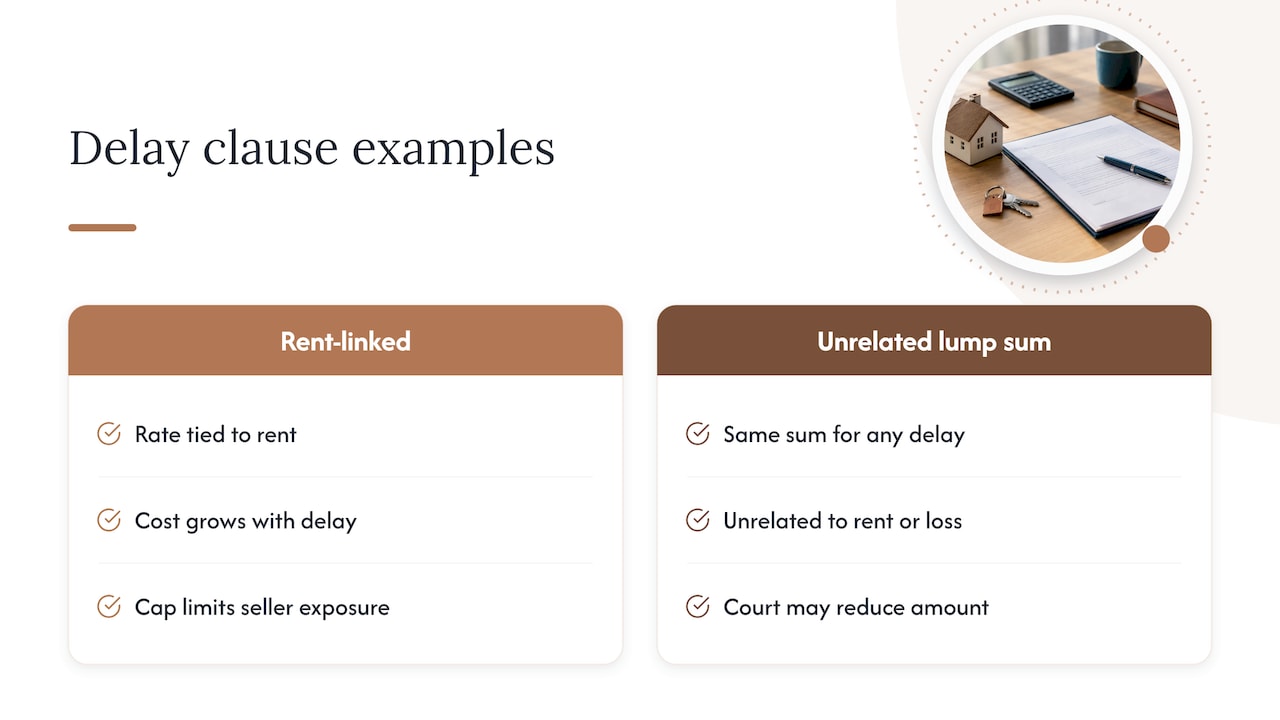
Imagine a foreign company agrees to buy an apartment off the plan in Israel. The contract says that if the seller fails to hand over the apartment by the agreed date, it pays a set amount for each month of delay. The company’s reasoning is easy to document: it will have to rent a similar apartment, or lose rental income it planned to collect.
That clause tells a clean story. The rate is connected to rent, it grows as the delay grows, and a cap protects the seller from open-ended exposure. If the seller later argues that the sum is unreasonable, the buyer has a ready explanation.
Now change one thing. The contract says that any delay, even one day, costs the seller a very large single sum unrelated to rent or any other loss. The buyer will find it harder to explain that figure, and the seller has a clear argument that the amount is out of proportion to the foreseeable harm. A court may reduce it.
The same structure applies in business contracts. A clause with a visible logic is far more likely to survive than one that exists only to scare the other side.
Common mistakes we see in cross-border contracts
- Copying a template from another country. Language drafted for a different legal system may rely on rules that don’t apply in Israel. The result is a clause that doesn’t match how an Israeli court will read it.
- Setting one sum for every breach. It is the easiest way to invite a reduction.
- Forgetting the interaction with other remedies. If the contract is silent, the parties argue later about whether the sum is the exclusive remedy.
- Ignoring dispute resolution. Governing law, forum, and language shape how the clause is enforced.
- Waiting until a dispute to ask a lawyer. Reviewing the clause before signing costs far less than fixing it afterward.
Perspective
Foreign clients usually arrive with one question: is this clause a penalty, yes or no? In Israel, the more useful question is whether the number can be defended as a reasonable estimate of foreseeable harm.
We approach every agreed-compensation clause the same way. We read the commercial story behind the number, check it against the Israeli statute, and reshape the clause if the story is thin. For a client who is enforcing, that means a clause built to stand up if challenged. For a client who is paying, it means knowing early whether there is room to negotiate.
Because we work remotely with overseas clients every day, we can review a draft, explain it in plain English, and answer quickly, without you traveling to Israel. We believe the best protection is a short conversation with an ইসরায়েলি আইনজীবী before signature.
মেনোরা আইন
How Menora Law can help
We prepare and review contracts under Israeli law for international clients, including real estate agreements, company and investor documents, and commercial contracts, and we represent clients in disputes over them. If you have a draft with a fixed-sum clause, or you have received a demand for one, we can walk you through where you stand and what your options are.

To talk to us about your contract, visit মেনোরা আইন and tell us what you are dealing with. We will tell you plainly what the next step should be.
FAQ
What is the difference between liquidated damages and a penalty?
Liquidated damages are a sum set in advance as a reasonable estimate of the loss a breach would cause. A penalty is a sum meant to pressure someone into performing, with little connection to the loss. In Israel, the statute speaks of agreed compensation, and a court can reduce the sum if it is unreasonable compared with the foreseeable damage.
Do I have to prove my actual loss to collect agreed compensation in Israel?
No, that is the purpose of the clause. The Remedies Law allows the injured party to claim the agreed sum without proving the damage. The other side can still ask the court to reduce the amount if it is unreasonable, so keeping a record of why the figure was chosen is useful.
Can an Israeli court cancel a penalty clause completely?
The statute’s tool is reduction, not automatic cancellation. The court looks at whether the sum is reasonable compared with the damage that could be foreseen at signing. Outcomes depend on the facts, so ask an ইসরায়েলি আইনজীবী to assess your specific clause.
How should I calculate liquidated damages for a delay?
Start with the real cost of the delay to you, such as rent, financing, or lost income. Then set a daily or monthly rate and add a cap. A rate linked to identifiable loss is much easier to defend than a single large number.
Does an English-language contract with a fixed-sum clause work in Israel?
It can, if the contract is valid and governed by Israeli law. Make sure the governing law, forum, and language are clear, and have an ইসরায়েলি আইনজীবী check that the clause is drafted in a way an Israeli court will understand.


 English
 Afrikaans
 العربية
 বাংলা
 Čeština
 简体中文
 Nederlands
 Suomi
 Français
 Deutsch
 עִבְרִית
 हिन्दी
 Magyar
 Italiano
 日本語
 한국어
 Polski
 فارسی
 Português do Brasil
 Русский
 Español de México
 Українська