
TL;DR:
- Proving heir status in Israel requires obtaining a court order, either a Succession or Probate Order, to access assets. These orders are essential proof recognized by banks, land registries, and government agencies, and they clarify inheritance rights. Non-resident heirs must authenticate foreign documents and work with Israeli attorneys to navigate the process efficiently.
Proving heir status in an Israeli estate comes down to one formal legal step: obtaining either a Succession Order (Tzav Yerusha) or a Probate Order (Tzav Kiyum Tzava) from the Israeli Registrar of Inheritance Affairs or the Family Court. Without one of these court orders, no bank, pension fund, or land registry in Israel will release a single asset to you, regardless of how clear your family relationship is.
Here is what that process requires at a glance:
- Succession Order applies when the deceased left no valid will. It identifies the legal heirs and their respective shares under Israeli law.
- Probate Order applies when a valid will exists. It confirms the will’s authenticity and authorizes distribution according to its terms.
- All supporting documents, including death certificates, birth certificates, and marriage records, must be authenticated and, if foreign, translated into Hebrew.
- Non-resident heirs typically need a licensed Israeli attorney to file on their behalf and communicate with local authorities.
- Israeli law governs all assets physically located in Israel, regardless of where the deceased lived or what foreign wills say.
Pro Tip: Start gathering and authenticating your documents as early as possible. Cross-border paperwork, apostilles, and Hebrew translations can add weeks to your timeline. An experienced Israeli attorney can coordinate this process remotely and prevent avoidable delays.
What is a Legal Heir Certificate and why does it matter?
In Israeli legal practice, the term “Legal Heir Certificate” refers collectively to the Succession Order and the Probate Order, the two formal instruments that establish heirship under ইসরায়েলের উত্তরাধিকার আইন. These are not optional formalities. They are the only recognized proof of inheritance rights in Israel.
The distinction between the two matters:
- ক Succession Order is issued when no valid will exists. It lists the heirs and their statutory shares as defined by the Succession Law 5725-1965.
- ক Probate Order is issued when a valid will is presented. It confirms will validity and authorizes distribution according to its terms.
Without one of these orders, the following institutions will refuse to act:
- Israeli banks and financial institutions
- The Land Registry (Tabu)
- Pension funds and insurance companies
- Any government body holding assets of the deceased
The certificate also reduces family disputes. Once issued, it creates a legally binding record of who inherits what, leaving little room for competing claims.
Who qualifies as a legal heir under Israeli law?
Israel’s Succession Law of 1965 establishes a clear hierarchy of statutory heirs when no valid will exists. The order is fixed, and personal promises or informal family arrangements carry no legal weight.
The order of priority is as follows:
- Surviving spouse — inherits half the estate when children exist; two-thirds when only parents or siblings survive.
- Children (including adopted children) — share the remaining half equally when a spouse survives, or inherit the entire estate when no spouse exists.
- Parents — inherit if no spouse or children survive.
- Siblings — inherit if no spouse, children, or parents survive.
- More distant relatives — grandparents and their descendants, in descending order.
- The State of Israel — inherits only when no relatives of any kind can be identified.
A valid will can override this default order, but it must be validated through a Probate Order. Israeli courts also recognize foreign wills, though foreign wills require a certified Hebrew translation and a legal opinion confirming validity under the law of the country where the will was made.
One important nuance: the spouse’s rights extend beyond a share of the estate. The surviving spouse also holds specific rights to the shared family home and household contents, independent of the inheritance split.
How to prove heir status: the step-by-step application process
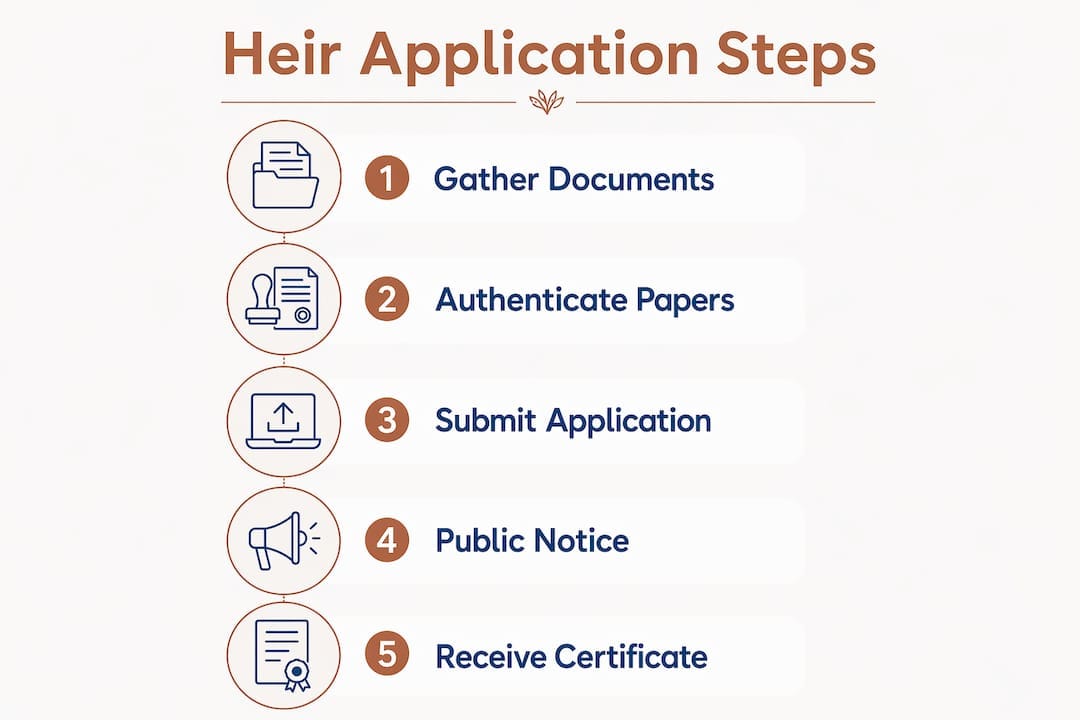
The process of proving heirship and obtaining the Legal Heir Certificate follows a defined sequence. Each step builds on the previous one, and missing documentation at any stage can stall the entire application.

Required documents by heir type and case complexity:
| Document | No-Will Case | Will Case | Foreign Heir |
|---|---|---|---|
| Death certificate (apostilled if foreign) | Required | Required | Required |
| Birth certificate proving relationship | Required | Required | Required + Hebrew translation |
| Marriage certificate (if spouse) | Required | Required | Required + Hebrew translation |
| Original will | Not applicable | Required | Required + Hebrew translation |
| Foreign law legal opinion | Not applicable | Sometimes | Often required |
| Heir waiver forms (if any heir disclaims) | Sometimes | Sometimes | Sometimes |
The application process, step by step:
- Obtain the death certificate. If the deceased died abroad, the certificate must carry an apostille under the Hague Convention and be translated into Hebrew by a certified translator.
- Compile proof of family relationships. Gather birth certificates, marriage certificates, and adoption records for all potential heirs. Foreign documents need apostilles and Hebrew translations.
- Determine whether a will exists. Search Israeli registries and the deceased’s personal records. If a will is found, a Probate Order is the correct filing; if not, apply for a Succession Order.
- Appoint an Israeli attorney if you are a non-resident. Remote handling is common when all documents are properly prepared, but a licensed Israeli representative must sign and submit the application.
- Submit the application to the Registrar of Inheritance Affairs in the district where the deceased last resided in Israel.
- Wait for the public notice period. The Registrar publishes a notice allowing any party to object. If no objections are filed, the order is typically issued within the standard processing window.
- Attend a Family Court hearing if required. Contested cases, complex estates, or applications involving foreign assets are referred to the Family Court, which may schedule hearings and request additional evidence.
- Receive the digital order. Israeli inheritance and probate orders are issued digitally and transmitted directly to relevant institutions such as banks and the Land Registry.
Pro Tip: Organize all foreign documents into a single authenticated package before filing. Submitting incomplete paperwork forces the Registrar to issue correction notices, which can add months to an already lengthy process.
What timelines and challenges should non-resident heirs expect?
Uncontested cases typically take a few months from the date of application to the issuance of the order. That window assumes all documents are complete, properly authenticated, and no objections are raised during the public notice period.
For non-resident heirs, the realistic timeline is often longer. Common challenges include:
- Foreign document authentication. Obtaining apostilles, certified translations, and notarizations from multiple countries takes time and coordination.
- Frozen assets. Israeli banks and the Land Registry freeze all assets of the deceased immediately upon notification of death. Nothing moves until the formal order is issued.
- Unclear family relationships. If the deceased had children from multiple relationships, or if family civil status records are incomplete, the Registrar may require additional evidence before proceeding.
- Foreign assets and multi-jurisdiction issues. When the deceased held assets in more than one country, each jurisdiction may require its own legal process. Israeli courts often request a foreign law opinion before issuing an order in these cases.
- No local representation. Without an Israeli attorney, non-residents cannot effectively communicate with the Registrar, respond to correction notices, or appear at Family Court hearings.
- Will disputes. If any heir challenges the validity of a will, the case moves to Family Court, where proceedings can extend the timeline considerably.
Statistic callout: Standard uncontested Israeli probate and succession orders take about 60 to 90 days to issue. Cases involving foreign documents, multi-jurisdictional assets, or contested claims often take longer.
For heirs dealing with multi-jurisdictional estate matters, early legal coordination across all relevant countries is the single most effective way to keep the process on track.
How to use the Legal Heir Certificate to access inherited assets
Once the Succession Order or Probate Order is issued, it functions as the master key to every inherited asset in Israel. The order is transmitted digitally by the Registrar directly to the relevant institutions, which means you do not need to physically deliver a paper document to each bank or registry.
Here is how the certificate works in practice across different asset types:
- Bank accounts: Present the order reference to the bank. The institution will unfreeze the account and transfer funds to the heirs according to their designated shares.
- Real estate: The Land Registry (Tabu) requires the order to update the property deed. Without this step, the property legally remains in the deceased’s name and cannot be sold or transferred.
- Pension funds and insurance policies: Pension administrators and insurers require the order before releasing accumulated funds or policy payouts to beneficiaries.
- Shares and investment accounts: Brokerage firms and investment managers follow the same protocol, releasing holdings only upon presentation of the valid order.
One practical point worth knowing: Israeli law applies absolutely to assets physically located in Israel, regardless of the deceased’s country of residence or the terms of a foreign will. This “situs rule” means that even if a foreign court has already issued an inheritance ruling, a separate Israeli order is still required before any Israeli asset can be transferred. If you are planning to sell inherited property after completing this process, understanding how inherited property transfers work with multiple heirs can help you prepare for the next steps.
How Menora Law helps non-residents navigate Israeli inheritance law
Handling an Israeli estate from abroad is genuinely difficult. The paperwork requirements, the public notice periods, the Family Court hearings, and the coordination with Israeli banks and registries all demand local knowledge and consistent follow-through.
Menora Law’s team works with non-resident heirs across the full lifecycle of an Israeli estate: from gathering and authenticating foreign documents, to filing with the Registrar, to representing clients at Family Court hearings when disputes arise. For estates that span multiple countries, the firm coordinates with foreign counsel to satisfy both Israeli and international legal requirements simultaneously.
What sets this kind of representation apart is responsiveness. Non-resident heirs often wait weeks for answers from local attorneys who are not set up for international clients. Menora Law’s practice is built around overseas clients, which means fast communication, clear explanations, and no surprises about where the case stands.
What documents do non-resident heirs specifically need?
Non-resident heirs face a higher documentation burden than Israeli residents, because every foreign document must meet Israeli authentication standards before the Registrar will accept it.
The core requirements for non-resident heirs are:
- Death certificate issued by the foreign country, bearing an apostille under the Hague Convention, plus a certified Hebrew translation.
- Proof of relationship (birth certificate, marriage certificate, or adoption record), each apostilled and translated into Hebrew.
- Passport copy of each heir, to confirm identity.
- Power of attorney authorizing an Israeli attorney to act on the heir’s behalf. This document must be notarized in the heir’s country of residence and, in most cases, apostilled.
- Foreign will (if applicable), with a certified Hebrew translation and a legal opinion from a qualified attorney in the country where the will was executed, confirming its validity under that country’s law.
- Heir waiver forms if any heir chooses to disclaim their share of the estate.
A practical note on apostilles: not every country is a signatory to the Hague Convention. If the heir’s country of residence is not a signatory, documents must go through a more involved legalization process through the Israeli consulate or embassy in that country. Confirming this requirement early avoids significant delays later.
Common legal hurdles when proving heir status in Israel
Several disputes and procedural complications come up repeatedly in Israeli inheritance cases, particularly when non-residents are involved.
Competing heir claims. When the deceased had children from multiple relationships, or when the family structure is complex, different parties may assert conflicting heirship claims. The Family Court resolves these disputes, but the process can take considerably longer than a straightforward application.
Invalid or contested wills. A will that does not meet Israeli formal requirements, or one that was signed under questionable circumstances, can be challenged by any interested party during the public notice period. If a challenge is filed, the case moves to Family Court for a full hearing.
Unlocated heirs. Israeli law requires that all known heirs be notified of the application. If an heir cannot be located, the Registrar may require additional steps before issuing the order, including publication in Israeli newspapers.
Debt and liability issues. Heirs who accept an inheritance also accept responsibility for the deceased’s debts up to the value of the estate. If the estate carries significant liabilities, heirs may need legal advice on whether accepting the inheritance is financially prudent.
Foreign asset complications. When the deceased held assets in Israel and abroad, each jurisdiction operates independently. An Israeli Probate Order does not automatically authorize asset transfers in other countries, and vice versa. Coordinating parallel legal processes across jurisdictions requires careful planning. Menora Law’s experience with Israeli multi-jurisdictional estates is particularly relevant here.
The most effective way to address any of these hurdles is to engage qualified Israeli legal counsel before filing, not after a problem surfaces.
What does it cost to obtain a Legal Heir Certificate in Israel?
Israeli inheritance law imposes no inheritance or estate tax, which is a meaningful advantage compared to many other countries. The transfer of assets from a deceased person to heirs is tax-free under Israeli law. That said, there are real costs involved in the process.
Filing fees. The Registrar of Inheritance Affairs charges a filing fee for each application. The exact amount varies based on the type of application and the complexity of the estate. These fees are set by Israeli regulations and are not publicly listed as a fixed universal figure.
Attorney fees. Legal representation is the most significant cost for most heirs, particularly non-residents who require ongoing coordination with Israeli authorities. Fees vary by firm and by the complexity of the estate.
Translation and authentication costs. Certified Hebrew translations, apostilles, and notarizations for foreign documents add up, especially when multiple heirs are involved and each has documents from different countries.
Subsequent property taxes. While the inheritance itself is tax-free, heirs who take ownership of Israeli real estate become responsible for ongoing municipal taxes and, if they later sell the property, may face capital gains considerations under Israeli tax law.
Court costs. If the case proceeds to Family Court, additional court filing fees apply. Contested cases that require multiple hearings will naturally incur higher costs than uncontested applications resolved at the Registrar level.
For a detailed breakdown of what to expect during the Israeli probate process, including typical cost ranges and processing timelines, Menora Law’s resources provide practical guidance tailored to international heirs.
Menora Law: expert Israeli inheritance representation for international heirs
Dealing with an Israeli estate from overseas is one of the more complex legal situations a family can face. The paperwork is demanding, the institutions are unforgiving about incomplete orders, and the timeline can stretch if anything is missed.
Menora Law offers a direct alternative to navigating this alone. As an internationally focused Israeli law practice, the firm handles the full inheritance process on behalf of non-resident heirs: document preparation, Registrar filings, Family Court representation, and coordination with Israeli banks and the Land Registry. Clients do not need to travel to Israel. Everything is managed remotely, with clear updates and fast responses throughout.
The firm’s Israeli inheritance law expertise covers both straightforward succession cases and complex multi-jurisdictional estates. Whether you are dealing with a contested will, a frozen bank account, or a property that needs to be transferred across borders, Menora Law has handled it before.
If you have inherited Israeli assets and are not sure where to start, reach out to Menora Law for a consultation. The sooner you begin, the sooner the estate can be resolved.
Key Takeaways
Proving heir status in an Israeli estate requires a formal court order, either a Succession Order or a Probate Order, without which no Israeli institution will release or transfer any inherited asset.
| Point | Details |
|---|---|
| Two types of orders | A Succession Order applies when no will exists; a Probate Order confirms a valid will’s terms. |
| Standard timeline | Standard uncontested probate and succession orders in Israel take about 60 to 90 days to issue; foreign documents and disputes can extend this timeline. |
| No inheritance tax | Israel imposes no estate or inheritance tax, but filing fees, attorney costs, and translation expenses apply. |
| Non-resident requirements | Foreign heirs need apostilled documents, Hebrew translations, and a power of attorney for an Israeli attorney. |
| মেনোরা আইন | Handles the full Israeli inheritance process remotely for non-resident heirs, from filing to asset transfer. |
FAQ
How do I prove I am an heir in an Israeli estate?
You prove heirship by obtaining a Succession Order (no will) or a Probate Order (valid will) from the Israeli Registrar of Inheritance Affairs or Family Court. These orders are the only legally recognized proof of inheritance rights in Israel.
How long does probate take in Israel?
In standard uncontested cases, probate and succession orders take about 60 to 90 days from filing to issuance. If there are foreign documents, contested wills, or assets in multiple countries, the process will often take significantly longer.
Who is first in line for inheritance in Israel?
Under the Succession Law 5725-1965, the surviving spouse is first, inheriting a significant share of the estate when children exist. Children share the remaining half equally; if no spouse survives, they inherit the entire estate.
Can non-residents handle an Israeli inheritance remotely?
Yes. Non-resident heirs can manage the process remotely through a licensed Israeli attorney holding a notarized power of attorney, provided all documents are properly authenticated and translated.
Does Israel charge inheritance tax?
No. Israel imposes no inheritance or estate tax on asset transfers from a deceased person to heirs. Heirs are responsible for filing costs, attorney fees, and any subsequent property taxes on inherited real estate.


 English
 Afrikaans
 العربية
 বাংলা
বাংলা Čeština
 简体中文
简体中文 Nederlands
 Suomi
Suomi Français
 Deutsch
 עִבְרִית
 हिन्दी
 Magyar
 Italiano
 日本語
日本語 한국어
한국어 Polski
 فارسی
فارسی Português do Brasil
 Русский
 Español de México
 Українська